
产能结构优化

Search documents
越买越涨?矿业巨头们业绩刷爆,股价却很冷静,洛阳钼业称“将适时展开新并购”
Hua Xia Shi Bao· 2025-07-18 02:22
Core Viewpoint - The strong performance of leading mining companies, Zijin Mining and Luoyang Molybdenum, is attributed to resource premium realization and capacity structure optimization, despite their stock prices remaining relatively stable after earnings announcements [1][4]. Group 1: Financial Performance - Zijin Mining is expected to achieve a net profit of approximately 232 billion yuan for the first half of 2025, representing a year-on-year increase of about 54% from 151 billion yuan [3][4]. - Luoyang Molybdenum anticipates a net profit between 82 billion and 91 billion yuan for the same period, reflecting a year-on-year increase of 51.37% to 67.98% [3][4]. - Both companies reported significant increases in production volumes for key minerals, with Zijin Mining's copper and gold production rising by 10% and 17% respectively, while Luoyang Molybdenum's copper and cobalt production increased by approximately 12.68% and 13.05% [3][4]. Group 2: Market Dynamics - Despite strong earnings, the stock prices of Zijin Mining and Luoyang Molybdenum have shown limited movement, indicating that market participants may be cautious about potential cyclical peaks in commodity prices [5][6]. - Analysts suggest that the current risk premium for strategic resources like gold and copper is in an upward cycle, which could enhance the overall value of related stocks [6][7]. Group 3: Strategic Actions - Both companies are actively pursuing acquisitions to expand their resource base, with Zijin Mining planning to acquire a large gold mine in Kazakhstan for $1.2 billion and Luoyang Molybdenum completing a deal for a gold mine in Ecuador [8][9]. - Luoyang Molybdenum has expressed intentions to continue exploring operational efficiencies and potential new acquisitions in copper and gold projects [9].


易普力(002096) - 002096易普力投资者关系管理信息20250711
2025-07-11 10:18
Production Capacity and Strategic Planning - The total industrial explosive production capacity managed by the company is 625,500 tons, with licensed capacity for packaged explosives at 307,000 tons and mixed explosives capacity at 318,500 tons, accounting for 50.92% of the total capacity, exceeding the target of 35% set by the "14th Five-Year" plan by 15.92 percentage points [1][2] - The company plans to dynamically allocate capacity towards strategic mineral-rich areas such as Xinjiang and Tibet to meet local market demands and enhance supply capabilities [2] Market Trends and Performance - In the first five months of 2025, Xinjiang's raw coal production reached 22.4 million tons, a year-on-year increase of 9.8%. Despite a 17.3% month-on-month decline in April, production rebounded by 18.9% in May, indicating a strong overall growth trend [2] - The company’s mining construction contracting business in Xinjiang is thriving, with project order volumes hitting new highs, ensuring robust growth [2] Regional Expansion and Capacity Allocation - The main entity for operations in Tibet is Yipuli Sichuan Blasting Company, with plans to expand into large open-pit mining and key national projects through newly established subsidiaries [3] - The company has set up 25,000 tons of industrial explosive capacity in Tibet specifically for the Jilong Copper Mine project, with intentions to adjust internal resources based on project needs [3] Capacity Expansion Goals - The company aims to solidify its leading position in the industrial explosive sector by optimizing capacity layout, upgrading product structure, and engaging in industry consolidation [4] - The company has established a diverse compensation system linked to performance, with various incentive mechanisms in place to motivate employees and enhance productivity [4]

隆基绿能2024年亏损86亿元,钟宝申:希望今年三季度实现盈亏平衡或扭亏
Sou Hu Cai Jing· 2025-04-30 03:59
Core Viewpoint - Longi Green Energy reported significant revenue decline and net losses in 2024, marking the most challenging year since its listing, primarily due to price drops in core products and industry-wide supply-demand imbalances [2][3]. Financial Performance - In 2023, Longi Green Energy achieved revenue of 82.582 billion yuan, a year-on-year decrease of 36.23%, and incurred a net loss of 8.618 billion yuan, reversing from profit to loss [2]. - For Q1 2025, the company recorded revenue of 13.652 billion yuan, down 22.75% year-on-year, with a net loss attributable to shareholders of 1.436 billion yuan, an improvement from a net loss of 2.350 billion yuan in the same period last year [2]. Industry Context - The management indicated that in 2024, the prices of silicon wafers and modules fell by 61% and 39% respectively, leading to an asset impairment loss of 8.7 billion yuan and an investment loss of 486 million yuan from affiliated silicon material companies [2]. - Despite global photovoltaic demand growth, the industry faced intensified supply-demand imbalances, causing prices to drop below production costs, which pressured the financial performance of photovoltaic companies [2]. Strategic Outlook - The management expressed a commitment to adjust operational strategies, focusing on cost reduction and efficiency improvements to mitigate losses [3]. - For 2025, the company plans to optimize production capacity structure and concentrate resources on the development and upgrade of HPBC 2.0 advanced production capacity, aiming to increase market share of BC products [3].



上市后的首份年报 红四方交出怎样的答卷?
Xin Lang Cai Jing· 2025-04-29 07:37
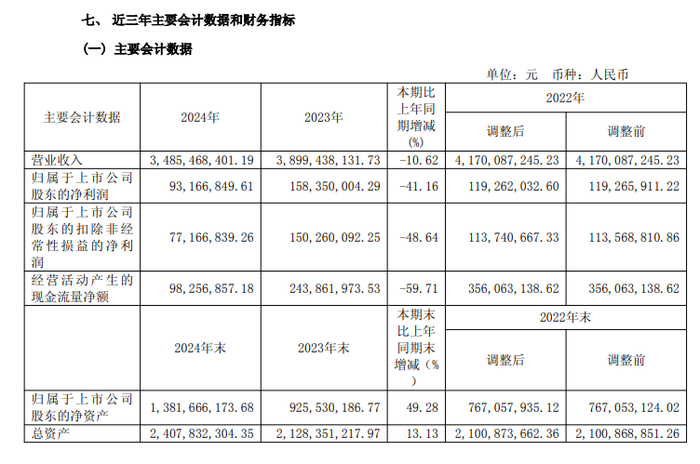
Core Viewpoint - Hong Sifang's 2024 annual report reveals significant declines in revenue and net profit, primarily due to falling prices in the nitrogen fertilizer market, particularly urea [1][2]. Financial Performance - In 2024, Hong Sifang achieved total revenue of 3.485 billion yuan, a decrease of 10.62% compared to 2023 [1]. - The net profit attributable to shareholders was 93.17 million yuan, down 41.16% year-on-year [1]. - The net profit after deducting non-recurring gains and losses was 77.17 million yuan, reflecting a 48.64% decline [1]. - The net cash flow from operating activities was 98.26 million yuan, a significant drop of 59.71% [1]. Product Performance - The production and sales of urea, a key nitrogen fertilizer, saw a sharp decline, with sales at 176,425.90 tons, down 26.45% year-on-year, only half of the production volume [4][6]. - The overall revenue from the chemical industry segment was 3.46 billion yuan, with a gross margin of 10.66%, down 1.83 percentage points [5]. - Revenue from compound fertilizers was 3.09 billion yuan, with a gross margin of 11.03%, also reflecting a decrease [5]. Market Conditions - The domestic urea market experienced significant price fluctuations, particularly in the fourth quarter, leading to sustained low prices [2]. - The company's performance was adversely affected by the overall market conditions for nitrogen fertilizers, which saw a decline in unit gross margins [2]. Research and Development - In 2024, the company invested 67.25 million yuan in R&D, accounting for 1.93% of total revenue, a decrease of 17.21% from the previous year [10]. - Despite the reduction in R&D spending, the company developed new products, including modified compound fertilizers, but market penetration remains insufficient [10]. - The company plans to continue focusing on new technology and product development to enhance market competitiveness [10].
中信特钢(000708) - 000708中信特钢投资者关系管理信息20250321
2025-03-21 01:24
Group 1: Company Performance and Strategy - The company reported a significant focus on optimizing product structure and capacity layout in response to market demand and policy changes [3][4][5]. - In 2024, the company exported 42,000 tons to the U.S., representing a low percentage of total exports, indicating minimal direct impact from U.S. tariff policies [5]. - The company aims to enhance its market position by focusing on high-end steel products, which are supported by government policies [4][5]. Group 2: Market Conditions and Challenges - The steel industry faces challenges due to supply-demand imbalances and potential production cuts of 50 million tons in 2025, which the company is monitoring closely [3][4]. - The company anticipates complex price fluctuations in the commodity market driven by global economic recovery and geopolitical factors [6][7]. - The company is prepared to manage procurement costs and risks associated with raw material price volatility through diversified sourcing strategies [6][7]. Group 3: Investment and Capital Expenditure - The company plans to align capital expenditures with operational needs, focusing on smart manufacturing and green initiatives [9][10]. - In 2024, the company actively explored over 20 steel projects in Southeast Asia, the Middle East, and Europe, laying the groundwork for international expansion [10][11]. - The company emphasizes a cautious approach to overseas investments, prioritizing acquisitions over greenfield projects due to lower costs and higher efficiency [10][11]. Group 4: Financial Outlook and Profitability - The company expects improved gross margins in Q4 2024, driven by raw material price management and a shift towards high-end product offerings [12][13]. - Interest expenses are projected to double from 2022 to 2024 due to the consolidation of Tianjin Steel and changes in capitalized projects [10][11]. - The company maintains a steady dividend policy, balancing shareholder returns with business growth [10][11]. Group 5: Industry Trends and Future Prospects - The demand for special steel products is expected to grow, particularly in high-end manufacturing sectors such as automotive and aerospace [8][9]. - The company is strategically positioned to capitalize on the increasing demand for advanced materials in robotics and renewable energy sectors [8][9]. - The company is committed to enhancing its competitive edge through R&D in high-tech materials and maintaining strong relationships with key clients [12][13].
