
信贷结构

Search documents
信贷淡季叠加需求疲软:10月居民贷款收缩,对公贷款“扛压”
Di Yi Cai Jing· 2025-11-14 10:33
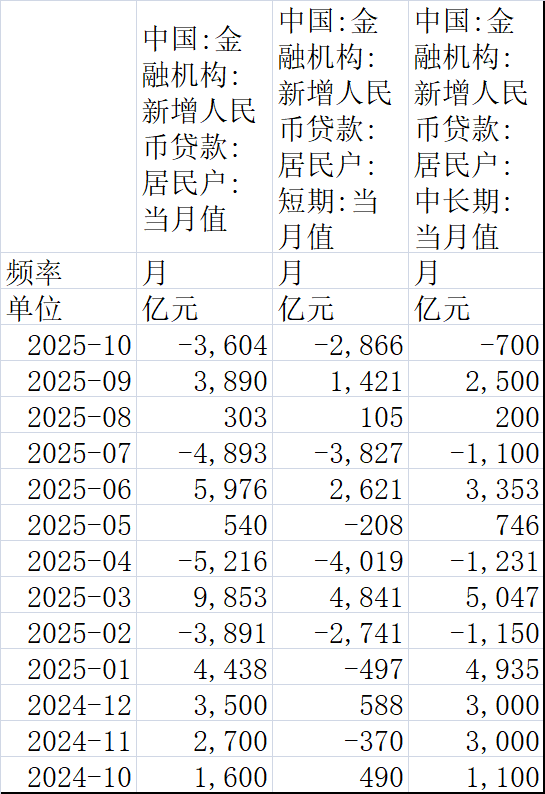
Core Insights - The impact of the newly introduced 500 billion yuan policy financial tools has not yet fully materialized, but it is expected to gradually improve the medium to long-term loan sentiment for enterprises [1][10] - In October, new RMB loans increased by 220 billion yuan, a year-on-year decrease of 280 billion yuan, while social financing saw a negative change of -201 billion yuan, indicating a slowdown in credit issuance [1][11] Group 1: Credit Market Overview - The decline in credit issuance is attributed to seasonal factors and structural changes in the economy, compounded by a weak real estate cycle and the impact of local and corporate debt replacement loans [1][9] - The credit structure shows characteristics of "supporting corporate loans, weak household loans, and increased bill financing" [1][6] Group 2: Household Loans - Household loans were the main drag on the overall credit growth in October, with a decrease of 360.4 billion yuan, which is a year-on-year reduction of 520.4 billion yuan [2][4] - Both short-term and medium to long-term household loans faced pressure, reflecting weak consumer and housing demand [2][4] Group 3: Corporate Loans - Corporate loans continued to act as a "stabilizing force" in the overall credit landscape, with new loans to enterprises increasing by 350 billion yuan, a year-on-year increase of 220 billion yuan [6][8] - The short-term loans for enterprises decreased by 190 billion yuan, while bill financing saw a significant increase of 500.6 billion yuan, indicating a divergence in loan types [6][7] Group 4: Real Estate Market - The real estate market remains relatively weak, with a slight increase in new residential prices and a decline in second-hand residential prices, reflecting a cautious sentiment among homebuyers [4][5] - The willingness of residents to purchase homes has decreased, particularly in third and fourth-tier cities, where confidence has dropped significantly [4][5] Group 5: Future Outlook - The gradual implementation of the 500 billion yuan policy financial tools is expected to support over 2,300 projects with a total investment of approximately 7 trillion yuan, which may lead to a marginal improvement in corporate loan sentiment [10][11] - The future expansion of credit is likely to focus on policy financial tools, loans related to new economic drivers, and the continued role of corporate loans in stabilizing the credit market [10][11]

10月末社会融资规模存量同比增8.5% 贷款利率处于低位、资金供给充裕
Shang Hai Zheng Quan Bao· 2025-11-13 17:55
Core Insights - The People's Bank of China reported that by the end of October, the total social financing stock, broad money (M2), and RMB loan balance grew by 8.5%, 8.2%, and 6.5% year-on-year respectively, indicating a favorable monetary environment for economic recovery [1][2][3] Group 1: Social Financing and Monetary Growth - As of the end of October, the total social financing stock reached 437.72 trillion yuan, with a year-on-year growth of 8.5%, and the cumulative increase in the first ten months was 30.9 trillion yuan, which is 3.83 trillion yuan more than the same period last year [2] - The growth in social financing was supported by rapid government bond issuance and high corporate bond issuance, with net financing from corporate bonds at 1.82 trillion yuan and government bonds at 11.95 trillion yuan in the first ten months [2] - The M2 balance was 335.13 trillion yuan, reflecting a year-on-year growth of 8.2%, which is 0.8 percentage points higher than the same period last year [3] Group 2: Loan Dynamics and Interest Rates - The RMB loan balance was 270.61 trillion yuan, with a year-on-year increase of 6.5%, and the total increase in loans for the first ten months was 14.97 trillion yuan [4] - The average interest rate for newly issued corporate loans was 3.1%, approximately 40 basis points lower than the same period last year, indicating a relatively low borrowing cost [4][5] - The structure of loans is improving, with inclusive small and micro loans growing by 11.6% year-on-year, and medium to long-term loans for the manufacturing sector increasing by 7.9% [6] Group 3: Economic Outlook and Policy Impact - Recent forecasts from international organizations have raised expectations for China's economic growth, with the IMF and World Bank increasing their 2025 growth projections by 0.8 percentage points [7] - The current economic environment shows positive signals, with expectations for macroeconomic policies to continue supporting economic recovery, aiming for a growth target of around 5% for the year [7] - The implementation of a moderately loose monetary policy is showing effects, with significant investments supported by new policy financial tools totaling approximately 7 trillion yuan [7]
央行 重磅发布!
Zhong Guo Ji Jin Bao· 2025-11-13 14:28
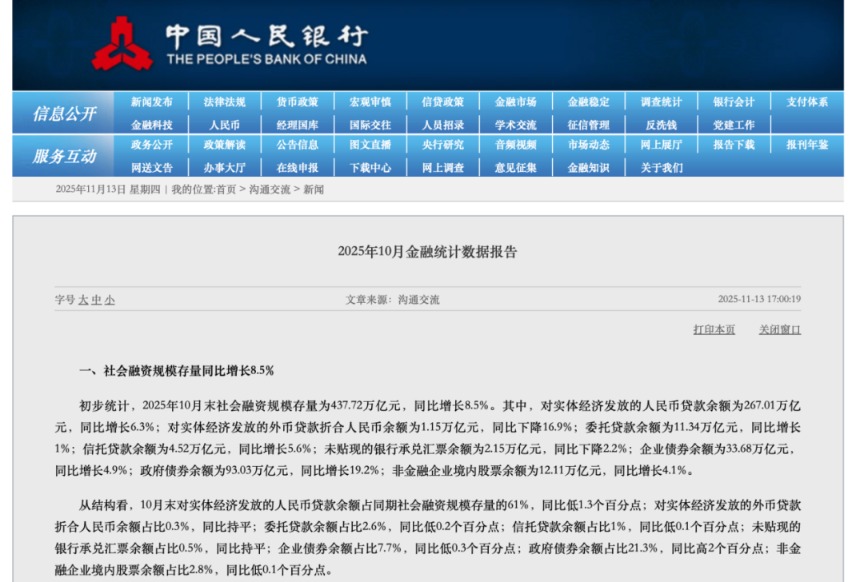
Core Viewpoint - The People's Bank of China (PBOC) has reported that M2 and social financing growth rates remain high, creating a favorable monetary environment for economic recovery. The current monetary policy stance is supportive, aiming to promote reasonable price recovery and maintain strong support for the real economy [1][12]. Monetary Supply and Financing - As of October 2025, the M2 balance reached 335.13 trillion yuan, with a year-on-year growth of 8.2% [4]. - The social financing scale stood at 437.72 trillion yuan, reflecting a year-on-year increase of 8.5% [5]. - From January to October, the incremental social financing was 30.9 trillion yuan, which is 3.83 trillion yuan more than the same period last year [6]. - The balance of various loans in renminbi was 270.61 trillion yuan at the end of October, showing a year-on-year growth of 6.5% [7]. Loan Rates and Structure - The average interest rate for newly issued corporate loans (in both domestic and foreign currencies) in October was 3.1%, approximately 40 basis points lower than the same period last year [7]. - The structure of loans is continuously optimizing, with inclusive small and micro loans growing by 11.6% year-on-year, and medium to long-term loans for the manufacturing sector increasing by 7.9% [11]. Government Bonds and Financing Channels - The issuance of government bonds and special refinancing bonds has accelerated, significantly supporting the growth of social financing. In 2025, the issuance of ultra-long special government bonds increased from 1 trillion yuan to 1.3 trillion yuan [8]. - The financial system has become more diversified, with enterprises increasingly utilizing bonds and stocks for financing rather than relying solely on bank loans [8]. Economic Indicators and Price Trends - The Consumer Price Index (CPI) turned positive in October, rising by 0.2% year-on-year, while the core CPI (excluding food and energy) increased by 1.2%, marking the highest growth since March 2024 [12]. - The Producer Price Index (PPI) decreased by 2.1% year-on-year, with the rate of decline narrowing for three consecutive months [12]. Future Monetary Policy Outlook - The current monetary policy is deemed supportive, with expectations for continued implementation of moderately loose monetary policies to maintain strong support for the real economy [12].
10月末社融存量同比增长8.5% 专家:更多资金转化为活期存款,企业生产经营活跃度提升
Mei Ri Jing Ji Xin Wen· 2025-11-13 13:52
Group 1 - The core viewpoint of the articles indicates that the financial statistics for October 2025 show a reasonable growth in social financing and monetary supply, which supports the real economy [1][2] - As of the end of October, the total social financing scale reached 437.72 trillion yuan, with a year-on-year growth of 8.5%, while the broad money (M2) balance was 335.13 trillion yuan, growing by 8.2% [1][2] - The issuance of government bonds, including special refinancing bonds, has significantly contributed to the growth of social financing, with net financing from government bonds reaching 11.95 trillion yuan in the first ten months of the year, an increase of 3.72 trillion yuan year-on-year [2] Group 2 - The weighted average interest rate for newly issued corporate loans in October was 3.1%, down approximately 40 basis points from the previous year, indicating a favorable financing environment [3] - The total loan balance reached 274.54 trillion yuan by the end of October, with a year-on-year growth of 6.3%, reflecting a shift in credit structure towards high-quality development [4] - Loans to technology-oriented small and medium-sized enterprises, inclusive small and micro loans, and green loans grew by 22.3%, 12.2%, and 17.5% respectively, all exceeding the overall loan growth rate [4]
10月M1-M2剪刀差为-2%,如何看待信贷小月数据表现?
第一财经· 2025-11-13 12:09
Core Viewpoint - The article discusses the performance of credit and financing in October, highlighting the growth in broad money supply (M2) and social financing scale, as well as the impact of government bond issuance on these metrics [2][4]. Group 1: Monetary and Financing Data - As of the end of October, the broad money (M2) balance reached 335.13 trillion yuan, with a year-on-year growth of 8.2%, which is 0.8 percentage points higher than the same period last year [2]. - The social financing scale stood at 437.72 trillion yuan, growing by 8.5% year-on-year, also 0.7 percentage points higher than the previous year [2]. - From January to October, the incremental social financing was 30.9 trillion yuan, which is 3.83 trillion yuan more than the same period last year [2]. Group 2: Government Bond Issuance - The issuance of government bonds, including treasury bonds and special refinancing bonds, has accelerated, significantly supporting the growth of social financing [3][4]. - In the first ten months of the year, the cumulative issuance of government bonds was approximately 22 trillion yuan, nearly 4 trillion yuan more than the same period last year [4]. - The issuance of ultra-long-term special treasury bonds is expected to increase from 1 trillion yuan last year to 1.3 trillion yuan this year, indicating fiscal support for economic growth [4]. Group 3: Changes in Financing Structure - The structure of social financing is gradually changing, with non-loan financing methods accounting for over half of the incremental social financing this year [6]. - In the first ten months, the increase in RMB loans was 14.52 trillion yuan, which is 1.16 trillion yuan less than the previous year, while net financing from corporate bonds was 1.82 trillion yuan, up by 1.36 billion yuan [6]. - The balance of RMB loans reached 270.61 trillion yuan by the end of October, with a year-on-year growth of 6.5%, and inclusive small and micro loans grew by 11.6% [8]. Group 4: Credit Structure Optimization - The increase in government bonds is seen as a short-term substitute for loans, aimed at supporting major projects and national strategies to boost demand and stabilize the economy [8]. - The leverage ratio of the government sector increased by 8.8 percentage points to 67.5% year-on-year, while the leverage ratios of non-financial enterprises and households saw slight changes [8]. - The ongoing changes in credit structure reflect the transformation and upgrading of the real economy, with a focus on supporting high-quality economic development [9]. Group 5: Monetary Policy and Economic Environment - M2 and social financing growth rates remain above 8%, providing a favorable monetary environment for economic recovery [10]. - The narrow money (M1) balance was 112 trillion yuan, with a year-on-year growth of 6.2%, indicating improved business activity and consumer demand [10]. - While there is still room for monetary policy adjustments, the marginal efficiency has declined, necessitating a balanced approach to maintain strong support for the real economy [10].
央行发布最新金融数据!社融增量30.9万亿
券商中国· 2025-11-13 11:12
Core Viewpoint - The People's Bank of China reported that the social financing scale increased by 30.9 trillion yuan in the first ten months of 2025, which is 3.83 trillion yuan more than the same period last year, indicating a supportive monetary environment for economic recovery [1][2]. Group 1: Social Financing and Government Debt - Government debt net financing accounted for nearly 40% of the social financing increment, with a total of 11.95 trillion yuan, which is an increase of 3.72 trillion yuan year-on-year [2]. - The issuance of government bonds reached approximately 22 trillion yuan in the first ten months, nearly 4 trillion yuan more than the previous year, supporting major projects and economic demand [2]. - Other financing methods, excluding loans, now account for over half of the social financing increment, indicating a shift in financing structure [2][3]. Group 2: Loan Structure and Trends - The total increase in RMB loans was 14.97 trillion yuan, with a growth rate of 6.5% as of the end of October [4]. - Inclusive small and micro loans and medium to long-term loans for manufacturing showed significant growth rates of 11.6% and 7.9%, respectively, surpassing the overall loan growth rate [4][5]. - Loans related to new economic drivers, such as technology and green financing, have maintained rapid growth, with technology SMEs loans increasing by 22.3% [5]. Group 3: Monetary Policy and Price Stability - The central bank's monetary policy aims to promote reasonable price recovery, with the CPI turning positive at 0.2% in October, indicating signs of stabilization [6]. - The monetary policy stance remains supportive, with expectations of continued effects from previous policy adjustments, despite a noted decrease in marginal efficiency [6][7]. - The weighted average interest rate for new corporate loans was 3.1%, approximately 40 basis points lower than the previous year, reflecting a low-cost borrowing environment [5].
央行,重磅发布!
Zhong Guo Ji Jin Bao· 2025-11-13 10:59
Core Insights - The central bank's October financial data indicates that M2 and social financing growth rates remain high, supporting economic recovery [1][4] - Loan growth is reasonable, with an optimized credit structure and low loan interest rates [1][4] Monetary Policy - Current monetary policy stance is supportive, creating a conducive environment for reasonable price recovery [1][10] - Future implementation of moderately loose monetary policy is necessary to maintain strong support for the real economy [1][10] Financial Data Highlights - As of October 2025, M2 balance reached 335.13 trillion yuan, with a year-on-year growth of 8.2% [4][6] - Social financing stock was 437.72 trillion yuan, growing 8.5% year-on-year [4][5] - From January to October, the increment in social financing was 30.9 trillion yuan, exceeding last year's figure by 3.83 trillion yuan [4][5] - By the end of October, the balance of RMB loans was 270.61 trillion yuan, with a year-on-year increase of 6.5% [4][8] Credit Structure - The structure of loans continues to improve, with inclusive small and micro loans growing by 11.6% and medium to long-term loans for manufacturing increasing by 7.9% [8][9] - The growth of loans related to new economic drivers indicates a shift towards high-quality development [8][9] Government Bonds and Financing - Rapid issuance of government bonds and high demand for corporate bonds have significantly supported the growth of social financing [5] - The issuance of special long-term government bonds increased from 1 trillion yuan last year to 1.3 trillion yuan this year, reflecting fiscal support for economic growth [5] Price Trends - Consumer Price Index (CPI) turned positive in October, indicating a 0.2% year-on-year increase, while core CPI rose by 1.2% [10] - Producer Price Index (PPI) decreased by 2.1%, with the rate of decline narrowing for three consecutive months [10]
央行,重磅发布!
中国基金报· 2025-11-13 10:54
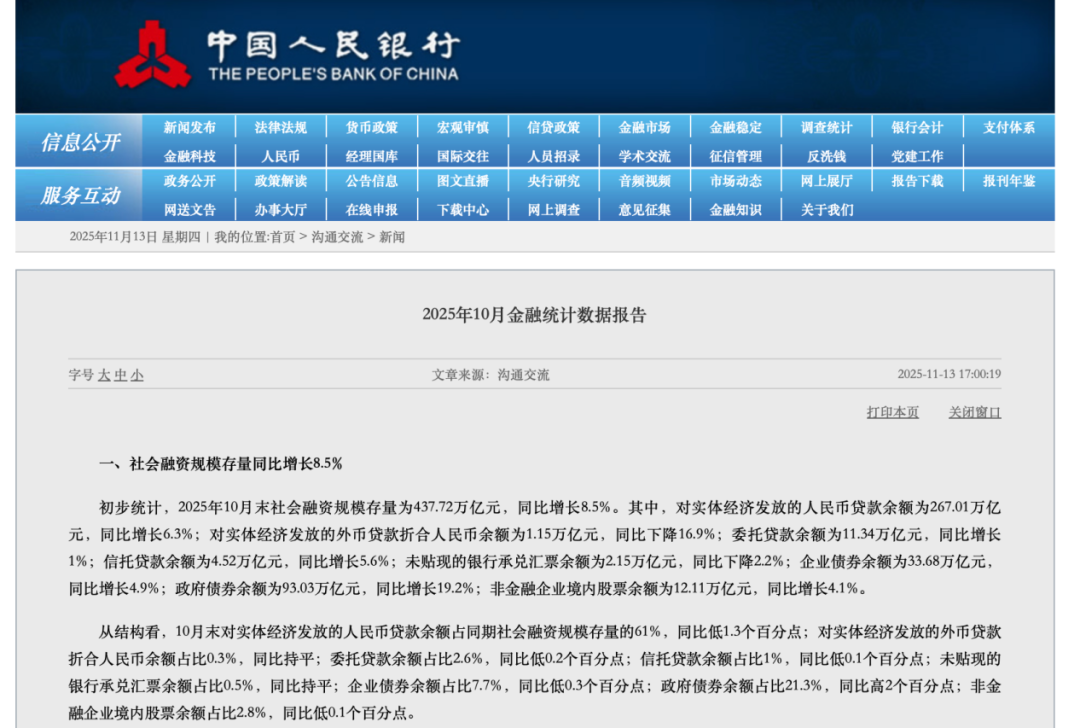
Core Viewpoint - The central viewpoint of the article emphasizes that the monetary policy stance in China remains supportive, creating a favorable monetary and financial environment for economic recovery, with a focus on maintaining appropriate levels of monetary easing to support the real economy [2][13]. Summary by Sections Social Financing Scale - As of the end of October 2025, the total social financing scale reached 437.72 trillion yuan, reflecting a year-on-year growth of 8.5% [4]. - The increment in social financing from January to October was 30.9 trillion yuan, which is 3.83 trillion yuan more than the same period last year [5]. Loan Growth and Structure - By the end of October, the balance of various RMB loans was 270.61 trillion yuan, showing a year-on-year increase of 6.5% [6]. - The weighted average interest rate for newly issued corporate loans (in both RMB and foreign currencies) in October was 3.1%, approximately 40 basis points lower than the same period last year [6]. - The structure of loans is continuously optimizing, with inclusive small and micro loans growing by 11.6% year-on-year, and medium to long-term loans for the manufacturing sector increasing by 7.9% [11]. Monetary Supply and Economic Indicators - The M2 balance stood at 335.13 trillion yuan at the end of October, with a year-on-year growth of 8.2% [9]. - The M1 balance was 112 trillion yuan, reflecting a year-on-year increase of 6.2%, indicating a recovery in corporate operations and personal consumption demand [9]. Government Bonds and Financing Channels - The issuance of government bonds, including special refinancing bonds, has accelerated, contributing significantly to the growth of social financing [8]. - The cumulative issuance of government bonds from January to October was approximately 22 trillion yuan, nearly 4 trillion yuan more than the same period last year [8]. Price Stability and Monetary Policy - The Consumer Price Index (CPI) turned positive in October, rising by 0.2% year-on-year, while the core CPI increased by 1.2%, marking the highest growth since March 2024 [14]. - The article notes that the effects of supportive monetary policy will continue to manifest, with a focus on maintaining a balance in monetary easing to avoid potential negative impacts such as capital market volatility [13][14].
央行最新发布,社融增量30.9万亿元,政府债净融资占近四成
Zheng Quan Shi Bao· 2025-11-13 10:10
Core Insights - The People's Bank of China reported that the cumulative social financing scale increased by 30.9 trillion yuan in the first ten months of 2025, which is 3.83 trillion yuan more than the same period last year [1] - The year-on-year growth rate of social financing stock was 8.5% at the end of October, while the broad money (M2) growth rate was 8.2%, both showing a decrease of 0.2 percentage points [1] - The structure of social financing is changing, with non-loan financing methods now accounting for over half of the total financing increment [3][4] Government Debt and Financing - Net financing from government bonds accounted for nearly 40% of the social financing increment, totaling 11.95 trillion yuan, which is an increase of 3.72 trillion yuan year-on-year [3] - The total issuance of government bonds reached approximately 22 trillion yuan in the first ten months, nearly 4 trillion yuan more than the same period last year [3] - The government is leveraging increased bond issuance to support major projects and stimulate demand in the economy [3] Loan Structure and Trends - In the first ten months, RMB loans increased by 14.97 trillion yuan, with a loan growth rate of 6.5% at the end of October [6] - The balance of inclusive small and micro loans reached 35.77 trillion yuan, growing by 11.6% year-on-year, while medium to long-term loans for the manufacturing sector increased by 7.9% [6] - Loans related to new economic drivers have maintained a rapid growth rate, indicating a shift in credit structure towards high-quality development [6] Monetary Policy and Economic Impact - The current monetary policy stance is supportive, aimed at promoting a reasonable recovery in prices [9] - The Consumer Price Index (CPI) showed a year-on-year increase of 0.2% in October, while the core CPI rose by 1.2%, marking the highest growth since March 2024 [9] - Experts suggest that while there is still room for monetary policy adjustments, the marginal efficiency has declined, and excessive easing could lead to negative effects [10]
10月M1-M2剪刀差为-2%,如何看待信贷小月数据表现?
Di Yi Cai Jing· 2025-11-13 09:45
Core Viewpoint - The recent data from the central bank indicates a stable growth in monetary supply and social financing, reflecting a supportive monetary environment for economic recovery, while emphasizing the need for a diversified approach to support the real economy rather than solely focusing on credit quantity [1][6]. Monetary Supply and Financing Growth - As of the end of October, the broad money supply (M2) reached 335.13 trillion yuan, growing by 8.2% year-on-year, which is 0.8 percentage points higher than the same period last year [1]. - The total social financing stock was 437.72 trillion yuan, with a year-on-year growth of 8.5%, also 0.7 percentage points higher than the previous year [1]. - The incremental social financing from January to October was 30.9 trillion yuan, exceeding the previous year's figure by 3.83 trillion yuan [1]. Government Bond Issuance - The rapid issuance of government bonds, including treasury and special refinancing bonds, has significantly supported the growth of social financing [2]. - From January to October, the cumulative issuance of government bonds was approximately 22 trillion yuan, nearly 4 trillion yuan more than the same period last year [2]. - The issuance of ultra-long-term special treasury bonds is expected to increase from 1 trillion yuan last year to 1.3 trillion yuan this year, indicating fiscal support for economic growth [2]. Credit Structure Optimization - In the first ten months, the increase in RMB loans to the real economy was 14.52 trillion yuan, which is a decrease of 1.16 trillion yuan year-on-year [3]. - The net financing from corporate bonds was 1.82 trillion yuan, an increase of 136.1 billion yuan year-on-year, while government bonds contributed 11.95 trillion yuan, up by 3.72 trillion yuan [3]. - The structure of credit is evolving, with a notable shift towards supporting major projects and strategic initiatives through government bond issuance [4]. Economic Transition and Financial Support - The growth of loans is transitioning from traditional sectors like infrastructure and real estate to emerging fields such as technological innovation and green development, reflecting the natural outcome of economic structural transformation [5]. - The leverage ratio of the government sector increased by 8.8 percentage points to 67.5% by the end of the third quarter, while the leverage ratios for non-financial enterprises and households saw slight changes [4]. Monetary Policy and Market Conditions - The narrow money supply (M1) reached 112 trillion yuan, growing by 6.2% year-on-year, indicating a recovery in business activity and consumer demand [6]. - The M1-M2 spread was -2%, showing a shift towards more funds being converted into demand deposits, which reflects positive signals in economic activity [6]. - While monetary policy remains supportive, experts caution that the marginal efficiency of such policies is declining, necessitating a balanced approach to maintain strong support for the real economy [6].