
修宪

Search documents
媒体:高市赌赢翻身,会“暴走”搞事吗?
Xin Lang Cai Jing· 2026-02-09 00:44
Group 1 - The core point of the article is that Japan's ruling Liberal Democratic Party (LDP), led by Prime Minister Sanae Takaichi, won 316 seats in the recent House of Representatives election, surpassing two-thirds of the total, which allows the LDP to pass legislation independently [1][3][5]. Group 2 - This election marks the first time in LDP history that it has secured over 310 seats in the House of Representatives [5]. - The victory enhances Takaichi's chances of long-term governance and may quell internal opposition within the LDP [5]. - The election results indicate a potential shift towards the legalization of nationalist and right-wing policies, including the introduction of anti-espionage laws and military expansion [5]. - Despite the LDP's victory, it remains a minority in the House of Councillors, which may limit immediate constitutional amendments [5]. - The election was characterized by a rapid 16-day turnaround from the dissolution of the House, reflecting Takaichi's urgency to address the LDP's previous "lame duck" status [3][5]. Group 3 - Social media discussions during the election highlighted key issues such as consumption tax, foreign workers, fiscal policy, and security, with misinformation circulating about foreign worker subsidies [6]. - The conservative shift among Japan's younger demographic significantly contributed to the LDP's electoral success, as they were previously disengaged from politics [6]. - Takaichi's election strategy involved a "short-term decisive battle," which left opposition parties unprepared [6]. - U.S. President Trump's public support for Takaichi was noted as unusual and may have influenced the election dynamics, although it drew mixed reactions from the Japanese public [8].

图谋让自卫队“入宪”,高市早苗遭猛批
Huan Qiu Shi Bao· 2026-02-03 22:57
Core Viewpoint - Japanese Prime Minister and Liberal Democratic Party President, Suga Yoshihide, has expressed a clear intention to amend the constitution to include the Self-Defense Forces, which has sparked significant criticism due to existing constitutional restrictions on military forces [1] Group 1: Constitutional Amendment Intent - Suga stated the need to amend the constitution to uphold the dignity of the Self-Defense Forces and strengthen their status as a powerful entity [1] - The ruling party aims to increase the number of seats in the House of Representatives to facilitate discussions on constitutional amendments [1] Group 2: Legislative Challenges - The proposal for constitutional amendment faces procedural hurdles, requiring a two-thirds majority support from both houses of the National Diet [1] - Even with support from parties like the Japan Innovation Party and the Democratic Party for the People, the total number of pro-amendment lawmakers does not reach the required two-thirds threshold [1] Group 3: Opposition and Criticism - Opposition leaders, including Noda Yoshihiko from the Democratic Party and members of the Communist Party, have criticized the amendment efforts, emphasizing the need to maintain Japan's pacifist principles and prevent military expansion [1] - Concerns have been raised about the potential for Japan's right-wing factions to exploit constitutional amendments to challenge post-war international order and regional peace [1]
日媒爆高市早苗酝酿提前大选
Xin Lang Cai Jing· 2026-01-12 00:28
Core Viewpoint - The Japanese government, led by Prime Minister Kishi, is considering an early dissolution of the House of Representatives to strengthen its political position and expedite policy implementation, amidst internal party disagreements and deteriorating relations with China [1][2][3]. Group 1: Political Context - There are two proposed timelines for the early dissolution of the House of Representatives: one for January 27 public announcement and February 8 voting, and another for February 3 public announcement and February 15 voting [2][15]. - The ruling party, the Liberal Democratic Party (LDP), currently holds 233 out of 465 seats in the House, barely maintaining a majority, while it remains a minority in the Senate, creating a "distorted parliament" situation [2][3]. - The opposition parties have expressed differing views on the potential dissolution, with some indicating readiness for an election if it occurs [2][3]. Group 2: Economic and Diplomatic Implications - Analysts suggest that Kishi's motivations for an early election include seeking public support for economic policies, breaking the Senate minority deadlock, and addressing the crisis in Japan-China relations [2][3][4]. - Recent Chinese export controls on dual-use items, including potential restrictions on rare earth materials, have heightened concerns within the Japanese government regarding the impact on domestic politics and the economy [3][4]. - The potential for negative events during the new parliamentary session could pose significant risks to Kishi's administration, prompting discussions around the necessity of an early election [3][4]. Group 3: Military and Security Developments - Despite uncertainties regarding the early election, the Japanese government is advancing its military capabilities, particularly in the Pacific, as part of its revised security strategy [4][5]. - The focus on enhancing Japan's defense capabilities is seen as a response to increasing Chinese military activities in the region, with plans for infrastructure improvements to support the Self-Defense Forces [5]. - This military strategy has raised concerns about Japan's role in regional geopolitics, with implications for its relations with China and overall regional stability [5].
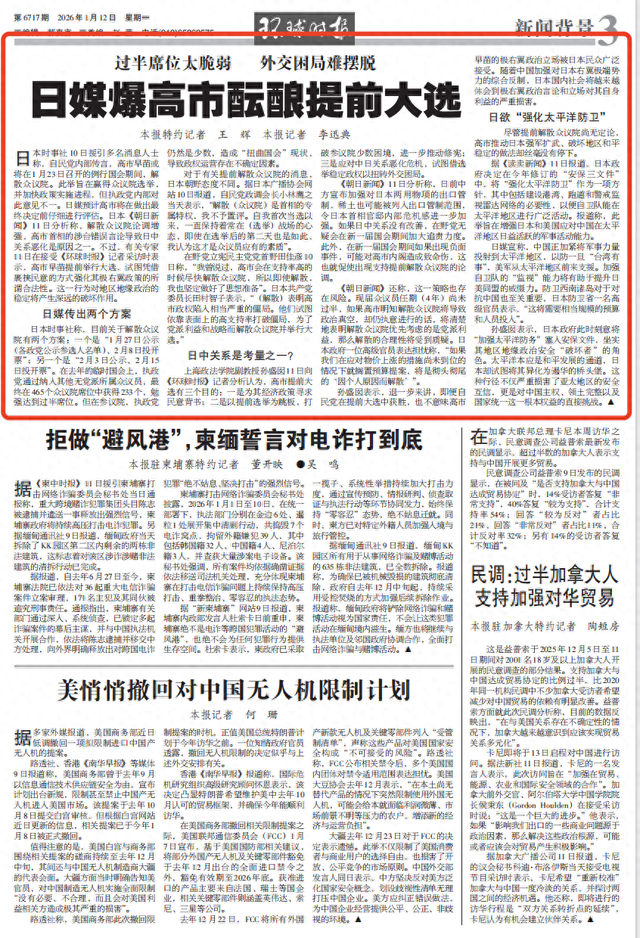
高市早苗考虑提前大选
Huan Qiu Shi Bao· 2026-01-10 07:19
据日本《读卖新闻》1月10日报道,日本首相高市早苗日前已开始考虑在定于23日召开的国会例会开幕 之际解散众议院。众议院选举极有可能在2月上中旬举行。高市认为,执政党在参议院一直处于少数, 有必要获得政策实现的推动力。 据报道,日本政府相关人士透露了上述情况。众议院选举的日程方案包括"1月27日发布公告—2月8日投 票"和"2月3日发布公告—2月15日投票"。 高市一直主张要"做强经济"和实施"负责任的积极财政",希望就自身的经济政策获得国民的信任。 预计修宪也将成为选举战的焦点。自民党和日本维新会在联合执政协议中明确写道,将制定创设紧急事 态条款的修宪条文方案,并力争在2026年度提交国会。 风险提示及免责条款 市场有风险,投资需谨慎。本文不构成个人投资建议,也未考虑到个别用户特殊的投资目标、财务状况或需要。用户应考虑本文中的任何 意见、观点或结论是否符合其特定状况。据此投资,责任自负。 自民党在众议院有199个席位,与维新会合计共233席。虽然勉强恢复了过半数(233席),但在参议院 仍处于少数,呈现"朝野政党分控两院"状态。 报道称,自高市就台湾问题在国会作出回应以来,中国加大了对日本的经济压力。高市似乎 ...
高市早苗挑衅背后:日本右翼“基因”激活,政治光谱加速右移 | 国际识局
Zhong Guo Xin Wen Wang· 2025-11-21 01:48
Core Viewpoint - The provocative remarks made by Japanese Prime Minister Sanae Takaichi regarding Taiwan signify a significant shift in Japan's political spectrum towards the right, revealing the resurgence of long-suppressed right-wing conservatism in Japan's political landscape [1][4]. Group 1: Right-Wing Ideology - Takaichi's strong right-wing stance is driven by a revival of Japanese nationalism, rooted in pre-war ideologies that reject the acknowledgment of Japan's wartime aggression and seek to restore national pride and military normalization [4][6]. - The political landscape has shifted since the 1980s, with the decline of the "55-year system" leading to a rise in right-wing conservatism, particularly under the leadership of figures like Shinzo Abe [4][5]. Group 2: Political Dynamics - Takaichi's political alignment closely mirrors that of Abe, characterized by historical revisionism, a push for constitutional amendments, and a hawkish stance towards China [5][6]. - The current political environment in Japan is marked by a rightward shift within the ruling Liberal Democratic Party (LDP), where hardline positions on defense and foreign policy have become the norm [9]. Group 3: External Threat Perception - The perception of external threats, particularly from China, has overshadowed traditional pacifist sentiments in Japan, leading to a fundamental change in political narratives and policies [8]. - The 2022 security policy changes, including the commitment to increase defense spending to 2% of GDP, reflect a significant departure from post-war security principles [8]. Group 4: Populism and Political Mobilization - Takaichi's remarks resonate with a growing populist sentiment in Japan, leveraging anti-China rhetoric to galvanize support among nationalist factions [10][11]. - The rise of online right-wing movements has amplified exclusionary nationalist sentiments, allowing Takaichi and similar politicians to bypass traditional media and directly engage with their base [10][11]. Group 5: Implications for Japan's Future - The combination of resurgent right-wing ideology, a shifting political landscape, and rising populism poses significant challenges for Japan's political stability and international relations [12]. - Takaichi's provocative stance on Taiwan is seen as a manifestation of deeper issues within Japan's political fabric, potentially leading to increased tensions in the region [12].
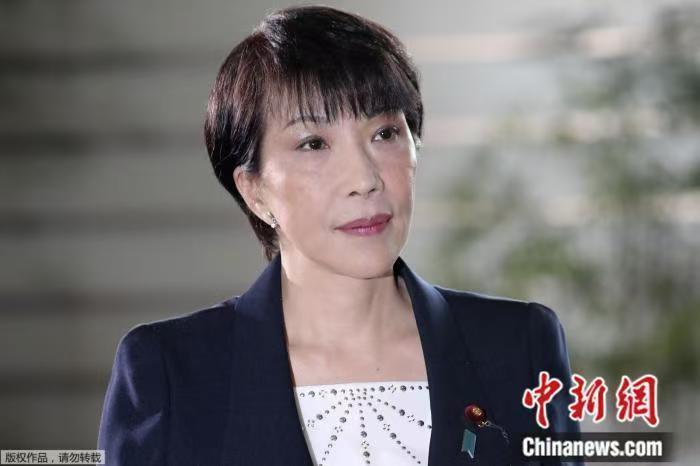
日本首位女首相有何来历?
Xin Hua She· 2025-10-21 06:55
Group 1: Core Insights - High Sannae has been elected as Japan's 104th Prime Minister, becoming the first female Prime Minister in Japan's history [1] - She is a close ally of former Prime Minister Shinzo Abe and is seen as a staunch successor to his policies [1] - High has a history of holding various significant positions in the government, including Minister of Internal Affairs and Communications and Minister for Economic Security [1] Group 2: Policy Positions - High advocates for a strong conservative stance, emphasizing the restoration of traditional Japanese values, constitutional reform, and enhanced national security [2] - In economic policy, she promotes "active fiscal" measures, including tax cuts and increased local government support to address rising prices [2] - Her foreign policy aims to continue Abe's "Free and Open Indo-Pacific" strategy, focusing on strengthening cooperation with ASEAN and global southern countries [2] Group 3: Security and Immigration Policies - High proposes to strengthen the Self-Defense Forces and improve the treatment of self-defense personnel, while not ruling out increased defense spending at the request of the United States [2] - On immigration, she supports stricter controls on illegal immigrants and intends to scrutinize foreign capital inflows [3] - High's historical perspective is notably right-leaning, with a history of visiting the Yasukuni Shrine, which may create diplomatic tensions in East Asia [3]
专访韩国前总统顾问:无论经济还是安全,中国对韩国都很重要
Xin Jing Bao· 2025-07-07 13:09
Group 1: Diplomatic and Security Policies - President Lee Jae-myung emphasizes a practical diplomacy centered on national interests, aiming to strengthen the Korea-U.S. alliance while improving relations with China and Russia [1][10] - Lee's administration has taken measures to ease tensions on the Korean Peninsula, including stopping the illegal distribution of leaflets to North Korea and halting loudspeaker broadcasts [3][4] - The importance of restoring summit diplomacy with China is highlighted, as it has been over 11 years since a Chinese president visited South Korea [11] Group 2: Economic Challenges - The South Korean economy is facing significant challenges, including the impact of the COVID-19 pandemic and trade wars, leading to a decline in the economic conditions of ordinary citizens [6] - Lee's government plans to issue universal subsidies to stimulate consumption and address structural economic issues [6] - There is a concern that South Korea is losing competitiveness in key industries such as semiconductors, shipbuilding, and automotive, which are crucial for its economy [6] Group 3: Domestic Political Landscape - The political landscape in South Korea is still recovering from the previous administration's controversies, with ongoing investigations into former President Yoon Suk-yeol and his associates [4][5] - Lee Jae-myung's administration is expected to push for constitutional reforms, including changes to presidential terms and power-sharing arrangements [5] - The process of constitutional reform is anticipated to be lengthy and requires consensus between the ruling and opposition parties [5]
距离投票仅剩一周,各自阐述内外政策,韩总统大选前上演“最后辩论”
Huan Qiu Shi Bao· 2025-05-27 22:48
Group 1 - The South Korean presidential election is entering its final week, with candidates Lee Jae-myung, Kim Moon-soo, and Lee Jun-suk in a competitive three-way race [1][2] - A final televised debate took place on the evening of the 27th, focusing on political polarization and candidates' platforms on political reform, foreign policy, and national security [1][2] - Polls indicate that Lee Jae-myung leads with a support rate of 49%, followed by Kim Moon-soo at 35% and Lee Jun-suk at 11%, with Lee Jae-myung maintaining his support level compared to earlier in the month [2][3] Group 2 - Lee Jae-myung emphasized the importance of the Korea-U.S. alliance in his foreign policy, advocating for substantial and future-oriented cooperation with the U.S. and Japan while also recognizing the significance of relations with China and Russia [2][3] - Concerns from Japan regarding Lee Jae-myung's potential presidency stem from his previous criticisms of past administrations' approaches to Japan, although he has recently softened his stance to attract centrist voters [3][4] - Investigations into former President Yoon Suk-yeol's emergency measures continue, with police taking action against former officials suspected of involvement in internal unrest [4]
“三强格局”逐步明朗,修宪或成焦点议题,韩国大选举行首次电视辩论
Huan Qiu Shi Bao· 2025-05-18 22:26
Core Viewpoint - The upcoming South Korean presidential election is shaping up with a clear "three strong candidates" dynamic, focusing on economic issues and potential constitutional reforms [1][2][3] Group 1: Election Candidates and Dynamics - The main candidates are Lee Jae-myung from the Democratic Party, Kim Moon-soo from the People Power Party, and Lee Jun-suk from the Reform New Party, with Lee Jae-myung currently leading in polls [1][3] - Lee Jae-myung's support rate has surpassed 50%, reaching 51%, while Kim Moon-soo stands at 29%, and Lee Jun-suk is at 8% [3] Group 2: Economic Debate and Responsibilities - The initial debate focused on the South Korean economy, with candidates blaming each other for the current economic downturn, particularly targeting the policies of the Yoon Suk-yeol administration [2] - Lee Jae-myung proposed constitutional reforms to enhance presidential accountability, suggesting a four-year term with the possibility of re-election [2] Group 3: Constitutional Reform Proposals - Kim Moon-soo welcomed Lee Jae-myung's proposal and suggested shortening the presidential term to three years to align with the National Assembly election cycle, aiming for decisive political reform [2]
140天历经3位代总统,韩国政局动荡持续
21世纪经济报道· 2025-05-02 04:42
Group 1 - The South Korean Supreme Court overturned a previous not guilty verdict against presidential candidate Lee Jae-myung, sending the case back for retrial [1] - Following the Supreme Court's decision, acting President Han Duck-soo and Economic Vice Minister Choi Sang-mok resigned from their positions [1] - The acting presidency will now be assumed by Education Minister Lee Joo-ho, as Choi Sang-mok also resigned [1] Group 2 - Han Duck-soo officially announced his candidacy for the 21st presidential election during a press conference, emphasizing the need for political reform in South Korea [3] - He proposed three key campaign promises: immediate constitutional amendments, addressing trade issues arising from U.S. tariffs, and national unity [3] - Han plans to draft a constitutional amendment in his first year if elected, complete it in the second year, and hold a presidential election under the new constitution in the third year [3][4]