全固态电池

Search documents
未知机构:国金电新特斯拉干法工艺实现规模化生产干法设备值得关注当地时-20260203
未知机构· 2026-02-03 01:55
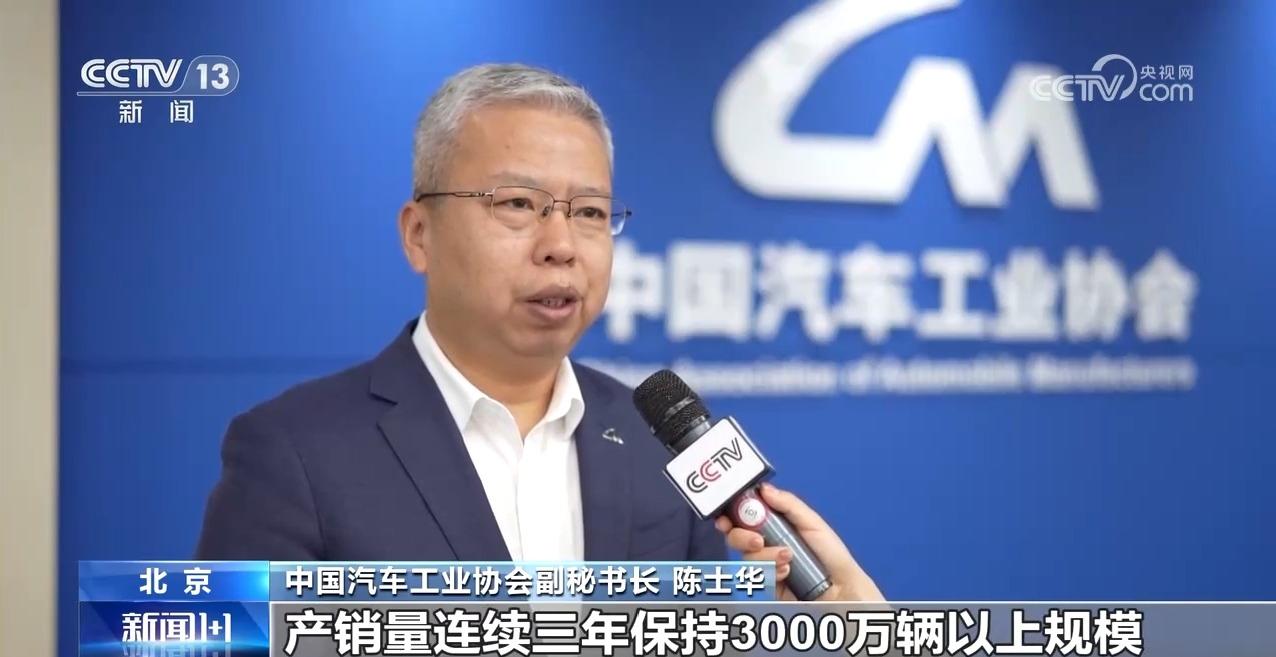
Summary of Conference Call Notes Company and Industry Involved - The discussion primarily revolves around **Tesla** and its advancements in **lithium battery production technology** through the implementation of **dry electrode manufacturing processes** [1][1]. Core Points and Arguments - **Achievement of Scale Production**: Tesla has successfully achieved large-scale production of the dry electrode process, which is considered a significant breakthrough in lithium battery production technology [1]. - **Cost and Efficiency Benefits**: The dry electrode manufacturing process is expected to lower costs, reduce energy consumption, and simplify factory operations while significantly enhancing scalability [1]. - **Advancements in Battery Technology**: The move reflects major progress in the dry process for liquid batteries, indicating Tesla's commitment to advancing its in-house 4680 battery production [1]. - **Comparison with Traditional Methods**: Traditional lithium battery electrode production typically uses a wet process, which involves mixing materials into a slurry, coating, and drying. In contrast, the dry process eliminates solvent use and drying steps, utilizing high-shear dry mixing and fiberization equipment to achieve direct film formation [1]. Other Important but Possibly Overlooked Content - **Future Prospects**: The dry process is not only a preferred method for all-solid-state batteries but also holds potential applications in conventional batteries, suggesting a broader impact on the battery manufacturing industry [2]. - **Companies to Watch**: Attention is drawn to companies involved in the dry process segment, specifically **MacroTech** and **Naconor**, indicating potential investment opportunities in this area [3]. - **Additional Companies Mentioned**: Other companies mentioned include **Mannstaedt**, which may also be relevant in the context of dry electrode technology [4].

特斯拉,固态电池技术大突破!
DT新材料· 2026-02-02 16:05
Core Viewpoint - Tesla has achieved large-scale production of dry electrode technology, marking a significant breakthrough in lithium battery production technology, which can lower costs, energy consumption, and factory complexity while significantly improving scalability [4]. Group 1: Dry Electrode Technology - Dry electrode technology is a process that manufactures battery electrodes using dry powder materials without solvents, utilizing polytetrafluoroethylene (PTFE) as a binder, which simplifies the process and reduces energy consumption [5]. - The core advantages of dry electrode technology include eliminating reliance on toxic solvents, reducing environmental pressure, and enhancing battery safety and stability by avoiding adverse reactions with solid electrolytes [5][6]. - The technology is crucial for the industrialization of next-generation all-solid-state batteries, which are expected to have higher energy density and cycle stability due to better particle contact and higher compaction density [6]. Group 2: Challenges in Industrialization - The industrialization of dry electrode technology faces significant challenges, including: 1. Binder compatibility issues, as PTFE can decompose in low-potential environments, affecting battery cycle life [8]. 2. High equipment requirements, with precision roller presses needed for dry production being five times more expensive than traditional equipment and having lower mass production efficiency [9]. 3. High difficulty in process control, requiring precise mixing uniformity and stability in self-supporting film formation [9]. Group 3: Industry Developments - Several domestic companies are actively advancing in the dry electrode field: - CATL has focused on the development and adaptation of dry processes for positive electrodes, achieving a compaction density of 3.8 g/cm³ [10]. - Shanghai Lianjing has developed composite binders to improve compatibility and has implemented dynamic rolling technology to address issues with material mixing and cracking [10]. - Nakanor has delivered dry electrode roller press equipment with precision levels far exceeding industry averages, improving yield rates for solid-state battery electrodes to over 98% [10]. - Qingyan Electronics has established a production line for solid-state batteries with a yield rate of 85% [11]. - Bettery has successfully tackled core process challenges for continuous production of electrode sheets [12]. Group 4: Future Outlook - Although the solid-state battery route is not fully confirmed, the changes in equipment and processes compared to liquid batteries are expected to drive increased demand for new equipment [13].

联赢激光(688518.SH):目前已为两家行业头部客户的中试线提供了全固态电池设备
Ge Long Hui· 2026-01-28 07:48
Group 1 - The company has provided solid-state battery equipment for two leading industry clients' pilot lines [1] - The company has more partnerships with manufacturers for semi-solid batteries [1] - The company's laser welding equipment is primarily used in industries such as power batteries, consumer electronics, automotive manufacturing, and optical communications, with no involvement in the aerospace sector [1]

联赢激光(688518.SH):目前全固态电池处于研发阶段,公司已经为两家行业头部客户的中试线提供了设备
Ge Long Hui· 2026-01-27 07:37
Group 1 - The core point of the article is that Lianying Laser (688518.SH) is currently in the research and development stage of all-solid-state batteries and has provided equipment for pilot lines to two leading industry clients [1] - The company is actively collaborating with leading battery companies to conduct research and development on solid-state battery equipment [1]
联赢激光:目前全固态电池处于研发阶段,公司已经为两家行业头部客户的中试线提供了设备
Ge Long Hui· 2026-01-27 07:36
Group 1 - The core viewpoint of the article is that Lianying Laser (688518.SH) is currently in the research and development stage of all-solid-state batteries and is actively collaborating with leading battery companies for equipment development [1] Group 2 - The company has provided equipment for pilot lines to two leading industry clients [1] - The company is committed to supporting leading battery companies in the research and development of solid-state battery equipment [1]
汽车早报|红旗全固态电池首台样车成功下线 大众汽车集团拟将核心品牌董事会成员削减三分之一
Xin Lang Cai Jing· 2026-01-22 00:41
Group 1: Regulatory Changes - The Ministry of Industry and Information Technology (MIIT) has revised the "Access Review Requirements for Road Motor Vehicle Production Enterprises" and "Access Review Requirements for Road Motor Vehicle Products," effective from January 1, 2027 [1] - The revised "Enterprise Review Requirements" includes 163 articles, maintaining the original framework while enhancing requirements for intelligent and connected capabilities, cybersecurity, data security, and software upgrades [2] - The "Product Review Requirements" have been updated to include safety, environmental, energy-saving, and anti-theft standards, with a focus on reliability testing and the integration of new technologies and materials [2] Group 2: Industry Developments - Hongqi's first solid-state battery prototype has successfully passed extreme heat abuse tests, achieving a high ionic conductivity of over 10 mS/cm [3] - Changan Automobile and Midea Group have signed a comprehensive strategic cooperation agreement to deepen collaboration in digitalization, smart manufacturing, and logistics [4] - Samsung Display will supply three types of car-mounted OLED screens for Zeekr's flagship SUV model, Zeekr 9X, starting in 2024 [5] - Zeekr has established a new sales service company in Taizhou, Zhejiang, with a registered capital of 5 million RMB, focusing on the sale of electric vehicles and related components [6] - Volkswagen Group plans to reduce the number of board members in its core brand group by one-third by summer 2026, aiming to streamline management and achieve cost savings of 1 billion euros by 2030 [7] - Ford is recalling over 119,000 vehicles in the U.S. due to a fire risk associated with engine block heaters, urging affected owners to contact dealers for free inspections [8]




【钛晨报】激发民间投资、促进消费,财政部详解一揽子扩内需政策;交易所紧急出手,调整金银铜铝合约风控参数;丹麦养老基金据悉将退出美国国债投资
Sou Hu Cai Jing· 2026-01-20 23:48
第三项是支持民营企业债券风险分担机制。这也是一项新政策。中央财政专门安排风险分担资金,与央行现有政策协同,为民营企业和私募股权投资机构发 行债券提供增信支持,代偿投资人部分损失。 【钛媒体综合】今年的首场国务院常务会议研究推出财政金融促内需一揽子政策,社会上高度关注。1月20日,财政部副部长廖岷在国新办新闻发布会上介 绍了一揽子政策的要点内容,概括为"一个目标""两个重点""三个原则"和"六项政策"。截至目前,这些政策已经陆续发布。 第一项是中小微企业贷款贴息政策。这是支持中小微民营企业发展的一项新政策。主要是对相关领域企业贷款予以贴息,重点包括新能源汽车、工业机器 人、医疗装备、移动通讯设备等14个重点产业链及上下游产业,以及科技、物流、信息和软件等生产性服务领域,还有农林牧副渔等领域。贴息为贷款总额 的1.5个百分点,最长贴息期2年,可享受贴息政策的单户贷款额度上限是5000万元。 第二项是民间投资专项担保计划。这项新政策主要是为中小微民营企业贷款提供担保,符合条件的中小微民营企业,因为生产场景的拓展、改造、升级,以 及改扩建厂房、店面装修等生产经营活动需要的中长期贷款,均可获得支持。单家企业可享受担保的 ...
上汽集团业绩大幅预增后股价微涨,上市车企集体遭遇市值烦恼
Zhong Guo Ji Jin Bao· 2026-01-18 11:06
Core Viewpoint - SAIC Motor Corporation has announced a significant profit forecast for 2025, expecting a year-on-year increase in net profit attributable to shareholders of 438% to 558%, yet its stock price remains undervalued and in a state of net asset deficit [4][8]. Group 1: Company Performance - On January 15, SAIC Motor released a profit forecast that surprised the market, but its stock price only rose by 0.81% on January 16, indicating a mismatch between market valuation and company performance [4][6]. - As of January 16, 2026, SAIC Motor's market capitalization was 172.3 billion yuan, significantly lower than BYD's 874 billion yuan, highlighting the valuation gap among leading automotive companies [4][5]. Group 2: Market Valuation Issues - Many listed automotive companies, including SAIC Motor, are facing challenges with market capitalization that does not reflect their performance, leading to calls for a re-evaluation of their value in the capital market [4][10]. - SAIC Motor's price-to-earnings ratio is 15.95, and its price-to-book ratio is 0.58, both of which are below industry averages, indicating a potential undervaluation [5][8]. Group 3: Shareholder Concerns - Investors have been actively inquiring about SAIC Motor's market value management strategies, questioning whether the company is effectively addressing its valuation issues [10][11]. - Despite previous share buyback plans totaling 4.747 billion yuan, the effectiveness of these measures has been questioned, as the company remains in a state of net asset deficit [11][12]. Group 4: Industry Context - The automotive industry is undergoing rapid transformation towards electrification and smart technology, which increases competition and investment challenges, contributing to the undervaluation of many companies [14][15]. - The market is saturated with numerous listed automotive companies, making it difficult for individual firms to stand out and achieve premium valuations [14][15].

新闻1+1丨产销十七连冠 中国汽车下一步怎么走
Yang Shi Xin Wen· 2026-01-16 06:46
Group 1 - The core viewpoint of the articles highlights that China's automotive industry is set to achieve record production and sales figures in 2025, with production reaching 34.53 million vehicles and sales at 34.40 million vehicles, marking a year-on-year growth of 10.4% and 9.4% respectively, maintaining its position as the world's largest automotive market for 17 consecutive years [1][3][11] - The production and sales of new energy vehicles (NEVs) are projected to reach 16.63 million and 16.49 million units respectively in 2025, reflecting a year-on-year growth of 29% and 28.2%, indicating strong government support and technological advancements in the NEV sector [3][5][11] - The Chinese automotive industry is undergoing a significant transformation, focusing on enhancing core competitiveness and creating new growth opportunities amidst increasing competition and market saturation [1][5] Group 2 - The rapid development of NEVs is attributed to advancements in technology, a shift in consumer preferences towards sustainable vehicles, and supportive government policies that favor NEVs over traditional fuel vehicles [13][15] - The industry is witnessing a shift towards smart and connected technologies, with many NEVs adopting "AI+" models to enhance user experience and operational efficiency [11][14] - The export of NEVs is accelerating due to rising global demand, favorable policies in various countries, and the increasing competitiveness of Chinese NEVs in international markets [15][16] Group 3 - The average range of NEVs in China is nearing 500 kilometers, with over 12.82 million charging stations established, and fast-charging technology enabling 80% charge in just 15 minutes [13][11] - The introduction of a licensing system for the export of pure electric passenger vehicles aims to enhance brand image and international competitiveness, ensuring better service and support for overseas customers [16][17] - Predictions for 2026 suggest stable high-level sales of approximately 34.75 million vehicles, supported by favorable policies and a steady international market [18]
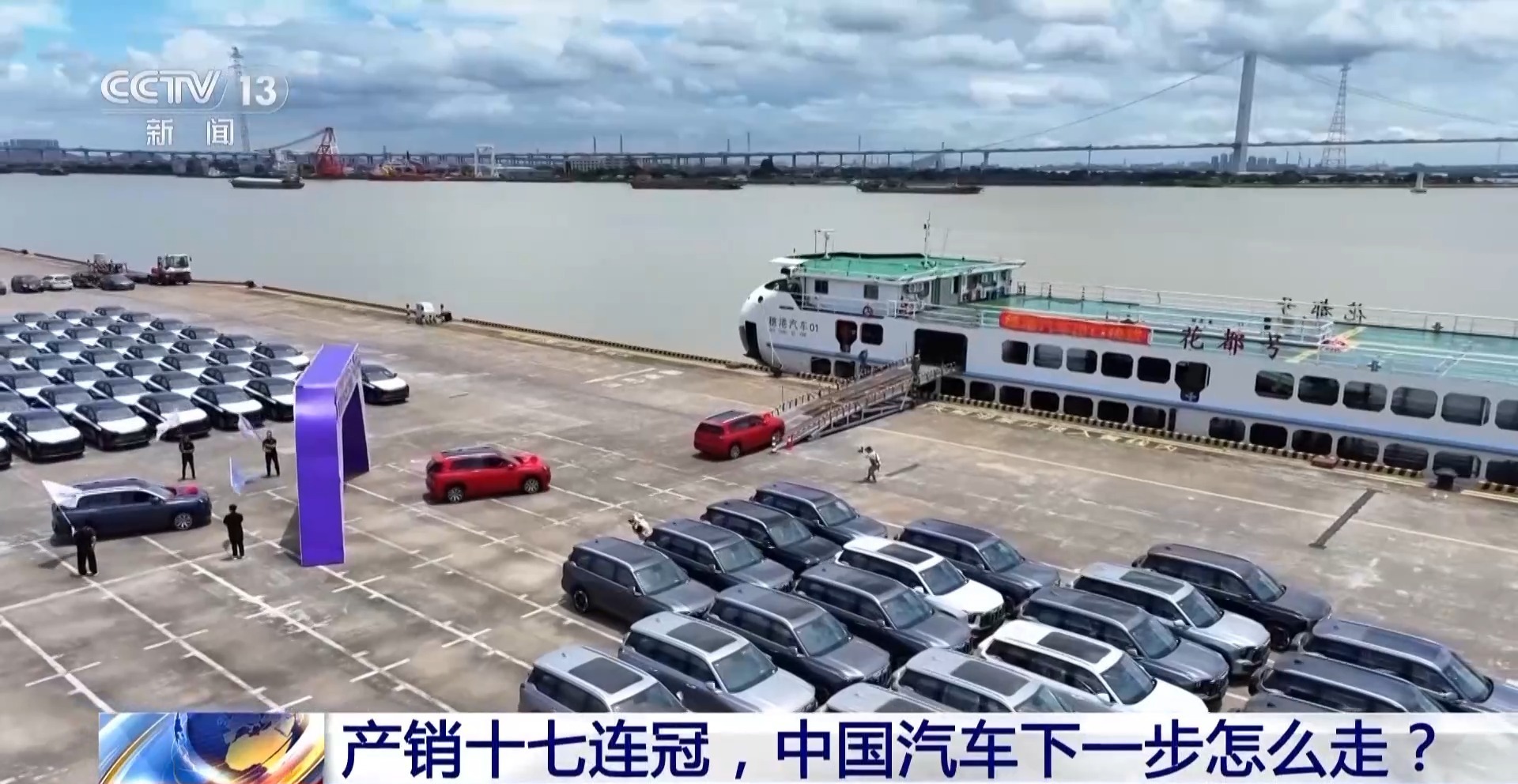
新闻1+1|产销十七连冠,中国汽车下一步怎么走?
Yang Shi Wang· 2026-01-16 03:42
Core Insights - The Chinese automotive industry is projected to achieve record production and sales of 34.53 million and 34.40 million vehicles respectively in 2025, marking a year-on-year growth of 10.4% and 9.4%, maintaining its position as the world's largest market for 17 consecutive years [1][2] - The industry is undergoing a significant transformation, focusing on overcoming homogenization and creating new growth opportunities [1] Industry Performance - During the 14th Five-Year Plan period, the automotive sector has maintained production and sales above 30 million units for three consecutive years, with revenue surpassing 10 trillion yuan, and exports ranking first globally [4] - New energy vehicles (NEVs) have seen production and sales of 16.63 million and 16.49 million units respectively, reflecting year-on-year growth of 29% and 28.2% [4] Technological Advancements - The industry is rapidly advancing in electric, intelligent, and connected technologies, with NEVs becoming the dominant force in the domestic market [4] - Significant R&D investments are being made in battery technology, including the development of solid-state batteries, which offer higher safety, energy density, longevity, and faster charging compared to traditional lithium-ion batteries [6] Market Dynamics - NEVs have surpassed 50% in the sales ratio compared to traditional fuel vehicles, driven by improved product competitiveness, changing consumer perceptions, and supportive government policies [8] - The average range of NEVs in China is nearing 500 kilometers, with over 12.82 million charging stations established, and fast-charging technology enabling 80% charge in 15 minutes [6] Export Growth - The rapid growth in NEV exports is attributed to increasing global demand, favorable policies in various countries, and the rising competitiveness of Chinese NEVs [12] - Chinese automotive companies are actively pursuing international markets, enhancing their global presence and brand image [17] Future Outlook - The forecast for 2026 anticipates stable high-level sales of approximately 34.75 million vehicles, with domestic demand expected to remain robust and international markets continuing to grow [20]