公司改革

Search documents
激进投资者Elliott斥资40亿美元入股百事
Zheng Quan Shi Bao Wang· 2025-09-02 23:53
Core Insights - Activist investor Elliott Management has invested $4 billion in PepsiCo and proposed a reform plan to the board, suggesting the evaluation of core business refranchising, divestiture of non-core assets, and streamlining the product portfolio [1] - Elliott believes that through these reforms, PepsiCo's stock price has the potential to increase by at least 50% [1] - PepsiCo's soda sales in the U.S. have dropped to fourth place, and the food business is under pressure, leading to a decline in the company's market value from its peak [1] Company Response - PepsiCo has stated that it will evaluate Elliott's views and engage in constructive communication with its shareholders while expressing confidence in its existing sustainable growth strategy [1] - Since the CEO took office, PepsiCo has implemented several measures, including cost-cutting, logistics integration, marketing expenditure assessment, and a relaunch of core brands, expecting a rebound in weak North American demand as strategic adjustments take effect [1]

维权投资者Elliott建立价值约40亿美元百事公司股份 寻求推动变革
Xin Lang Cai Jing· 2025-09-02 18:20
Core Viewpoint - Elliott Investment Management has acquired approximately $4 billion in shares of PepsiCo and plans to advocate for changes within the struggling beverage manufacturer [1] Group 1: Investment and Shareholder Engagement - Elliott's stake makes it one of PepsiCo's largest investors [1] - PepsiCo stated it will evaluate Elliott's views in conjunction with its growth strategy aimed at accelerating growth and creating long-term shareholder value [1] Group 2: Market Challenges - PepsiCo is facing challenges due to competitive pressures and changing consumer tastes, with its market value declining over 20% since its peak in May 2023 [1] - Elliott outlined a reform plan for PepsiCo, which may include restructuring its beverage division and reassessing its snack product portfolio [1] Group 3: Performance Concerns - The market share of PepsiCo's beverage division, which includes brands like Coca-Cola, Gatorade, and Mountain Dew, has been declining and has underperformed for over a decade [1] - Following the announcement, PepsiCo's stock price increased by 2.2% [1]
中炬高新(600872):25Q2点评:业绩承压,静待改革成效
Huaan Securities· 2025-09-01 14:59
Investment Rating - The investment rating for the company is "Buy" (maintained) [2] Core Views - The company is currently undergoing a period of reform, which is causing some pain in its operations. However, there are expectations for revenue improvement in the coming years [5][7] - In Q2 2025, the company experienced marginal revenue improvement due to a low base effect, despite overall revenue pressure [5][6] - The gross margin improved significantly due to cost benefits from lower raw material prices, although profit margins were under pressure due to ongoing reforms [6][7] Financial Performance Summary - For H1 2025, the company reported revenue of 2.13 billion yuan (down 19% YoY) and a net profit of 260 million yuan (down 27% YoY) [9] - In Q2 2025, revenue was 1.03 billion yuan (down 9% YoY) with a net profit of 76 million yuan (down 32% YoY) [9] - The company’s gross margin for Q2 2025 was 39.4%, reflecting a year-on-year increase of 3.2 percentage points, primarily due to lower raw material costs [6][9] - Revenue projections for 2025-2027 are 5.04 billion, 5.50 billion, and 6.03 billion yuan respectively, with expected net profits of 715 million, 854 million, and 965 million yuan [7][10] Product and Regional Performance - In Q2 2025, revenue from soy sauce increased by 6.4% YoY, while chicken essence and cooking oil saw declines of 13.7% and 48.8% respectively [9] - Revenue performance varied by region, with East and North regions showing improvements of 1.1% and 6.8% YoY, while the South region declined by 12.4% [9]

恒顺醋业(600305):Q2收入承压 结构优化促利润率提升
Xin Lang Cai Jing· 2025-08-31 02:26
Core Viewpoint - The company reported a solid performance in H1 2025, with revenue and net profit showing year-on-year growth, although Q2 faced challenges due to weak consumer demand. The company remains committed to strengthening its core business and improving profitability through ongoing reforms [1][2]. Financial Performance - In H1 2025, the company achieved revenue of 1.13 billion, net profit of 110 million, and net profit excluding non-recurring items of 100 million, representing year-on-year increases of 12.0%, 18.1%, and 22.8% respectively [1]. - Q2 2025 saw revenue of 500 million, net profit of 50 million, and net profit excluding non-recurring items of 50 million, with year-on-year changes of -8.2%, +40.6%, and +43.9% respectively [1]. - The revenue performance in Q2 was primarily affected by subdued consumer demand, while new product categories like复调 outperformed traditional categories [1][2]. Product and Channel Analysis - In H1 2025, revenue from various product categories was as follows: vinegar 740 million, liquor 150 million, sauce 80 million, and other products 150 million, with year-on-year changes of +8.0%, -5.4%, -3.5%, and +176.6% respectively [2]. - For Q2 2025, revenue from vinegar, liquor, and sauce was 370 million, 60 million, and 40 million, showing year-on-year declines of -1.0%, -18.9%, and -29.0% respectively [2]. - Online and offline channel revenues in H1 2025 were 80 million and 420 million, with year-on-year changes of +18.7% and -12.1% [2]. Profitability and Cost Structure - The company's gross margin in H1 2025 was 38.4%, an increase of 1.9 percentage points year-on-year, with Q2 gross margin reaching 42.1%, up 9.6 percentage points year-on-year [3]. - In H1 2025, the sales and management expense ratios were 18.1% and 4.2%, reflecting year-on-year changes of +1.5 and -1.0 percentage points respectively [3]. - The net profit margin for H1 2025 was 9.8%, an increase of 0.5 percentage points year-on-year, while Q2 net profit margin was 10.8%, up 3.8 percentage points year-on-year [3]. Future Outlook and Valuation - The company is optimistic about the long-term impact of management reforms and maintains its earnings forecasts for 2025-2027, projecting EPS of 0.18, 0.20, and 0.21 respectively [4]. - The target price for 2025 is set at 10.44, based on a PE ratio of 58x, reflecting an increase from the previous target of 9.36 [4].

中炬高新(600872):下滑幅度收窄 期待改善
Xin Lang Cai Jing· 2025-08-29 00:32
Core Viewpoint - The company is experiencing operational pressure due to weak demand and intense competition, but there are expectations for improvement in the future [1] Investment Highlights - The investment recommendation is to maintain a "Buy" rating, with projected EPS for 2025-2027 at 0.9, 1.12, and 1.17 yuan respectively. The company is undergoing a reform process and is expected to achieve both organic and external growth, with a target price of 22.5 yuan per share based on a 25x PE for 2025 [2] - In Q2 2025, the company's main business revenue decline narrowed to single digits, with revenue of 1.03 billion yuan, down 9.11% year-on-year, and net profit attributable to the parent company at 76 million yuan, down 31.57% year-on-year. The main seasoning products saw a revenue of 1.992 billion yuan in H1 2025, down 18.39% year-on-year, with Q2 revenue at 966 million yuan, down 3.29% year-on-year, indicating a slowdown in the decline compared to Q1 [2][3] - The sales expense ratio significantly increased in Q2 2025, with a gross margin increase of 3.22 percentage points to 39.39%, primarily due to cost reductions. The sales expense ratio was 18.88%, up 4.05 percentage points, likely due to significant increases in employee compensation and advertising expenses [2] Financial Metrics - In Q2 2025, management, R&D, and financial expense ratios increased by 0.37, 0.04, and -0.18 percentage points to 8.12%, 3.74%, and 0.05% respectively. Despite the increase in gross margin, the significant rise in sales expense ratio led to a decrease in net profit margin attributable to the parent company by 1.03 percentage points to 8.03% [3] - The revenue growth rate for soy sauce turned positive in Q2 2025. The revenue and growth rates for various products in H1 2025 were as follows: soy sauce at 1.298 billion yuan, down 16.68% (Q1: -31.57%, Q2: +6.39%), chicken essence and powder at 255 million yuan, down 21.98% (Q1: -28.6%, Q2: -13.73%), cooking oil at 109 million yuan, down 49.39% (Q1: -50.01%, Q2: -48.84%), and other products at 331 million yuan, down 3.23% (Q1: -6.89%, Q2: +2.84%) [3] Regional Performance - The southern main sales area remains significantly pressured. Revenue and growth rates by region in H1 2025 were as follows: Eastern region at 436 million yuan, down 28.64% (Q1: -47.71%, Q2: +1.11%), Southern region at 808 million yuan, down 16.29% (Q1: -19.63%, Q2: -12.36%), Central and Western region at 434 million yuan, down 16.12% (Q1: -29.05%, Q2: +5.61%), and Northern region at 316 million yuan, down 9.64% (Q1: -18.72%, Q2: +6.79%) [4] - The number of distributors increased by 245 to 2,799, with further channel penetration, achieving a county development rate of 86% and a prefecture-level city development rate of 97.9% [4]
洋河股份(002304):公司信息更新报告:库存持续出清,期待经营拐点
KAIYUAN SECURITIES· 2025-08-22 08:42
Investment Rating - The investment rating for the company is "Outperform" (maintained) [1] Core Views - The company is actively reducing inventory and is expected to see operational improvements in the future. Despite significant revenue and profit declines in the first half of 2025, the company's brand strength and consumer base remain intact, making future reforms promising [5][6] Financial Performance Summary - In H1 2025, the company achieved revenue of 14.796 billion, a year-on-year decline of 35.32%, and a net profit attributable to shareholders of 4.344 billion, down 45.34%. Q2 revenue was 3.729 billion, down 43.67%, with net profit of 707 million, a decline of 62.66% [5] - The company has adjusted its profit forecasts for 2025-2026, now expecting net profits of 4.763 billion (-57.6%), 4.907 billion (-61.8%), and 5.159 billion for 2027, with year-on-year changes of -28.6%, +3.0%, and +5.1% respectively [5] - The current stock price corresponds to P/E ratios of 22.8, 22.2, and 21.1 for 2025, 2026, and 2027 respectively [5] Product and Regional Performance - The mid-to-high-end product segment saw a revenue decline of 36.5% to 12.67 billion, while ordinary liquor revenue fell by 27.2% to 1.84 billion. The decline in the mid-to-high-end segment is attributed to decreased demand for the company's main product line [6] - Revenue from the domestic market was 7.12 billion, down 25.8%, while revenue from outside the province was 7.39 billion, down 42.7%, indicating a more significant decline in external markets [6] Contract Liabilities and Cash Flow - As of the end of H1 2025, contract liabilities stood at 5.88 billion, an increase of 1.94 billion year-on-year but a decrease of 1.15 billion quarter-on-quarter. Q2 sales cash receipts were 2.57 billion, down 48%, aligning with revenue trends [7] Profitability Metrics - Q2 gross margin was relatively stable at 73.3%, down 0.4 percentage points year-on-year. However, the sales expense ratio increased by 2.3 percentage points due to fixed advertising and personnel costs amid declining revenue. The net profit margin fell significantly by 9.6 percentage points to 18.9% [8] - The company’s gross margin is projected to remain around 73% for the next few years, with net margins expected to recover slightly by 2027 [10]

淡马锡考虑进行重大改革以提高回报
Di Yi Cai Jing· 2025-08-20 07:54
Core Insights - Temasek is considering significant reforms to enhance its returns [1] Group 1 - The company aims to implement changes that could lead to improved financial performance [1]
研报掘金丨华鑫证券:维持洋河股份“买入”评级,改革有望逐渐释放积极成效
Ge Long Hui A P P· 2025-08-20 06:25
Core Viewpoint - Yanghe Brewery's net profit attributable to shareholders for H1 2025 is projected to be 4.344 billion yuan, representing a 45% decrease year-on-year, with Q2 net profit at 707 million yuan, down 63% year-on-year [1] Financial Performance - For H1 2025, the company's revenue from domestic and external markets is 7.121 billion yuan and 7.392 billion yuan respectively, reflecting a decrease of 26% and 43% year-on-year [1] - The company has seen a faster pace of inventory destocking in the domestic market compared to the external market, leading to better performance domestically [1] Strategic Adjustments - The company is entering a deep reform phase, actively adjusting its growth strategy by slowing down operations [1] - Recent management changes have been implemented, and the company plans to continue controlling inventory and stabilizing prices to alleviate channel pressures [1] Future Outlook - The company is expected to gradually release positive results from its reforms, supported by brand strength [1] - Earnings per share (EPS) forecasts for 2025-2027 are 2.42 yuan, 2.60 yuan, and 2.89 yuan respectively, with current stock prices corresponding to price-to-earnings (PE) ratios of 31, 28, and 26 times [1]
砍掉年销低于300万元经销商,娃哈哈:正常优化
2 1 Shi Ji Jing Ji Bao Dao· 2025-08-11 13:43
Core Insights - Wahaha has eliminated distributors with annual sales below 3 million, leading to disputes over payments as some have been integrated into larger distributors [1] - The company claims that the changes in its distributor system are part of a normal dynamic optimization based on market strategy and cooperation willingness, rather than targeting specific scale customers [1] Group 1: Leadership Changes - Zong Fuli officially took over 29.40% of Wahaha Group's shares and became the chairperson of the company in August 2024 [2] - Zong Fuli is described as a workaholic and strong leader, implementing a series of aggressive reform measures since her takeover [2] Group 2: Distributor and Management Reforms - The distributor contracts have been transferred to Hongsheng Beverage, controlled by Zong Fuli, with adjustments in partnerships for various regions including Tibet and Qinghai [2] - A significant restructuring of the core management team has occurred, with many departments merged or eliminated, and employee contracts transferred to Hongsheng Beverage [2] - Wahaha views the complaints arising from the transfer of employee contracts as a "short-term pain" associated with internal compliance reforms [2]
当改革遇上政治:英特尔(INTC.US)复兴算盘还能打响吗?
智通财经网· 2025-08-08 12:56
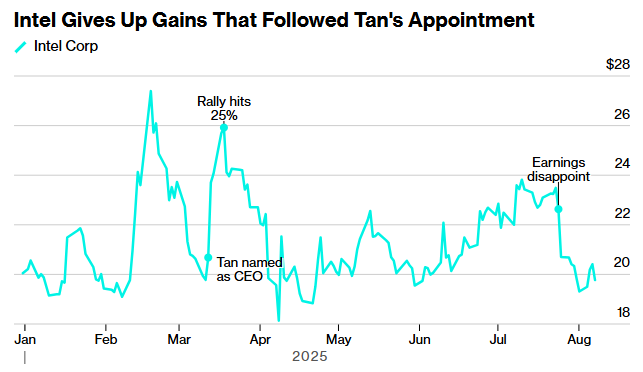
Core Viewpoint - Intel faces significant challenges as CEO Pat Gelsinger's recent criticisms and President Trump's public discontent create uncertainty around the company's reform efforts and future direction [1][6]. Group 1: Company Leadership and Challenges - CEO Chen Liwu has been targeted by President Trump, who called for his resignation due to alleged conflicts of interest, despite no evidence being provided [1]. - Chen's appointment initially boosted Intel's stock by 25%, but optimism has since faded, with the stock now on track for a second consecutive year of decline, a situation not seen in 40 years [5][6]. - The company is struggling to balance cost-cutting measures with the need for advanced product development to compete with rivals like Nvidia and AMD [6]. Group 2: Market Reactions and Investor Sentiment - Following Trump's comments, Intel's stock dropped 3.1% but rebounded in pre-market trading, indicating that investors do not expect Chen to leave the company imminently [1]. - Investors were left confused after Intel's recent quarterly earnings call, where Chen criticized previous investment strategies and focused more on cost reduction rather than innovation [5][6]. - In contrast, Apple's commitment to invest $100 billion in domestic production has positively impacted its stock, highlighting a stark difference in market sentiment between the two companies [2][5].