
关税压力

Search documents
Walmart Stock Stumbles on Rare Earnings Letdown
Schaeffers Investment Research· 2025-08-21 15:03
Core Insights - Walmart Inc reported a profit of 68 cents per share, missing earnings estimates for the first time since 2022, while revenue reached $177.4 billion, exceeding expectations [1] - Despite tariff pressures, price concerns, and one-time expenses, strong U.S. and e-commerce sales led Walmart to raise its full-year sales and profit outlook [1] Stock Performance - The stock is down 4.3% to $98.15, breaking a three-day winning streak and falling below the $100 resistance level [2] - Year-to-date, Walmart's equity is still up 8.6% [2] Analyst Sentiment - A majority of analysts remain optimistic, with 36 out of 37 firms rating Walmart a "buy" or better [3] - The stock's 50-day call/put volume ratio of 1.98 indicates strong long-term sentiment, ranking higher than 87% of readings from the past year [3] Options Activity - Bearish activity has increased in the options market, with 114,000 puts exchanged, significantly above the intraday average [4] - The most popular contracts are the August 97-, 98-, and 92-strike puts, with positions opening at all three levels [4]



瀚亚投资:料关税压力将在下半年显现 美联储降息预期利好新兴市场及亚洲股票
Zhi Tong Cai Jing· 2025-08-13 06:40
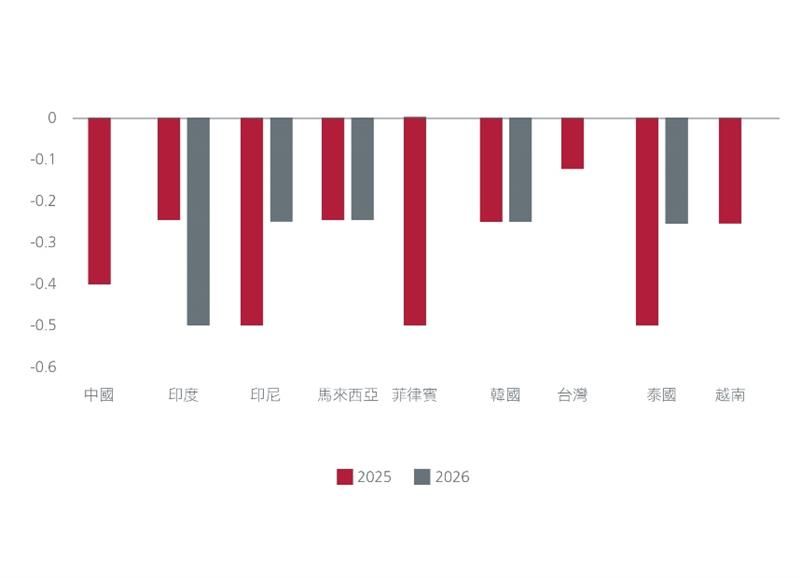
Group 1: Economic Outlook - The US economy performed better than expected in the first half of the year, but rising tariffs may pressure consumer spending, a key growth driver [1][2] - The year-on-year growth rate in the US is expected to slow to 1.6% by the end of the year, remaining below trend levels through 2026 [2] - Inflation in the US is rising due to tariffs affecting prices, while Asian economies (excluding Japan) face slowing inflation due to weak growth and low oil prices [2] Group 2: Monetary Policy - The Federal Reserve may cut interest rates by 25 to 50 basis points by the end of the year, depending on inflation data, with most Asian central banks expected to ease policies in a low inflation environment [2] - The US dollar is projected to depreciate by 3% to 5% over the next 6 to 9 months, which may lead to a moderate appreciation of most Asian currencies [2] Group 3: Investment Strategy - The company prefers emerging markets and Asian stocks over the US market due to more attractive valuations and macroeconomic conditions [1][5] - US high-yield bonds remain attractive with a yield of 7%, while emerging market bonds offer upside potential due to dollar depreciation [1][5] - US Treasury bonds are viewed positively as they provide yield opportunities and can hedge against potential risks from slowing US economic growth [1][5] Group 4: Asset Allocation - The company has adopted a more positive tactical stance on risk assets, particularly stocks and credit, as the impact of tariffs is assessed to be less severe than previously thought [4] - Key indicators such as global purchasing managers' index and corporate earnings forecasts continue to support a positive short-term outlook [4]
外贸数据超预期的四点观察——7月进出口数据点评
一瑜中的· 2025-08-08 09:45
Core Viewpoints - In July, China's export growth rate exceeded Bloomberg's consensus expectations, with a year-on-year increase of 7.2%, slightly below the company's forecast of 7.5% but higher than the previous value of 5.9% [2][4] - The resilience of exports is supported by low base effects and driven by three key regions: ASEAN, EU, and Africa, which may continue to provide unexpected strength against US tariff pressures [4][6] - Import growth in July significantly surpassed expectations, primarily driven by raw materials and intermediate goods, including crude oil and integrated circuits, indicating potential future pressures on import demand [4][11] Group 1: Trade Data Observations - July's export data aligns closely with the company's expectations, with a year-on-year increase supported by a low base from the previous year, while the month-on-month figure fell below the historical average [6][12] - The resilience of exports is notable given the backdrop of significant US tariff increases, with cumulative export growth remaining robust despite potential "export rush" factors [6][16] - The overall external demand may face downward pressure in the second half of the year, compounded by the potential for a decline in import demand [9][10] Group 2: Regional Export Performance - Exports to the EU, ASEAN, and Africa have shown strong growth, contributing significantly to the overall export performance in July [7][17] - The recovery in EU exports aligns with the manufacturing cycle in the Eurozone, while ASEAN exports may be influenced by transshipment trade dynamics [20][23] - African exports have been particularly strong, driven by vehicle and parts exports, indicating a divergence from trends seen in other regions [26][29] Group 3: Export Outlook - Short-term export resilience is expected to face adjustments due to external demand slowing and high base effects in the fourth quarter [9][34] - Leading indicators suggest that export growth may range between 3%-4% for the year, with potential declines in the second half [10][34] Group 4: Import Performance - July's import growth rate of 4.1% significantly exceeded expectations, driven by various categories including crude oil and integrated circuits [38][60] - The contribution to import growth primarily came from unlisted other goods, indicating a potential reliance on specific categories for sustained growth [11][39] - Future import growth may face challenges due to declining commodity prices and ongoing pressures in the manufacturing sector [39][63]

目前为止,美股二季报表现如何?
Hua Er Jie Jian Wen· 2025-08-04 13:46
Core Insights - The earnings reports for Q2 have revealed a strong performance, with 63% of S&P 500 companies exceeding earnings expectations, marking a 25-year high in this metric [1][2][3] - Despite the impressive earnings, market reactions have been muted due to previously low expectations driven by tariff pressures [1][3] - Large technology companies have shown exceptional growth, with their earnings growth rate being over six times that of other sectors [1][7] Group 1: Earnings Performance - As of August 1, 327 companies in the S&P 500 have reported Q2 earnings, representing 69% of the total market capitalization [2] - The S&P 500's Q2 EPS grew by 9% year-over-year, significantly surpassing the initial analyst expectation of 4% [2] - The average EPS exceeded expectations by 8%, while average revenue surpassed expectations by 3%, indicating strong performance in both revenue generation and cost control [2] Group 2: Market Reactions and Expectations - The high percentage of companies exceeding expectations is somewhat diluted by the context of lowered expectations set earlier in the year [3] - The market's response to companies beating earnings expectations has been weak, with stock prices of these companies only outperforming the S&P by 55 basis points post-announcement, below the historical median of 101 basis points [3] - Companies that missed expectations saw their stock prices underperform by 362 basis points, nearly double the historical average [3] Group 3: Corporate Guidance and Analyst Revisions - In contrast to Q1, corporate guidance for full-year earnings has turned optimistic, with 56% of companies raising their EPS forecasts, nearly double the 29% from Q1 [4] - The breadth of earnings revisions has reached its highest level since the end of 2021, indicating a collective upward adjustment in analyst expectations for future earnings [4] - Despite the positive revisions, EPS consensus forecasts for 2025 and 2026 remain about 3% lower than at the beginning of the year, reflecting lingering concerns over long-term profitability [4] Group 4: Tariff Impact and Corporate Strategies - Tariff pressures have been a central theme in the earnings reports, with 27% of companies expressing that the impact on profits will be less than previously anticipated [5][6] - Companies are employing diverse strategies to mitigate tariff impacts, with 76% restructuring supply chains, 60% raising prices, and 51% cutting other costs [6] - The widespread adoption of price increases aligns with expectations that tariff costs will be passed on to consumers, potentially raising inflation but posing risks to actual revenue growth [6] Group 5: Technology Sector Performance - The standout performers in Q2 have been large technology companies, with the "Magnificent Seven" showing a 26% year-over-year EPS growth, compared to just 4% for the remaining S&P 500 companies [7] - This significant disparity in growth rates highlights the increasing weight of large tech firms in the S&P 500's overall earnings [7] - Future earnings expectations will be influenced by the upcoming earnings reports from major tech firms, particularly Nvidia, and their assessments of tariff impacts for Q3 [7]


加拿大贸易部长:与美国的贸易谈判仍在进行中,但渥太华不会屈服于关税压力。
news flash· 2025-08-03 15:05
Core Viewpoint - The Canadian Trade Minister stated that trade negotiations with the United States are ongoing, but Ottawa will not yield to tariff pressures [1] Group 1 - The Canadian government is actively engaged in trade discussions with the U.S. [1] - There is a firm stance from Canada against succumbing to tariff-related pressures from the U.S. [1]
植华集团(01842.HK)预期上半年亏损净额增加约40%至50%
Ge Long Hui· 2025-08-01 10:44
Group 1 - The company, Zhihua Group (01842.HK), reported a net loss of approximately HKD 5.8 million for the six months ending June 30, 2024, and anticipates a net loss increase of about 40% to 50% in the first half of 2025 [1] - The expected increase in net loss for the first half of 2025 is primarily due to a slight decline in revenue, mainly attributed to ongoing tariff-related pressures from the United States [1] - The company confirmed an unrealized loss of approximately HKD 3.3 million on listed securities investments for the first half of 2025, compared to a loss of HKD 2.2 million in the first half of 2024 [1] - Administrative expenses are expected to rise by approximately HKD 1.9 million, mainly due to the company's efforts to strengthen its diversified supply chain network and advance business development initiatives [1]
惠誉:尽管面临关税压力,但欧洲、中东和非洲汽车业的降级有限。
news flash· 2025-07-30 15:26
Core Viewpoint - Despite facing tariff pressures, the downgrade of the automotive industry in Europe, the Middle East, and Africa is limited [1] Group 1 - The automotive sector in Europe, the Middle East, and Africa is experiencing challenges due to tariffs, but the overall impact on credit ratings is not severe [1] - Fitch Ratings indicates that the automotive industry is adapting to the changing regulatory environment and is expected to maintain stable credit profiles [1] - The limited downgrade reflects the resilience of the automotive sector in these regions amid external pressures [1]
日本政坛,重磅事件!创下历史新高
证券时报· 2025-07-19 23:54
Core Viewpoint - The upcoming Japanese Senate election is critical for the ruling coalition's future, with potential implications for Prime Minister Kishida's government and Japan's political landscape [3][12][14]. Group 1: Election Context - The voting for the Japanese Senate election began on the 20th, with over 21.45 million early votes cast, marking a historical high [2]. - The Senate has 248 seats, with 125 seats contested in this election, including 124 regular seats and one special election in Tokyo [2]. - The ruling coalition, consisting of the Liberal Democratic Party (LDP) and Komeito, needs to secure at least 50 seats to maintain a majority [2]. Group 2: Political Implications - Analysts suggest that a loss for the ruling coalition could further complicate Prime Minister Kishida's governance, especially after losing the House of Representatives last year [3][14]. - Kishida's government has set a target to retain a majority in the Senate, but recent polls indicate a challenging election ahead, with predictions of only 30 seats for the LDP [6][7]. Group 3: Public Sentiment and Support Rates - Kishida's cabinet support rate has dropped to 20.8%, the lowest since he took office, with a corresponding rise in disapproval to 55% [9]. - The decline in support is attributed to rising living costs and ineffective policies addressing inflation, leading to increased public dissatisfaction [16]. Group 4: Economic Factors - Japan is facing economic pressures from rising prices and potential tariffs from the U.S., which could impact key sectors like the automotive industry [10][11]. - The consumer price index rose by 4.0% in May, with real wages decreasing for five consecutive months, exacerbating the economic challenges for the government [11].

What's Happening With Ericsson's Stock?
Forbes· 2025-07-18 14:07
Core Insights - Ericsson's stock has decreased by nearly 10% over the last five trading days despite a Q2 earnings report that exceeded expectations, attributed to macroeconomic concerns and cautious forecasts overshadowing margin improvements and a return to profitability [2][3] Financial Performance - The company reported an adjusted operating profit of SEK 7.0 billion (~$728 million), surpassing consensus estimates of SEK 6.1 billion, marking a recovery from a SEK 11.9 billion loss the previous year [3] - Gross margin increased to 47.5%, and EBITDA margin reached a three-year peak of 13.2%, indicating enhanced operational efficiency [3] - Revenue fell by 6% year-over-year to SEK 56.1 billion, impacted by a SEK 4.7 billion headwind from currency fluctuations, with organic growth limited to only 2% [4] Regional Performance - North America showed small gains, while significant declines were observed in India and Southeast Asia as telecom operators reduced expenditures following intense 5G rollouts [4] Market Challenges - Tariffs are squeezing margins despite efforts to localize production in the U.S., with management cautioning that these pressures could intensify [5] - Q3 forecasts fell short of expectations, with anticipated Networks sales expected to fall below seasonal patterns, while Cloud Software and Services are expected to keep pace with historical trends [5] Valuation Metrics - The stock is trading at a trailing P/E of approximately 14.5x, significantly lower than the S&P 500's 26.9x, and a forward P/E of 15–16x, marginally above its 10-year average of roughly 13x [6] - Price-to-sales ratio stands at 1.0x, aligning with its historical range, while price-to-free cash flow is merely 0.6 compared to 20.9 for the S&P 500 [6] Future Outlook - Sustained investor interest will likely depend on growth in underperforming regions, stabilization of tariff pressures, and margin enhancement beyond cost cuts [7]


通用电气航空公司首席执行官:我们无法自己全部抵消关税压力,正在与航空公司就此进行沟通。
news flash· 2025-07-17 11:15
Group 1 - The CEO of General Electric Aviation stated that the company cannot fully offset the pressure from tariffs on its own [1] - The company is currently in communication with airlines regarding the tariff impacts [1]
