利率下降

Search documents
美国总统特朗普:尽管美联储主席鲍威尔反对,利率仍将下降。
Sou Hu Cai Jing· 2025-12-14 18:56
Core Viewpoint - President Trump stated that interest rates will decrease despite opposition from Federal Reserve Chairman Jerome Powell [1] Group 1 - The announcement indicates a potential shift in monetary policy direction, which could impact various sectors reliant on borrowing costs [1] - The statement reflects ongoing tensions between the executive branch and the Federal Reserve regarding economic management [1]
黄金,又爆了!网友:“真的很夸张”
Sou Hu Cai Jing· 2025-12-13 10:25
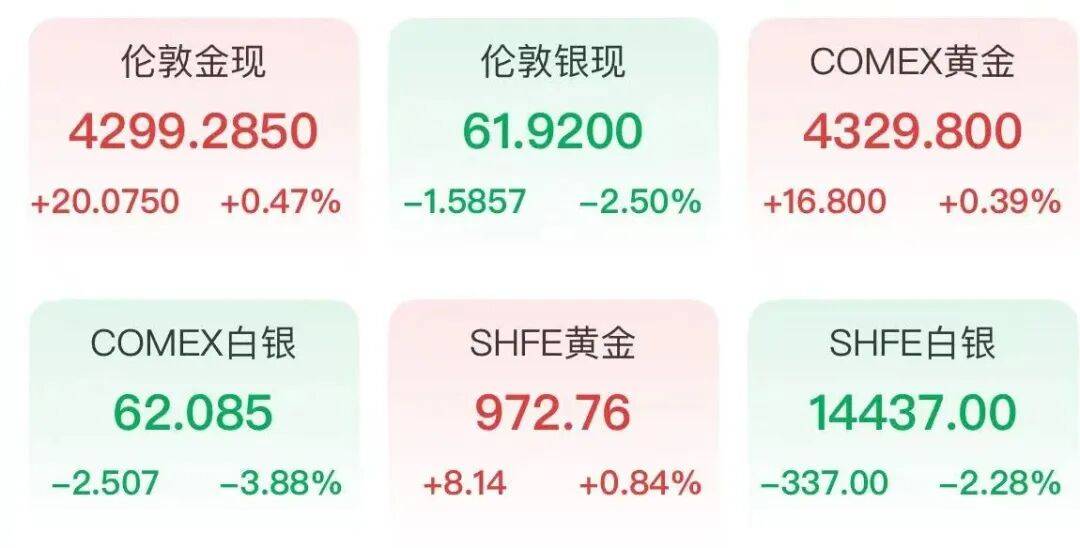
Group 1 - The price of spot gold has surged, breaking through $4,350 per ounce, nearing historical highs, although it experienced a short-term decline afterward [1] - Brand gold jewelry prices have also risen significantly, with Lao Miao gold reaching ¥1,352 per gram, Chow Sang Sang at ¥1,351 per gram, and Chow Tai Fook at ¥1,348 per gram, all surpassing ¥1,350 per gram [3] Group 2 - The recent upward momentum in gold prices is driven by the Federal Reserve's less hawkish stance than market expectations, alongside strong bets on future easing policies. Additionally, the decline in the US dollar and lower US Treasury yields have positively impacted gold [5] - The World Gold Council forecasts that gold prices will continue to be influenced by ongoing geopolitical economic uncertainties, with potential for "surprises" in 2026. If economic growth slows and interest rates decline further, gold may see moderate increases, while in more severe economic downturns characterized by rising global risks, gold could perform strongly [5] - Goldman Sachs analysts predict significant upside potential for gold prices, forecasting $4,900 per ounce by the end of 2026. They expect central bank gold purchases to average 80 tons in 2025 and 70 tons in 2026, with emerging market central banks likely to continue diversifying reserves from the dollar to gold [5]

美国服务业11月强劲扩张 第四季度年化GDP增速有望达2.5%
Sou Hu Cai Jing· 2025-12-03 14:54
Core Insights - The U.S. services sector showed strong expansion in November, with service demand growing at the fastest pace of the year [1] - The manufacturing sector also reported robust output growth, contributing to an expected annualized GDP growth rate of 2.5% in the fourth quarter [1] - Favorable financial conditions, including declining interest rates and a rising stock market, are supporting the economy's resilience [1] Economic Activity - Financial services activity surged in November, indicating continued economic strength [1] - Both consumer services and business services are expanding, although customer demand is under pressure due to affordability issues [1] Pricing and Inflation Concerns - Service charge prices increased at a faster rate in November as businesses attempt to pass on higher costs, often related to tariffs [1] - There are concerns that rising prices may hinder the Federal Reserve's ability to further cut interest rates, potentially limiting the expansion of the financial services sector [1]
美财长面临特朗普施压沪银价动荡
Jin Tou Wang· 2025-11-20 07:36
Group 1 - Silver futures are currently trading above 12045, with an opening price of 12290 and a current price of 12067, reflecting an increase of 0.89% [1] - The highest price reached today was 12306, while the lowest was 11912, indicating a short-term oscillating trend in silver futures [1] - The recent upward momentum in silver prices has been notable, with expectations for targets around 12500, suggesting a continuation of bullish sentiment [3] Group 2 - President Trump expressed dissatisfaction with the Federal Reserve, indicating potential consequences for Treasury Secretary Mnuchin if interest rates do not decrease [2] - Trump reiterated his desire to dismiss Federal Reserve Chairman Jerome Powell, citing incompetence and criticizing the costs associated with the Fed's headquarters renovation [2] - The political pressure on the White House is increasing as voters demand lower living costs, highlighting the tension between government officials and the Federal Reserve [2]
利率不降就炒贝森特鱿鱼,特朗普对财长的玩笑影射鲍威尔
Sou Hu Cai Jing· 2025-11-19 19:04
Core Viewpoint - President Trump indicated that if Treasury Secretary Mnuchin does not help lower interest rates, he may be fired, despite the fact that interest rate decisions are made by the Federal Reserve, not government officials [1] Group 1 - Trump criticized Mnuchin's handling of the Federal Reserve, stating that "the only thing Scott messed up is the Fed" [1] - Trump expressed dissatisfaction with current interest rates, labeling them as "too high" [1] - The comments were made during the Saudi-U.S. investment forum in Washington [1]
Circle stock plunges as concerns over falling interest rates overshadow strong revenue, earnings growth
Yahoo Finance· 2025-11-12 17:44
Core Insights - Circle's stock experienced a decline of up to 10% due to investor concerns over falling interest rates, despite strong earnings and revenue growth driven by increased market share in stablecoin issuance [1][2] - The company reported total revenue and reserve income of approximately $740 million in Q3, representing a 66% year-over-year increase, exceeding Wall Street's expectations of $707.3 million [1][2] Financial Performance - Circle's adjusted earnings were $0.64 per share, significantly higher than analysts' expectations of $0.20 [2] - The company's reserve return rate decreased by 96 basis points to 4.15% during the quarter, a trend anticipated by Wall Street as the Federal Reserve began cutting interest rates [2] Market Position and Growth - Circle's stablecoin market share increased to 29% in the last quarter, up from 28% in the previous three months, with USDC circulation rising by 108% year over year [4] - The company is diversifying its revenue streams through initiatives like Circle Payments and the Arc blockchain platform, which aims to enhance on-chain economic activity [4] Strategic Partnerships - Circle has formed numerous partnerships, including with Brex, Fireblocks, Hyperliquid, and Visa, which are expected to bolster future results [5] - Analysts have noted the potential for Arc to develop its own native coin, which is viewed as a positive indicator for Circle's stock [5] Stock Performance - Since its IPO in June, Circle's stock has surged by 180%, although it remains approximately 60% below its all-time highs reached earlier in the summer [6]
【环球财经】星展银行:利率从“逆风”转“顺风” 新加坡房地产投资信托估值仍合理
Xin Hua Cai Jing· 2025-11-09 01:51
Group 1 - The core viewpoint of the report is that interest rates have shifted from being a "headwind" to a "tailwind" for Singapore Real Estate Investment Trusts (S-REITs) due to a significant decline in the SORA rate, which has decreased by approximately 1.15% [1] - Despite a year-to-date increase of about 12.5% in the S-REITs sector, the current price-to-book ratio (P/B) of approximately 0.9 and a forward dividend yield of about 5.7% for the fiscal year 2026 indicate that valuations remain "undemanding" [1] - The report predicts that the decline in interest rates will lead to substantial interest savings for REITs, potentially allowing them to save up to 200 basis points (2%) in interest costs when refinancing loans maturing in 2026-2027 [1] Group 2 - The report highlights that the overall yield for the S-REITs sector is expected to increase by 40 basis points, bringing the long-term yield back to around 6.0% by 2026, a level that may attract investors back into the market [1] - In terms of market dynamics, the report notes that the Federal Reserve's interest rate cut at the end of October may help alleviate borrowing costs, but its "hawkish" signals could lead to short-term market volatility [2] - The investment strategy recommended by the bank emphasizes "buying on weakness" and suggests that investors focus on "alpha picks" and interest rate-sensitive stocks, particularly mid-cap stocks with a higher proportion of floating-rate debt [2]
AI板块反攻美股收涨,热门中概股分化,黄金再战4000美元
Di Yi Cai Jing· 2025-11-06 00:17
Market Overview - The U.S. stock market rebounded on Wednesday, with the Dow Jones increasing by 225.86 points (0.48%) to 47,311.10, the Nasdaq rising by 0.65% to 23,499.80, and the S&P 500 gaining 0.37% to 6,796.29, driven by optimistic corporate earnings and better-than-expected economic data [2] - The ADP reported an addition of 42,000 jobs in the private sector for October, indicating a rebound, although signs of labor market weakness persist with ongoing layoffs in some industries [4] - The ISM services PMI for October reached 52.4, marking the fastest expansion in eight months, primarily due to a rapid recovery in new orders, despite companies facing the highest input costs in three years [4] Company Performance - Notable tech stocks showed varied performance: Tesla rose by 4%, Google by 2.4%, Meta by 1.3%, Amazon by 0.3%, while Nvidia fell by 1.7% [3] - Ford and General Motors, which are sensitive to tariff risks, saw their stock prices increase by over 2% following the Supreme Court's skepticism regarding the legality of tariffs imposed by former President Trump [5] - Caterpillar's stock also rose approximately 4%, reflecting positive market sentiment amid tariff uncertainty [5] Economic Indicators - The 10-year U.S. Treasury yield increased by 6.4 basis points to 4.16%, while the 2-year yield rose by 4.8 basis points to 3.63%, indicating a shift in investor sentiment towards interest rates [5] - International oil prices weakened, with WTI crude oil falling by 1.59% to $59.60 per barrel and Brent crude down by 1.43% to $63.52 per barrel [6] - Gold prices rebounded, with COMEX gold futures for November delivery rising by 0.83% to $3,980.30 per ounce, driven by increased risk aversion [6]
3 Reasons Not to Open a CD Right Now, Even With Rates at 4%
Yahoo Finance· 2025-10-26 12:00
Group 1 - Certificates of deposit (CDs) are a popular investment option for generating income with minimal risk, where investors lock up cash for a set period in exchange for interest payments at an agreed annual percentage yield (APY) [1] - The average yields of 12-month CDs have climbed to 5%-6% due to the Federal Reserve's interest rate hikes in 2022 and 2023, making them appealing to investors [4] - The Federal Reserve has already reduced its benchmark rate three times in 2024 and once in 2025, leading to expectations of further rate cuts, which will decrease the attractiveness of CDs [5] Group 2 - As interest rates decline, income-oriented investors are likely to shift towards blue chip dividend stocks that offer higher yields than CDs, such as AT&T with a forward dividend yield of 4.3% [7] - Altria, focusing on smoke-free products, offers an even higher forward yield of 6.6%, making it an attractive alternative for income-seeking investors [9] - Investors locking up cash in CDs may miss out on more attractive investment opportunities as rates decline, potentially leading to suboptimal investment decisions [6][8]
Money market funds will find a home in small caps when rates fall, Needham's Chris Retzler
Youtube· 2025-10-15 18:31
Market Outlook - Small caps are expected to enter a favorable period after underperforming for the last couple of years, with revenue acceleration being a significant benefit [2] - The capital markets for both equity and debt are open, and M&A activity is robust, providing a positive environment for small caps [4] - The current cycle of rate cutting is anticipated to lead to increased liquidity in small caps as money market rates drop [6] Tariff Impact - Tariff concerns have been absorbed to some extent, but they still impact many companies, particularly smaller ones [3][4] - The China tariff remains a significant concern for many companies, highlighting the need for more certainty in the market [4] Investment Opportunities - Companies like Generac, Badger Meter, and Adran are highlighted as potential investment opportunities, with Generac's demand for backup generation in data centers being particularly notable [9][10] - Badger Meter is positioned well due to the ongoing infrastructure buildout, while Adran is expected to benefit from rural broadband investments [10] Market Dynamics - The outperformance of small caps is anticipated as liquidity tightens, leading to increased demand for shares in this segment [7] - Historical false starts in small caps have been noted, but recent market conditions suggest a potential shift [5]