制造业智能化

Search documents
中国经济年报丨国家税务总局:2025年我国制造业智能化 绿色化加快发展
Sou Hu Cai Jing· 2026-01-21 13:38
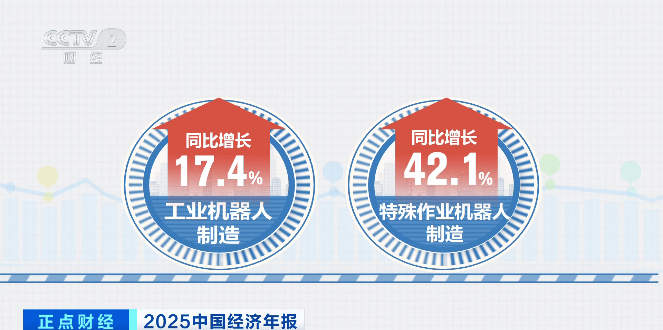
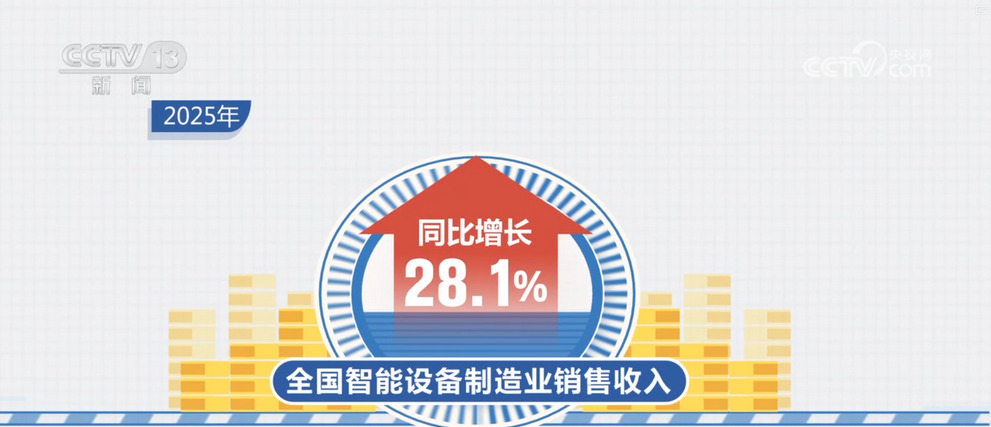
Group 1 - The core viewpoint of the article highlights the accelerated development of intelligent and green transformation in China's manufacturing industry by 2025, with steady increases in sales revenue from intelligent equipment, new energy vehicles, and digital products [1][5]. Group 2 - In 2025, the sales revenue of the intelligent equipment manufacturing industry nationwide is expected to grow by 28.1% year-on-year, with industrial robots and special operation robots increasing by 17.4% and 42.1% respectively [3]. - The transition towards intelligent and digital transformation in manufacturing is accelerating, with expenditures on automation and digital equipment rising by 11.3% and 10% year-on-year respectively [3]. Group 3 - The green transformation in manufacturing is also progressing, with the sales revenue of high-energy-consuming manufacturing industries decreasing by 1.1 percentage points compared to the previous year, indicating an optimization of the industrial structure [5]. - Expenditures on environmental governance services by manufacturing enterprises increased by 7.3% year-on-year, reflecting a growing investment in green governance [5]. - The new energy-related industries are rapidly developing, with sales revenue from new energy vehicle manufacturing and lithium-ion battery manufacturing increasing by 14.3% and 25.1% year-on-year respectively [5]. Group 4 - The integration of the digital economy with the real economy is deepening, with sales revenue from the digital product manufacturing industry growing by 9.4% year-on-year [7]. - Manufacturing enterprises' expenditures on digital technology increased by 10.4% year-on-year, with a growth rate that accelerated by 3.5 percentage points compared to the previous year, particularly in the automotive manufacturing and computer communication equipment manufacturing sectors, which saw increases of 24.5% and 11.8% respectively [7].

税收数据视角下的2025年制造业发展亮点:智能化、绿色化步伐加快
Yang Shi Wang· 2026-01-21 08:41
Group 1 - The core viewpoint of the articles indicates that by 2025, China's manufacturing industry will accelerate its development in terms of intelligence and greenness, with steady increases in sales revenue from intelligent equipment, new energy vehicles, and digital products [1][3][4] Group 2 - In 2025, the sales revenue of high-energy-consuming manufacturing industries will decrease by 1.1 percentage points compared to the previous year, reflecting an optimization in industrial structure [3] - The amount spent by manufacturing enterprises on environmental governance services will increase by 7.3% year-on-year, indicating a growing investment in green governance [3] - The sales revenue of the new energy vehicle manufacturing industry and lithium-ion battery manufacturing will grow by 14.3% and 25.1% year-on-year, respectively [3] Group 3 - The sales revenue of the intelligent equipment manufacturing industry will increase by 28.1% year-on-year in 2025, with industrial robots and special operation robots growing by 17.4% and 42.1% respectively [4] - The procurement of automation and digital equipment by manufacturing enterprises will increase by 11.3% and 10% year-on-year, respectively [4] Group 4 - The sales revenue of the digital product manufacturing industry will grow by 9.4% year-on-year in 2025, with the procurement of digital technology by manufacturing enterprises increasing by 10.4%, an acceleration of 3.5 percentage points compared to the previous year [6] - In the automotive manufacturing and computer communication equipment manufacturing sectors, the procurement of digital technology will increase by 24.5% and 11.8% year-on-year, respectively [6]
税收数据显示:中国制造业智能化、绿色化、融合化步伐加快
Zhong Guo Xin Wen Wang· 2026-01-21 07:42
Group 1 - The core viewpoint of the article highlights the accelerated pace of intelligent, green, and integrated development in China's manufacturing industry, with manufacturing sales revenue expected to grow faster than the national average by 1.7 percentage points by 2025 [1] - The manufacturing sector's share of total national sales is projected to reach 29.7% in 2025, an increase of 0.5 percentage points from the previous year, underscoring its role as an economic stabilizer [1] - The implementation of the "Artificial Intelligence + Manufacturing" initiative is driving significant growth in the procurement of automation and digital equipment, with year-on-year increases of 11.3% and 10% respectively [1] Group 2 - The sales revenue of high-energy-consuming manufacturing industries is expected to decrease by 1.1 percentage points compared to the previous year, indicating ongoing optimization of the industrial structure [2] - Investment in environmental governance services by manufacturing enterprises has increased by 7.3%, with high-energy-consuming sectors seeing a 14.6% rise in spending on such services, reflecting a commitment to green governance [2] - The sales revenue of the new energy vehicle manufacturing industry and lithium-ion battery manufacturing is projected to grow by 14.3% and 25.1% respectively, highlighting the rapid development of related industries [2] Group 3 - The sales revenue of digital product manufacturing is expected to grow by 9.4%, with manufacturing enterprises increasing their procurement of digital technologies by 10.4%, a 3.5 percentage point acceleration from the previous year [2] - The automotive manufacturing and computer communication equipment manufacturing sectors are leading in digital technology procurement, with increases of 24.5% and 11.8% respectively, indicating a deepening integration of the digital economy with the real economy [2] - The National Taxation Administration emphasizes the importance of implementing tax and fee incentives to support the transformation and upgrading of the manufacturing sector, ensuring that policy benefits reach enterprises effectively [2]
稳、进、新、活 2025年工业和信息化发展呈现四大特点
Zhong Guo Xin Wen Wang· 2026-01-21 06:40
Core Viewpoint - The development of the industrial and information technology sectors in 2025 is characterized by four main features: stability, progress, innovation, and vitality, reflecting a commitment to high-quality development and the achievement of key economic goals. Group 1: Stability - The industrial economy has maintained a stable growth trajectory, with the added value of industrial enterprises above designated size increasing by 5.9% year-on-year, and the manufacturing sector's contribution to GDP remaining stable [1] - The telecommunications business volume grew by 9.1% year-on-year, contributing over 40% to overall economic growth, reinforcing its role as an economic stabilizer [1] Group 2: Progress - The pace of high-quality development has accelerated, with the added value of equipment manufacturing and high-tech manufacturing increasing by 9.2% and 9.4% year-on-year, respectively, outpacing overall industrial growth by 3.3 and 3.5 percentage points [2] - The establishment of over 35,000 basic-level and 8,200 advanced-level smart factories has been achieved, alongside the cultivation of 15 leading smart factories, indicating solid progress in the digital transformation of manufacturing [2] Group 3: Innovation - Significant advancements in technology and industry innovation have been made, with breakthroughs in major equipment such as ultra-large diameter shield machines and heavy-duty gas turbines, and over 300 key technologies developed in the first phase of 6G testing [3] - The added value of integrated circuits and electronic materials increased by 26.7% and 23.9% year-on-year, respectively, while the production of industrial robots rose by 28%, and new energy vehicle sales reached 16.49 million, up 28.2% [3] Group 4: Vitality - Reforms in key areas have been accelerated, with actions taken to reduce corporate burdens and clear overdue payments, creating a more vibrant business environment [4] - The cultivation of specialized and innovative small and medium-sized enterprises has seen over 140,000 such firms established, with high-tech enterprises reaching 504,000, indicating a robust growth in the industrial sector [4]
税收数据显示:制造业经济“压舱石”作用更加凸显
Xin Hua She· 2026-01-21 04:20
新华社北京1月21日电(记者刘开雄)记者21日从国家税务总局获悉,国家税务总局日前利用税收大数 据对制造业开展分析显示,2025年,我国制造业销售收入较全国总体销售增速高1.7个百分点;制造业 占全国总体销售比重为29.7%,较上年提高0.5个百分点,制造业智能化、绿色化、融合化步伐加快,经 济"压舱石"作用更加凸显。 ...
工信部:2025年工业和信息化发展呈现“稳”“进”“新”“活”四个特点
Xin Hua Cai Jing· 2026-01-21 03:20
Core Viewpoint - The press conference held by the State Council Information Office highlighted the achievements in industrial and information development by 2025, showcasing four key characteristics: stability, progress, new momentum, and vitality. Group 1: Stability - The industrial and information sector has maintained a stable growth trajectory, with the added value of large-scale industries increasing by 5.9% year-on-year, and the manufacturing sector's contribution to GDP remaining stable, keeping its position as the world's largest for 16 consecutive years [1] - The total telecommunications business volume grew by 9.1% year-on-year, contributing over 40% to economic growth, effectively acting as a "ballast" for the economy [1] Group 2: Progress - The focus on high-quality development has accelerated, with the added value of equipment manufacturing and high-tech manufacturing increasing by 9.2% and 9.4% year-on-year, respectively, outpacing overall industrial growth by 3.3 and 3.5 percentage points [2] - The establishment of over 35,000 basic-level and 8,200 advanced-level smart factories has been achieved, alongside the cultivation of 15 leading smart factories, indicating solid progress in the digital transformation of manufacturing [2] Group 3: New Momentum - Significant advancements in technology and industry innovation have been made, with breakthroughs in major equipment such as ultra-large diameter shield machines and heavy-duty gas turbines, and over 300 key technologies reserved for 6G [3] - The added value of integrated circuits and electronic materials increased by 26.7% and 23.9% year-on-year, respectively, while industrial robot production rose by 28%, and new energy vehicle sales reached 16.49 million, up 28.2% [3] Group 4: Vitality - Reforms in key areas have been accelerated, with actions taken to reduce corporate burdens and clear overdue payments, creating a more vibrant business environment [4] - The cumulative cultivation of over 140,000 specialized and innovative small and medium-sized enterprises has been achieved, with high-tech enterprises reaching 504,000, indicating a robust ecosystem for innovation [4]
税收数据显示:2025年我国制造业智能化、绿色化、融合化加快发展“十五五”
Zhong Guo Jing Ji Wang· 2026-01-21 02:52
Group 1 - The core viewpoint of the articles emphasizes the importance of focusing on the real economy, particularly in manufacturing, while accelerating the transition towards intelligent, green, and integrated development [1][2] Group 2 - By 2025, manufacturing sales revenue in China is projected to grow 1.7 percentage points faster than the overall national sales growth, reaching a share of 29.7% of total sales, an increase of 0.5 percentage points from the previous year [1] - The intelligent upgrade of manufacturing is accelerating, with a projected year-on-year increase of 11.3% in the purchase of automation equipment and 10% in digital equipment by manufacturing enterprises [1] - The sales revenue of the intelligent equipment manufacturing industry is expected to grow by 28.1% year-on-year, with industrial robots and special operation robots seeing increases of 17.4% and 42.1% respectively [1] Group 3 - The green transformation is ongoing, with high-energy-consuming manufacturing sales revenue decreasing by 1.1 percentage points, indicating an optimization of the industrial structure [2] - The purchase of environmental governance services by manufacturing enterprises is expected to increase by 7.3% year-on-year, with high-energy-consuming sectors seeing a 14.6% increase [2] - Sales revenue in the new energy vehicle manufacturing and lithium-ion battery manufacturing sectors is projected to grow by 14.3% and 25.1% year-on-year, respectively [2] Group 4 - The digital integration within manufacturing is deepening, with digital product manufacturing sales revenue expected to grow by 9.4% year-on-year and the purchase of digital technology by manufacturing enterprises increasing by 10.4% [2] - The growth rate of digital technology purchases is accelerating by 3.5 percentage points compared to the previous year, with the automotive manufacturing and computer communication equipment manufacturing sectors seeing increases of 24.5% and 11.8% respectively [2] Group 5 - The tax authorities are committed to implementing policies that support the transformation and upgrading of the manufacturing sector, ensuring that tax benefits reach enterprises effectively to contribute to high-quality development [2]
今年工业经济发展形势如何?将采取哪些措施保增长?访工信部部长
Xin Lang Cai Jing· 2026-01-13 06:22
Core Viewpoint - The construction of a modern industrial system in China is being accelerated, focusing on the integration of technological and industrial innovation to enhance international competitiveness [1] Group 1: Industrial Economic Development - The industrial economy in China is expected to maintain stability and growth, with a focus on four key areas: stability, expansion, innovation, and enhancement [2] - Stability involves supporting key industries and regions that account for 80% of industrial output, implementing growth plans, and ensuring policy support [2] - Expansion focuses on increasing effective demand through flexible manufacturing and promoting new technologies, while also initiating major engineering projects [2] - Innovation aims to enhance value creation by upgrading traditional industries and developing emerging sectors, such as integrated circuits and aerospace [3] - Enhancement emphasizes improving the vitality of enterprises, particularly small and medium-sized ones, by reducing burdens and ensuring timely payments [3] Group 2: Manufacturing Development - The focus during the "14th Five-Year Plan" period will be on intelligent, green, and integrated development of manufacturing, ensuring supply chain security and stability [4] - Traditional industries will undergo renewal through the implementation of targeted upgrade plans and the adoption of smart and green technologies [4] - Emerging industries will be promoted through the establishment of demonstration bases and large-scale application of new technologies [5] - Future industries will be strategically developed, focusing on areas like quantum technology and 6G, with an emphasis on innovation and ecosystem building [5] Group 3: Technological Innovation - The integration of technological and industrial innovation is prioritized to enhance productivity and secure a competitive edge in global markets [6] - High-quality technological supply will be increased through national projects and collaboration between enterprises and research institutions [6] - The role of enterprises in technological innovation will be strengthened, with policies to support R&D investments and enhance participation in major projects [7] Group 4: Digital Transformation - The promotion of digital transformation in manufacturing will be driven by the large-scale application of industrial internet and artificial intelligence [8] - A strong digital foundation will be established by focusing on high-quality data collection and usage, particularly in key manufacturing sectors [8] - The development of industrial internet platforms and smart solutions will be prioritized to enhance connectivity and application in various industries [9]
“人工智能+制造”专项行动实施意见印发
Zhong Guo Hua Gong Bao· 2026-01-12 02:53
石化化工行业智能化转型再获助力 记者注意到,作为《意见》的细化,两个附件提到的具体措施与石化化工行业息息相关。《指引》提出 要推动石化化工行业提质增效。如综合利用大模型、数字孪生技术突破油气勘探开发、化工新材料研发 范式。深度融合油气生产作业、管网储运、化工工艺等工艺机理、专家经验、生产运行数据等,打造石 化化工行业大模型,推动大小模型融合应用,实现油田作业区及化工安全生产监测预警、设备预测性维 护、工艺流程自适应优化、产品质量预测等。构建行业高质量数据集、数据资源节点等数据基础设施, 支撑行业大模型、智能体训练与开发,提升复杂场景人工智能应用水平。《指南》则为企业智能化转型 升级提供实施路径和方法指引。 "2023年以来,行业重点企业积极探索人工智能应用,涌现出智能化工大模型、TPT时序大模型、昆仑 大模型等系列专用大模型,但仍存在高质量数据集建设进展缓慢、可靠性不足、基础支撑薄弱等问 题。"工信部石化化工行业数字化转型推进中心秘书长李渊源介绍说,而此次《指引》专门提到推动石 化化工行业提质增效,《指南》也给出初步的落地应用指引,建议企业进一步夯实自身数据基础,挖掘 人工智能高价值应用场景,实现企业智能化升 ...
重磅!八部门发布专项行动实施意见
中国能源报· 2026-01-07 11:32
Core Viewpoint - The "Artificial Intelligence + Manufacturing" initiative aims to enhance the integration of AI technologies in the manufacturing sector, targeting significant advancements by 2027, including the development of key AI technologies, industry models, and high-quality data sets to support industrial transformation and innovation [1][4][5]. Group 1: Overall Requirements - The initiative is guided by Xi Jinping's thoughts and aims to promote a new development pattern, focusing on innovation-driven growth and the dual empowerment of AI technology and manufacturing applications [5][6]. - By 2027, the goal is to achieve reliable supply of key AI technologies, maintain a leading position in industry scale and empowerment levels, and develop 3-5 general models for deep application in manufacturing [5][6]. Group 2: Innovation Foundation - Emphasis on strengthening AI computing power supply, supporting the development of high-end training chips and AI service platforms [7]. - Development of high-performance algorithms tailored for manufacturing, fostering a model system that enhances adaptability and real-time application [7][8]. Group 3: Application Expansion - Accelerating AI empowerment in key industries through expert-led initiatives and application platforms to match supply and demand [9][12]. - Systematic transformation of manufacturing processes, integrating AI into design, production, and management to enhance efficiency and quality [11][12]. Group 4: Product Breakthroughs - Promotion of intelligent equipment and systems, including AI-driven industrial robots and medical devices, to enhance decision-making and operational capabilities [14][16]. - Development of intelligent terminals and software solutions to support various industrial applications, including smart homes and healthcare [16][40]. Group 5: Ecosystem Development - Strengthening standards and open-source initiatives to foster a collaborative AI ecosystem, enhancing safety and governance in AI applications [18][19]. - Fostering talent development in AI, focusing on interdisciplinary skills that combine AI knowledge with manufacturing expertise [19][20]. Group 6: Safety Assurance - Enhancing safety capabilities through the development of key technologies for data protection and risk management in AI applications [20][21]. - Establishing governance mechanisms for AI safety, including risk monitoring and emergency response protocols [21][22]. Group 7: International Cooperation - Encouraging enterprises to tailor AI solutions for different international markets and participate in global AI discussions [22][24]. - Building international cooperation platforms to enhance collaboration and share best practices in AI development [22][24]. Group 8: Support Measures - Establishing a collaborative framework among various stakeholders to promote the "AI + Manufacturing" initiative, ensuring resource allocation and investment in relevant technologies [24][25]. - Implementing large-scale demonstration actions for new technologies and products to stimulate market demand and innovation [24][25].