医保药品目录调整

Search documents
做好医保药品目录的“加减法”
Zhong Guo Jing Ji Wang· 2026-01-09 12:31
Core Insights - The latest medical insurance drug list has been officially implemented on January 1, 2026, marking the eighth consecutive year of optimization by the medical insurance department, aimed at enhancing both the efficiency of fund usage and the level of medication security for the public [1][2] Group 1: Drug List Adjustments - A total of 114 new drugs have been added to the list, covering critical areas such as oncology, chronic diseases, and rare diseases, including 10 specific drugs for rare diseases, providing more treatment options for patients [1] - The average price reduction for newly added drugs exceeds 60% due to national medical insurance negotiations, significantly lowering the financial burden on patients [1] Group 2: Fund Efficiency and Clinical Relevance - The adjustments are designed to ensure that the medical insurance fund is directed towards high-efficiency and urgently needed medications, removing those that are no longer supplied or have better alternatives [2] - Specific drugs have had their payment scope adjusted to better align with clinical realities, such as the change in coverage for a drug used to increase white blood cell counts [1] Group 3: Support for Innovation and Long-term Strategy - The introduction of a commercial insurance innovative drug directory alongside the basic medical insurance aims to create a multi-layered support system for diverse patient medication needs, alleviating long-term pressure on the medical insurance fund [2] - The new drug list supports high-value innovative drugs, encouraging pharmaceutical companies to shift from marketing-driven approaches to those focused on clinical value, fostering innovation in the pharmaceutical industry [2] Group 4: Patient-Centric Reforms - The adjustments represent a patient-centered reform driven by clinical needs, emphasizing the importance of timely integration of new drugs into hospital procurement lists and addressing practical challenges faced by patients [2] - A long-term mechanism involving collaboration among medical insurance departments, medical institutions, and companies is necessary to maximize the benefits of these reforms for the public [2]
114种新药“入保”,百姓“药篮子”再升级
Zheng Quan Shi Bao· 2026-01-08 02:07
Core Viewpoint - The implementation of the "National Basic Medical Insurance, Maternity Insurance, and Work Injury Insurance Drug List (2025)" aims to optimize the drug reimbursement system, enhancing both the efficiency of medical insurance funds and the accessibility of essential medications for the public [1] Group 1: Drug List Changes - The new drug list includes 114 new drugs, with 50 being innovative first-class drugs, while 29 drugs with lower clinical value have been removed, bringing the total to 3,253 drugs [1] - The updated list covers key areas such as oncology, rare diseases, chronic diseases, and pediatric medications [1] Group 2: New Drug Characteristics - Newly included drugs exhibit three significant characteristics: they either fill clinical treatment gaps, are superior alternatives, or offer better cost-effectiveness [1] - Specific examples include new drugs for treating triple-negative breast cancer and pancreatic cancer, which improve affordability and accessibility for patients [2] Group 3: Payment Scope Adjustments - The payment scope for 65 drugs has been revised to better align with clinical realities, such as expanding the use of certain drugs to a broader patient age range [3] - New conditions have been added for some drugs to prevent misuse while ensuring that medical insurance funds are utilized effectively [3] Group 4: Cost Reduction Initiatives - The combination of price negotiations and medical insurance reimbursements is expected to lower the cost of medications for the public [3] - A new "Commercial Health Insurance Innovative Drug List (2025)" has been introduced, including 19 high-value innovative drugs, which complements basic medical insurance and addresses diverse health needs [3] Group 5: Implementation and Accessibility - The medical insurance department has mandated that medical institutions incorporate newly added drugs into their procurement lists by the end of February [4] - A transition policy allows for a 6-month period during which patients can still purchase removed drugs at previous reimbursement rates [4] - A new feature for querying the updated basic medical insurance drug list has been launched on the National Medical Insurance Bureau's WeChat public account [4]
一针少花两千,新版医保目录调整能省多少钱
Zhong Guo Xin Wen Wang· 2026-01-08 01:28
Core Insights - The recent adjustment to the National Medical Insurance Drug List has significantly reduced the costs of long-acting growth hormone treatments, benefiting many families [1] - The new drug list includes a substantial number of innovative drugs, with an average price reduction of over 60%, aimed at improving patient access to essential medications [2] Group 1: New Drug Additions - A total of 114 new drugs have been added to the insurance list, covering critical areas such as oncology, chronic diseases, and rare diseases [2] - Notable new drugs include innovative treatments for triple-negative breast cancer and pancreatic cancer, as well as long-acting growth hormone for children [2][4] - The new drugs are characterized by either filling clinical treatment gaps, being superior to existing options, or offering better cost-effectiveness [2] Group 2: Existing Drug Adjustments - The payment scope for 65 existing drugs has been optimized, including expanding the target population for certain medications [3] - Adjustments have been made to align drug descriptions more closely with clinical realities, facilitating easier prescription by healthcare providers [3] Group 3: Policy and Industry Impact - The adjustment aims to optimize the use of medical insurance funds, allowing for the introduction of innovative drugs while removing less effective ones [4] - The removal of 29 drugs primarily targets those with lower cost-effectiveness or available alternatives, with minimal impact on most patients [4] - The inclusion of numerous innovative drugs reflects the strengthening of domestic pharmaceutical companies' R&D capabilities [5] Group 4: Financial Implications - The National Medical Insurance Bureau has adjusted the drug list for eight consecutive years, adding a total of 949 new drugs, with significant financial implications for the pharmaceutical market [5] - The insurance fund has spent over 460 billion yuan on negotiated drug expenditures, driving sales growth exceeding 600 billion yuan [5]
2025年医保药品目录变更情况汇总!国家医保局发布药品“清单”
Xin Lang Cai Jing· 2026-01-07 10:07
Core Insights - The latest medical insurance drug list has been officially implemented as of January 1, 2026, featuring significant updates that enhance accessibility and affordability for insured individuals [1]. Group 1: New Drug Additions - A total of 114 new drugs have been added to the list, with 50 classified as new category 1 drugs, marking a record high in both quantity and proportion [2][3]. - Notable new drugs include treatments for triple-negative breast cancer, pancreatic cancer, and various chronic conditions, such as long-acting growth hormone injections and diabetes medications [3]. Group 2: Expanded Payment Scope - The payment scope has been broadened to include 65 drugs with new indications, allowing for better access to treatments for conditions like non-small cell lung cancer and rare diseases [4]. - Adjustments have been made to align payment criteria more closely with clinical practices, such as changing the payment criteria for certain drugs to reflect actual treatment scenarios [4]. Group 3: Restrictions and Conditions - New restrictions have been introduced for certain drugs to prevent misuse, ensuring that insurance funds are utilized effectively [5]. - Some drugs have had non-core restrictions removed, but the fundamental usage requirements remain unchanged, emphasizing the need for clinical discretion [5]. Group 4: Structural Adjustments - A total of 29 drugs have been removed from the list, primarily those that have been clinically obsolete or are no longer in production [6]. - A transition period of six months has been established for drugs that were removed but were under negotiation, allowing insured individuals to continue purchasing them at previous reimbursement rates until June 2026 [6]. Group 5: User Accessibility - The National Medical Insurance Bureau has launched a new feature on its WeChat account for users to query the updated basic medical insurance drug list easily [6].


新华鲜报|用药利好事关你我!国家医保药品“清单”一览
Xin Hua She· 2026-01-07 03:48
Core Insights - The latest medical insurance drug list will be implemented on January 1, 2026, featuring significant updates that focus on clinical needs and expand access to essential medications [1] Group 1: New Drug Additions - A total of 114 new drugs have been added to the list, with 50 classified as first-class new drugs, marking a record high in both quantity and proportion [1] - Notable new drugs include treatments for triple-negative breast cancer, pancreatic cancer, and long-acting growth hormone injections for children with growth deficiencies [3] Group 2: Expanded Payment Coverage - The payment coverage has been expanded for 65 drugs, with new indications included for existing medications, such as additional targets for non-small cell lung cancer treatments and broader age eligibility for rare disease treatments [4] - Adjustments have been made to payment criteria to better align with clinical practices, such as changing the payment range for certain drugs from "previous chemotherapy" to "past chemotherapy" [4] Group 3: Restrictions and Adjustments - New limitations have been introduced for certain drugs to prevent misuse, ensuring that insurance funds are utilized effectively [5] - Some drugs have had non-core restrictions removed, but the fundamental usage requirements remain unchanged, such as the diabetes medication semaglutide [5] Group 4: Drug List Structure and Transition Policies - The updated list has removed 29 drugs that are either clinically obsolete or have not been produced for an extended period, including several that did not successfully renew their negotiation agreements [6] - A transition policy has been established, allowing a 6-month period for patients to purchase removed drugs at previous reimbursement standards [6] - A new query function for the basic medical insurance directory has been launched on the National Medical Insurance Bureau's WeChat account for easier access to the updated list [6]

用药利好!国家医保药品“清单”一览
Xin Lang Cai Jing· 2026-01-07 00:39
Core Insights - The latest medical insurance drug list will be implemented on January 1, 2026, featuring significant updates that benefit insured individuals [1][9]. Group 1: New Drug Additions - A total of 114 new drugs have been added to the list, with 50 classified as first-class new drugs, marking a record high in both quantity and proportion [10]. - New drugs include treatments for critical conditions such as triple-negative breast cancer and pancreatic cancer, as well as medications for growth hormone deficiency in children and diabetes [12]. Group 2: Expanded Payment Coverage - The payment scope has been expanded for 65 drugs, with new indications included for several medications, such as additional targets for non-small cell lung cancer treatment and expanded age eligibility for narcolepsy treatment [4][12]. - Adjustments have been made to payment criteria to better align with clinical practices, such as changing the payment scope for certain drugs from "previous chemotherapy" to "past chemotherapy" [4][12]. Group 3: Drug Removals - A total of 29 drugs have been removed from the list, primarily those that have been clinically obsolete or not produced for an extended period [5][14]. - A transition policy has been established, allowing a 6-month period for insured individuals to purchase removed drugs at the original reimbursement standards [14]. Group 4: Accessibility and User Support - The National Medical Insurance Bureau has launched a new function on its WeChat public account for users to query the updated basic medical insurance directory [8][16].

1月1日起执行的新版医保药品目录有什么新变化?如何更好满足群众用药需求?
Xin Lang Cai Jing· 2026-01-05 11:45
Core Viewpoint - The National Healthcare Security Administration (NHSA) announced the 2025 version of the National Basic Medical Insurance Drug List and the first Commercial Health Insurance Innovative Drug List, which includes significant updates to enhance drug accessibility for patients [1][2][3]. Group 1: Drug List Adjustments - The new drug list adds 114 new drugs, including 50 innovative drugs, while removing 29 drugs that are either unavailable or can be replaced by others [1][2][3]. - The total number of drugs in the list now stands at 3,253, comprising 1,857 Western medicines and 1,396 traditional Chinese medicines, with improved coverage for critical areas such as cancer, chronic diseases, mental health, rare diseases, and pediatric medications [1][2][3]. Group 2: Financial Implications - The NHSA has assessed the budget impact of new drugs on the medical insurance fund, concluding that the overall financial burden remains manageable within the national budget [3][4][12]. - The introduction of new drugs may lead to increased costs, but many are expected to replace older medications, mitigating the financial impact [3][4][12]. Group 3: Challenges in Hospital Implementation - Despite being included in the insurance list, many "nationally negotiated drugs" face challenges in being adopted by hospitals due to limited capacity in hospital drug lists, which typically accommodate only 1,500 to 2,000 drugs [4][6][8]. - The approval process for new drugs in hospitals can be lengthy, often taking from one to twelve months, which complicates timely access for patients [8][12][44]. Group 4: Dual-Channel Policy - To address the issue of drug availability, the government introduced a "dual-channel" policy, allowing patients to access "nationally negotiated drugs" through designated hospitals and retail pharmacies, ensuring equal reimbursement [14][16][50]. - As of now, 402 nationally negotiated drugs have been integrated into this dual-channel system, significantly increasing sales from under 4 billion yuan in 2020 to nearly 15 billion yuan in 2024 [16][50]. Group 5: Commercial Health Insurance Innovations - The newly established Commercial Health Insurance Innovative Drug List includes 19 drugs, selected from 121 candidates, aimed at covering high-value drugs not included in the basic insurance [27][30][67]. - This list is designed to complement the basic medical insurance system, addressing the gap for high-cost innovative treatments that are crucial for patients with severe conditions [30][32][67]. Group 6: Future Implications - The introduction of the Commercial Health Insurance Innovative Drug List is expected to enhance patient access to high-value treatments, encouraging insurance companies to cover these drugs and potentially increasing patient enrollment in commercial health plans [30][66][73]. - The dual-directory approach aims to create a more robust healthcare financing system, ensuring that patients can access necessary medications while maintaining the sustainability of the insurance funds [30][66][73].

纳入医保,已正式落地实施!
Xin Lang Cai Jing· 2026-01-04 01:41
Core Insights - The new national medical insurance drug list was officially implemented on January 1, adding 114 new drugs, including long-acting growth hormones for children with endogenous growth hormone deficiency [1] Group 1: Drug Inclusion and Benefits - Two domestic long-acting growth hormone preparations included in the insurance are Yipei (from TeBao Biotech) and Jinpei (from JinSai Pharmaceutical), with Yipei being a class 1 new drug expected to launch in 2025 [2] - Long-acting growth hormones require administration only once a week, significantly reducing the number of injections by over 300 per year compared to traditional short-acting hormones, thus improving adherence and long-term management [2] Group 2: Price Adjustments - The price of Yipei 5mg was reduced from 1798 yuan to 853.2 yuan, a decrease of approximately 53%, while Jinpei's price was reported to drop from about 3500 yuan to approximately 900 yuan, a reduction of about 75% [2] - The actual price for Jinpei may vary as it still requires negotiations with local insurance bureaus, and the reported price of 900 yuan is considered an industry secret [2] Group 3: Financial Impact on Patients - For a child weighing 30 kg, the annual treatment cost with Jinpei was estimated to drop from about 120,000 yuan to 30,000 yuan after the price reduction, with potential further reductions based on local insurance reimbursement policies [5] - Families previously facing high treatment costs due to ineffective therapies will experience substantial relief from the new pricing structure [5]


视频丨涉及社会民生多个领域 一批新规今起正式施行
Xin Lang Cai Jing· 2026-01-01 04:21
Group 1 - The new version of the National Basic Medical Insurance, Maternity Insurance, and Work Injury Insurance Drug Directory has been implemented, adding 114 new drugs to the reimbursement list [2][4] - The updated directory will officially take effect on January 1, 2026, increasing the total number of drugs in the directory to 3,253, including 1,857 Western medicines and 1,396 traditional Chinese medicines [4] - The adjustment enhances coverage for key areas such as cancer, chronic diseases, mental illnesses, rare diseases, and pediatric medications [4] Group 2 - The drug traceability code, which acts as an "electronic ID" for pharmaceuticals, is now required to be fully collected and uploaded by all medical institutions [5] - The National Medical Insurance Information Platform has collected 110.369 billion traceability codes, aiding in the resolution of multiple national counterfeit drug cases and addressing violations by 39,100 institutions [7] - The public can verify drug compliance through the National Medical Insurance Service Platform App, with over 5 million daily scans for drug verification [9] Group 3 - A new policy for kindergarten fees mandates a directory management system for charges, requiring public disclosure of service and additional fees [10] - The policy aims to prevent unauthorized charges by ensuring that only fees listed in the directory and publicly disclosed can be collected [10] Group 4 - The People's Bank of China has adjusted the one-time credit repair policy, allowing for automatic adjustments of overdue information under specific conditions [11] - Overdue debts incurred between January 1, 2020, and December 31, 2025, with amounts not exceeding 10,000 yuan, can be removed from credit reports if repaid by March 31, 2026 [11] Group 5 - The new Value-Added Tax Law and its implementation regulations have come into effect, with 14 out of 18 existing tax types now having legal frameworks [13]
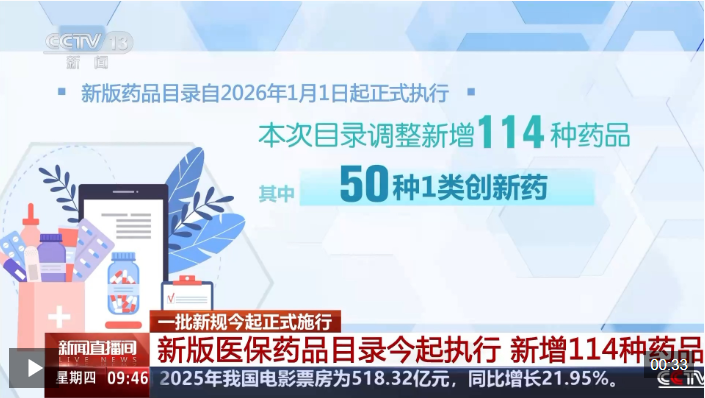
涉及社会民生多个领域 一批新规今起正式施行
Xin Lang Cai Jing· 2026-01-01 03:17
Group 1 - The new version of the National Basic Medical Insurance, Maternity Insurance, and Work Injury Insurance Drug Directory has been implemented, adding 114 new drugs to the reimbursement list, including 50 first-class innovative drugs, while removing 29 drugs that are either not clinically available or can be replaced by better alternatives [2] - The total number of drugs in the directory has increased to 3,253, with 1,857 Western medicines and 1,396 traditional Chinese medicines, significantly enhancing coverage for key areas such as cancer, chronic diseases, mental illnesses, rare diseases, and pediatric medications [2] Group 2 - Starting today, all medical institutions are required to fully collect and upload drug traceability codes, which serve as "electronic IDs" for drugs, ensuring traceability throughout the production, circulation, usage, and insurance settlement processes [3] - The National Medical Insurance Information Platform has collected 110.369 billion traceability codes, aiding in the resolution of multiple national counterfeit drug cases and addressing 39,100 illegal institutions, with 188 cases referred to judicial authorities [3][5] Group 3 - A new policy requires kindergartens to implement a directory management system for fees, establishing two separate lists for service fees and kindergarten-specific charges, with strict public disclosure requirements [6] Group 4 - The People's Bank of China will automatically adjust credit information based on repayment conditions, with specific criteria set for overdue debts occurring between January 1, 2020, and December 31, 2025, allowing for the removal of certain overdue information from personal credit reports if conditions are met [8] - The new VAT law and its implementation regulations have come into effect, with 14 out of 18 existing tax types now having legal frameworks, covering a significant portion of tax revenue [8]