南下资金

Search documents
南下资金净买入港股10亿港元
Jin Rong Jie· 2026-01-21 01:58
Group 1 - The core point of the article is that southbound funds have net purchased Hong Kong stocks amounting to 1 billion Hong Kong dollars [1]
港股通数据统计周报-20260114
Zhe Shang Guo Ji Jin Rong Kong Gu· 2026-01-14 02:28
Group 1: Top Net Buy/Sell Companies - The top net buy company is 盈富基金 (2800.HK) with a net buy amount of 6.465 billion CNY, representing a holding change of 244,904,500 shares[8] - The second highest net buy is 小米集团-W (1810.HK) with a net buy amount of 3.704 billion CNY, with a holding change of 97,941,310 shares[8] - The top net sell company is 中国移动 (0941.HK) with a net sell amount of -3.517 billion CNY, reflecting a holding change of -43,443,065 shares[9] Group 2: Industry Distribution of Net Buy/Sell - The financial sector shows a significant net buy, while the telecommunications sector has a notable net sell, indicating a shift in investor sentiment[11] - Information technology companies like 小米集团-W and 腾讯控股 are actively traded, with mixed net buy/sell results, suggesting volatility in this sector[11] - The healthcare sector, represented by companies like 石药集团, has seen a net buy, indicating potential growth interest from investors[11] Group 3: Active Stocks - 阿里巴巴-W (9988.HK) is the most active stock in the Shanghai-Hong Kong Stock Connect with a total trading volume of 6.569 billion CNY and a net sell of -2.114 billion CNY[18] - The second most active stock is 金风科技 (2208.HK) with a trading volume of 3.307 billion CNY and a net sell of -0.130 billion CNY[18] - The trading activity of 中芯国际 (0981.HK) shows a total volume of 2.174 billion CNY with a net sell of -0.174 billion CNY, indicating investor caution[18]
港股通数据统计周报 2025.12.29-2026.01.04-20260107
Zhe Shang Guo Ji Jin Rong Kong Gu· 2026-01-07 06:12
Group 1: Top Net Buy/Sell Companies - The top net buy company is Agricultural Bank of China (1288.HK) with a net buy amount of 10.51 billion CNY, acquiring 181,815,021 shares[8] - The top net sell company is China Mobile (0941.HK) with a net sell amount of -46.61 billion CNY, selling 57,046,826 shares[9] - Other notable net buys include Industrial and Commercial Bank of China (1398.HK) with 6.50 billion CNY and China Petroleum & Chemical Corporation (0386.HK) with 3.49 billion CNY[8] Group 2: Industry Distribution of Net Buy/Sell - The financial sector shows significant net buying, while the telecommunications sector has the highest net selling, particularly driven by China Mobile and China Unicom[14] - The net buy/sell distribution indicates a strong preference for financial stocks, with utilities and consumer staples also seeing positive net inflows[14] - The energy sector has a moderate net buy, reflecting ongoing interest in energy stocks despite broader market trends[14] Group 3: Active Stocks - Alibaba (9988.HK) and Tencent (0700.HK) are the most active stocks, with total trading volumes of 41.57 billion CNY and 34.90 billion CNY respectively, both showing significant net selling[20] - Semiconductor Manufacturing International Corporation (0981.HK) has a notable trading volume of 34.20 billion CNY, with a net sell of -7.65 billion CNY[20] - Other active stocks include Xiaomi (1810.HK) and China Mobile, both experiencing substantial trading activity but with negative net buying figures[20]
资金动向丨南下资金2025年净买入额再创新纪录,最受欢迎个股名单揭晓
Ge Long Hui· 2025-12-31 11:13
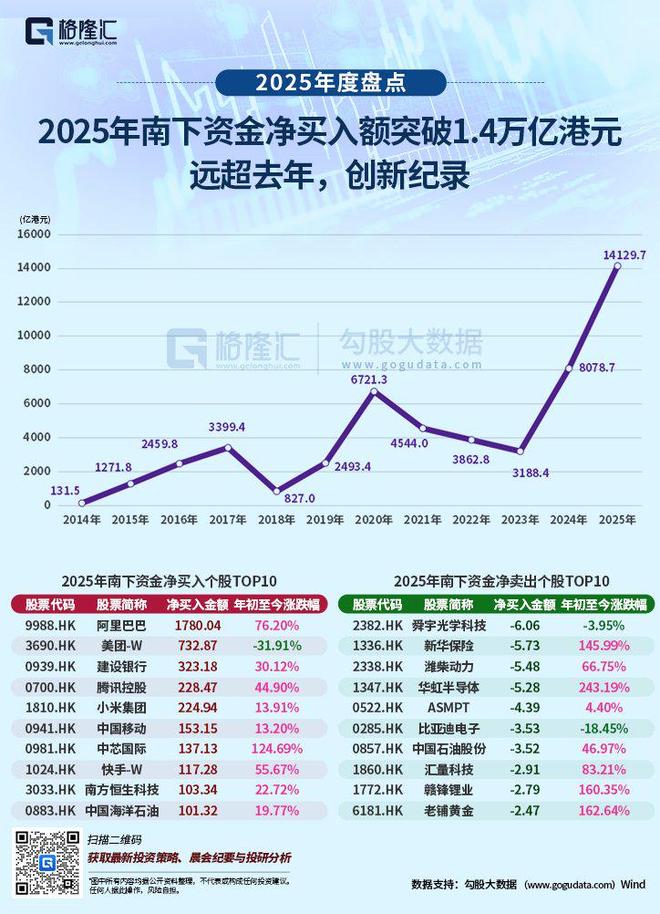
Group 1 - The core point of the article highlights that southbound capital has significantly increased its investment in Hong Kong stocks, with a record net purchase amount of 14,129 million HKD in 2025, surpassing previous years [1][3] - Since the launch of the Stock Connect mechanism in 2014, the cumulative net purchase of Hong Kong stocks by southbound capital has reached 51,107 million HKD [1] - In 2025, there were over 60 trading days where the net purchase exceeded 10,000 million HKD, including 11 days where it surpassed 20,000 million HKD, with the highest single-day net purchase recorded at 35,876 million HKD on August 5 [1] Group 2 - The top ten stocks with the highest net purchases by southbound capital in 2025 include Alibaba, Meituan-W, China Construction Bank, Tencent Holdings, Xiaomi Group, China Mobile, SMIC, Kuaishou-W, Southern Hang Seng Technology, and China National Offshore Oil [1][5] - Conversely, the top ten stocks with the highest net sales include Sunny Optical Technology, New China Life Insurance, Weichai Power, Hua Hong Semiconductor, ASMPT, BYD Electronics, China Petroleum, Huizhou Technology, Ganfeng Lithium, and Laopu Gold [1][5] Group 3 - The net purchase amounts and year-to-date price changes for the top ten net bought stocks show significant gains, with Alibaba seeing a net purchase of 1,780.04 million HKD and a price increase of 76.20% [6] - Other notable stocks include Meituan-W with a net purchase of 732.87 million HKD but a price drop of 31.91%, and Tencent Holdings with a net purchase of 228.47 million HKD and a price increase of 44.90% [6] - In contrast, the top net sold stocks show varying performance, with Sunny Optical Technology experiencing a slight net sale of 6.06 million HKD and a price decrease of 3.95% [6]

港股通数据统计周报-20251230
Zhe Shang Guo Ji Jin Rong Kong Gu· 2025-12-30 05:27
Group 1: Top Net Buy/Sell Companies - Tencent Holdings (0700.HK) had a net buy amount of 12.01 billion CNY with a holding change of 1,992,172 shares[8] - Xiaomi Group (1810.HK) saw a net buy of 10.01 billion CNY with a holding change of 25,516,147 shares[8] - China Mobile (0941.HK) was the top net sell company with a net sell amount of -23.20 billion CNY and a holding change of -28,015,413 shares[9] Group 2: Industry Distribution of Net Buy/Sell - The technology sector had significant net buying activity, contributing positively to the overall market[11] - The financial sector also saw notable net buying, indicating investor confidence in financial institutions[11] - The energy sector experienced net selling, reflecting a potential shift in investor sentiment towards energy stocks[11] Group 3: Active Stocks - Alibaba (9988.HK) was among the most active stocks with a total trading volume of 42.74 billion CNY and a net sell of -10.81 billion CNY[20] - Semiconductor Manufacturing International Corporation (0981.HK) had a total trading volume of 34.72 billion CNY with a net buy of 2.59 billion CNY[20] - China Mobile (0941.HK) recorded a total trading volume of 22.04 billion CNY with a net sell of -14.82 billion CNY[19]
南下资金年内净买入超1.4万亿港元
Shen Zhen Shang Bao· 2025-12-29 07:16
Group 1 - The core viewpoint of the articles highlights a significant increase in southbound capital inflow into Hong Kong stocks, with a net purchase amount exceeding 1.4 trillion HKD in 2023, surpassing the total net purchase for the previous year [1][3] - Southbound capital has recorded over 60 trading days this year with net purchases exceeding 10 billion HKD, including 11 days with net purchases over 20 billion HKD, with the highest single-day net purchase reaching 35.88 billion HKD on August 5 [1] - The top ten stocks with net purchases by southbound capital include Alibaba, Meituan-W, and China Construction Bank, with net purchase amounts ranging from 179.51 billion HKD to 10.17 billion HKD [1] Group 2 - The top ten stocks with net sales by southbound capital include Hua Hong Semiconductor and BYD Electronics, with net sales amounts between 9.67 million HKD and 2.47 million HKD, with the top three exceeding 500 million HKD [2] - As of December 28, 2023, there are 423 stocks where southbound capital holds over 10%, with 150 stocks over 30%, and 41 stocks over 50%, including China Telecom with a holding ratio of 71.99% [2] - In 2023, 231 stocks saw an increase in southbound capital holdings by over 5%, with 107 stocks over 10%, and 28 stocks over 20%, with the top three increases being 55.92%, 45.32%, and 45.15% respectively [2] Group 3 - The top five industries with net purchases from southbound capital include banking, retail, and pharmaceuticals, with net purchase amounts of 208.80 billion HKD, 177.81 billion HKD, and 138.82 billion HKD respectively [3] - From 2020 to 2024, the net purchase amounts by southbound capital have shown a significant increase, with 2024 expected to see a doubling of net purchases compared to previous years [3] - In 2025, southbound capital is projected to accelerate net purchases, surpassing the total for 2024 within just seven months, with a total net purchase exceeding 1.4 trillion HKD [3]
港股通数据统计周报 2025.12.15-2025.12.21-20251223
Zhe Shang Guo Ji Jin Rong Kong Gu· 2025-12-23 09:39
Group 1: Top Net Buy/Sell Companies - The top net buy company is Xiaomi Group-W (1810.HK) with a net buy amount of 6.196 billion CNY, representing a holding change of 152,825,727 shares[8] - Meituan-W (3690.HK) ranks second with a net buy amount of 5.164 billion CNY and a holding change of 50,284,391 shares[8] - Alibaba-W (9988.HK) is the top net sell company with a net sell amount of -3.418 billion CNY, reflecting a holding change of -23,521,579 shares[9] Group 2: Industry Distribution of Net Buy/Sell - The net buy distribution shows significant inflows in the Consumer Discretionary sector, with a total of 5.164 billion CNY[13] - The Information Technology sector also saw substantial net buying, totaling 6.196 billion CNY[13] - The Energy sector experienced the highest net sell amount, totaling -1.664 billion CNY[13] Group 3: Active Stocks - Alibaba-W (9988.HK) had a total trading volume of 25.32 billion CNY with a net buy of 0.87 billion CNY on December 18, 2025[19] - Tencent Holdings (0700.HK) recorded a trading volume of 23.41 billion CNY with a net buy of 6.30 billion CNY on December 16, 2025[21] - Xiaomi Group-W (1810.HK) had a trading volume of 19.99 billion CNY with a net buy of 1.75 billion CNY on December 16, 2025[21]
港股通数据统计周报-20251216
Zhe Shang Guo Ji Jin Rong Kong Gu· 2025-12-16 05:55
Group 1: Top Net Buy/Sell Companies - The top net buy company is Xiaomi Group-W (1810.HK) with a net buy amount of 56.44 billion CNY, representing a holding change of 131,375,016 shares[9] - The second highest net buy is China Merchants Bank (3968.HK) with a net buy amount of 22.49 billion CNY, with a holding change of 43,890,998 shares[9] - The top net sell company is Tencent Holdings (0700.HK) with a net sell amount of -33.37 billion CNY, reflecting a holding change of -5,417,066 shares[10] Group 2: Industry Distribution of Net Buy/Sell - The net buy/sell distribution shows that the consumer discretionary sector had significant activity, with a net buy of 10.57 billion CNY for Li Auto (9863.HK) and 9.62 billion CNY for BYD Company (1211.HK)[9][10] - The financial sector also saw notable net buys, particularly with China Merchants Bank (3968.HK) and Agricultural Bank of China (1288.HK) totaling 29.71 billion CNY combined[9] - The energy sector experienced net sells, with China Petroleum (0857.HK) and China Shenhua (1088.HK) totaling -12.51 billion CNY in net sells[10] Group 3: Active Stocks - Alibaba-W (9988.HK) was the most active stock with a total trading volume of 35.98 billion CNY and a net sell of -6.26 billion CNY on December 12, 2025[19] - Xiaomi Group-W (1810.HK) had a trading volume of 20.57 billion CNY with a net sell of -5.97 billion CNY on the same date[19] - The trading activity indicates a trend where major tech stocks like Tencent and Alibaba are facing net sells, while companies in the consumer discretionary sector are attracting net buys[19]
图解丨南下资金大幅净买入美团、小米
Ge Long Hui A P P· 2025-12-11 10:48
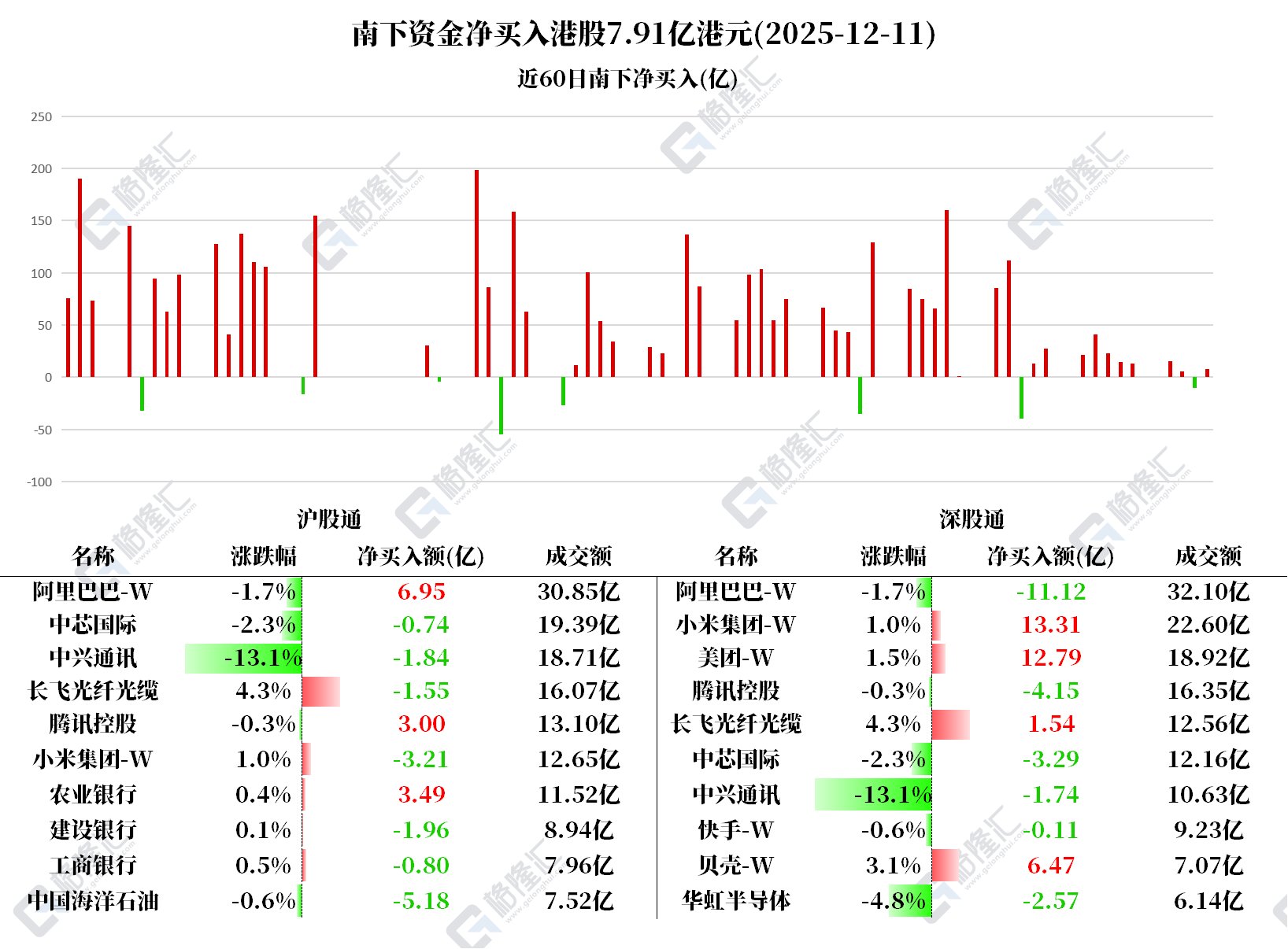
Group 1 - Southbound funds net bought Hong Kong stocks worth 791 million HKD today [1] - The top net purchases included Meituan-W at 1.279 billion HKD, Xiaomi Group-W at 1.009 billion HKD, and Agricultural Bank at 348 million HKD [1] - The top net sales included CNOOC at 517 million HKD, Alibaba-W at 417 million HKD, and SMIC at 403 million HKD [1] Group 2 - Southbound funds have net bought Xiaomi for 10 consecutive days, totaling 8.40743 billion HKD [1] - Agricultural Bank has seen net purchases for 4 consecutive days, amounting to 1.34172 billion HKD [1] - SMIC has experienced net sales for 3 consecutive days, totaling 972.63 million HKD [1]