
外汇储备结构优化

Search documents
中国连续12个月增持黄金
Sou Hu Cai Jing· 2025-11-10 12:03
Core Insights - The strategic function of China's foreign exchange reserves is shifting from traditional liquidity support to asset structure optimization and currency credit support amid global economic adjustments and geopolitical risks [2][5][8] Foreign Exchange Reserves - As of the end of October, China's foreign exchange reserves stood at $33,433 billion, remaining above $3.3 trillion for three consecutive months, marking the highest level since November 2015 [2] - The People's Bank of China (PBOC) has increased its gold reserves to 7.409 million ounces, marking the twelfth consecutive month of gold accumulation since November 2024 [2][4] Gold Reserves - The recent increase in gold reserves was approximately 3,000 ounces (about 1 ton), which is significantly lower than previous monthly purchases of 10 tons or more, attributed to high gold prices [3][4] - Currently, gold reserves account for only 8.0% of China's official international reserves, which is below the global average of 15% [4] U.S. Treasury Bonds - The PBOC is adopting a strategy of "continuously increasing gold reserves while moderately reducing U.S. Treasury holdings" to optimize reserve structure and enhance the credit foundation of the Renminbi [4][5] - The recent stability in foreign exchange reserves is attributed to a rise in the U.S. dollar index and a significant increase in global financial asset prices, which offset potential declines in reserves [4][7] Global Trends - Since 2022, global central bank gold purchases have surged, with net purchases reaching 1,089 tons in 2024, the highest on record, indicating a reassessment of the traditional dollar-dominated reserve system [6][8] - The ongoing geopolitical conflicts and the trend of financial sanctions have led to a systemic risk in over-concentration on a single sovereign bond, prompting a shift towards increasing gold allocations [5][6] Future Outlook - The PBOC's strategy of gradually increasing gold reserves while managing U.S. Treasury holdings is seen as a long-term approach to enhance financial security and support the internationalization of the Renminbi [7][8] - The expansion of the Renminbi's cross-border usage and the improvement of domestic currency settlement mechanisms will necessitate a more urgent and practical optimization of foreign reserve structures [8]


我国央行连续12个月增持黄金 专家:未来仍可能增持
Zhong Guo Jing Ying Bao· 2025-11-07 13:20
Core Viewpoint - China's central bank continues to increase its gold reserves, reaching 74.09 million ounces (approximately 2,304.457 tons) by the end of October, marking the twelfth consecutive month of accumulation, although the increase has been at a low level for the past eight months [1][2] Group 1: Central Bank Actions - As of the end of October, China's foreign exchange reserves stood at $3.343 trillion, slightly up from $3.339 trillion at the end of September [1] - The increase in gold reserves is seen as a strategic move to optimize the structure of foreign exchange reserves and reduce the risk associated with a high proportion of dollar assets [2] Group 2: Market Analysis - Global demand for gold among central banks is rising, with gold surpassing the euro to become the second-largest reserve asset globally [2] - The geopolitical risks and inflationary pressures are driving significant investment demand for gold, suggesting potential for appreciation [2] Group 3: Price Forecasts - After reaching a high of $4,300 per ounce, international gold prices have retreated to around $4,000 per ounce, with potential support levels identified between $3,945 and $4,060 [3] - Future price targets for gold are set at $4,300 per ounce in the next three months and $4,500 per ounce over the next twelve months, driven by geopolitical uncertainties and concerns over U.S. fiscal policy [3]
中国需持续增持黄金储备 适度减持美债
Jing Ji Guan Cha Wang· 2025-11-07 11:00
Core Viewpoint - The strategic function of China's foreign exchange reserves is shifting from traditional liquidity support to asset structure optimization and currency credit support in the context of a changing global economic landscape and ongoing geopolitical risks [1][3]. Group 1: Foreign Exchange Reserves - As of the end of October, China's foreign exchange reserves stood at $33,433 billion, remaining above $3.3 trillion for three consecutive months, marking the highest level since November 2015 [1]. - The People's Bank of China (PBOC) has increased its gold reserves to 7.409 million ounces, marking the twelfth consecutive month of gold accumulation since November 2024 [1][3]. - The increase in foreign reserves is attributed to a slight rise in the dollar index and a corresponding increase in global financial asset prices, which offset potential declines in reserves due to non-dollar asset depreciation [2]. Group 2: Gold Reserves and Strategy - China's gold reserves account for only 8.0% of its official international reserves, significantly lower than the global average of 15%, prompting a strategy of increasing gold reserves while reducing U.S. Treasury holdings [2][3]. - The PBOC's recent gold purchases, amounting to 3,000 ounces (approximately 1 ton), reflect a cautious approach due to high gold prices, contrasting with previous months' larger purchases [1][3]. - The ongoing global trend of central banks increasing gold reserves, with a net purchase of 1,089 tons in 2024, indicates a reevaluation of the traditional dollar-dominated reserve system [4]. Group 3: Economic Context and Future Outlook - The U.S. federal debt has surpassed $38 trillion, and the frequent political interference in monetary policy is diminishing the "risk-free" status of dollar assets, necessitating a shift in reserve asset allocation [3][4]. - The strategic increase in gold reserves is seen as essential for enhancing national financial security and supporting the internationalization of the renminbi [3][5]. - The future strategy will likely involve a gradual increase in gold holdings while reducing the concentration of U.S. Treasury securities, ensuring liquidity and yield without significantly raising costs [4][5].
我国再抛美债825亿,降至14年来新低,美债有暴雷的风险吗?
Sou Hu Cai Jing· 2025-11-03 17:37
Core Viewpoint - China continues to reduce its holdings of U.S. Treasury bonds, with the latest data showing a decrease of $11.3 billion in June, bringing the total to $835.4 billion, the lowest level in nearly 14 years [1][12]. Group 1: Reasons for Reducing U.S. Treasury Holdings - The primary concern driving China's reduction of U.S. Treasury bonds is the fear of default risk associated with U.S. debt, which has reached $32.659 trillion, exceeding the U.S. GDP of $25.45 trillion in 2022 [5][12]. - The reduction is also aimed at optimizing China's foreign exchange reserves, which have historically been heavily weighted towards U.S. dollar assets, constituting about 70% of reserves [8][12]. - By selling off U.S. Treasuries and increasing holdings in gold and other currencies, China seeks to diversify its risk and mitigate potential losses from a significant depreciation of the dollar [8][12]. Group 2: Comparison with Other Countries - In contrast to China, Japan's approach to U.S. Treasury holdings has been inconsistent, with fluctuations in buying and selling influenced by political considerations and currency stabilization efforts [9]. - Japan's recent actions include increasing holdings by $39.3 billion in April, reducing by $30.4 billion in May, and then increasing again by $8.8 billion in June, reflecting a more reactive strategy compared to China's systematic reduction [9]. Group 3: Implications of Collective Selling - The likelihood of a "blow-up" in the U.S. Treasury market due to collective selling by countries like China is considered low in the short term, as the total U.S. debt is significantly larger than China's holdings [11][12]. - Even if China were to sell all its U.S. Treasury bonds, the Federal Reserve and other financial institutions would likely absorb the impact, preventing systemic risk [11]. - The U.S. economy, with a GDP of $25.45 trillion, retains the capacity to manage its debt through exports and technological advancements, further reducing the risk of a debt crisis [11][12].

美国37万亿债务压顶,中国悄然出手!连续增持黄金!有何深意?
Sou Hu Cai Jing· 2025-10-07 13:38
Core Insights - The article discusses the ongoing trend of the People's Bank of China (PBOC) purchasing gold despite rising international gold prices, indicating a strategic move to bolster China's gold reserves and diversify its foreign exchange holdings [1][3]. Group 1: Central Bank's Gold Purchases - As of September, China's foreign exchange reserves reached $33,387 billion, with a 0.5% increase from August, and the PBOC purchased 40,000 ounces of gold, marking 11 consecutive months of gold accumulation [3][5]. - The current gold holdings represent only about 7% of China's foreign exchange reserves, significantly lower than the global average of 15% and some European countries' holdings, which can be as high as 50% [5]. Group 2: Reasons for Gold Accumulation - The primary reason for the PBOC's gold purchases is China's relative lack of gold reserves compared to its economic size, which necessitates increasing gold holdings to stabilize its foreign exchange reserves [3][5]. - The complex international landscape, including trade tensions and sanctions, has led to a declining trust in the US dollar, prompting a shift towards gold as a more stable asset [6][7]. - Gold serves as a hedge against potential currency risks and can act as a "last resort" payment method during economic downturns, making it a crucial asset for national financial security [9]. Group 3: Implications for Renminbi Internationalization - The article posits that for the Renminbi to gain international acceptance, it needs to be backed by gold, similar to the Bretton Woods system where the dollar was convertible to gold [12]. - The PBOC's strategy to increase gold reserves is seen as essential for enhancing the Renminbi's global influence and supporting its internationalization efforts [10][12]. Group 4: Concerns Over US Economic Stability - The article highlights concerns regarding the US government's financial instability, including a significant debt burden and recent government shutdowns, which have heightened global risk aversion [13][15]. - The PBOC's gold purchases are viewed as a proactive measure to secure China's economic stability in light of potential declines in US dollar dominance [15].
中国再抛257亿美债,美国“大动脉”被切,逼出2个接盘国
Sou Hu Cai Jing· 2025-09-28 06:20
Group 1 - The current U.S. national debt has reached $37.2 trillion, exceeding the entire annual GDP of the U.S. by 20%, with a deficit rate surpassing 15% [3] - China has reduced its holdings of U.S. Treasury bonds by $25.7 billion, bringing its total to $730.7 billion, the lowest level since 2008 [3][5] - Japan and the UK have increased their holdings of U.S. Treasury bonds, with Japan's holdings rising to $1.15 trillion and the UK's to $899.3 billion, marking a historical high [5][13] Group 2 - China has been selling U.S. Treasury bonds to purchase gold, with the People's Bank of China increasing its gold reserves to 7.402 million ounces, marking the tenth consecutive month of increases [7] - The proportion of gold in China's foreign exchange reserves is only 7.6%, significantly lower than the world average of 15% and much lower than developed countries like the U.S. and Germany [9] - There is a global trend among central banks to increase gold reserves, with a reported increase of 166 tons in Q2 of this year, indicating a shift in foreign exchange strategies to mitigate risks associated with the U.S. dollar [11]

中国继续减持美债、增持黄金!为啥越来越多国家“不买账”了?
Sou Hu Cai Jing· 2025-09-22 12:45
Core Insights - China has significantly reduced its holdings of US Treasury bonds, with a notable decrease of $25.7 billion in July 2025, bringing its total holdings down to $730.7 billion, the lowest level since 2009 [1] - This reduction has positioned China as the third-largest foreign holder of US debt, following Japan and the UK, which have increased their holdings during the same period [1] - The trend of reducing US debt holdings began in 2022, with China offloading $173.2 billion in 2022, $50.8 billion in 2023, and $57.3 billion in 2024, indicating a growing trend of divestment [1] Group 1 - The reduction in US Treasury holdings reflects a broader shift in confidence among countries regarding US debt, with China simultaneously increasing its gold reserves as a strategy to optimize its foreign exchange reserves and reduce reliance on dollar assets [3][5] - China's central bank has been purchasing gold for ten consecutive months, indicating a strategic pivot towards gold as a more reliable reserve asset amid high gold prices [3][5] - The global central bank landscape is also changing, with the total value of gold and digital currencies surpassing the US M2 money supply for the first time in November 2024, marking a significant shift in asset allocation [3] Group 2 - In 2025, the total value of gold held by global central banks has surpassed that of US Treasury bonds for the first time since 1996, with gold now accounting for 20% of central bank reserves, second only to the dollar [5] - China's strategy of reducing US debt and increasing gold holdings aims to lower risk exposure and enhance asset security, while also facilitating the internationalization of the renminbi [5][7] - The increasing US national debt, projected to exceed $37 trillion by 2025, along with a declining credit rating and rising interest payment obligations, has contributed to diminishing confidence in US Treasury bonds [7] Group 3 - Geopolitical factors, including ongoing US-China trade tensions and financial sanctions against Russia, have prompted China to reassess the safety of holding significant assets abroad [7] - The need for a more secure and stable foreign exchange reserve structure is critical for China to promote the internationalization of the renminbi, with gold serving as a strong hedge against dollar risks [7][9] - Since reaching a peak of $1.3 trillion in US Treasury holdings in 2013, China has reduced its holdings by over 40%, while simultaneously increasing its gold reserves, indicating a strategic "reduce and increase" approach to enhance financial security and the international standing of the renminbi [7]
大抛售重启,美债只剩7307亿,机会难得,中国抛售突然加速
Sou Hu Cai Jing· 2025-09-21 20:43
Core Insights - China has significantly reduced its holdings of US Treasury bonds, selling $25.7 billion in July 2025 alone, bringing its total holdings down to $730.7 billion, the lowest since 2009, and a 41% decrease from the peak of $1.3 trillion in 2013 [1][15][17] - This reduction in US debt holdings coincides with increased purchases of US Treasuries by the UK and Japan, indicating a shift in global financial dynamics [1][2] Group 1: China's Debt Reduction Strategy - China's reduction of US Treasury bonds has been ongoing since April 2022, with total reductions of $173.2 billion in 2022, $50.8 billion in 2023, and $57.3 billion in 2024 [2][4] - As a result of this strategy, China has fallen to the third-largest holder of US debt, surpassed by the UK and Japan [2] Group 2: Strategic Considerations Behind the Reduction - The US government's debt has ballooned to $37 trillion, raising concerns about fiscal sustainability and the credibility of the dollar as a global reserve currency [4][6] - The actual yield on 10-year US Treasuries is around 4%, while Chinese government bonds yield only 1.85%, making US debt less attractive [6] - Trade tensions with the US have also motivated China to reduce its holdings as a form of financial countermeasure [6] Group 3: Shift to Gold and Diversification - Concurrently, China has been increasing its gold reserves, which reached 74.02 million ounces by August 2025, as part of a strategy to diversify its foreign exchange reserves [8][10] - The current gold reserves represent only 7.3% of China's international reserves, indicating room for growth towards a target of 10% [8] Group 4: Global Financial Implications - China's actions may lead to a decline in US Treasury prices and a rise in yields, potentially increasing borrowing costs for the US government and corporations [10][14] - The reduction in US debt holdings is contributing to a broader trend of "de-dollarization," with the share of dollar assets globally dropping to 58.7% in 2024 [10][14] Group 5: Strategic Transition in Reserve Management - China's strategy is shifting from passive holding to active optimization of its foreign exchange reserves, with a focus on enhancing the international role of the renminbi [14][15] - The establishment of a digital renminbi and gold settlement system is part of this strategy, aimed at reducing reliance on the US dollar [14][15] Group 6: Future Outlook - The trend of reducing US Treasury holdings is expected to continue as part of China's long-term strategy to optimize its foreign exchange reserves [17] - This capital movement is reshaping the global financial landscape, as China seeks to establish a new financial order centered around gold [17]

中国大规模减持美债,一个月抛了超1800亿元!央行已连续10个月买入黄金
Mei Ri Jing Ji Xin Wen· 2025-09-20 14:46
Group 1 - The core point of the news is that China has significantly reduced its holdings of U.S. Treasury bonds, with a notable decrease of $25.7 billion in July 2025, bringing its total holdings to $730.7 billion, the lowest level since 2009 [1][2] - This reduction marks the fourth time China has decreased its U.S. Treasury holdings in 2025, continuing a trend that began in April 2022 when holdings fell below $1 trillion [2] - The overall trend shows that China has reduced its U.S. Treasury holdings by $173.2 billion in 2022, $50.8 billion in 2023, and $57.3 billion in 2024, indicating a consistent pattern of divestment [2] Group 2 - In contrast to China's actions, Japan and the UK have increased their holdings of U.S. Treasury bonds, highlighting China's unique position in the current market [3] - Analysts attribute China's reduction in U.S. Treasury holdings to concerns over U.S. fiscal policies, including tariffs and the rising national debt, which has reached $37 trillion [3][4] - The Federal Reserve's monetary policy and the potential for a weakened dollar are also cited as factors influencing China's decision to reduce its U.S. Treasury exposure [4] Group 3 - Concurrently, the People's Bank of China has been increasing its gold reserves for ten consecutive months, with a total of 74.02 million ounces as of the end of August 2025, reflecting a strategic shift towards gold as a non-sovereign credit reserve asset [7] - The increase in gold reserves is seen as a way to hedge against the risks associated with a single currency, particularly the dollar, and to enhance the credibility of the Chinese yuan in international markets [7][8] - China's gold reserves currently account for 7.3% of its official international reserve assets, which is significantly lower than the global average of around 15%, indicating room for further increases [7][8]
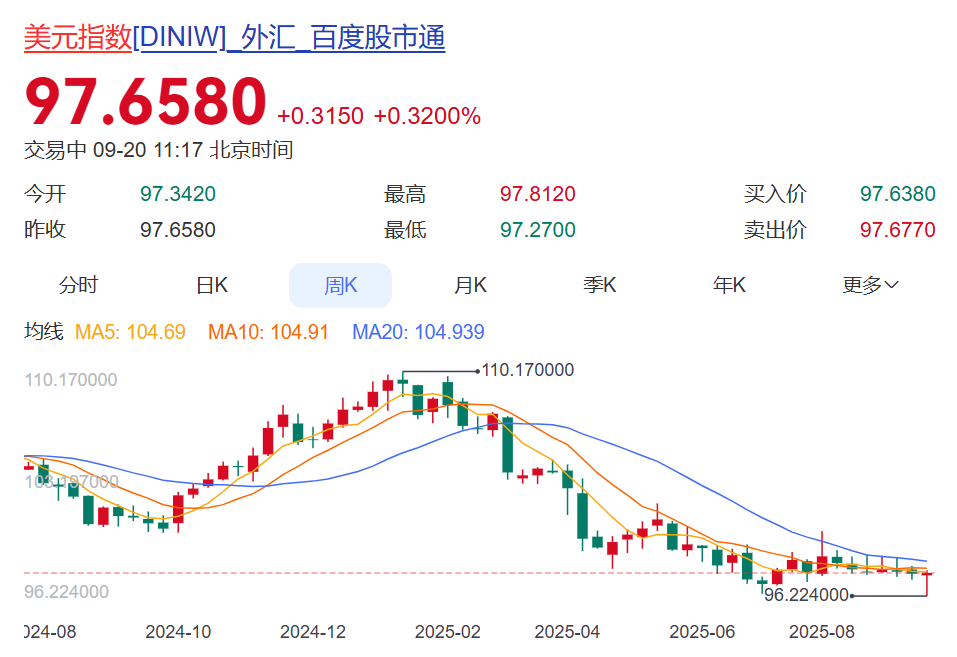
外储再超3.3万亿美元 央行连续10个月增持黄金
Zheng Quan Shi Bao· 2025-09-07 18:20
Core Viewpoint - As of the end of August, China's foreign exchange reserves reached $33,222 billion, marking an increase of $299 billion from the end of July, with a growth rate of 0.91% [1] Group 1: Foreign Exchange Reserves - China's foreign exchange reserves have remained above $3.2 trillion for 21 consecutive months, indicating stable economic performance and resilience [2] - The increase in reserves is attributed to factors such as changes in major economies' monetary policies and macroeconomic data, leading to a decline in the US dollar index and an overall rise in global financial asset prices [1][2] Group 2: Economic Indicators - The decline in the US dollar index was influenced by weaker US economic data and heightened expectations for a Federal Reserve rate cut, following disappointing non-farm payroll numbers and stable inflation levels [1] - Despite rising expectations for a rate cut in September, uncertainties remain due to ongoing inflation increases and relatively low unemployment rates in the US [1] Group 3: Gold Reserves - As of the end of August, China's official gold reserves stood at 74.02 million ounces, with an increase of 60,000 ounces from the previous month, marking ten consecutive months of gold accumulation by the central bank [2] - The proportion of gold in China's official international reserves is significantly lower than the global average, suggesting a potential direction for future increases in gold holdings to optimize reserve structure and support the internationalization of the renminbi [2]