客户体验

Search documents
LendingClub(LC) - 2025 Q3 - Earnings Call Transcript
2025-10-22 22:02
Financial Data and Key Metrics Changes - The company reported a 37% growth in originations year-over-year, reaching $2.62 billion, exceeding guidance [4][10] - Revenue increased by 32% to $266 million, driven by higher marketplace volume and improved loan sales prices [10][14] - Diluted earnings per share nearly tripled to $0.37, with return on tangible common equity improving to 13.2% [10][18] - Pre-provision net revenue grew 58% to $104 million, reflecting the scalability of the business model [10][14] Business Line Data and Key Metrics Changes - Marketplace revenue surged by 75%, marking the highest level in three years, with structured certificate sales exceeding $1 billion [7][10] - Non-interest income rose to $108 million, benefiting from higher marketplace sales volumes and improved loan sales prices [13] - Net interest income reached an all-time high of $158 million, supported by a larger portfolio of interest-earning assets [14] Market Data and Key Metrics Changes - Total assets grew to $11.1 billion, up 3% compared to the prior quarter, indicating a strong balance sheet [16] - Total deposits ended the quarter at $9.4 billion, with a notable increase in relationship deposits [14] Company Strategy and Development Direction - The company aims to leverage its competitive advantages and innovative products to drive sustainable, profitable growth [4][10] - Plans to invest in marketing to support growth initiatives and expand the balance sheet while maintaining a disciplined approach to underwriting [15][19] - The introduction of new products like LevelUp Checking is designed to enhance member engagement and drive repeat loan issuance [8][10] Management's Comments on Operating Environment and Future Outlook - Management expressed confidence in strong loan investor demand and improving loan sales pricing, anticipating originations of $2.5 to $2.6 billion in Q4 [18][19] - The company expects to see a normalized effective tax rate of 25.5% and anticipates two interest rate cuts in Q4 [19] - Management remains cautious about potential seasonality effects on originations due to the holiday season [18] Other Important Information - The company has secured a memorandum of understanding with BlackRock for the purchase of up to $1 billion through its marketplace programs [7] - The tangible book value per share now stands at $11.95, reflecting the company's strong capital position [18] Q&A Session Summary Question: Future disposition plans between various channels - Management indicated a steady approach to held-for-investment targeting roughly $500 million, with strong demand for structured certificates and rated products [23][24] Question: Competitive state of the market and underwriting standards - Management confirmed that they have not seen pressure on underwriting standards despite increased origination volumes across the industry [26][27] Question: Dynamics of loan reserves and fair value adjustments - The increase in loan reserves was attributed to a re-estimation of lifetime losses and growth in businesses like purchase finance [36][32] Question: Demand for marketplace loans and investor appetite - Management noted strong demand for their asset class, with a positive outlook for the fourth quarter despite broader market concerns [46][47] Question: Credit performance and delinquency trends - Management reported stable credit performance with no significant changes in delinquency trends, maintaining a restrictive approach to underwriting [52][53] Question: Updates on product roadmap and new products - Management highlighted ongoing product development, including LevelUp Checking and LevelUp Savings, with more to come [101]

客户体验在AI时代下的重塑与跃迁 —— 专访麦肯锡全球董事合伙人余子健
麦肯锡· 2025-09-29 09:53
Core Insights - Generative AI (GenAI) is revolutionizing customer experience, unlocking significant value across industries, with a potential commercial value of up to $1.3 trillion in customer experience improvements [1][2] - GenAI plays three key roles in enhancing customer experience: real-time customer information collection, intelligent restructuring of customer journeys, and scalable personalized experiences [1][2] Challenges and Opportunities - The implementation of GenAI faces three main challenges: insufficient strategic focus on customer experience, difficulties in organizational collaboration, and inadequate measurement systems [2][3] - Companies must leverage big data and AI to closely link customer feedback with actual business metrics for effective measurement [2] Case Studies - A leading global coffee chain transitioned from traditional surveys to real-time customer data collection, optimizing customer touchpoints [2] - An international energy retail company upgraded its voice hotline system with AI, significantly reducing service costs while enhancing customer satisfaction [2] - A travel platform focused on airport scenarios utilized big data and AI to offer customized services based on different traveler profiles, improving customer satisfaction through personalized, cost-effective solutions [2] Strategic Recommendations - Companies should ensure that customer experience transformation is driven by top management, making it a core strategic focus with clear business objectives [3][4] - Utilizing real-time customer data to identify pain points and focusing on high-frequency scenarios can facilitate effective transformation [3] - For resource-constrained mid-sized companies, identifying key areas for customer experience enhancement and leveraging AI tools can maximize value [3] CEO Actionable Insights - CEOs should anticipate potential obstacles in large-scale customer experience transformations and develop strategies to address them, including establishing unified success definitions and evaluation standards [4] - A clear vision and goals for customer experience strategy should be set, breaking down departmental silos to foster collaboration [4] - A scientific measurement system should be constructed to ensure that customer experience optimization is deeply linked to business outcomes [4] Future Trends - AI is fundamentally reshaping customer experience through three disruptive changes: enhanced real-time behavior tracking, more human-like AI assistants improving service satisfaction and reducing costs, and a shift from group profiling to personalized services [4] - Companies must adapt to these changes to effectively engage with customers in the future [4]


Banco Latinoamericano de ercio Exterior(BLX) - 2025 Q4 - Earnings Call Transcript
2025-08-28 02:00
Financial Data and Key Metrics Changes - The Beacon Lighting Group achieved record sales of $329 million, representing a 3.7% increase from the previous year [5][9] - Gross profit margin improved to 69.1%, up from 68.9% last year, reflecting effective product development [6][10] - EBITDA grew by 2.5% to $87.1 million, while net profit after tax was $29.4 million, down slightly by 0.7% [11][12] - Operating expenses increased by 5.3%, accounting for 43.5% of sales, compared to 42.8% last year [11][16] Business Line Data and Key Metrics Changes - Trade sales grew to 40% of total sales, with a 24% increase in trade sales through stores, totaling $125 million [7][29] - Retail sales momentum built throughout the year, culminating in strong fourth-quarter results [12][13] - The company introduced 558 new products, enhancing its core range of 3,005 products [27] Market Data and Key Metrics Changes - Comparative sales increased by 1.5%, with South Australia, Western Australia, and Queensland being the best-performing regions [13][27] - Victorian store sales began to improve in the second half of the financial year after a challenging period [14][81] Company Strategy and Development Direction - The company focuses on four strategic pillars: store expansion, trade partnerships, e-commerce growth, and complementary businesses [22][23] - The vision for 2030 aims to position Beacon Lighting as Australia's leading provider of quality lighting and electrical accessories for both homeowners and trade professionals [24][25] - The company plans to open four new stores annually and relocate two stores to stronger premises [52][56] Management's Comments on Operating Environment and Future Outlook - Management noted positive signs of retail spending due to recent rate cuts, which may enhance future performance [3][40] - The company is optimistic about capturing growth as building activity strengthens, particularly in the trade sector [12][35] - The outlook for FY 2026 is positive, with continued focus on product innovation and customer engagement [36][104] Other Important Information - The company maintained a robust cash balance of over $55 million, allowing for flexibility in future growth [6][19] - A fully franked dividend of $0.38 per share was declared for the second half of FY 2025 [20] Q&A Session Summary Question: Insights on changes from Q3 to Q4 and acceleration drivers - Management indicated that improvements were seen across both trade and retail, with positive performance in Victoria [39][40] Question: Guidance on cost expectations moving forward - Costs are expected to stabilize, with some items being managed tighter, but statutory costs may continue to rise [41][43] Question: Performance of the trade club loyalty program - The trade club has around 60,000 members, with increasing frequency of visits from existing customers [44][46] Question: Challenges in finding new store sites - The company aims for four new stores and two relocations annually, though timing may vary due to construction delays [50][52] Question: Impact of U.S. tariffs on pricing - No significant changes in pricing were noted, with stable buying prices and consistent supplier relationships [56][58] Question: Marketing costs and their impact on sales - Marketing expenses were lower than usual, but the company plans to increase spending while seeking cost savings [59][60] Question: Total trade sales growth in FY 2025 - Trade sales growth was in the high teens, with store sales up 24% [68] Question: Gross profit margin expectations for FY 2026 - Management is comfortable with maintaining strong gross profit margins, with stability in pricing and product mix [71][73] Question: International revenue growth in FY 2025 - International revenue grew by 6.5%, with strong performance in Hong Kong and Europe, but softer results in the U.S. [75][87]

TPG(TPG) - 2025 Q2 - Earnings Call Transcript
2025-08-28 01:32
Financial Data and Key Metrics Changes - The company reported a 2.2% increase in service revenue, primarily driven by mobile, with modest growth in fixed services [10][28] - Statutory EBITDA increased by 1%, reaching $618 million, while pro forma EBITDA was $786 million, reflecting a growth of 0.9% compared to the previous year [32][38] - Net profit after tax (NPAT) was significantly up, reaching $32 million, attributed to improved operating performance and lower financing costs [33] Business Line Data and Key Metrics Changes - The mobile subscriber base grew by 100,000, with strong growth from digital-first brands TPG and Felix, despite a decline in international arrivals [5][12] - Fixed service revenue saw a slight increase of just under 1%, with fixed wireless now representing 14% of total fixed subscribers [20][21] - Average revenue per user (ARPU) for postpaid increased by 14.5% over the last three years, while total ARPU rose by 7.8% [14] Market Data and Key Metrics Changes - The company gained market share in both metropolitan and regional centers, with domestic growth in postpaid services coming at the expense of competitors [5][12] - The NBN market remains competitive, with intense competition impacting subscriber numbers for larger incumbents [21] Company Strategy and Development Direction - The company plans to return $3 billion in cash to shareholders and increase minority ownership through a reinvestment plan [7][48] - A focus on customer well-being and accessibility is part of the company's three-year roadmap to ensure fair access to essential connectivity [24] - The company is committed to maintaining a disciplined approach to operating expenses, targeting flat growth in nominal terms through to 2029 [31] Management's Comments on Operating Environment and Future Outlook - Management expressed optimism about the momentum in the mobile segment, although they expect a more moderate performance in the second half of the year [63] - The government’s revitalized student visa program for 2026 is expected to positively impact the company’s mobile business [16] - Management acknowledged the challenges in the fixed market but emphasized the importance of maintaining profitability and improving service offerings [82] Other Important Information - The company has taken steps to address a recent cyber incident affecting iINET customers, with ongoing support measures in place [7][9] - The company has successfully canceled $1.7 billion in bank loans as part of its capital management plan [44] Q&A Session Summary Question: Mobile subscriber growth expectations for the second half - Management does not provide specific guidance on customer numbers but remains optimistic about continued growth, albeit at a moderated pace [63] Question: ARPU for digital-first brands - Management indicated that ARPU for digital-first brands is likely in the mid-twenties, with consistent growth across different brands [64] Question: Pricing strategies in the mobile industry - Management acknowledged the challenges posed by tier-two operators and the need for pricing adjustments in the market [62][66] Question: Margin differentials between digital brands and traditional prepaid - Management noted that the margin differential is significant, with digital brands benefiting from lower operational costs [73] Question: CapEx for LEOSAT opportunities - Management highlighted that investments in LEOSAT will be smaller compared to terrestrial networks, with potential for future monetization [79] Question: Fixed subscriber trends and market competition - Management expressed confidence in maintaining profitability in the fixed segment despite competitive pressures [82]

WOW(WOW) - 2025 Q4 - Earnings Call Transcript
2025-08-27 01:30
Financial Data and Key Metrics Changes - Group sales for FY25 increased by 3.6% to $69.1 billion, with a normalized sales growth of 2.9% excluding Petstock [21][22] - Group EBIT before significant items was $2.8 billion, a decrease of 12.6% compared to the prior year, primarily due to lower contributions from Australian Food and BIG W [22][24] - Group NPAT attributable to equity holders before significant items was $1.4 billion, down 17.1% reflecting lower EBIT and higher financing costs [23] - Group ROCE was 13.7%, a decline of 194 basis points compared to the prior year [23][29] Business Line Data and Key Metrics Changes - Australian Food sales increased by 3.1% to $51.5 billion, with e-commerce sales growing by 17.4% [21][24] - BIG W sales increased by 1.1%, with a loss of $35 million for the year, reflecting challenges in the competitive market [27][18] - New Zealand sales increased by 3.4%, with EBIT performance improving by 40.6% for the year [26][18] - Complementary businesses like Cartology saw revenue growth of 19.5% [19] Market Data and Key Metrics Changes - E-commerce sales in Australia grew by 17.4%, with 87% of orders fulfilled within 24 hours [10][11] - The average inventory days increased by 1.6 days, reflecting higher investment in inventory to improve availability [29] - The average payable days decreased by 3.3 days, largely due to payment timing differences [29] Company Strategy and Development Direction - The company aims to be the first choice for customers for the freshest Australian food, improve returns in New Zealand Food and BIG W, and grow complementary businesses [38][41] - A focus on delivering consistently good customer experiences and establishing price trust is emphasized [43][44] - The company plans to invest in lowering prices and improving retail execution to enhance customer perception and loyalty [47][54] Management's Comments on Operating Environment and Future Outlook - Management acknowledged challenges in the operating environment, including cost of living pressures and competitive retail dynamics [3][5] - There are expectations for improved financial performance in FY26, driven by strategic priorities and a more stable operating environment [52][54] - The company is committed to restoring customer trust through compelling value and retail execution excellence [54] Other Important Information - The company completed its five-year sustainability plan, delivering an estimated $2.6 billion in net societal benefits [20] - Significant item losses before tax of $569 million were reported, primarily related to impairments and restructuring costs [28] Q&A Session Summary Question: Online profitability improvement - Management highlighted the potential for optimizing picking and packing processes and the importance of e-commerce customers who tend to spend more [58][60] Question: Investment confidence in turning around business - Management emphasized a long-term strategy focused on delivering sustainable returns and improving customer value perception [63][66] Question: Clarification on sustaining CapEx - Management clarified that capital expenditures are strictly capitalized based on future cash flows, with a focus on long-term investments in supply chain and technology [70][79]

云仓如何提升直播电商的客户体验
Sou Hu Cai Jing· 2025-08-25 15:26
Group 1 - The core viewpoint emphasizes that customer experience is a critical factor for success in the increasingly competitive live e-commerce sector, with cloud warehouses optimizing logistics to enhance shopping experiences and create competitive advantages for merchants [1] - Rapid delivery is highlighted as a key aspect of improving customer experience, with a fresh food e-commerce company achieving delivery within one hour by utilizing a cloud warehouse network and an intelligent forecasting system [1] - Accurate fulfillment is another significant advantage, as a digital brand reduced its error rate from 1.2% to 0.05% after implementing a cloud warehouse system, leading to fewer customer complaints and returns [1] - Flexible return and exchange processes are crucial, with a clothing brand reducing average return processing time from 5 days to 24 hours through a dedicated return handling line in the cloud warehouse system [1] - Personalized services are a distinctive feature of cloud warehouses, offering customized packaging and services based on consumer shopping habits, enhancing emotional experiences for customers [1] Group 2 - Temperature control is vital for specific products, as a high-end cosmetics brand uses a smart temperature control system in cloud warehouses to maintain a constant temperature throughout the logistics process, increasing brand trust through transparency [2] - The intelligent customer service system in cloud warehouses enhances service experiences by providing real-time responses to consumer inquiries, significantly improving customer satisfaction [2] - Future developments include deeper integration with live streaming platforms to achieve seamless order-to-delivery processes, with cloud warehouses redefining service standards in live e-commerce [2]

个人取款超5万元仍需登记?多家银行问询用途,监管拟取消硬性规定
Sou Hu Cai Jing· 2025-08-12 04:45
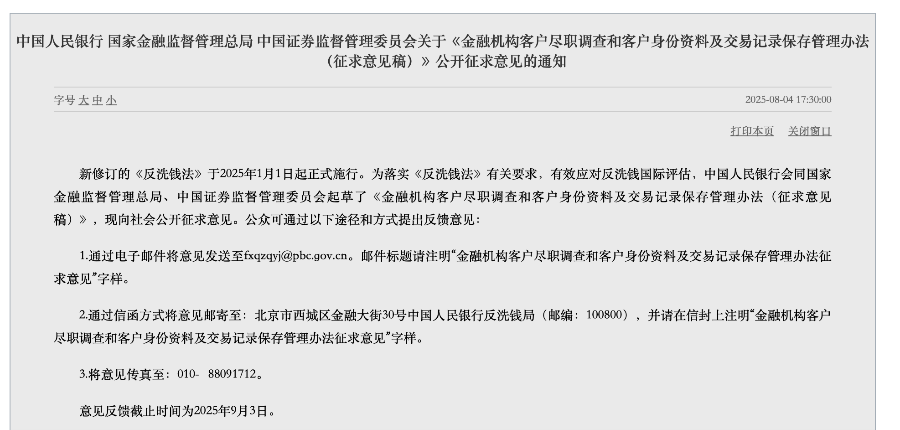
Core Viewpoint - The People's Bank of China, along with the National Financial Regulatory Administration and the China Securities Regulatory Commission, has released a draft regulation on customer due diligence and transaction record management, seeking public feedback until September 3 [1] Group 1: Regulatory Changes - The most notable change in the new regulation is the removal of the mandatory requirement for individuals to "understand and register the source or purpose of funds" for cash transactions exceeding 50,000 yuan, as stipulated in the 2022 regulatory rules [2] - Financial institutions are still required to conduct due diligence and register basic customer identity information for one-time transactions exceeding 50,000 yuan, such as cash remittances and physical precious metal transactions [2] Group 2: Public Reaction and Implementation Challenges - The previous regulation requiring registration for cash withdrawals over 50,000 yuan sparked widespread public concern, with some viewing it as an infringement on personal privacy and others supporting it as a necessary measure against money laundering [3] - A central bank official noted that transactions over 50,000 yuan accounted for only about 2% of all cash transactions, indicating limited impact on most customers and asserting that it would not reduce business convenience [3] - The implementation of the regulation was initially scheduled for March 1, 2022, but was postponed due to "technical reasons," with related transactions continuing under previous rules [3] Group 3: Balancing Compliance and Customer Experience - Financial institutions face the challenge of balancing anti-money laundering due diligence with customer experience and privacy protection [4] - Experts suggest that banks should find a dynamic balance between compliance and customer experience by optimizing processes, applying digital tools, and strictly protecting customer privacy [4] - Recommendations include simplifying processes for low-risk customers, enhancing investigations for high-risk customers, and utilizing digital tools to allow customers to upload documents online, thereby reducing in-person wait times [4]
存款取款单笔超5万,还要不要说明来源和用途?三部门发文,口径有变
Mei Ri Jing Ji Xin Wen· 2025-08-10 13:42
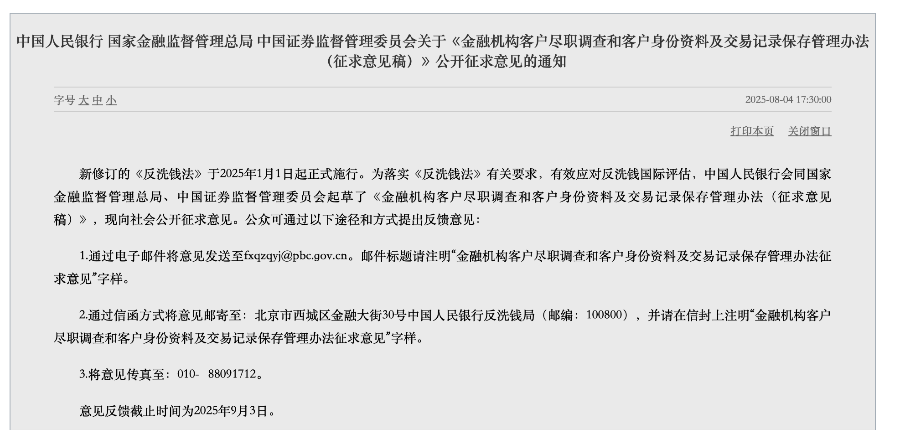
Core Viewpoint - The People's Bank of China, the National Financial Regulatory Administration, and the China Securities Regulatory Commission have jointly released a draft regulation for public consultation, which proposes significant changes to the customer due diligence and identity verification processes for financial institutions [1][2]. Regulatory Changes - The new draft regulation removes the mandatory requirement from the 2022 version that required individuals to explain and register the source or purpose of cash transactions exceeding 50,000 yuan [2][3]. - Financial institutions are still required to conduct due diligence and register basic customer identity information for one-time transactions exceeding 50,000 yuan, such as cash remittances and physical precious metal transactions [2]. Background and Public Reaction - The previous regulation, which mandated registration of cash sources for transactions over 50,000 yuan, faced widespread public controversy and was temporarily suspended due to technical reasons [3]. - The initial regulation was intended to combat money laundering but raised concerns about privacy and the complexity of transaction processes [3]. Implementation Challenges - Financial institutions are tasked with balancing anti-money laundering due diligence requirements with customer experience and privacy protection [4]. - Experts suggest that banks should optimize processes for customer experience, apply digital tools to reduce manual steps, and strictly protect customer privacy by adhering to the principle of minimal necessary information collection [4].
重大调整!事关个人存取款
Sou Hu Cai Jing· 2025-08-10 10:23
Core Viewpoint - The People's Bank of China, along with the National Financial Regulatory Administration and the China Securities Regulatory Commission, has released a draft regulation for public consultation regarding customer due diligence and the management of customer identity information and transaction records, with the consultation period running from August 4 to September 3 [1] Group 1: Regulatory Changes - The most notable change in the new regulation is the removal of the mandatory requirement for individuals to "understand and register the source or purpose of funds" for cash transactions exceeding 50,000 yuan, as stipulated in the 2022 regulatory rules [2] - Financial institutions are still required to conduct due diligence and register basic customer identity information for one-time transactions exceeding 50,000 yuan, such as cash remittances and physical precious metal transactions [2] Group 2: Public Reaction and Challenges - The previous regulation regarding cash transactions over 50,000 yuan sparked widespread public debate, with concerns about increased complexity in business operations and potential privacy infringements [3][4] - A small percentage (approximately 2%) of cash transactions exceeded 50,000 yuan, indicating that the previous regulation had limited impact on most customers [4] - Balancing anti-money laundering due diligence with customer experience and privacy protection remains a challenge for financial institutions [5] Group 3: Recommendations for Financial Institutions - Financial institutions are encouraged to optimize processes to enhance customer experience while implementing a tiered management strategy, simplifying procedures for low-risk customers and intensifying investigations for high-risk ones [5] - The use of digital tools to replace manual processes is recommended, such as developing mobile banking features for customers to upload verification documents online [5] - Strict privacy protection measures should be adhered to, following the principle of collecting only necessary information related to the business [5]
存款取款单笔超5万元,还要不要说明“来源”和“用途”?央行、证监会等三部门发文,口径有变
Mei Ri Jing Ji Xin Wen· 2025-08-10 07:40
Core Viewpoint - The People's Bank of China, the National Financial Regulatory Administration, and the China Securities Regulatory Commission have jointly released a draft regulation for public consultation regarding customer due diligence and the management of customer identity information and transaction records, with a focus on easing previous stringent cash transaction requirements [1][2]. Group 1: Regulatory Changes - The most notable change in the new regulation is the removal of the mandatory requirement for individuals to "understand and register the source or purpose of funds" for cash transactions exceeding 50,000 yuan, as stipulated in the 2022 version of the regulatory rules [2][4]. - Financial institutions are still required to conduct due diligence and register basic customer identity information for one-time transactions exceeding 50,000 yuan, including retaining copies of valid identification documents [2][4]. Group 2: Background and Controversy - The previous regulation, which mandated that financial institutions verify the source of funds for cash transactions over 50,000 yuan, sparked widespread public debate and concern regarding privacy and the complexity of transaction processes [3][4]. - The initial implementation of the 2022 regulation was postponed due to technical reasons, despite the fact that transactions over 50,000 yuan accounted for only about 2% of all cash transactions, indicating limited impact on most customers [4]. Group 3: Balancing Compliance and Customer Experience - Financial institutions face the challenge of balancing anti-money laundering due diligence requirements with customer experience and privacy protection [5]. - Experts suggest that banks can enhance customer experience by optimizing processes, applying digital tools to replace manual steps, and strictly protecting customer privacy by adhering to the principle of collecting only necessary information [5].