强美元

Search documents
大摩2026全球展望:美国强经济推迟降息,日央行全年按兵不动,中国出口持续扩大……
Sou Hu Cai Jing· 2026-01-16 11:28
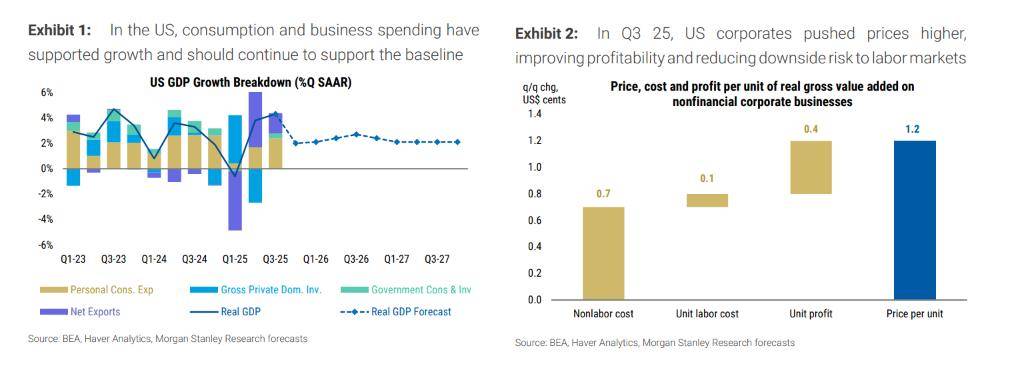
Group 1: Global Economic Outlook - Morgan Stanley indicates that the global economy is at a highly differentiated crossroads, with market expectations for liquidity easing potentially misaligned with reality [1] - The expectation for the Federal Reserve to cut rates early in the year has largely evaporated due to strong U.S. consumer data, pushing the first rate cut expectation to mid-year [1][5] - The first half of 2024 is expected to operate under a "high interest rate, strong dollar" monetary environment, leading to increased asset price volatility [1] Group 2: U.S. Economic Conditions - The U.S. economy shows a confusing yet resilient divergence, with consumer spending growing at a strong annualized rate of 3.5% despite signs of labor market weakness [2][5] - Inflation, particularly driven by tariff costs, is becoming a more pressing threat than recession, with a significant portion of tariff cost pass-through to consumers still pending [5] Group 3: Eurozone and UK Economic Challenges - The Eurozone is experiencing stagnation, with the composite PMI dropping from 52.8 to 51.9, indicating a loss of growth momentum [6] - Core inflation in the Eurozone has decreased to 2.3%, supporting the case for potential rate cuts by the European Central Bank in June and September [8] - The UK economy remains weak, with labor demand softening and inflation expected to return to target levels by April 2026, increasing the likelihood of a rate cut in February [8] Group 4: Japan's Monetary Policy Outlook - Morgan Stanley predicts that the Bank of Japan will maintain its interest rates throughout 2026, contrary to market expectations for rate hikes, due to anticipated declines in core CPI [9][12] - Political uncertainty in Japan, including potential early elections, adds to the challenges for monetary policy tightening [12] Group 5: China's Economic Strategy - China is expected to increase its share of the global export market from 15% to 16.5% by 2030, reflecting a strong export outlook [13] - The recent PMI data indicates the effectiveness of prior fiscal expansion, with continued fiscal support expected in 2026 [14] Group 6: Emerging Markets Dynamics - India is projected to be a growth engine in emerging markets, with a growth forecast of 7.4% for the fiscal year 2026, driven by policy easing and strong demand [17] - Latin America is poised for a policy shift towards more market-friendly approaches, with Brazil expected to cut rates significantly while facing moderate economic slowdown [17]


美联储鹰派基调触发强美元觉醒! 美元空头正在遭遇绞杀
智通财经网· 2025-10-10 02:56
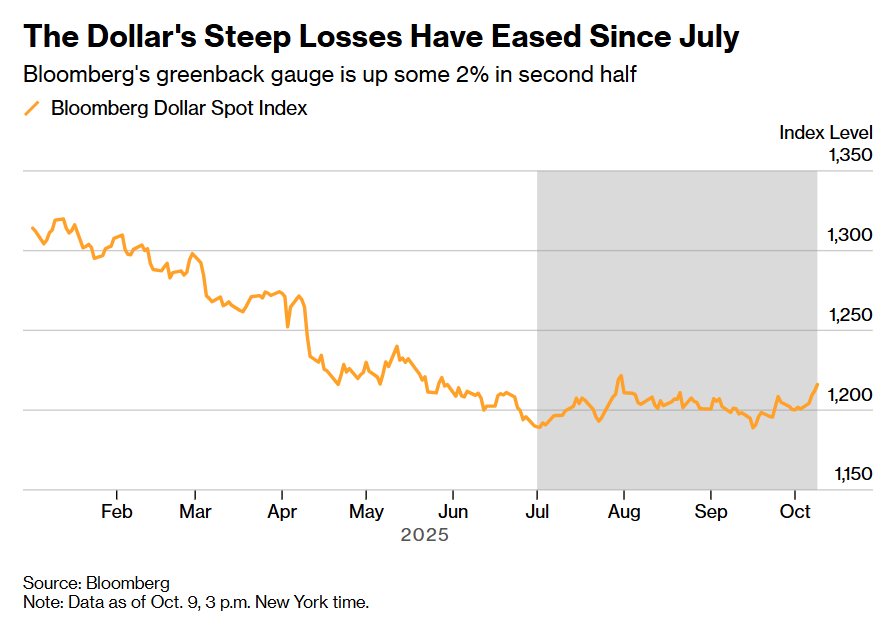
Core Viewpoint - The dollar's recent strength is attributed to a combination of overseas market dynamics, particularly the decline of the euro and yen, and hawkish comments from Federal Reserve officials regarding interest rate cuts [2][3][12]. Group 1: Dollar Strength and Market Sentiment - The global forex market has seen a shift towards betting on a stronger dollar, with hedge funds increasing their bullish positions on the dollar against weaker G10 currencies [7][8]. - The Bloomberg Dollar Spot Index has risen approximately 2% since mid-year, reversing a steep decline earlier in the year [6]. - Market sentiment towards the dollar has turned optimistic, reaching its highest level since April, as traders anticipate potential interest rate cuts from the Federal Reserve [11][12]. Group 2: Implications of Dollar Strength - A prolonged dollar appreciation could complicate monetary policy for other central banks, increase commodity costs, and raise the burden of dollar-denominated debt for emerging markets [3][6]. - The strong dollar may negatively impact emerging market equities and bonds, dampening optimistic expectations for these markets in the final quarter of the year [3][12]. - The current dollar strength is seen as a potential trigger for a new wave of short squeezes among those holding bearish positions on the dollar [12]. Group 3: Future Outlook and Factors Influencing the Dollar - The Federal Reserve's actions will be crucial in determining the dollar's trajectory, with traders currently pricing in two 25 basis point rate cuts by year-end [12][16]. - Political instability in France and Japan is contributing to a more favorable outlook for the dollar against the euro and yen, as these currencies face significant pressures [16]. - Despite the dollar's recent strength, some Wall Street institutions still predict a weakening dollar by year-end, influenced by potential labor market weaknesses and fiscal concerns [13][16].
特朗普更喜欢“弱美元”?经济学家警告:这将伤害美国家庭
Feng Huang Wang· 2025-08-01 03:57
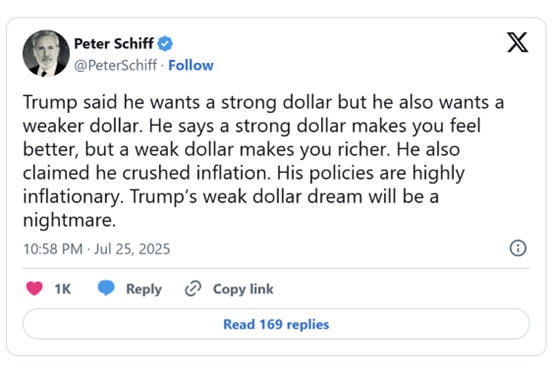
Group 1 - President Trump's preference for a weaker dollar is aimed at benefiting U.S. businesses, despite opposition from several economists who argue it could harm American households [1][2] - Trump claims that a weaker dollar can enhance the competitiveness of U.S. manufacturers and boost tourism, citing the recent stock price increase of Caterpillar as an example [1] - Economists warn that a weaker dollar makes imported goods more expensive, potentially driving inflation and increasing costs for everyday items, which could negatively impact families [2][3] Group 2 - The U.S. economy is characterized as consumption-driven and reliant on imports, meaning a weaker dollar could lead to higher prices for imported goods and contribute to inflation [2] - Critics highlight that the rising deficit and debt are undermining global confidence in the dollar, despite Trump's assertions that his policies will strengthen the economy [3] - The dollar index experienced a significant decline of 10.8% in the first half of the year, marking the worst performance since 1973 [3]
对等关税落地在即,市场如何咀嚼?
对冲研投· 2025-04-02 10:50
Core Viewpoint - The market is currently focused on Trump's upcoming announcement of "reciprocal tariffs" and the non-farm employment data for March. There are indications that tariff details may still be adjusted at the last moment, but the market has begun to digest this information. The Hong Kong stock market appears to be desensitized to tariff news [1][2]. Group 1: Market Reactions - Unlike the previous trade war in 2018, where the Hong Kong stock market reacted negatively to tariff news, this time, after the announcement of Trump's new tariff policy, the US stock market declined while the Hang Seng Index performed well. This suggests a decoupling between the Hong Kong and US markets, indicating that the Hong Kong market has shown signs of desensitization [1][3][5]. - The upcoming implementation of "reciprocal tariffs" may serve as a new observation point for the market. Previously, the US market was highly concerned about tariffs, leading to negative performance. The question now is whether the market, having digested the tariff policy for some time, will see new variables emerge to gradually dominate market sentiment [5][6]. Group 2: Economic Indicators - The US dollar index has recently shown signs of bottoming out, while US Treasury yields have continued to decline, reaching near-year lows. This divergence suggests that the market still believes the tariff policy may lead to a "strong dollar," but rising risk aversion in the stock market has made bonds a safe haven [2][5]. - If the dollar strengthens, the actual effects of the tariffs may be partially offset, as imported goods are ultimately priced in dollars. Additionally, rising economic uncertainty may lead to more funds choosing US Treasuries as a safe harbor, potentially providing both capital gains and currency gains [5][6].
海外研究|从美元指数看“海湖庄园协议”叙事
中信证券研究· 2025-03-28 00:15
Core Viewpoint - The recent weakening of the US dollar index since March is attributed to unexpected strength in the euro due to fiscal stimulus plans and market speculation around "Trump Recession," rather than the narrative of the "Mar-a-Lago Accord" being the main cause [1][4]. Group 1: "Mar-a-Lago Accord" Concept - Stephen Miran's concept of the "Mar-a-Lago Accord" suggests that the dollar's trajectory will follow two phases: an initial phase of strong dollar due to tariffs, followed by a weaker dollar phase due to currency agreements [2][12]. - The first phase, characterized by tariffs, is currently in effect, aligning with the strong dollar narrative promoted by the Trump administration [12]. Group 2: Impact of "Mar-a-Lago Accord" Narrative - The narrative surrounding the "Mar-a-Lago Accord" has circulated widely in the market, but it has not significantly influenced pricing, despite its weak dollar target seemingly correlating with the dollar index's decline [4][12]. - Concerns about a US recession are not as pronounced as they were in Q4 2023, indicating that the market's apprehension regarding a downturn is less than half of previous levels [4]. Group 3: Future Outlook for the US Dollar Index - The expectation is that the "Mar-a-Lago Accord" narrative will not significantly impact the market in the short term, especially with the current economic data showing no clear signs of weakness [17]. - If Trump's tariff policies exceed expectations and the euro returns to a stronger fundamental position, the dollar index may experience a rebound [17].