战争溢价

Search documents
原油周报:多重利空叠加,原油大幅回落-20251013
Bao Cheng Qi Huo· 2025-10-13 02:37
1. Report Industry Investment Rating No relevant content provided. 2. Core Viewpoints of the Report - The resurgence of the tariff war by President Trump and the ongoing shutdown of the US federal government have led to a significant decline of 4.27% in the domestic crude oil futures 2512 contract last Friday, closing at 448.5 yuan per barrel. It is expected that the contract will maintain a weak and volatile trend in the future [5]. - The continuous shutdown of the US federal government, the decision of 8 OPEC+ oil - producing countries to increase production by 137,000 barrels per day in November, and the easing of the Middle East geopolitical situation have all contributed to the weakening of support for oil prices. It is expected that domestic crude oil futures will maintain a weak and volatile trend [5]. 3. Summary According to the Table of Contents 3.1 Market Review 3.1.1 Spot Price Slightly Rises, Basis Discount Significantly Narrows - As of the week ending October 10, 2025, the spot price of crude oil produced in the Shengli Oilfield area was 63.53 US dollars per barrel, equivalent to 451.4 yuan per barrel, a slight increase of 0.6 yuan per barrel compared to before the holiday. The main 2511 contract of domestic crude oil futures closed at 461.9 yuan per barrel, a significant weekly decline of 17.8 yuan per barrel. The basis was 10.5 yuan per barrel, and the discount significantly narrowed [9]. 3.1.2 Multiple Negative Factors Lead to a Sharp Decline in Crude Oil - President Trump's tariff war and the US federal government shutdown led to a collective decline in the peripheral financial markets last Friday. The domestic crude oil futures 2512 contract closed 4.27% lower at 448.5 yuan per barrel. It is expected to maintain a weak and volatile trend [13][14]. 3.2 Upgrading of Crude Oil Supply - Demand Surplus, Accelerating Production Increase 3.2.1 OPEC+ Accelerates Capacity Release, Intensifying Supply Surplus Expectations - Since April 2025, OPEC+ has shifted from a production - cut cycle to a production - increase cycle, with a cumulative production increase of 1.919 million barrels per day from April to August. In August 2025, OPEC member countries' crude oil production was 27.948 million barrels per day, a significant monthly increase of 478,000 barrels per day and a significant annual increase of 1.296 million barrels per day. It is expected that OPEC+ oil - producing countries will accelerate production increases, increasing supply pressure [21][22][23]. 3.2.2 Non - OPEC Oil - Producing Countries Maintain High - Level Production Capacity - As of the week ending October 3, 2025, the number of active oil drilling platforms in the US was 422, a slight weekly decrease of 2 and a decrease of 57 compared to the same period last year. The daily crude oil production was 13.629 million barrels, a significant weekly increase of 124,000 barrels per day and a significant annual increase of 429,000 barrels per day. However, the growth rate of US domestic crude oil production is expected to slow down [37]. 3.2.3 The Peak Season of Crude Oil Demand in the Northern Hemisphere is Coming to an End - After entering October, the peak season of oil demand in the Northern Hemisphere ends, demand weakens, and inventory accumulation pressure increases. Different energy institutions have different forecasts for the global crude oil market, but overall, there are concerns about supply - demand imbalances [41]. 3.2.4 A Significant Increase in US Crude Oil Inventories and a Slight Increase in Refinery Utilization Rate - As of the week ending October 3, 2025, US commercial crude oil inventories reached 420.3 million barrels, a significant weekly increase of 3.715 million barrels. The refinery utilization rate was 92.4%, a slight weekly increase of 1.0 percentage point [44]. 3.2.5 A Slight Increase in China's Crude Oil Imports in August 2025 - In August 2025, China's crude oil imports reached 49.492 million tons, a significant monthly increase of 2.288 million tons and a slight annual increase of 392,000 tons. However, China's crude oil processing and import consumption may be restricted by weak demand [48]. 3.3 Easing Signs in the Middle East Situation, but Risks Remain - During the National Day holiday, the Middle East geopolitical situation showed signs of easing, weakening the support for the crude oil market. The "war premium" has subsided, and the resumption of the oil export channel in the Iraqi Kurdish region has increased the global crude oil supply expectation, suppressing oil prices [59]. 3.4 Net Long Positions in the International Crude Oil Market Show Mixed Changes Week - on - Week - As of September 23, 2025, the average non - commercial net long position in WTI crude oil was 102,958 contracts, a significant weekly increase of 4,249 contracts. As of September 30, 2025, the average net long position of Brent crude oil futures funds was 202,480 contracts, a significant weekly decrease of 9,903 contracts [64]. 3.5 Conclusion - The ongoing shutdown of the US federal government, the production increase decision of 8 OPEC+ oil - producing countries, and the easing of the Middle East situation are expected to cause domestic crude oil futures to maintain a weak and volatile trend [68].
宝城期货原油早报-2025-10-13:品种晨会纪要-20251013
Bao Cheng Qi Huo· 2025-10-13 02:08
Report Summary 1. Report Industry Investment Rating - The investment rating for the domestic crude oil futures 2512 contract is "Weak" [1][5] 2. Report's Core View - Due to systemic risks, the domestic crude oil futures 2512 contract is expected to maintain a weak and volatile trend. The contract closed 4.27% lower at 448.5 yuan/barrel last Friday, and it may continue this trend on Monday [5] 3. Summary by Related Catalogs Price and Trend - Short - term view: The short - term trend of the crude oil 2512 contract is weak [1] - Medium - term view: The medium - term trend of the crude oil 2512 contract is weak and volatile [1][5] - Intraday view: The intraday trend of the crude oil 2512 contract is a decline [1][5] Driving Factors - Geopolitical and economic factors: Trump restarted the tariff war targeting China, causing the peripheral financial markets to weaken. The US government is in a shutdown due to the lack of consensus between the two parties. These factors contribute to systemic risks [5] - Supply factors: Eight OPEC+ oil - producing countries decided to increase production by 137,000 barrels per day in November, increasing the supply pressure in the oil market [5] - Geopolitical situation: The geopolitical situation in the Middle East has shown signs of easing. The "war premium" that previously supported oil prices has diminished [5]
宝城期货原油早报-20251010
Bao Cheng Qi Huo· 2025-10-10 01:13
Report Summary 1. Report Industry Investment Rating - No information provided on the investment rating of the industry in the report. 2. Core View of the Report - The domestic crude oil futures contract 2511 is expected to run weakly, with a short - term outlook of weak oscillation, a medium - term outlook of oscillation, and an intraday outlook of decline. Overall, it is expected to maintain a weakly oscillating trend on Friday [1][5]. 3. Summary by Related Content Market Situation of Crude Oil Futures 2511 - Short - term: Weak oscillation; Medium - term: Oscillation; Intraday: Decline; Overall view: Weak operation [1]. Core Logic - Macro factors have weakened as the US federal government shutdown due to the failure of the two parties to reach an agreement has led to a significant increase in global financial market risk - aversion sentiment, pressuring risk assets [5]. - The supply pressure in the oil market has increased again as eight OPEC+ oil - producing countries decided to maintain the production increase measure in November, increasing crude oil production by 137,000 barrels per day [5]. - The "war premium" that previously supported oil prices has subsided as the geopolitical situation in the Middle East has shown signs of easing, with Israel and Hamas signing the first - stage agreement of the "20 - point plan" [5]. - The domestic crude oil futures 2511 contract opened lower and ran weakly on Thursday, and the weak pattern continued at night. It is expected to maintain a weakly oscillating trend on Friday [5].
国际油价单日暴涨%,布伦特原油破美元,分析师:战争溢价持续
Sou Hu Cai Jing· 2025-06-23 16:01
Core Viewpoint - Recent significant fluctuations in international oil prices have been driven primarily by geopolitical tensions, particularly the escalation of conflict between Israel and Iran, which has raised concerns about potential disruptions in oil supply from the Middle East [1][3]. Group 1: Oil Price Surge - On June 13, a large-scale airstrike by Israel on Iran led to a surge in oil prices, with Brent and WTI crude oil futures experiencing intraday gains exceeding 13%, marking the largest single-day increase in over three years [1]. - By June 16, Brent crude oil prices surpassed the $80 per barrel mark, closing at $80.34 [1]. Group 2: Geopolitical Risks and Market Reactions - The primary driver of the recent oil price increase is attributed to geopolitical risks, particularly the potential impact on oil supply from Iran, a significant oil-producing nation [3]. - The weaker U.S. dollar, influenced by lower-than-expected CPI data in May, has also contributed to the upward pressure on oil prices [3]. Group 3: Future Price Outlook - Analysts have differing views on the future trajectory of oil prices. Some suggest that if Iran's oil supply is severely affected or if the conflict spreads to other oil-producing countries, prices could rise significantly, potentially exceeding $100 per barrel for Brent crude [5]. - Conversely, others point out that major oil-producing countries like Saudi Arabia and the UAE have approximately 3 million barrels per day of spare capacity, which could limit the extent of price increases in times of crisis [5]. - Overall, the future of international oil prices will be influenced by a variety of factors, with geopolitical developments in the Middle East being a key area to monitor [5].


【期货热点追踪】SC原油高开低走,是高点已现还是为后市的上涨蓄力?
Jin Shi Shu Ju· 2025-06-23 11:23
Core Viewpoint - The geopolitical tensions in the Middle East, particularly the conflict between the US and Iran, have significantly influenced oil prices, with potential for further volatility depending on supply disruptions [1][2]. Group 1: Oil Price Movements - Oil prices initially surged following US military actions against Iran, reaching a four-month high of 588.6 CNY per barrel before retreating as the "war premium" was largely absorbed [1]. - Analysts suggest that for oil prices to rise further, there must be substantial damage to supply, as OPEC+ has considerable idle capacity [1]. - If the Strait of Hormuz is closed, oil prices could spike to $120 per barrel, according to various financial institutions [2]. Group 2: Demand and Supply Outlook - Short-term demand for oil appears strong, particularly in North America due to the summer driving season, but long-term growth forecasts vary significantly among major energy agencies [3]. - The EIA predicts a global oil demand increase of 800,000 barrels per day for this year, while the IEA is more conservative at 720,000 barrels per day. In contrast, OPEC maintains a higher estimate of 1.3 million barrels per day [3]. Group 3: Market Sentiment and Geopolitical Risks - The market sentiment is heavily influenced by the potential closure of the Strait of Hormuz, which is critical for global oil transport, accounting for about one-third of maritime oil trade [2]. - Analysts from various institutions express concerns over the geopolitical risks, suggesting that if the Strait is blocked, oil prices could rise dramatically, with estimates reaching $120 per barrel [2][4]. - The current geopolitical tensions are expected to elevate market concerns over supply, leading to increased volatility in oil prices [5].
【期货热点追踪】随着大部分“战争溢价”消化,SC原油大幅回落,是价格高点已经出现?还是“虚晃一枪”为后市的上涨行情蓄力?
news flash· 2025-06-23 10:48
Core Viewpoint - The article discusses the significant decline in SC crude oil prices following the absorption of most "war premium," raising questions about whether the peak price has been reached or if this is merely a temporary dip before a potential upward trend [1] Group 1 - SC crude oil has experienced a substantial drop in prices, indicating a possible end to the recent price surge [1] - The article poses a critical question regarding the future trajectory of crude oil prices, suggesting that the current decline could either signify a peak or serve as a preparatory phase for future increases [1]
伊以冲突点燃“战争溢价”,油价要重返100美元?
智通财经网· 2025-06-16 07:36
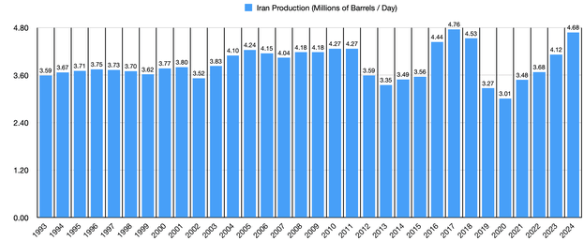
Core Points - The article discusses the significant decline in major U.S. stock indices due to escalating tensions between Israel and Iran, raising concerns about potential military conflict and its economic implications [1] - The defense and oil industries are expected to benefit from the heightened conflict, with oil prices rising amid fears of supply disruptions [1][12] Group 1: Conflict Escalation - Israel launched a major military operation named "Operation Lion's Rise," deploying over 200 aircraft and drones to strike key military targets in Iran, including nuclear facilities [2] - The U.S. withdrawal from the nuclear agreement during the Trump administration has heightened fears regarding Iran's nuclear capabilities and potential military actions against the U.S. and Israel [2][3] - Iran retaliated with drone and ballistic missile strikes, escalating the conflict further [3] Group 2: Oil Industry Impact - The conflict is likely to positively impact the oil industry, as past sanctions on Iran significantly reduced its oil production from 4.76 million barrels per day in 2017 to 3.01 million barrels per day in 2020, a decline of 36.8% [5] - Despite sanctions, Iran's oil production rebounded to 4.68 million barrels per day last year due to increased flexibility in oil transport and temporary exemptions for certain countries [5] - Oil prices are influenced by the dollar's value and economic conditions, with a balanced oil market typically requiring OECD commercial inventories to fluctuate between 50 to 60 days of supply [7] Group 3: Global Oil Supply Dynamics - The global oil market is currently in a delicate state of oversupply, with last year's production exceeding consumption by approximately 60,000 barrels per day, totaling an excess of 21.9 million barrels annually [8] - The potential for supply disruptions in the Middle East could far exceed the current global supply-demand gap, particularly concerning the Strait of Hormuz, which is crucial for oil transport [10][11] - Approximately 20% of the world's oil is transported through this region, making it a significant geopolitical leverage point for Iran [11] Group 4: Price Predictions - Analysts from Goldman Sachs and JPMorgan have raised oil price forecasts, predicting potential spikes to $100 or even $130 per barrel if the Strait of Hormuz is closed [12] - The current geopolitical climate presents a meaningful opportunity for investors in the oil sector, particularly in light of previous pressures from trade wars and economic downturns [12]