拨备覆盖率

Search documents
中国平安20260110
2026-01-12 01:41
Summary of Ping An Bank Conference Call Company Overview - **Company**: Ping An Bank - **Industry**: Banking and Financial Services Key Points and Arguments Credit Structure Adjustment - Ping An Bank is shifting its credit focus from high-yield, high-risk assets to medium-yield assets, particularly in retail lending, where consumer loan and credit card rates are decreasing while mortgage rates remain stable. Overall yield is experiencing a gradual decline [2][3][9] Deposit Cost Management - The bank is actively controlling deposit costs by reducing high-cost deposits and increasing the proportion of demand deposits to improve deposit structure. This strategy is expected to stabilize the loan growth rate in 2026, with a slight increase anticipated [2][7] Loan Growth and Yield Outlook - For 2026, Ping An Bank expects loan yields to face downward pressure but aims to stabilize margins through optimized funding costs. New loan rates may slightly decline due to macroeconomic factors affecting consumer income and spending [2][8][20] Risk Management - The bank maintains a low Loan-to-Value (LTV) ratio for mortgages, ensuring strong collateral and asset quality control. Risks associated with consumer loans and credit cards have been significantly cleared, allowing for better risk management in retail lending [2][10] Credit Cost Stability - Credit costs are expected to remain stable in 2026, with a consistent provision coverage ratio. The bank plans to maintain a sufficient loan-to-provision ratio to manage future risks effectively [2][12] Retail Business Recovery - Since Q4 2025, the recovery trend in retail business has continued, with sustained investment in mortgages and medium-yield assets while reducing high-risk assets. The bank aims for a dual recovery in revenue and performance in 2026 [4][20] Corporate Lending Strategy - Corporate lending will focus on sectors such as real estate, infrastructure, and energy, with a slight decrease in growth expected. The bank will prioritize risk control in the retail sector due to a weak consumer environment [6][20] Macro Economic Outlook - Ping An Bank holds an optimistic view of the macroeconomic environment for 2026, anticipating that government policies will effectively stimulate economic recovery and consumer spending [8][20] Non-Interest Income and Insurance Business - The bank's insurance business is a strategic focus, contributing approximately 30-40% of wealth management income. The bank expects continued growth in this area, enhancing overall revenue support [4][12][13] Future Asset Growth and Dividend Policy - The bank does not have a specific growth target for 2026 but aims for stability in corporate lending while maintaining a dividend payout ratio of around 27% [16][17] Medium-Yield Asset Development - Ping An Bank is committed to developing medium-yield assets as a key product to improve risk management and meet customer needs, with a target of 30 billion yuan for 2025 and ongoing discussions for 2026 [17] Overseas Business Development - Currently, Ping An Bank operates a branch in Hong Kong focused on cross-border financing, with plans to maintain a light business model and prioritize retail banking in the long term [18][19] Performance Expectations for 2026 - The bank anticipates a phase of performance recovery in 2026, aiming for improved revenue and profitability compared to the previous two years, although quarterly performance will need to be monitored closely [20]


资本充足水平大幅下滑,长安银行增资26.11亿股获批
Xin Lang Cai Jing· 2025-12-10 10:11
Group 1 - The core point of the article is that Chang'an Bank is facing a decline in its capital adequacy ratio and has received approval for a capital increase to address this issue [2][11] - The bank plans to raise no more than 2.611 billion shares, with all funds raised designated for supplementing core Tier 1 capital [3][12] - As of the third quarter, Chang'an Bank's core Tier 1 capital adequacy ratio is 8.23%, down 0.92 percentage points from the end of the previous year, which is below the industry average [4][13] Group 2 - Chang'an Bank was established on July 29, 2009, and has undergone multiple capital increases, raising its registered capital from 3 billion to 7.577 billion yuan [3][12] - The bank's major shareholders include Shaanxi Yanchang Group (19.04%), Shaanxi Coal and Chemical Industry Group (18.71%), and Shaanxi Nonferrous Metals Group (11.22%) [3][12] - The bank's capital adequacy ratios as of the third quarter are 8.23% for core Tier 1, 9.62% for Tier 1, and 11.66% for total capital, all showing a downward trend compared to the previous year [4][13] Group 3 - The decline in capital adequacy is attributed to rapid loan growth and a slight increase in non-performing loans, which have put pressure on capital consumption [5][14] - Loan growth rates for the years 2022, 2023, and 2024 are 15.51%, 14.09%, and 9.58% respectively, with non-performing loans growing at a faster rate than normal loans [5][14] - The non-performing loan ratios for the same years are 1.82%, 1.81%, and 1.85%, indicating a rising trend in asset quality issues [5][14] Group 4 - The bank's provision coverage ratio has also decreased, with figures of 182.30%, 191.15%, and 173.44% for the years 2022 to 2024 [6][14] - To mitigate the impact of non-performing loans on capital, Chang'an Bank plans to recover and dispose of 5.528 billion yuan in non-performing assets in 2024 [6][15] - The bank's revenue for 2024 is projected to be 9.461 billion yuan, a decrease of 3.26%, with net profit expected to be 2.315 billion yuan, down 5.29% [7][16] Group 5 - Despite the challenges, Chang'an Bank's operating income for the third quarter has shown an increase of 18.08% year-on-year, reaching 7.643 billion yuan, with net profit up 6.11% to 1.882 billion yuan [8][17] - The bank's net interest income for 2024 is expected to be 9.017 billion yuan, a decrease of 2.48%, while fee and commission income has been negative since 2019, with a projected loss of 601 million yuan in 2024 [7][17]


苏州银行(002966) - 2025年12月5日投资者关系活动记录表
2025-12-05 09:46
苏州银行股份有限公司投资者关系活动记录表 1 | | 3、如何展望全年拨备覆盖率水平? | | --- | --- | | | 答:截至 年 月末,集团拨备覆盖率 2025 9 420.59%, | | | 持续保持较厚的风险抵补能力。本行将继续按照审慎性原 | | | 则,计提好充足的拨备,预计全年拨备覆盖率将保持相对 | | | 稳定水平。 | | 关于本次活动是否 | 接待过程中,公司接待人员与投资者进行了充分的交流与 | | 涉及应披露重大信 | 沟通,严格按照有关制度规定,没有出现未公开重大信息 | | 息的说明 | 泄露等情况。 | | 活动过程中所使用 | | | 的演示文稿、提供的 | | | 文档等附件(如有, | | | 可作为附件) | | 2 | 编号:2025-18 | | | --- | --- | | 特定对象调研 | □分析师会议 | | 投资者关系活动类 | □媒体采访 □业绩说明会 | | 别 | □新闻发布会 □路演活动 | | □现场参观 | | | □其他(请文字说明其他活动内容) | | | 调研人员:中信建投马鲲鹏、李晨,富国基金徐健荣,长 | 信基金吴廷华,H ...
浙江稠州商业银行年内两度领罚:基金销售存四宗违规
Xin Lang Cai Jing· 2025-12-03 08:41
来源 :证券之星 年末监管风暴再度席卷浙江稠州商业银行。近日,浙江证监局一纸责令改正通知书,直指其基金销售业 务四大违规行为,这已是该行年内第二次遭遇监管处罚。今年7月,稠州银行南京分行曾因转贴现、同 业业务违规领罚200万元。 证券之星注意到,合规问题之外,稠州银行业绩端也有不小压力,2025年前三季度,该行营收同比增长 12.25%至80.14亿元,净利润却仅微增1.09%至11.56亿元,第三季度单季净利润更是同比下滑17.2%。资 本充足率指标的隐忧则进一步放大了风险,尽管核心一级资本充足率8.92%暂时踩线达标,但资本补充 压力已迫在眉睫。 01. 涉四项问题遭监管处罚,合规漏洞持续暴露 12月1日,中国证券监督管理委员会浙江监管局网站发布《关于对浙江稠州商业银行股份有限公司采取 责令改正措施的决定》。 浙江证监局发现,浙江稠州商业银行存在部分从事基金销售业务人员未取得从业资格、部分基金宣传推 介材料、基金销售业务制度修订未经合规风控人员审查、为个别未进行风险测评的客户办理基金销售业 务以及未按规定报送反洗钱相关材料等四个方面问题。 具体来看,其一,部分基金销售人员无证上岗,直接触碰了金融销售的资质 ...
息差企稳、不良双升 三季度银行业盈利与风险博弈继续
Sou Hu Cai Jing· 2025-11-19 16:28
Core Insights - The banking industry is experiencing a phase of stabilization in net interest margins (NIM), with the NIM at 1.42% as of Q3 2025, marking the end of a continuous decline [1][2] - There is a slight increase in non-performing loans (NPLs) and NPL ratios, indicating ongoing risks in certain sectors of the economy [4][5] - The balance between supporting the real economy and maintaining prudent operations is a central concern for the banking sector [1] Group 1: Net Interest Margin Stabilization - As of Q3 2025, the commercial banks' NIM is 1.42%, showing a stabilization compared to previous quarters, despite a year-on-year decline of 11 basis points [2] - Different types of banks show varied trends: joint-stock commercial banks saw a slight increase in NIM to 1.56%, while private banks experienced a decrease to 3.83% [2] - The stabilization is attributed to effective cost control on the liability side and regulatory measures to optimize pricing capabilities [2][3] Group 2: Non-Performing Loans - The NPL balance reached 3.5 trillion yuan, an increase of 883 billion yuan from the previous quarter, with the NPL ratio rising to 1.52% [4][5] - NPL ratios for different bank types are as follows: state-owned banks at 1.22%, city commercial banks at 1.84%, rural commercial banks at 2.82%, and private banks at 1.83% [4] - The increase in NPLs is primarily concentrated in retail loans and the real estate sector, reflecting ongoing economic challenges [5][6] Group 3: Loan Rates and Economic Impact - Loan rates are nearing a "glass bottom," with the average interest rate for new corporate loans at 3.1%, down approximately 40 basis points year-on-year [7][8] - The decline in loan rates is driven by a combination of falling deposit costs and rising credit risks in personal loans [8][9] - Recommendations for policy adjustments include asymmetric reductions in deposit rates and measures to alleviate debt pressures on households [9]
银行三季度净息差环比持平,股份行回升1BP!三类银行机构利润下滑
Xin Lang Cai Jing· 2025-11-17 12:24
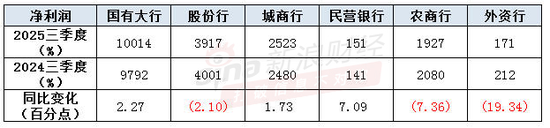
Core Insights - The banking sector in China reported a slight decline in net profit for the first three quarters of 2025, with a total of 1.87 trillion yuan, representing a year-on-year decrease of 0.02%, although the decline has narrowed compared to the first half of the year [1][6] Profitability - State-owned banks, city commercial banks, and private banks saw an increase in net profit, with private banks leading at a growth rate of 7.09% [1][3] - The net profit for state-owned banks was 1.00 trillion yuan, while city commercial banks and private banks reported 252.3 billion yuan and 15.1 billion yuan, respectively [3] - In contrast, joint-stock banks, rural commercial banks, and foreign banks experienced declines in net profit, with decreases of 2.1%, 7.36%, and 19.34%, respectively [1][3] Net Interest Margin - The net interest margin (NIM) for commercial banks remained stable at 1.42% in Q3, with private banks having the highest NIM at 3.83% [1][8] - State-owned banks had the lowest NIM at 1.31%, while joint-stock banks saw a slight increase of 0.01 percentage points to 1.56% [8][9] - Year-on-year, all types of banks experienced a decline in NIM, with state-owned and rural commercial banks both down by 0.14 percentage points [9][10] Asset Quality - As of the end of Q3 2025, the non-performing loan (NPL) balance for commercial banks was 3.5 trillion yuan, with an NPL ratio of 1.52%, reflecting a slight increase of 0.03 percentage points from the previous quarter [13][14] - Foreign banks had the lowest NPL ratio at 1.06%, while rural commercial banks had the highest at 2.82% [14] - Only state-owned banks saw a decrease in NPL ratios compared to the end of the previous year, while other types of banks experienced varying degrees of increase [14] Provision Coverage - The loan loss provision balance for commercial banks was 7.3 trillion yuan, with a provision coverage ratio of 207.15%, both showing a decrease from the previous quarter [16]






【银行】息差保持稳定,盈利增速回升—2025年三季度商业银行主要监管指标点评(王一峰/董文欣/赵晨阳)
光大证券研究· 2025-11-16 23:03
Core Viewpoint - The report highlights the performance of commercial banks in China for the first three quarters of 2025, indicating a stable net profit with slight improvements in growth rates, while also addressing challenges in credit demand and asset quality [6][7]. Summary by Sections 1. Net Profit and Growth Rates - Commercial banks achieved a net profit of 1.87 trillion yuan in the first three quarters, with an average capital return rate of 8.18%. The net profit growth rate improved by 1.2 percentage points compared to the first half of 2025, with state-owned banks showing the highest growth at 2.3% [6][7]. 2. Loan and Asset Growth - The total assets and loans of commercial banks grew by 8.8% and 7.3% year-on-year, respectively, with slight declines in growth rates compared to the previous quarter. Non-credit assets provided strong support for balance sheet expansion, with loan and non-loan asset growth rates at 7.3% and 10.9% [8][9]. 3. Interest Margin and Cost of Liabilities - The net interest margin for commercial banks remained stable at 1.42% for the first three quarters, with a year-on-year decrease of 11 basis points. The reduction in liability costs helped alleviate pressure on interest margins [10]. 4. Asset Quality - The overall asset quality remained stable, with a non-performing loan (NPL) rate of 1.52%, which increased by 3 basis points from the previous quarter. The provision coverage ratio stayed above 200%, indicating a strong risk mitigation capacity [11]. 5. Risk-Weighted Assets and Capital Adequacy - Risk-weighted assets grew by 8% year-on-year, with the core Tier 1 capital adequacy ratio declining by 6 basis points to 10.87%. Factors affecting capital adequacy included market fluctuations and the return of certain assets to the balance sheet [12].
银行2025年三季报综述:息差筑底,手续费改善,国有行全部营利双增
China Post Securities· 2025-11-13 10:57
Industry Investment Rating - The industry investment rating is maintained at "Outperform" [2] Core Viewpoints - The overall operating income, pre-provision profit, and net profit growth rates for listed banks in the first three quarters of 2025 are 0.91%, 0.56%, and 1.48% respectively, indicating a recovery in performance driven by scale and an ongoing improvement in fee income [4][12] - The growth rate of interest-earning assets for listed banks is 9.40% year-on-year, with loans and debt investments increasing by 7.83% and 13.94% respectively [4][5] - The net interest margin for listed banks is stable at 1.35%, with a slight decline in state-owned banks, while other types of banks have stabilized [5] - Non-interest income has increased by 5.02% year-on-year, although it has seen a quarter-on-quarter decline due to adjustments in the bond market [5] - The asset quality is improving, with the non-performing loan ratio at 1.23%, showing a slight decrease from the previous half-year [5] Summary by Sections 1. Performance Recovery Driven by Scale and Fee Improvement - In the first three quarters of 2025, listed banks showed a growth in operating income, pre-provision profit, and net profit, with respective growth rates of 0.91%, 0.56%, and 1.48% [12] - City commercial banks outperformed other types of banks, while state-owned banks also showed positive growth [12] 2. Growth of Interest-Earning Assets and Slower Expansion of Liabilities - The year-on-year growth rate of interest-earning assets for listed banks is 9.40%, with loans and debt investments increasing by 7.83% and 13.94% respectively [4][5] 3. Stabilization of Net Interest Margin - The net interest margin for listed banks is stable at 1.35%, with a slight decline in state-owned banks [5] 4. Non-Interest Income Performance Affected by Bond Market Adjustments - Non-interest income increased by 5.02% year-on-year, but saw a quarter-on-quarter decline due to bond market adjustments [5] 5. Improvement in Asset Quality and Declining Credit Costs - The non-performing loan ratio for listed banks is 1.23%, showing a slight decrease from the previous half-year, with a significant decline in credit costs [5][12] 6. Investment Recommendations - Focus on banks with significant deposit maturities and potential for interest margin improvement, such as Chongqing Bank, China Merchants Bank, and Bank of Communications [6] - Attention to city commercial banks that will benefit from improvements in fixed asset investment, such as Jiangsu Bank, Qilu Bank, and Qingdao Bank [6]
5家银行不良率下降,零售AUM增长成亮点
Nan Fang Du Shi Bao· 2025-11-06 23:10
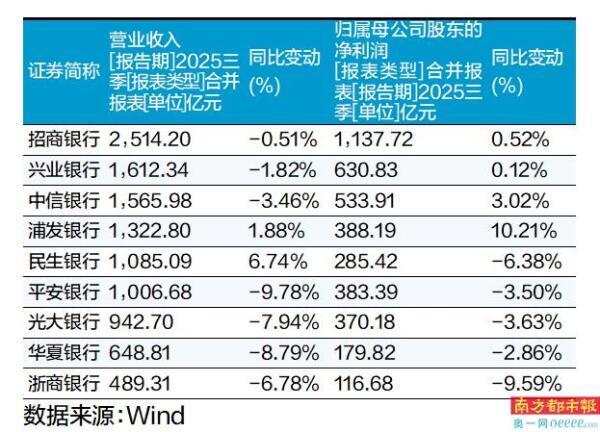
Core Viewpoint - The performance of A-share listed joint-stock banks in the third quarter of 2025 shows a mixed picture, with seven banks experiencing a year-on-year decline in operating income and five banks reporting a drop in net profit. Only Shanghai Pudong Development Bank achieved growth in both metrics [1][2][3]. Group 1: Revenue Performance - Among the nine listed joint-stock banks, only Shanghai Pudong Development Bank and Minsheng Bank reported year-on-year revenue growth, with Minsheng Bank achieving the highest growth rate of 6.74% [2]. - China Merchants Bank led in revenue scale with 2,514.20 billion yuan, followed by Industrial Bank and CITIC Bank with 1,612.34 billion yuan and 1,565.98 billion yuan, respectively [2][3]. - Ping An Bank experienced the most significant revenue decline at -9.78%, while several other banks, including Everbright Bank and Huaxia Bank, also saw declines exceeding 6% [2][3]. Group 2: Net Profit Analysis - China Merchants Bank maintained the highest net profit at 1,137.72 billion yuan, with a slight increase of 0.52% year-on-year. Shanghai Pudong Development Bank saw a notable increase of 10.21% in net profit [3]. - The banks that reported a decline in net profit include Zhejiang Commercial Bank, which had the largest drop at -9.59%, along with Minsheng Bank, Ping An Bank, and others experiencing varying degrees of decline [3]. Group 3: Interest Income and Net Interest Margin - Interest income growth varied significantly, with China Merchants Bank leading at 1,600.42 billion yuan and a 1.74% increase. Shanghai Pudong Development Bank had the highest growth rate in interest income at 3.93% [5]. - The net interest margin faced pressure across the industry, with CITIC Bank experiencing the largest decline of 16 basis points. Only Minsheng Bank reported a slight increase of 2 basis points [5][6]. Group 4: Asset Quality and Provision Coverage - The asset quality of joint-stock banks showed resilience, with a mixed performance in non-performing loan (NPL) ratios. China Merchants Bank had the best NPL ratio at 0.94%, while several banks saw slight increases in their NPL ratios [8]. - Provision coverage ratios decreased for most banks, with China Merchants Bank still leading at 405.93%, despite a decline of 6.05 percentage points [9][10]. Group 5: Loan Structure - The loan structure indicates a shift towards corporate loans, with all five banks reporting growth in corporate loans, while personal loan growth was weak for several banks [11][12]. - China Merchants Bank led in personal loan balance with nearly 3.7 trillion yuan, while corporate loan growth was particularly strong for CITIC Bank, which saw a 10.45% increase [11][12].




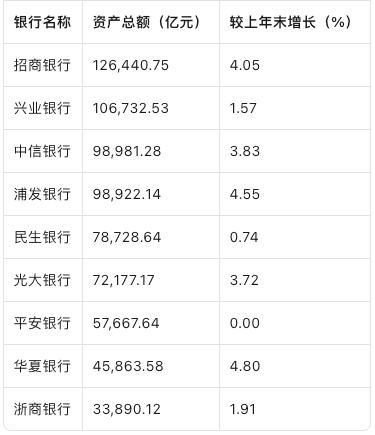
翻遍9家银行财报,我发现行业洗牌的秘密藏在这些数字里
3 6 Ke· 2025-11-06 02:03
Core Insights - The overall performance of the nine listed joint-stock banks in China showed a decline in both revenue and net profit for the first three quarters of the year, with total operating income at 1.12 trillion yuan, down 2.56% year-on-year, and net profit at 406.1 billion yuan, down nearly 1% [1][3] Group 1: Performance Overview - Among the nine banks, four experienced declines in both revenue and net profit, while some banks managed to achieve growth in both metrics [1][4] - The top joint-stock banks by asset size are China Merchants Bank (12.64 trillion yuan), Industrial Bank (10.67 trillion yuan), and CITIC Bank, with Shanghai Pudong Development Bank showing the fastest growth rate at 4.55% [1][2] Group 2: Revenue and Profit Analysis - Only Minsheng Bank and Shanghai Pudong Development Bank reported year-on-year revenue growth, with increases of 6.74% and 1.88%, respectively; the remaining seven banks saw revenue declines, with Ping An Bank experiencing the largest drop at 9.8% [3][4] - In terms of net profit, only four banks, including Shanghai Pudong Development Bank, reported growth, with the latter achieving a 10.21% increase, making it the leader in profit growth among joint-stock banks [4] Group 3: Net Interest Income and Margin - Net interest income, a key indicator of banks' operating income, showed mixed results, with only three banks reporting growth; China Merchants Bank led with 160.04 billion yuan, up 1.74% [5][6] - The net interest margin (NIM) faced pressure, with most banks experiencing declines; China Merchants Bank maintained the highest NIM at 1.87%, while CITIC Bank saw the largest drop of 16 basis points [7] Group 4: Asset Quality and Risk Management - The non-performing loan (NPL) ratio improved for most banks, with China Merchants Bank having the lowest NPL ratio at 0.94% [9][10] - However, the provision coverage ratio decreased for seven banks, with Ping An Bank showing the largest decline of 21.11 percentage points; Shanghai Pudong Development Bank's coverage ratio increased by 11.08 percentage points, indicating enhanced risk mitigation [10][11]