新能源汽车市场

Search documents
11月乘用车市场销量分析:新能源逆势增长 头部品牌领跑赛道
Zhong Guo Zhi Liang Xin Wen Wang· 2025-12-16 05:09
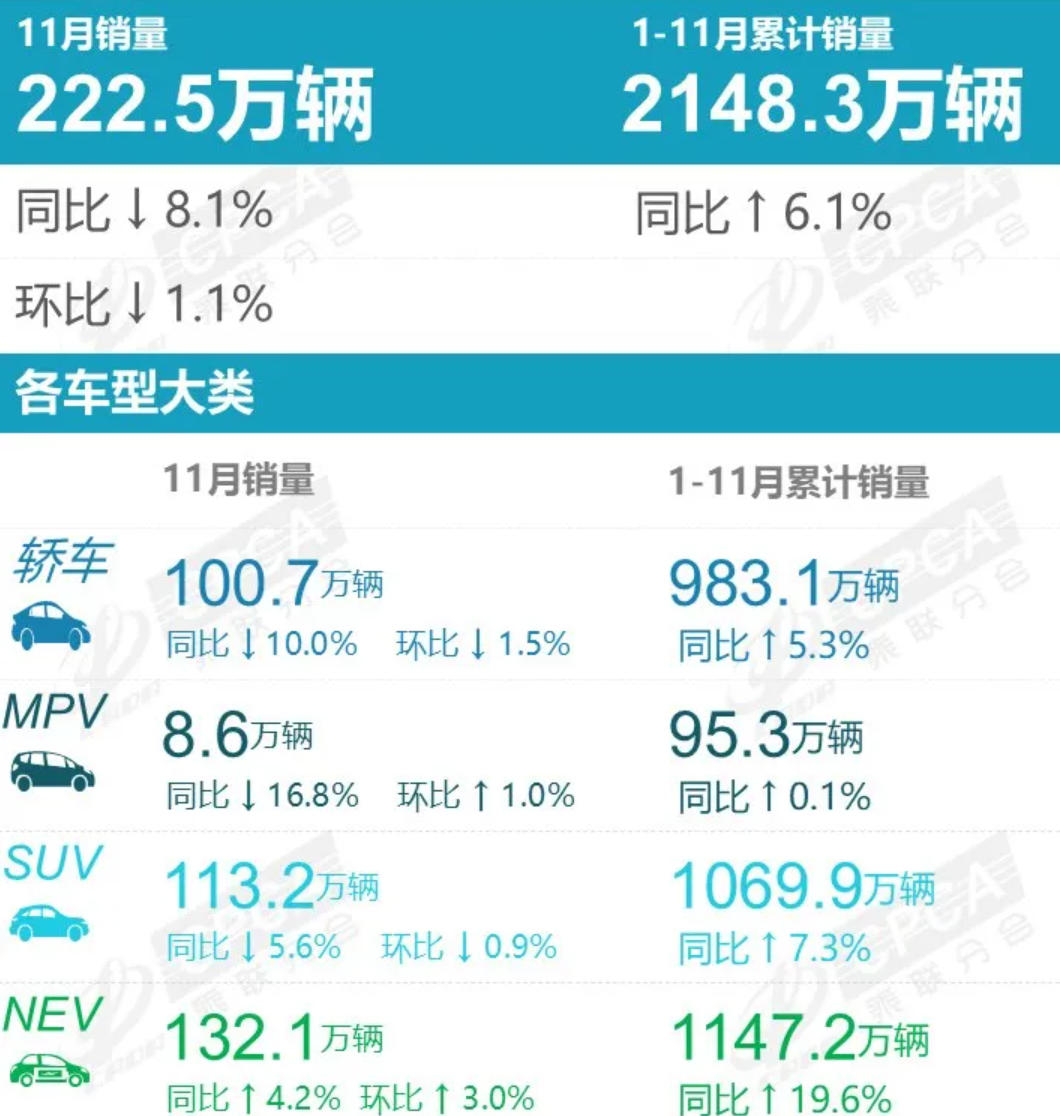
Group 1: Overall Market Performance - In November, the domestic passenger car market faced pressure, with retail sales reaching 2.225 million units, a year-on-year decline of 8.1% and a month-on-month decline of 1.1% [1] - The new energy vehicle (NEV) market, however, showed resilience with sales of 1.321 million units, a year-on-year increase of 4.2% and a month-on-month increase of 3.0%, achieving a penetration rate of over 59% [1] Group 2: Segment Performance - The sedan market saw retail sales of 1.007 million units, down 10.0% year-on-year and slightly down 1.5% month-on-month, with NEV sedans becoming a key growth point [4] - The MPV market was the weakest segment, with retail sales of 86,000 units, a year-on-year decline of 16.8% and a slight month-on-month increase of 1.0% [4] - The SUV market, while also facing year-on-year declines, performed better than sedans and MPVs, with retail sales of 1.132 million units, down 5.6% year-on-year and down 0.9% month-on-month; NEV SUVs sold 683,000 units, up 12.5% year-on-year [4] Group 3: Brand Performance - Among the top ten manufacturers, five were domestic brands, capturing 61% of the total market sales; domestic brands sold 1.49 million units, down 4% year-on-year, while joint venture brands sold 490,000 units, down 19% [4] - BYD led the sales with 306,561 units, although it experienced a year-on-year decline of 26.5% [7] - Geely ranked second with sales of 268,337 units, showing a year-on-year increase of 23.5%, becoming the fastest-growing company among the top brands [9] Group 4: Competitive Landscape - The German brands, particularly FAW-Volkswagen, maintained a stable performance in the shrinking joint venture market, with retail sales of 137,500 units [5] - SAIC Volkswagen's sales were 86,857 units, down 29.3% year-on-year, but it still retained a solid base in the fuel vehicle market [6] - New entrants like Hongmeng Zhixing and Xiaomi Auto showed significant growth, with Hongmeng Zhixing achieving a year-on-year increase of 95.2% [11][18] Group 5: Future Outlook - The market is expected to enter a phase of aggressive sales push in December, with domestic brands likely to maintain their lead in the NEV sector [18] - The competition is shifting from traditional product competition to a focus on technological strength and product quality, indicating a trend towards high-quality development in the automotive industry [18]



今年11月新能源乘用车市场零售132.1万辆
Bei Jing Shang Bao· 2025-12-08 09:36
Core Insights - The retail sales of new energy passenger vehicles in China reached 1.321 million units in November, marking a year-on-year increase of 4.2% and a month-on-month increase of 3% [1] Industry Summary - The data was released by the China Automobile Dealers Association's Passenger Car Market Information Joint Conference [1] - The growth in sales indicates a positive trend in the new energy vehicle market within the country [1]
乘联分会:11月新能源乘用车市场零售132.1万辆 同比增长4.2%
Zheng Quan Shi Bao Wang· 2025-12-08 08:09
Core Insights - The retail sales of new energy passenger vehicles in November reached 1.321 million units, representing a year-on-year increase of 4.2% and a month-on-month increase of 3.0% [1] - Cumulatively, from January to November, the retail sales of new energy passenger vehicles totaled 11.472 million units, reflecting a growth of 19.6% [1] - In contrast, the retail sales of conventional fuel passenger vehicles in November were 900,000 units, showing a year-on-year decline of 22% and a month-on-month decline of 7% [1] - For the period from January to November, the cumulative retail sales of conventional fuel passenger vehicles amounted to 10.01 million units, indicating a decrease of 6% [1]
营收、研发费用和现金储备保持新势力车企领先水平,MEGA召回导致理想Q3亏损
Xin Lang Cai Jing· 2025-11-26 10:26
Core Insights - Li Auto reported Q3 2025 revenue of 27.4 billion yuan, with total revenue for the first three quarters reaching 83.5 billion yuan [1] - The company incurred a Q3 operating loss due to a proactive recall of certain 2024 Li MEGA models, which included costs for replacing coolant, power batteries, and front motor controllers [1] - Li Auto's cash reserves stood at 98.9 billion yuan as of the end of Q3, indicating strong liquidity [1] Revenue and Financial Performance - Q3 revenue was 27.4 billion yuan, while total revenue for the first three quarters was 83.5 billion yuan [1] - R&D expenses for Q3 amounted to 3 billion yuan, with an expected total R&D investment of 12 billion yuan for the year [1] - The recall of the Li MEGA models led to a Q3 gross margin of 16.3%, but the adjusted overall gross margin was 20.4%, indicating profitability when excluding recall costs [1] Product Launch and Market Performance - Two new pure electric SUVs, the Li i8 and Li i6, were successfully launched in Q3, with cumulative orders exceeding 100,000 units [1] - The Li MEGA performed exceptionally well in the high-end market, achieving the highest sales in both the pure electric and MPV categories priced above 500,000 yuan in Q3 [1] - The company is currently addressing capacity issues in collaboration with its supply chain partners [1]


雷军“愤怒”后,小米汽车业绩炸了;俞敏洪被骂,发数条南极游视频;宗馥莉缺席娃哈哈经销商大会;董明珠称玫瑰空调是艺术品|| 大件事
Sou Hu Cai Jing· 2025-11-19 11:59
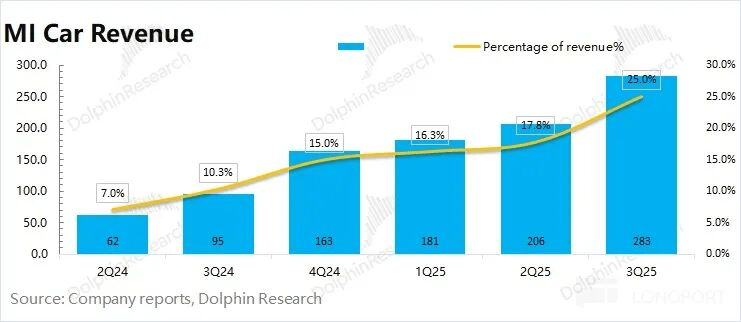
Group 1: Xiaomi's Financial Performance - Xiaomi reported a revenue of 113.1 billion yuan for Q3, a year-on-year increase of 22.3% [2] - Adjusted net profit reached 11.3 billion yuan, marking an 80.9% year-on-year growth, the highest quarterly level in history [2] - The smartphone segment generated 45.97 billion yuan, a decline of 3.1% year-on-year, contributing 40.6% to total revenue, down from 51.3% a year ago [2] Group 2: Automotive Business Growth - Revenue from Xiaomi's smart electric vehicle business reached 29 billion yuan, a significant increase of 199.2%, accounting for 25.6% of total revenue [2] - The automotive division achieved a quarterly delivery of 108,800 units, a year-on-year increase of 173.4%, with an average selling price of 260,000 yuan, up 9% [3] - Xiaomi aims to deliver over 300,000 vehicles by 2026 and has already delivered over 260,000 units in the first three quarters of the year [3] Group 3: Challenges and Controversies - Xiaomi faces ongoing product lawsuits and safety controversies, including a delayed lawsuit regarding false advertising of the SU7 Ultra model [4] - Safety concerns have arisen following incidents involving the SU7, leading to public criticism regarding the company's focus on aesthetics over safety [4] - Recent changes in the public relations team, including the departure of a long-serving executive, have raised concerns about the company's crisis management capabilities [4] Group 4: New Oriental's Internal Issues - New Oriental's CEO, Yu Minhong, faced backlash from employees regarding an internal letter, leading to a series of social media posts about his trip to Antarctica [6][13] - The company reported a significant revenue decline, with a 32.7% drop in revenue year-on-year, totaling 4.392 billion yuan for the 2025 fiscal year [13] - Internal management issues have been highlighted, particularly following the departure of key personnel and the impact on the company's strategic execution [13][28] Group 5: Suning's Financial Struggles - Suning's restructuring plan has been postponed again, with over 230 billion yuan in debt and assets valued at only 41 billion yuan [15][16] - The restructuring aims to balance debt repayment and corporate revival, with the founder pledging personal assets to support the plan [17] - Suning's financial reports indicate a significant decline in revenue and profit, with a 95.78% drop in net profit for Q3 compared to the previous year [18] Group 6: Gree's Market Position - Gree's new rose air conditioner has sparked controversy, with the company positioning it as an innovative product in the market [20][23] - Despite holding the largest market share in air conditioning, Gree faces intense competition, leading to a slight decline in retail volume and revenue share [20] - Gree's financial performance has shown a decline, with a 6.5% drop in revenue year-on-year for the first three quarters [20]



14亿加仓新势力,李书福被坑惨了
3 6 Ke· 2025-11-18 01:26
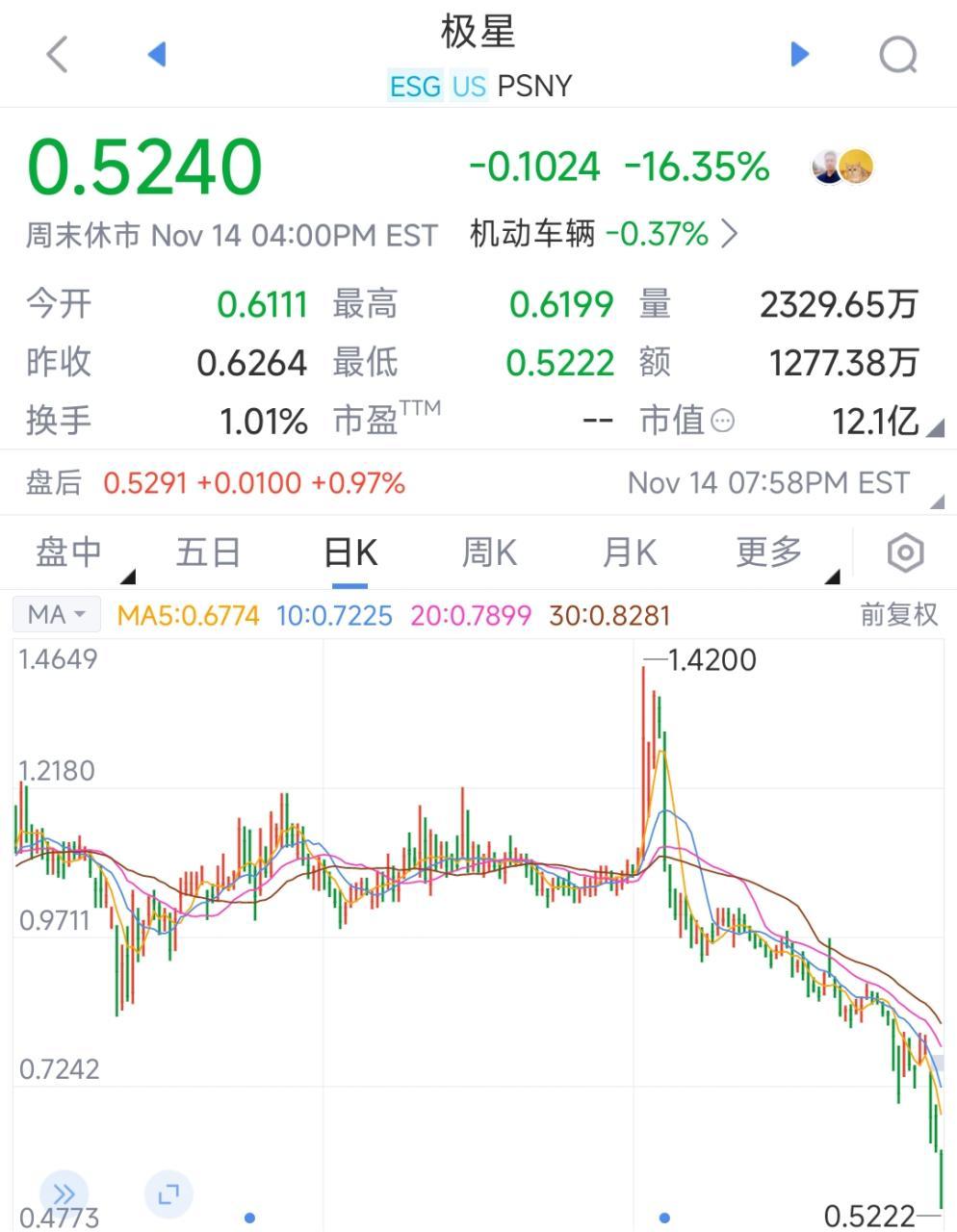
Core Viewpoint - Polestar Automotive is facing a significant decline in stock price and is at risk of delisting from NASDAQ due to its stock price remaining below $1 for an extended period, with a current price of approximately $0.5 [1][3] Financial Performance - For the first half of 2025, Polestar reported revenue of $1.423 billion and a net loss of $1.193 billion, representing a year-on-year decline of 119.37% [1][6] - The company's debt-to-asset ratio stands at 217.11%, indicating it is in a state of insolvency [1][6] - Cumulatively, Polestar has incurred nearly $6 billion in net losses from 2021 to the first half of 2025 [6] Market Position and Sales - Polestar's vehicle sales from 2021 to 2024 were 29,000, 51,500, 54,626, and 44,851 units respectively, with the highest annual sales in China being only 2,048 units [3] - In the first ten months of 2025, Polestar's domestic sales have nearly stalled, with only 163 vehicles sold [3] Strategic Adjustments - The company has closed its last physical store in China and is shifting to an online sales model to adapt to changing consumer demands [5] - Polestar currently offers only one model, the Polestar 4, while the Polestar 2 has been discontinued and the Polestar 3 is not yet available [5] Investment and Support - Geely Holding Group has injected $200 million into Polestar to support its operations, but this investment has already seen a loss of over 50% in value within five months [1][8] - Geely views Polestar as a strategic asset for its global expansion, contributing to 13% of the group's total exports in the first three quarters of 2025 [8]
李书福加仓新势力,5个月浮亏40%
Di Yi Cai Jing Zi Xun· 2025-11-14 08:25
Core Viewpoint - Polestar Automotive, controlled by Geely Holding Group's chairman Li Shufu, has seen a significant decline in stock price, dropping 16.25% on November 12 and an additional 5.97% on November 13, reaching a new low since its reverse merger listing in June 2022 [1] Group 1: Stock Performance - Since its listing, Polestar's stock has decreased by 94.4% over the past three and a half years [2] - The stock price has fallen to $0.6264, marking a record low for the company [1] Group 2: Sales Performance - Polestar, which emerged from Volvo's high-performance division, has struggled in the electric vehicle market, particularly in China, where it has seen a dramatic decline in sales [2] - Global sales figures from 2021 to 2024 show a peak of 54,626 vehicles in 2022, followed by a drop to 44,851 in 2023, and only 163 vehicles sold in the first ten months of this year [2] Group 3: Financial Health - Polestar has reported cumulative losses of nearly $6 billion (approximately 42.4 billion RMB) from 2021 to the first half of this year, with total assets of $3.643 billion and total liabilities of $7.909 billion, indicating insolvency [2] - The company faces a pressing challenge to address the risk of delisting due to its stock price remaining below $1 for an extended period [4] Group 4: Investment Dynamics - Volvo has been reducing its stake in Polestar since last year, while Geely has increased its investment, becoming the largest shareholder [3] - In June, Polestar secured a $200 million equity investment from PSD Investment Limited, controlled by Li Shufu, at a price of $1.05 per share [3] - Despite a 51% year-over-year increase in global sales in the first half of this year, the sales volume remains insufficient to reach breakeven [4]

乘联分会:10月全国新能源乘用车厂商批发销量161万辆;智界发布购置税补贴延期公告 | 汽车早参
Mei Ri Jing Ji Xin Wen· 2025-11-04 22:36
Group 1: Industry Insights - In October, the wholesale sales of new energy passenger vehicles in China reached 1.61 million units, marking a year-on-year increase of 16% and a month-on-month increase of 7%. Cumulatively, from January to October, the total sales reached 12.054 million units, reflecting a 30% year-on-year growth [1] - The strong market demand for new energy vehicles is evident, with the cumulative sales surpassing 12 million units, indicating increasing consumer acceptance [1] - The overall valuation and market confidence in the new energy vehicle sector are expected to improve, supported by policy backing and infrastructure development, which may enhance market activity [1] Group 2: Company Developments - Changan Automobile's indirect controlling shareholder, China Changan Automobile Group, has completed the transfer of shares, increasing its holding to 35.04%. This restructuring is not expected to significantly impact the company's operations or harm the interests of minority shareholders [2] - The restructuring is seen as a positive move for optimizing Changan Automobile's shareholder structure, potentially boosting market confidence in corporate governance and stability [2] - Geely Automobile is expanding its production capacity by repurposing the former SAIC-GM Beisheng factory to meet the rising demand for its Galaxy model, which has achieved a sales target of one million units ahead of schedule [3] - Geely's strategy to utilize existing resources rather than building new factories reflects a focus on cost control and efficiency, which may set a precedent for resource optimization in the industry [3] Group 3: Market Strategies - Horizon Robotics announced an extension of the purchase tax subsidy for its R7 and new S7 models, allowing customers to benefit from a subsidy of up to 15,000 yuan if the vehicle delivery occurs in 2026 due to reasons beyond the customer's control [4] - This extension aims to alleviate the financial burden on consumers and attract potential buyers who are still undecided, thereby helping the brand maintain stable sales amid market fluctuations [4] - The strategy is expected to enhance market share in a competitive environment for new energy vehicles [4]


碳酸锂快速去库支撑偏强,供应增量压制上行动能
Tong Hui Qi Huo· 2025-10-31 07:09
Group 1: Report Industry Investment Rating - No information provided Group 2: Core View of the Report - In the short term, the price of lithium carbonate may maintain a relatively strong oscillation, but the upside space is restricted by the expected increase in future supply. The current low - inventory pattern and demand resilience support the price, and the reluctance of lithium salt manufacturers to sell exacerbates the shortage of spot goods. However, the gradual release of new production capacity such as Dazhong Mining, the supply elasticity after the commissioning of Tianqi Lithium's production line, and the risk of a month - on - month decline in new energy vehicle sales will suppress the momentum for the price to continuously break through the previous high [3] Group 3: Summary According to the Directory 1. Daily Market Summary - **Lithium carbonate futures market data change analysis** - **Main contract and basis**: On October 30, the price of the lithium carbonate main contract closed at 82,900 yuan/ton, up 1.5% from the previous day. The price center in the past week gradually shifted up from 79,520 yuan/ton to 82,900 yuan/ton, and market sentiment recovered. The basis weakened slightly from - 2,340 yuan/ton on October 29 to - 2,600 yuan/ton [1] - **Position and trading volume**: The position of the main contract continued to rise, reaching 506,900 lots on October 30, a 17.5% increase from 431,200 lots a week ago. The trading volume was 659,400 lots, which declined from the previous day but remained at a high level [1] - **Analysis of industrial chain supply - demand and inventory changes** - **Supply side**: The price of spodumene concentrate remained stable at 7,330 yuan/ton, while the price of lepidolite concentrate rose 3% to 3,775 yuan/ton. The capacity utilization rate remained at 74.39%, and the output in October may reach a record high [2] - **Demand side**: The retail sales of new energy vehicles from October 1 - 26 were flat year - on - year, but the demand for power batteries was strong, with the prices of ternary cells rising 0.89% - 1.96% within the week. The pre - placement of orders for energy storage and commercial vehicles further boosted the demand for lithium - battery materials [2] - **Inventory and warehouse receipts**: Lithium carbonate inventory decreased for two consecutive weeks, dropping to 130,400 tons on October 30, a 1.7% decrease from the previous week, and the upstream destocking speed accelerated [2] - **Market summary**: In the short term, the price of lithium carbonate may maintain a relatively strong oscillation, but the upside space is restricted by the expected increase in future supply. The current low - inventory pattern and demand resilience support the price, and the reluctance of lithium salt manufacturers to sell exacerbates the shortage of spot goods. However, the gradual release of new production capacity such as Dazhong Mining, the supply elasticity after the commissioning of Tianqi Lithium's production line, and the risk of a month - on - month decline in new energy vehicle sales will suppress the momentum for the price to continuously break through the previous high [3] 2. Industrial Chain Price Monitoring - On October 30, 2025, the price of the lithium carbonate main contract was 83,400 yuan/ton, up 0.60% from the previous day; the basis was - 3,100 yuan/ton, down 19.23% from the previous day; the position of the main contract was 532,871 lots, up 5.13% from the previous day; the trading volume of the main contract was 829,117 lots, up 25.73% from the previous day. The market price of battery - grade lithium carbonate remained unchanged at 80,300 yuan/ton, the market price of spodumene concentrate remained unchanged at 7,330 yuan/ton, the market price of lepidolite concentrate rose 3% to 3,775 yuan/ton, the price of lithium hexafluorophosphate rose 2.91% to 106,000 yuan/ton, the price of power - type ternary materials rose 0.22% to 139,000 yuan/ton, and the price of power - type lithium iron phosphate rose 0.59% to 35,805 yuan/ton [5] 3. Industry Dynamics and Interpretation - **Spot market quotation** - On October 30, the SMM battery - grade lithium carbonate index price was 79,881 yuan/ton, up 674 yuan/ton from the previous working day; the price range of battery - grade lithium carbonate was 78,200 - 81,800 yuan/ton, with an average price of 80,000 yuan/ton, up 850 yuan/ton from the previous working day; the price range of industrial - grade lithium carbonate was 77,300 - 78,300 yuan/ton, with an average price of 77,800 yuan/ton, up 850 yuan/ton from the previous working day. The futures price of lithium carbonate rose significantly, and the center of the main contract shifted up to the range of 82,200 - 85,000 yuan/ton. Currently, the operating rate of downstream material manufacturers continues to rise, and demand supports spot transactions. However, as the price rises, the reluctance of lithium salt manufacturers to sell intensifies, and the market transaction situation is dull. On the supply side, the overall operating rate of lithium salt manufacturers remains high, with the operating rates of the spodumene and salt - lake ends both maintaining above 60%, becoming the main supply force. It is expected that the total output of lithium carbonate in October will continue to rise and is expected to break through the historical high. The demand side is stronger. The new energy vehicle market is growing rapidly in both the commercial and passenger vehicle fields, and together with the energy storage market, it presents a pattern of strong supply and demand, continuously driving the demand for lithium - battery materials. In general, although the supply of lithium salt continued to grow steadily in October, due to the strong growth in demand continuously consuming inventory, the upstream inventory is currently at a low level, and the market has presented a significant de - stocking pattern [6] - **Downstream consumption situation** - According to the data of the Passenger Car Association, from October 1 - 26, the retail sales of new energy passenger vehicles in the country were 901,000 units, a 0% year - on - year increase compared with the same period in October last year, and an 8% decrease compared with the same period last month. The cumulative retail sales this year were 9,771,000 units, a 22% year - on - year increase; from October 1 - 26, the wholesale of new energy passenger vehicles by domestic manufacturers was 1,034,000 units, a 4% year - on - year increase compared with the same period in October last year, and a 5% decrease compared with the same period last month. The cumulative wholesale this year was 11,480,000 units, a 29% year - on - year increase [7] - **Industry news** - On October 28, Dazhong Mining's (001203.SZ) "Mining Plan for Jada Lithium Mine Mineral Resources" was officially approved by the Ministry of Natural Resources, with an annual mining scale of 2.6 million tons/year. The spodumene mining scale is among the top in the industry, and it can produce about 50,000 tons of lithium carbonate per year after reaching full production. This key node marks that it is closer to obtaining the mining license and will enter the "production capacity implementation sprint" stage. This mine is the core carrier of the company's strategic transformation from the traditional iron ore field to the new energy mineral track. The approval not only verifies its strength and responsibility in dimensions such as resource development efficiency, safety risk management and control, and green and sustainable operation, but also locks in the certainty of the "exploration - to - mining" process through the full - process authoritative compliance procedures of the Ministry of Natural Resources [9] - On October 20, Tianqi Lithium announced that after repeated commissioning and optimization, the first bag of battery - grade lithium hydroxide products from its 30,000 - ton/year lithium hydroxide project in Zhangjiagang, Jiangsu passed the sampling inspection by the company's internal laboratory, and all parameters were confirmed to meet the battery - grade lithium hydroxide standard. Subsequently, the company will continue to commission and optimize this project to achieve continuous and stable production of products and flexible switching of lithium carbonate [9] 4. Industrial Chain Data Charts - The report provides data charts on the lithium carbonate futures main contract and basis, battery - grade and industrial - grade lithium carbonate prices, lithium concentrate prices, lithium hexafluorophosphate and electrolyte prices, ternary precursor prices, ternary material prices, lithium iron phosphate prices, lithium carbonate operating rate, lithium carbonate inventory, and cell selling prices, with data sources including iFinD, SMM, and Shanghai Steel Union [10][13][15]

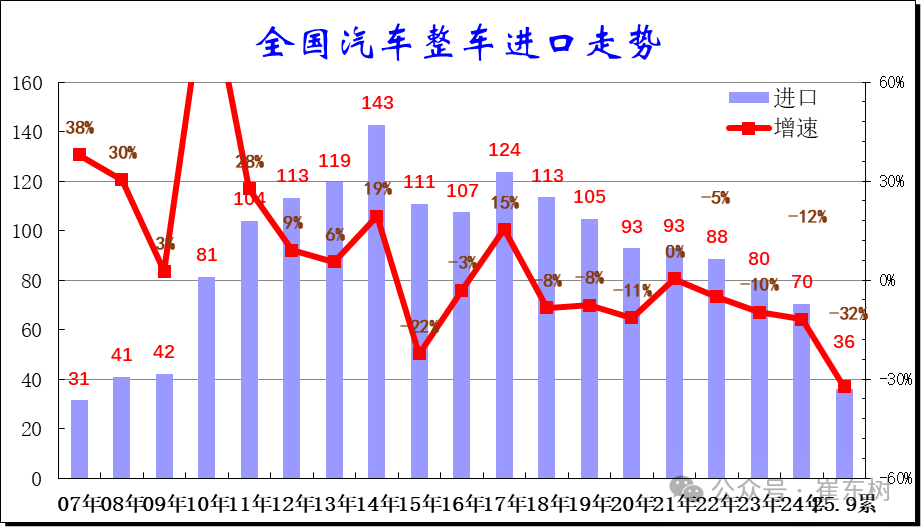
崔东树:2025年1-9月进口汽车36万辆 同比下降32%
智通财经网· 2025-10-28 09:33
Core Insights - The import of automobiles in China is experiencing a significant decline, with a projected 360,000 units imported from January to September 2025, representing a 32% year-on-year decrease. This trend is attributed to the rise of domestic new energy vehicles and a shift towards high-end models, leading to sustained pressure on imported vehicles [1][6][20]. Group 1: Overall Trends in Automobile Imports - The peak of automobile imports occurred in 2014 with 1.43 million units, followed by a continuous decline. The import volume is expected to drop to 700,000 units in 2024, down 12% year-on-year, and further to 360,000 units in the first nine months of 2025, down 32% year-on-year [6][20]. - In September 2025, 41,000 imported vehicles were recorded, marking a 26% decline year-on-year and a 10% decrease from August [1][6]. Group 2: Country-Specific Import Data - The top ten countries for automobile imports in September 2025 included Japan (18,265 units), Germany (10,549 units), and Slovakia (3,832 units). Notably, imports from the U.S. have plummeted, with only 41,736 units imported from January to September 2025, a staggering 52% decrease year-on-year [1][2][20]. - The U.S. vehicle imports saw a dramatic drop in September 2025, with only 1,462 units imported, reflecting an 85% year-on-year decline [2][20]. Group 3: Market Dynamics and Consumer Preferences - The demand for traditional fuel vehicles continues to shrink, with domestic manufacturers benefiting from a low base effect in sales. The market is shifting towards electric vehicles, which has led to a notable decrease in the demand for imported fuel vehicles [2][6][15]. - The luxury car segment showed some improvement in September 2025, with brands like Rolls-Royce and Ferrari performing well, particularly in the Shanghai region [3]. Group 4: Import Structure and Vehicle Types - In the first nine months of 2025, passenger cars accounted for 98% of total imports, with a significant focus on gasoline vehicles, which dominate the market despite the rise of new energy vehicles [12][13]. - The import of electric vehicles has seen a drastic decline, with pure electric vehicle imports dropping by 81% year-on-year in the first nine months of 2025 [14][15]. Group 5: Future Outlook - The ongoing decline in imported vehicles is expected to continue, with challenges in maintaining a reasonable scale of imports and ensuring the security of international supply chains amid complex international relations [2][20].