注意力经济

Search documents
音乐界也有“通货膨胀”了
虎嗅APP· 2026-02-05 14:27
Core Viewpoint - The article discusses the impact of AI and platforms on the music industry, highlighting the phenomenon of "music inflation" where the number of songs vastly outnumbers listeners, leading to devaluation of music and income challenges for individual musicians [5][8]. Group 1: AI Music Production - As of the end of 2024, China's digital music library is expected to reach 263 million songs, with AI music platforms generating millions of songs monthly [5][7]. - The efficiency and low cost of AI music production have led to an oversupply of songs, resulting in a supply-demand imbalance in the music market [9][8]. - AI music creation relies on statistical patterns rather than emotional or artistic inspiration, producing music that aligns with popular trends rather than genuine creativity [12][15]. Group 2: Accessibility and Equality in Music Creation - The barriers to music creation have been significantly lowered, allowing anyone with basic tools to become a "composer," thus democratizing music production [16][18]. - This "artistic equality" benefits many small businesses and content creators who require functional music for various purposes without the need for expensive licensing [22]. Group 3: Economic Implications - The demand for "functional" music has led to a decrease in the fees paid for music production, as AI-generated music can replace traditional composers at a fraction of the cost [25][26]. - The competition in the music industry has intensified, with the cost of music production nearing zero, shifting the focus to gaining attention and streams rather than artistic merit [27][28]. Group 4: Attention Economy and Consumption Patterns - The rise of AI music has transformed music consumption from enjoying full songs to consuming short snippets, leading to a phenomenon where songs become mere background material for other media [32][34]. - This shift has resulted in a loss of collective cultural memory, as listeners may remember catchy snippets but forget the artists or full songs [36][38]. Group 5: Algorithmic Influence on Music - AI music and platform algorithms create a self-reinforcing system where AI-generated content fuels algorithmic recommendations, leading to a homogenization of music [41][44]. - The success of music now heavily depends on its alignment with algorithmic preferences, sidelining traditional evaluation methods like radio play and music reviews [45].


感谢AI和平台,音乐界也有“通货膨胀”了
3 6 Ke· 2026-02-05 12:30
Core Insights - The total number of registered songs in China is projected to reach 263 million by the end of 2024, indicating a significant increase in the digital music library [1] - The rise of AI music generation has led to an explosion in song production, with platforms like Suno generating approximately 7 million songs daily, and domestic platforms producing millions of songs monthly [2] - The oversupply of music, without a corresponding increase in audience size, is leading to music devaluation and income challenges for individual musicians, as well as a crisis in consumer aesthetics [3] Group 1: AI Music Generation - The barrier to music creation has been lowered significantly due to generative AI, allowing anyone with basic digital skills to become a "composer" [14][19] - AI music creation involves statistical modeling rather than emotional or inspirational creativity, resulting in songs that are structurally sound but lack genuine artistic value [12][7] - The relationship between AI music and platform algorithms creates a self-reinforcing system where AI-generated content feeds the algorithm's need for constant new material, leading to a homogenization of music [40][42] Group 2: Market Dynamics and Impacts - The demand for functional music has increased, particularly among small businesses and content creators, who require background music that is cost-effective and easily accessible [23][26] - The financial compensation for music production is declining as AI-generated music becomes a cheaper alternative, impacting the livelihoods of traditional music creators [27][28] - The competition in music creation has intensified, with the cost of production nearing zero, leading to a focus on gaining attention rather than artistic expression [29][32] Group 3: Cultural and Social Implications - The shift towards algorithm-driven music consumption has resulted in fragmented cultural memories, as listeners engage with only snippets of songs rather than complete works [34][38] - The personalization of music recommendations through algorithms may lead to a lack of shared cultural experiences, complicating communication and understanding across different demographics [39] - The dominance of algorithms in defining music success means that traditional evaluation methods, such as media reviews and radio play, are becoming less relevant [43][44]
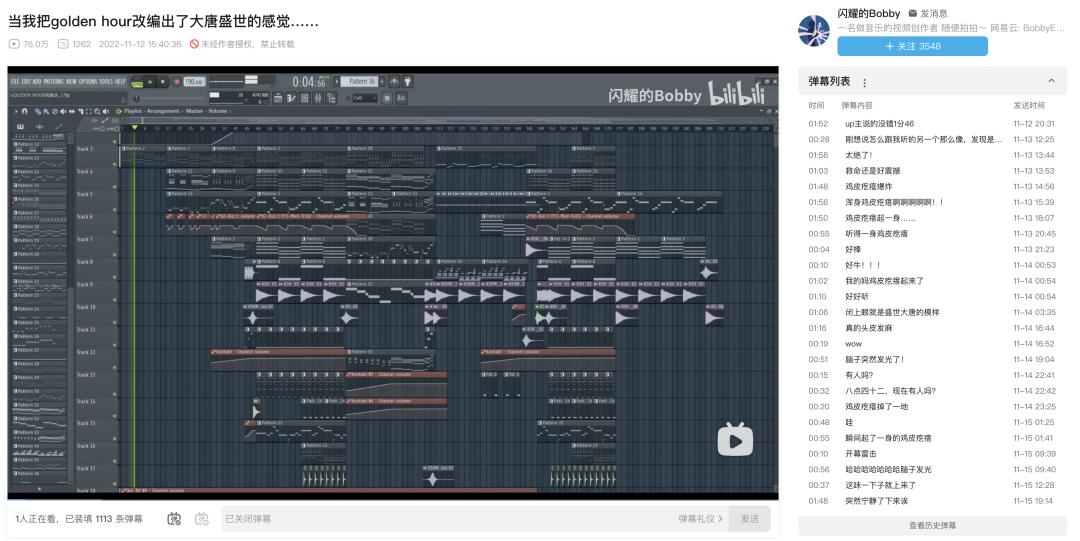
第一批对 ChatGPT 广告的吐槽来了,竟然来自死对头
3 6 Ke· 2026-02-05 04:11
Core Insights - Anthropic launched a series of advertisements during the Super Bowl, directly targeting OpenAI's ChatGPT, indicating a competitive stance in the AI market [1][3] - OpenAI is transitioning from a subscription model to an ad-supported model, driven by high operational costs and the need for sustainable revenue [5][7] Financial Overview - OpenAI raised $40 billion at a valuation of $260 billion, with annual recurring revenue (ARR) expected to reach $200 billion by the end of 2025, while facing operational costs between $8 billion to $12 billion annually [5] - The appointment of Fidji Simo as CEO of Applications signals a strategic shift towards monetization through advertising [7] Advertising Models - The article contrasts three advertising models: Meta's attention economy, Google's intent economy, and OpenAI's emerging action economy [8][10][13] - OpenAI aims to create an "action economy" where advertisements are integrated into user interactions, allowing for direct transactions rather than simple ad clicks [13][15] Competitive Landscape - OpenAI's model seeks to monetize user decision-making, contrasting with Meta's focus on attention and Google's focus on intent [16] - The potential for OpenAI to achieve an average revenue per user (ARPU) of $50 by 2029 could challenge Google's dominance in the advertising space [15][21] User Engagement - OpenAI's strategy involves creating a closed-loop economic system where users can complete purchases directly through AI interactions, enhancing user engagement and monetization [17] - The integration of advertisements into AI responses may lead to subtle and less noticeable advertising, potentially bypassing traditional user defenses against ads [19][21]

为什么这次散户的共识,会形成的如此之快
虎嗅APP· 2026-02-02 10:49
Core Viewpoint - The article discusses the rapid rotation of sectors in the Chinese capital market, highlighting the shift from traditional commodities to chemical and agricultural sectors, and explores the underlying forces that enable retail investors to quickly form consensus on investment opportunities [4][10]. Group 1: Market Dynamics - The recent sector rotation in the Chinese market has been unprecedented in speed, with traditional commodities like gold and silver giving way to chemicals and agriculture [4]. - This rapid rotation is attributed to a global market thirst for commodities and a compressed investment cycle [4]. Group 2: Attention Economy vs. Intent Economy - The past two decades have been characterized by an attention economy, where the focus is on capturing user attention to generate value [5]. - The emergence of AI marks a shift to an intent economy, where the goal is to understand and fulfill user intentions rather than merely capturing attention [5][6]. Group 3: Information Dynamics - In the intent economy, information access has become democratized, allowing retail investors to obtain insights previously available only to institutional investors, leading to "information equality" [6]. - However, this information equality results in an overwhelming amount of similar information, diluting its unique value and predictive power [6][7]. Group 4: Market Behavior and Investor Psychology - The compression of information processing time leads to a phenomenon where investors feel they possess all necessary information but struggle to ascertain its true value, creating a state of "omniscient anxiety" [7]. - The article introduces the concept of "information appearing as lagging," where rapid dissemination of information can lead to misjudgments about market opportunities [7][8]. Group 5: Consensus Formation - The speed of consensus formation among retail investors has accelerated dramatically, with significant shifts occurring in mere days, contrasting with the months or years required in the past [9]. - New influencers in the market leverage simplified narratives to rapidly implant ideas in the minds of retail investors, creating a self-reinforcing cycle of consensus [9][10].

专家热议“十五五”中国文化产业和旅游业高质量发展趋势
Zhong Guo Jing Ji Wang· 2026-02-01 23:06
Core Insights - The report indicates that China's cultural and tourism industries will experience steady progress and high-quality development by 2025, driven by new productive forces and consumption upgrades [1] - The report highlights ten trends in the industry, including the integration of social aesthetics and experiential economy, modernization of cultural narratives, and the digital transformation of industry logic [1] Industry Overview - The report is the first comprehensive annual academic achievement reviewing both cultural and tourism sectors, providing insights into policy trends, industry hot topics, and significant events [1] - It emphasizes the importance of cultural tourism consumption as a key driver for domestic demand recovery and a critical link for internal and external circulation [1] Expert Opinions - Experts noted that the report captures new trends and characteristics in consumption changes and industry innovations, providing essential support for government decision-making and business operations [2] - The report is seen as a guide for strategic planning, policy development, and environmental optimization in the cultural tourism sector [2] Development Trends - Key characteristics of the current cultural and tourism sectors include policy empowerment, technological support, scene implementation, consumer engagement, and quality improvement [3] - The integration of technology and culture, as well as the exploration of full-scenario value, are essential for development during the 14th Five-Year Plan period [3] Future Directions - The industry is expected to focus on the emotional value of experiences, with innovation driving the enhancement of spiritual value and consumer purchasing power [3] - The competition in cultural and tourism consumption will revolve around attention economy, with strategies to capture consumer time being a significant challenge [5] Long-term Perspective - The industry must adopt a long-term view on investment and operations, recognizing the evolving logic of development while maintaining the characteristics of long-termism [6] - The role of individuals in the cultural and tourism sectors will become increasingly important, emphasizing the need for products and experiences that meet consumer demands [6]
《中国文化产业和旅游业年度研究报告(2025)》发布十大趋势
Xin Lang Cai Jing· 2026-01-31 12:17
Core Insights - The report indicates that China's cultural and tourism industries will continue to develop steadily and positively in 2025, maintaining a high-quality growth trend post-recovery [1] - The industries are expected to face challenges such as supply-demand matching, structural adjustments, and regional balance while becoming a key driver of domestic demand recovery and a crucial link in the internal and external circulation [1] Group 1: Industry Trends - The report outlines ten major trends in the cultural and tourism sectors, including modernization of cultural narratives, collaboration between cultural and industrial sectors, digitalization of industry logic, networking of regional functions, assetization of data elements, democratization of creative subjects, stratification of consumer markets, platformization of industry forms, boundary-less integration, and a dual circulation development pattern [1] - The five core characteristics of the current cultural and tourism sectors are identified as policy empowerment, technological support, scene implementation, consumer penetration, and quality improvement of business formats [2] Group 2: Strategic Recommendations - The integration of tourism with daily life is emphasized, suggesting that the industry should break down boundaries and strengthen connections between source and destination, as well as emotional resonance between tourists and local residents [2] - The importance of finding competitive advantages for traditional cultural and tourism enterprises in the new era is highlighted, along with the need for management departments to construct governance paths that align with the digital intelligence era [2] - The competition for consumer attention in cultural and tourism consumption is expected to intensify, with a focus on how to encourage consumers to spend and enhance service quality being crucial for the industry's upgrade [2]
Sensor Tower:2025年全球移动市场应用内购收入达1670亿美元 再创历史新高
智通财经网· 2026-01-30 03:54
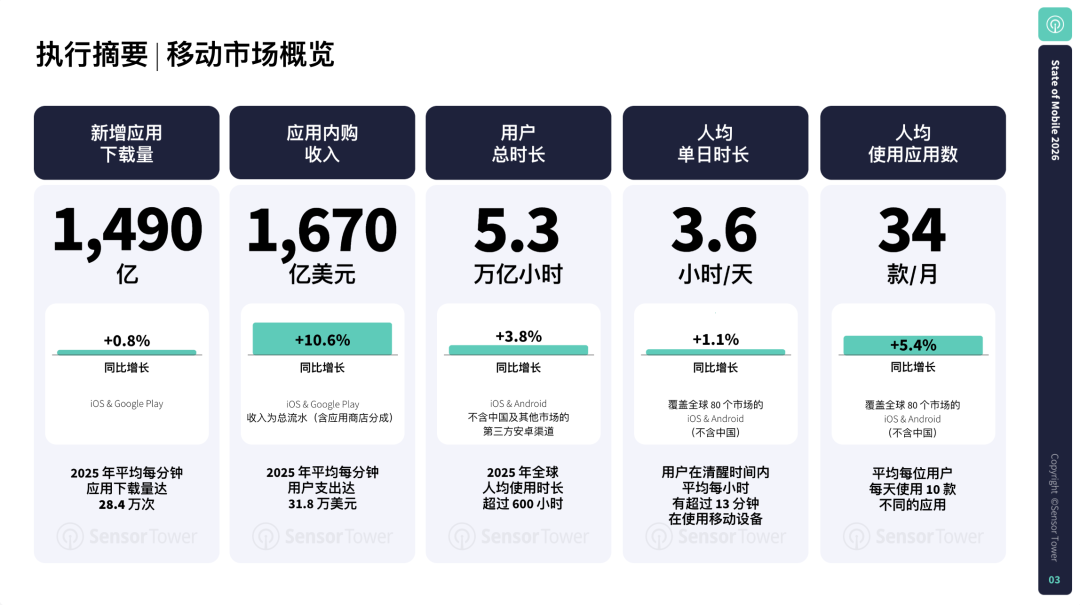
Core Insights - In 2025, the mobile ecosystem is expected to reach historical highs in key metrics driven by generative AI and commercialization opportunities, with global in-app purchase revenue growing by 10.6% to $167 billion, marking a new development phase focused on monetization [1][4]. Group 1: Market Growth and Trends - The mobile app market is maturing, shifting focus from customer acquisition to monetization efficiency, with global downloads from App Store and Google Play slightly increasing by 0.8% to nearly 150 billion [2]. - Total user engagement time on mobile apps is projected to reach 53 trillion hours in 2025, reflecting a 3.8% year-over-year growth, averaging about 3.6 hours per user daily [2]. - In-app purchase and paid app revenue on App Store and Google Play is expected to reach $167 billion, with non-gaming apps surpassing gaming apps in revenue growth, increasing by 21% [4]. Group 2: Regional Insights - The U.S. remains the largest market for mobile revenue, with consumer spending nearing $60 billion, while Western Europe, particularly the UK, Germany, and France, also contributes significantly to global growth [5]. - User engagement trends show divergence across regions, with U.S. usage time increasing by 4% after a previous decline, while China experiences a slight decrease [7][10]. Group 3: Gaming Industry Dynamics - The gaming industry is experiencing its third consecutive year of revenue growth, with in-app purchase revenue approaching $82 billion, reflecting a modest 1.3% increase [8]. - The industry is transitioning from user base expansion to maximizing the value of existing users, focusing on retention, payment structures, and monetization efficiency [10]. Group 4: AI Application Growth - Generative AI applications are witnessing robust growth, with downloads exceeding 3.8 billion, a year-over-year increase of over 100%, and in-app purchase revenue nearing $5 billion, tripling from the previous year [11]. - Cumulative usage time for generative AI applications is projected to reach 48 billion hours, approximately 3.6 times that of 2024, indicating a significant integration into daily user activities [13]. - The volume of user interactions with AI applications is expected to surpass 1 trillion, with growth rates for interactions outpacing download growth, highlighting a shift towards deepening user engagement [15].
莫让强制广告扫走用户体验丨金视角
Xin Lang Cai Jing· 2026-01-24 05:11
Group 1 - The core issue is the negative impact of intrusive advertisements on the user experience of QR code payment systems for parking, which undermines public trust in digital economy [1] - Users are not opposed to commercial information itself, but rather the forced and disrespectful manner in which it is presented, which can erode trust in digital technologies [1] - The article emphasizes the need for a balance between commercial value and user experience, suggesting that advertisements should transition from being a "distraction" to a "service" in the attention economy [1] Group 2 - Regulatory authorities are encouraged to include QR payment interface advertisements in key regulatory areas, focusing on issues like mandatory viewing of ads and difficulty in closing them [2] - Parking lot operators are urged to take responsibility and ensure compliance from their technical partners and advertisers to stop intrusive practices [2] - Suggestions for improving user experience include clearly indicating promotional content next to QR codes and offering incentives for ad viewing, which could enhance user engagement and reduce resistance [2]
莫让强制广告扫走用户体验
Xin Lang Cai Jing· 2026-01-23 22:57
Core Viewpoint - The article highlights the negative impact of intrusive advertising on the user experience of QR code payment systems for parking, emphasizing the need for a balance between commercial interests and user satisfaction [1][2] Group 1: User Experience and Trust - Many users are frustrated by forced pop-up advertisements during QR code payment processes, which detracts from the payment experience [1] - The article argues that such advertising practices undermine public trust in digital technologies and can harm the healthy development of the digital economy [1] Group 2: Regulatory and Operational Recommendations - Relevant authorities should regulate QR code payment interface advertisements, focusing on issues like mandatory viewing of ads and difficulty in closing them [2] - Parking lot operators should be held accountable, ensuring that their technical partners and advertisers comply with legal standards to eliminate disruptive practices [2] Group 3: Enhancing User Choice - If advertisements must be included in payment processes, user rights to information and choice should be prioritized, such as clearly indicating promotional content next to QR codes [2] - Exploring incentive models like discounts for watching ads could improve user acceptance and foster positive interactions between commercial promotion and user experience [2]
错版“马茅”炒上天!帮主郑重:是收藏革命,还是营销“现形记”?
Sou Hu Cai Jing· 2026-01-23 02:26
Core Viewpoint - The recent incident involving the "Ma Miao" zodiac wine from Moutai, which featured a printing error, has sparked significant market interest and speculation, highlighting the interplay between marketing strategies and consumer psychology [1][3]. Group 1: Company Response - Moutai's swift acknowledgment of the printing error and provision of a remedy (either correction or replacement) demonstrates a commitment to maintaining a responsible brand image [3]. - The inclusion of a traditional craft element in the remedy adds a unique narrative to the product, enhancing its perceived value in the eyes of consumers and collectors [3]. Group 2: Market Dynamics - The phenomenon of "error" items stimulating market interest is rooted in a long-standing pricing logic in the collectibles market: "Error" + "Scarcity" = "Premium" [3]. - The limited availability of the misprinted bottles, combined with Moutai's endorsement of the error's authenticity, transforms the product from a mere beverage into a potentially appreciating collectible [3]. Group 3: Consumer and Investor Insights - The premium associated with the misprinted bottles is fragile and could collapse if Moutai's handling of the situation changes or if market enthusiasm wanes [4]. - The incident reflects Moutai's marketing challenges in appealing to younger consumers and maintaining interest in its cultural products, especially as the zodiac wine market cools [4]. - The focus on a trivial error rather than the product's core value (consumption) serves as a cautionary tale for consumers and investors, indicating a shift from genuine consumption to speculative behavior [4]. Group 4: Strategic Recommendations - Consumers should distinguish between "consumption" and "investment," purchasing at official prices for enjoyment rather than speculative gain [5]. - Investors are advised to look beyond the surface of this event and maintain their long-term value assessment of Moutai's core business, which remains robust despite challenges in new product lines [5]. - The strategy of turning defects into scarcity can be observed across various sectors, prompting market participants to critically evaluate the true value behind premium pricing [5].