
经济稳定增长

Search documents
何立峰会见清华大学经济管理学院顾问委员会委员代表
Xin Hua She· 2025-10-16 10:04
Core Viewpoint - China is advancing the construction of a unified national market and is committed to expanding high-level opening-up, aiming for stable economic growth and deepening mutually beneficial cooperation with countries worldwide [1] Group 1: Economic Development - The Chinese government is focused on achieving stable economic growth through the promotion of a unified national market [1] - There is an emphasis on high-level opening-up to enhance international cooperation and share opportunities for high-quality development [1] Group 2: International Cooperation - Tim Cook, the chairman of the advisory committee, expressed confidence in China's development prospects and a commitment to deepening investment and cooperation in the Chinese market [1] - The advisory committee members are encouraged to act as a bridge to support China's economic development and international exchanges [1]
央行:有效落实好各类结构性货币政策工具 扎实做好金融“五篇大文章”
智通财经网· 2025-09-26 11:24
Core Viewpoint - The People's Bank of China (PBOC) emphasizes the need for monetary policy to support the real economy, enhance financial stability, and address challenges in domestic demand and low inflation levels [3][4][5]. Monetary Policy and Economic Environment - The PBOC's monetary policy has been moderately loose this year, with a focus on counter-cyclical adjustments and the effective use of various monetary policy tools to support high-quality economic development [3][4]. - The loan market quotation rate reform is showing positive effects, and the social financing costs are at historically low levels [3]. - The external economic environment is becoming more complex, with weakening global growth and increasing trade barriers, while domestic economic performance shows steady improvement [3][4]. Financial Sector Support - Large banks are encouraged to play a leading role in serving the real economy, while small and medium-sized banks should focus on their core responsibilities and enhance capital strength [5][6]. - Structural monetary policy tools will be effectively implemented to support key areas such as technological innovation, consumption, small and micro enterprises, and foreign trade [5][6]. - Continuous support for the development of the private economy and small enterprises is emphasized, with efforts to remove financing obstacles for small and micro businesses [5][6]. Real Estate Market Stability - The PBOC aims to stabilize the real estate market by enhancing the financial infrastructure and revitalizing existing properties and land [5][6]. - The meeting highlights the importance of implementing existing financial policies effectively to maintain stability in the real estate sector [5][6]. Policy Implementation and Coordination - The PBOC plans to strengthen monetary policy adjustments, ensuring that the implementation of policies is timely and effective [4][6]. - There is a focus on maintaining liquidity, guiding financial institutions to increase credit supply, and ensuring that social financing growth aligns with economic growth and price stability [4][6]. - The meeting underscores the need for macroeconomic policy coordination to enhance domestic demand and stabilize expectations [6].
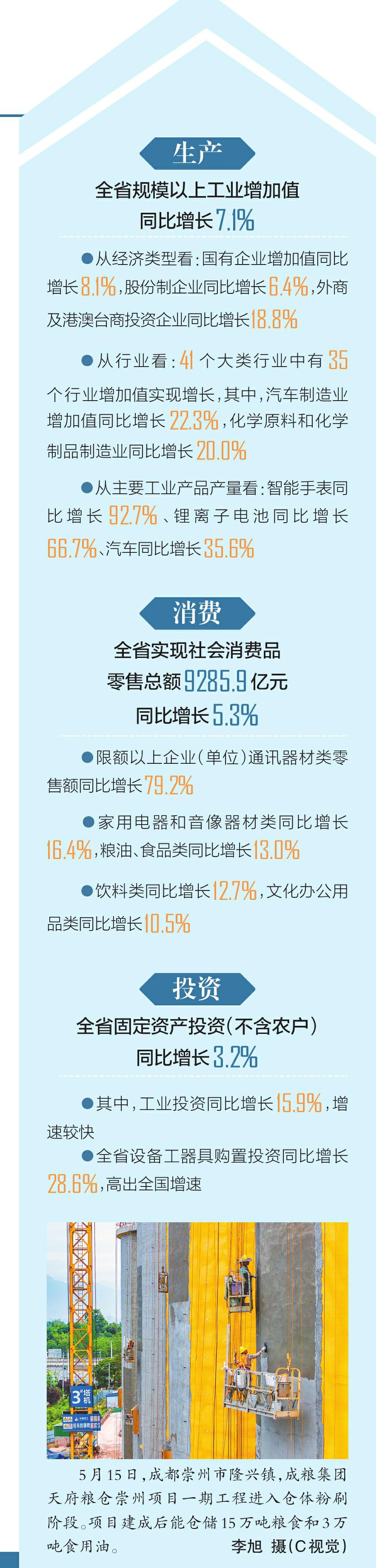
前4月各项主要经济指标发布 稳定增长 彰显发展韧性
Si Chuan Ri Bao· 2025-05-21 00:17
Production - The industrial added value of large-scale enterprises in Sichuan province increased by 7.1% year-on-year in the first four months, indicating strong industrial economic growth [8][10] - Among 41 major industries, 35 reported an increase in added value, with notable growth in the automotive manufacturing industry at 22.3% and chemical raw materials and products manufacturing at 20.0% [10][11] - The production of smartwatches surged by 92.7%, lithium-ion batteries by 66.7%, and automobiles by 35.6% [15] Consumption - The total retail sales of consumer goods in Sichuan reached 928.5 billion yuan, growing by 5.3% year-on-year [4][11] - Retail sales in the telecommunications equipment category increased by 79.2%, while home appliances and audio-visual equipment grew by 16.4% [4][12] - The growth in retail sales reflects the effectiveness of policies aimed at stimulating consumer demand [11][12] Investment - Fixed asset investment (excluding rural households) in Sichuan rose by 3.2% year-on-year, with industrial investment increasing by 15.9% [11][13] - Investment in equipment and tools saw a significant increase of 28.6%, outpacing the national growth rate [13] - The province has implemented policies to support economic recovery, particularly in the automotive and commercial sectors [13][14]

4月经济实现稳定增长:出口表现好于预期,规上工业增长6.1%
2 1 Shi Ji Jing Ji Bao Dao· 2025-05-19 09:27
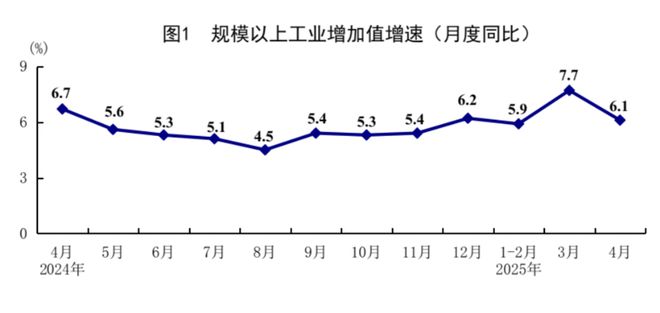
Economic Overview - In April, major economic indicators such as industrial added value, service production index, and retail sales showed a slight decline compared to March, but overall performance remained stable, contributing to an upward trend in some indicators from January to April [1][3] - The industrial added value in April grew by 6.1% year-on-year, a decrease of 1.6 percentage points from March, while the growth for January to April was 6.4%, down by 0.1 percentage points from the previous quarter [1][3] Service Sector Performance - The service production index in April increased by 6.0% year-on-year, down 0.3 percentage points from March, while the growth for January to April was 5.9%, slightly up by 0.1 percentage points from the previous quarter [3] - Retail sales of consumer goods in April rose by 5.1% year-on-year, a decline of 0.8 percentage points from March, with a growth of 4.7% for January to April, which is an increase of 0.1 percentage points from the previous quarter [3] Trade and Export Dynamics - The total import and export value in April, measured in RMB, grew by 5.6% year-on-year, down 0.3 percentage points from March, while the growth for January to April was 2.4%, an increase of 1.1 percentage points from the previous quarter [6] - Exports in April increased by 9.3% year-on-year, despite a 4.1 percentage point decline from March, leading to a 7.5% growth in exports for January to April, up by 0.6 percentage points from the previous quarter [6][7] Impact of Tariffs - The significant increase in tariffs on exports to the U.S. has impacted trade, with exports to the U.S. in April totaling $33.024 billion, a year-on-year decrease of 21.2%, and a total of $148.602 billion for January to April, down 2.5% year-on-year [7] - Despite the tariff impacts, the resilience of exports was noted, attributed to factors such as "export grabbing" in markets outside the U.S. and the delayed implementation of high tariffs [8][9] Investment Trends - Fixed asset investment in January to April grew by 4%, a slight decline of 0.2 percentage points from the previous quarter [7] - The macroeconomic policies have been supportive, allowing for stable economic growth despite external shocks, with industrial production continuing to show rapid growth [10]
新世纪期货交易提示(2025-4-28)-20250428
Xin Shi Ji Qi Huo· 2025-04-28 03:26
Report Industry Investment Ratings - Iron ore: Recommend shorting at high prices [2] - Coking coal and coke: Sideways [2] - Rebar and wire rod: Sideways [2] - Glass: Sideways [2] - Soda ash: Sideways [2] - Shanghai Stock Exchange 50 Index: Rebound [2] - CSI 300 Index: Sideways [4] - CSI 500 Index: Upward [4] - CSI 1000 Index: Upward [4] - 2 - year Treasury bond: Sideways [4] - 5 - year Treasury bond: Sideways [4] - 10 - year Treasury bond: Sideways [4] - Gold: Sideways [4] - Silver: Sideways [4] - Soybean oil: Sideways [4] - Palm oil: Sideways [4] - Rapeseed oil: Sideways [6] - Soybean meal: Sideways to weak [6] - Rapeseed meal: Sideways to weak [6] - Soybean No. 2: Sideways to weak [6] - Soybean No. 1: Sideways [6] - Rubber: Sideways [6] - Pulp: Weak sideways [6] - Logs: Sideways [7] - PX: Wait - and - see [7] - PTA: Wait - and - see [7] - MEG: Operate in the low - range [7] - PR: Wait - and - see [7] - PF: Wait - and - see [7] - Plastic: Sideways [7] - PP: Sideways [7] - PVC: Sideways [8] Core Viewpoints - The iron ore market is affected by tariff disturbances and potential crude steel production restrictions, with supply expected to increase in Q2 and demand facing uncertainties [2] - The coking coal and coke market is under pressure due to high domestic production, poor steel spot sales, and unfulfilled price increases [2] - The rebar market is in a neutral valuation, with supply contraction expected from production restrictions and weakening demand [2] - The glass market has cost increases in the far - month contracts, but demand remains weak due to the real estate adjustment [2] - The stock index market shows positive signs with improved corporate profits and policy support, and long - positions can be held [4] - The Treasury bond market has a complex situation with flat yields and changing short - term rates, and long - positions can be reduced [4] - The precious metal market is influenced by central bank purchases, inflation, and geopolitical factors, with short - term uncertainties [4] - The oil and fat market is facing supply increases from Southeast Asian palm oil and South American soybeans, and is expected to be volatile [4][6] - The rubber market has supply increases and weakening demand, and is expected to be weak sideways [6] - The pulp market has falling costs and weak demand, and is expected to be weak [6] - The log market has marginal improvement in fundamentals and is expected to be sideways [7] - The petrochemical products market is affected by raw material prices, supply - demand relationships, and geopolitical factors, with different trends for each product [7][8] Summary by Categories Black Industry - **Iron ore**: Supply is expected to increase in Q2 as weather improves and mine maintenance ends. Steel mills may replenish stocks before the May Day holiday, but export is still under pressure due to anti - dumping and tariffs. Radical investors can hold the Iron Ore 09 contract [2] - **Coking coal and coke**: Domestic coking coal production is high, and the market is affected by tariffs and poor steel sales. Coke production has increased, but the second price increase has not been implemented. The overall market follows the trend of finished steel products [2] - **Rebar and wire rod**: After the tariff impact at the beginning of the month, the market is cautious. Supply may contract due to production restrictions, and demand is showing signs of peaking, especially in exports [2] - **Glass**: Cost increases in the far - month contracts due to energy - source conversion. Supply has slightly decreased, and demand is still weak due to the real estate adjustment. Inventory has been decreasing, but pressure remains [2] - **Soda ash**: No specific additional information other than the rating of sideways [2] Financial Industry - **Stock Index**: Industrial enterprise profits have improved, and the government emphasizes policy support. With the stabilization of the external market and reduced risk - aversion sentiment, long - positions can be held [4] - **Treasury Bond**: Yields are flat, short - term rates are changing, and the central bank conducts reverse - repurchase operations. With the easing of risk - aversion, long - positions can be reduced [4] - **Precious Metals**: Gold's pricing mechanism is changing, influenced by central bank purchases, inflation, and geopolitical factors. Silver is also affected by market sentiment and economic data, with short - term uncertainties [4] Oil and Fat Industry - **Soybean oil, palm oil, and rapeseed oil**: Southeast Asian palm oil is in the production - increasing season, and South American soybeans have a record harvest. Supply is expected to increase, and the market is expected to be volatile [4][6] - **Soybean meal and rapeseed meal**: With a large amount of imported soybeans arriving in Q2, supply will increase, and demand may become more cautious after short - term stocking. The market is expected to be weak sideways [6] - **Soybean No. 1 and No. 2**: Supply will gradually become more abundant as South American soybeans arrive, and the market is expected to be sideways to weak [6] Soft Commodities - **Rubber**: Supply is increasing as the production season starts, and demand is weakening with the approaching May Day holiday. Inventory is still relatively high, and the market is expected to be weak sideways [6] - **Pulp**: The cost of raw materials is decreasing, and demand from the paper - making industry is weak. The market is expected to be weak [6] - **Logs**: The fundamentals are improving marginally, and the market is expected to be sideways [7] Petrochemical Industry - **PX and PTA**: Prices are affected by raw material prices, supply - demand relationships, and geopolitical factors, and the market is in a wait - and - see state [7] - **MEG**: Supply and demand are currently not bad, but the market is volatile due to macro - sentiment fluctuations [7] - **PR and PF**: The PR market is strong due to factory support, and the PF market may be slightly warmer but faces pressure [7] - **Plastic, PP, and PVC**: These markets are affected by raw material prices, supply - demand relationships, and potential tariff policies. They are expected to be sideways, with inventory and production - capacity utilization being important factors [7][8]