
文化办公用品

Search documents
1-2月投资消费数据点评:内生动能渐次回归,弱复苏格局深化
金融街证券· 2026-03-18 11:07
Consumption Insights - In January-February 2026, the total retail sales of consumer goods increased by 2.8% year-on-year, a significant rebound from 0.86% in December 2025[1] - Core consumption, excluding automobile sales, grew by 3.7%, returning to levels seen in the second half of 2024[1] - Current potential consumption growth is estimated to be in the range of 4%-5%, with core consumer goods growth nearing the lower bound of this range[5] Investment Trends - Fixed asset investment increased by 1.8% year-on-year in January-February 2026, with infrastructure investment rising by 11.4% and manufacturing investment by 3.1%, while real estate development investment fell by 11.1%[2] - The share of private investment in fixed asset investment has been declining, dropping to 50.1% in 2024, and is expected to fall below 50% in 2025[4] - Private fixed asset investment decreased by 2.6% year-on-year, but the decline is less severe compared to a 6.4% drop in 2025, indicating a gradual accumulation of internal growth momentum[10] Policy and Financial Support - Special bonds for local governments are expected to maintain a high issuance quota of 4.4 trillion yuan in 2026, with 82.42 billion yuan issued in January-February, a 38.1% increase year-on-year[13] - The government is focusing on using special bonds for project investment rather than resolving existing risks, which may alleviate funding constraints for local investments[3] - Policy tools such as long-term special bonds and structural monetary policy are being utilized to support infrastructure and manufacturing investments[11] Risks and Outlook - Risks include potential unexpected declines in consumption, insufficient policy support, and weak recovery of internal growth momentum[20] - The overall investment environment is in a weak recovery phase, with the sustainability of effective investments relying on internal growth dynamics[19]
社零数据点评:1-2月社零+2.8%,消费开年温和复苏
HUAXI Securities· 2026-03-17 11:37
Investment Rating - Industry rating: Recommended [4] Core Insights - The retail sales of consumer goods in January-February 2026 increased by 2.8% year-on-year, slightly above the consensus expectation of 2.7% [1] - The real estate sector showed significant declines in new construction, completion, sales area, and development investment, with year-on-year decreases of 23.3%, 26.9%, 15.9%, and 10.7% respectively [1][2] - The furniture and cultural office supplies sectors experienced growth rates of 8.8% and 5.8% respectively, indicating a structural recovery in the home goods market [2] - The cosmetics sector saw retail sales of 75.3 billion yuan, with a year-on-year increase of 4.5%, although February faced temporary pressure due to logistics delays and decreased consumer demand [3][6] - The gold and jewelry retail sector reported a retail sales increase of 13.0% year-on-year, supported by rising gold prices and a recovering economy [6] Summary by Category Home Goods - The real estate market is stabilizing, with expectations of recovery supported by ongoing policies and macroeconomic stability [2] - The home goods market is benefiting from trade-in subsidies, activating consumer demand [2] - Key companies to watch include Oppein Home and Mousse, which have strong channel capabilities and product innovation [7] Cosmetics - The cosmetics market is expected to recover, driven by consumer upgrade trends and the upcoming 618 shopping festival [3] - Brands with strong cultural characteristics and clear improvement trends are recommended, such as Maogeping and Lin Qingxuan [7] Gold and Jewelry - The gold and jewelry sector is expected to maintain resilience, particularly among high-end and youth-oriented brands [6] - Companies with strong brand premiums and differentiated pricing models, such as Laopu Gold, are highlighted for investment [7]
开年经济的温度
HUAXI Securities· 2026-03-16 12:25
Economic Performance - Industrial added value increased by 6.3% year-on-year in January-February, exceeding the expected 5.0%[1] - Fixed asset investment rose by 1.8% year-on-year, against an expected decline of 4.2%[1] - Retail sales of consumer goods grew by 2.8% year-on-year, surpassing the expected 2.1%[1] Supply and Demand Dynamics - The weighted year-on-year growth of industrial and service production indicators was 5.6%, rebounding by 0.5 percentage points from December[1] - The gap between supply and demand narrowed from 9.6 percentage points to 2.5 percentage points[1] External Demand and Exports - Industrial export delivery value surged by 6.3%, the highest growth rate since April of the previous year, contributing 0.7 percentage points to industrial added value[2] - The expected annual export growth rate has been revised upward from 3-5% to around 6%[2] Consumer Spending Trends - Retail sales growth for services reached 5.6%, significantly higher than the 2.5% growth for goods[2] - Automobile sales negatively impacted retail performance, contributing a drag effect of 2.2 percentage points on retail sales[3] Infrastructure and Investment - Fixed asset investment increased by 1.8%, with infrastructure investment growing at 11.4%, outperforming manufacturing and real estate investments[4] - State-owned investment rose by 7.7% year-on-year, significantly higher than the previous year's decline of 2.5%[4] Real Estate Market Insights - Real estate sales area and sales value showed better-than-seasonal performance, with sales area declining by only 1.1% month-on-month[5] - New home prices in first-tier cities saw a reduced decline of 0.1% month-on-month, indicating a stabilization trend[5] Overall Economic Outlook - The economic data indicates improvements in consumption and investment, particularly in infrastructure, driven by state-owned enterprises[6] - The real estate sector shows signs of recovery, although challenges remain due to previous weak sales and limited land acquisition by developers[6]
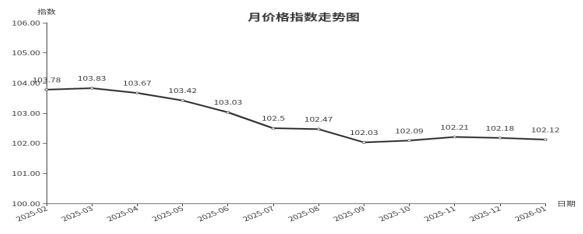
2026年1月临沂商城月价格总指数为102.12点,环比下跌0.06点
Zhong Guo Fa Zhan Wang· 2026-02-24 06:36
Core Viewpoint - The overall price index of Linyi Mall decreased slightly this month, indicating a mixed trend in various product categories with some experiencing price increases while others saw declines [1][13]. Price Index Summary - The total price index for Linyi Mall is 102.12 points, down 0.06 points month-on-month, a decrease of 0.06%, and down 1.72 points year-on-year, a decrease of 1.66% [1]. - Among 14 categories, 6 experienced price increases, 2 remained stable, and 6 saw price declines [3]. Category-Specific Price Changes Building and Decoration Materials - The price index for building and decoration materials rose to 107.90 points, an increase of 1.41 points month-on-month [5]. - The increase was driven primarily by the rise in prices of decorative materials, which increased by 1.50 points, while structural materials saw a slight decline [6]. Hardware and Electrical Materials - The price index for hardware and electrical materials reached 119.99 points, up 0.20 points month-on-month [9]. - The increase was influenced by a significant rise in copper prices, which raised production costs for electrical cables, leading to higher selling prices [9]. Educational and Office Supplies - The price index for educational and office supplies fell to 106.60 points, down 2.02 points month-on-month [10]. - The decline was mainly due to a significant drop in the prices of sports and entertainment products, which decreased by 5.09 points [10]. Steel Products - The price index for steel products decreased to 95.29 points, down 0.39 points month-on-month [12]. - The decline was attributed to weak demand in the real estate market, leading to reduced end-user demand and a cautious outlook among market participants [12].

西南证券:新经济、新动能行业洞察系列(二):新消费演进中的价格与产业洞察
Sou Hu Cai Jing· 2026-02-21 14:27
Group 1 - The report highlights that "new consumption" is driven by information technology and focuses on quality and personalization, serving as a strategic pillar for domestic demand circulation and enhancing its strategic position as policies continue to strengthen [1][8][17] - Since 2023, final consumption expenditure has consistently contributed the most to GDP, with a stable contribution rate around 3%, significantly higher than developed economies [1][25][28] - Service consumption is showing strong growth momentum, with retail sales of services expected to outpace goods retail sales by 1.7 percentage points in 2025, indicating a shift towards experience-based consumption [1][29][31] Group 2 - The restructuring of CPI weights reflects a shift in consumer spending from basic necessities to quality upgrades, with significant increases in the weights of housing, transportation, and communication categories from 2021 to 2025 [2][3][22] - New consumption is providing an upgrade path for industrial development, with policies transitioning from broad expansion to precision targeting, effectively stimulating mid-to-upstream industries [2][4][18] - Rural consumption is becoming a core scene for new consumption, with retail sales in rural areas expected to grow at a rate of 4.1% in 2025, outpacing urban areas for four consecutive years [2][4][39] Group 3 - The report indicates that new consumption is reshaping the economic landscape by enhancing supply-demand matching efficiency, which in turn supports price stability and drives industrial upgrades [16][22][23] - The analysis of consumer spending shows that healthcare and other services are experiencing the highest growth rates, while traditional categories like food and clothing are growing at a slower pace [31][39] - The report emphasizes that the new consumption model is characterized by digital technology and innovation, which reduces reliance on traditional economic cycles and provides new growth momentum for the economy [22][23][24]


2025年我国规上轻工业增加值同比增长5.3%
Xin Hua Wang· 2026-02-03 12:35
Core Insights - The light industry in China is expected to maintain a stable economic operation in 2025, with a year-on-year growth of 5.3% in added value for large-scale light industry [1] - The light industry accounts for 13% of national industrial assets, contributing to 16.5% of national industrial revenue and 18.8% of profits [1] Group 1: Economic Performance - In 2025, the added value growth rates for certain sectors are projected to exceed 20%, including electric vehicles, batteries, and plastic furniture manufacturing [1] - The agricultural and food processing industries are expected to see added value growth of 5.6% and 5.3% respectively [1] - Among 90 major light industrial products, 35 are expected to see production increases, with electric bicycle production growing by 21.6% and solar cell production by 7.6% [1] Group 2: Domestic Consumption - Retail sales of 11 categories of light industrial goods are projected to reach 86,719 billion yuan, reflecting a year-on-year growth of 7.8% [1] - Specific categories such as home appliances and audio-visual equipment are expected to see retail sales growth of 11%, while furniture sales are projected to grow by 14.6% and cultural office supplies by 17.3% [1] Group 3: Export Performance - Among 22 major export categories in the light industry, 11 are expected to see year-on-year growth in export value [1] - Exports of batteries and battery parts are projected to reach 84.73 billion USD, with a growth of 22.3%, while daily chemical products and light machinery are expected to grow by 10.9% and 11.6% respectively [1] Group 4: Future Outlook - The President of the China Light Industry Federation, Zhang Chonghe, indicates that in 2026, the light industry will continue to show resilience and stable development due to ongoing economic stabilization and consumption promotion policies [2] - The light industry is expected to exhibit overall stability and differentiated growth characteristics, maintaining a medium-speed growth trend [2]
山东消费市场“稳中有进”,2025年零售总额超4.2万亿元
Feng Huang Wang Cai Jing· 2026-01-28 07:16
Core Insights - In 2025, Shandong province implemented a series of policies to promote the replacement of old consumer goods, effectively stimulating market vitality and optimizing consumption structure, achieving a total retail sales of consumer goods of 42,082.9 billion yuan, a year-on-year increase of 5.1% [1] Group 1: Retail Performance - Urban retail sales reached 35,220.9 billion yuan, growing by 5.0% year-on-year, while rural markets showed stronger performance with retail sales of 6,861.9 billion yuan, a growth rate of 5.5%, indicating coordinated growth between urban and rural consumption [1] - Retail sales of goods amounted to 37,467.0 billion yuan, increasing by 5.1%, while catering revenue reached 4,615.9 billion yuan, up by 4.5% [1] Group 2: Essential Goods - Basic living goods continued to play a stabilizing role, with retail sales of grain and oil, beverages, tobacco and alcohol, and daily necessities increasing by 10.0%, 12.6%, 12.9%, and 17.4% respectively, collectively accounting for 22.2% of retail sales above the designated size, contributing 2.4 percentage points to overall retail sales growth [1] Group 3: Upgrading Consumption - The sales of upgraded consumer goods showed positive trends, with retail sales of gold, silver, and jewelry, sports and entertainment products, and cultural and office supplies increasing by 9.6%, 12.4%, and 22.8% respectively, together contributing 0.6 percentage points to retail sales growth, an increase of 0.3 percentage points compared to the previous year [2] Group 4: Replacement Goods - Retail sales of communication equipment surged by 29.8%, while home appliances and audio-visual equipment, and furniture grew by 12.0% and 12.9% respectively, with new energy vehicle sales also increasing by 8.7%, collectively driving a 2.9 percentage point increase in retail sales above the designated size [1]
2026年宏观经济展望——全球经济再平衡|宏观经济
清华金融评论· 2026-01-25 09:20
Economic Outlook - The core viewpoint of the article emphasizes a recovery in prices and a stable GDP growth rate of around 5% for 2026, aligning with expectations. Inflation indicators are expected to gradually improve, leading to better corporate profits and household incomes. Overall, a trend of oscillating recovery is anticipated, with a key turning point expected in the second to third quarter when the comprehensive price level is projected to turn positive from negative [1][8]. GDP and Economic Growth - In 2025, China's GDP is expected to achieve a growth rate of 5%, with a similar outlook for 2026. Notably, the relationship between nominal GDP and real GDP is changing, with both showing a gradual recovery. A significant turning point is anticipated in the second to third quarter, where nominal GDP is expected to surpass real GDP, indicating a positive growth in overall inflation indicators [3]. Consumer Market - The "trade-in" policy for consumer goods has played a crucial role in supporting consumption. In 2025, the total retail sales of social consumer goods are projected to grow by approximately 3.7%, with categories related to the "trade-in" policy, such as communication equipment and home appliances, showing rapid growth. The policy's effects are expected to continue into 2026, with an expansion of coverage to include smart products and AI glasses [4]. Manufacturing Sector - The "14th Five-Year Plan" emphasizes maintaining a stable proportion of manufacturing in the economy. China's manufacturing sector is leading among major industrial countries, with improvements in quality and efficiency reflected in rising labor productivity. Emerging industries, including AI, big data, and biomedicine, are expected to drive future growth [4]. Real Estate Market - During the "14th Five-Year Plan" period, the focus in the real estate sector will be on inventory reduction. Although the inventory of unsold commercial housing has decreased, there remains a need for further de-stocking. Various policy tools have been prepared to support this, including central bank loans for affordable housing and special bonds for inventory reduction [5]. Infrastructure Investment - Debt reduction is crucial for infrastructure investment. The article categorizes provinces into "debt reduction" and "economic powerhouse" regions, noting that investment growth has been higher in economic powerhouse provinces. As debt reduction efforts progress, investment space in relevant provinces is expected to be released. New policy financial tools introduced recently are anticipated to positively impact infrastructure investment [6]. Export Performance - China's export growth has been unexpectedly strong, with a projected 5% increase in 2025 and a trade surplus of approximately $1 trillion. The resilience in exports is attributed to diversification and structural upgrades in the industry. The share of exports to the U.S. has decreased from nearly 20% to 11%, while exports to ASEAN countries have risen to 17% [7]. Monetary and Fiscal Policy - The fiscal policy for 2025 is described as very proactive, with a deficit rate of about 4% and an increase in special bond quotas. For 2026, fiscal policy is expected to remain expansive, focusing on structural optimization and potentially easing local financing restrictions [12]. Capital Market Trends - The domestic A-share market has shown an upward trend, particularly in the technology sector. The global capital markets have also experienced varying degrees of growth, with emerging markets performing notably well. The article suggests that these trends are likely to continue into 2026, driven by a weak dollar environment [14]. Currency and Gold Market - Since November 2025, the RMB has strengthened significantly, supported by a large trade surplus and increased demand for the currency. The article anticipates a continued moderate appreciation of the RMB in 2026. Additionally, gold prices have been rising, reflecting both its monetary and credit attributes, suggesting that gold will maintain its investment value in 2026 [15][16].
中国经济微观察 “两新”政策加力提效 供需良性循环增强发展后劲
Ren Min Wang· 2026-01-23 17:42
Core Insights - The "Two New" policies in China are effectively driving investment and consumption, optimizing supply structure, and enhancing economic quality, providing a solid foundation for stable and long-term economic growth [1] Investment Sector - Equipment investment is experiencing strong growth, with a year-on-year increase of 11.8% in 2025, contributing 1.8 percentage points to overall investment growth and accounting for 18.0% of total investment, an increase of 2.5 percentage points from the previous year [2] - The growth in equipment investment is attributed to a combination of government policies, such as fiscal subsidies and tax incentives, and proactive responses from enterprises in the manufacturing and high-tech sectors [2] - This investment is not only expanding production capacity but also driving the digitalization, intelligence, and greening of production systems, thereby enhancing the resilience and safety of the industrial supply chain [2] Consumption Sector - The "old-for-new" consumption policy has been significantly strengthened in 2025, stimulating potential consumer demand and promoting the optimization of consumption structure, with retail sales of consumer goods above designated size increasing by 3.4% year-on-year, accelerating by 0.7 percentage points from the previous year [3] - Key trends in consumption include: - Green and smart products becoming the main theme, with retail sales of communication equipment and cultural office supplies growing by 20.9% and 17.3% respectively [4] - Home furnishings seeing a 14.6% increase in retail sales, significantly up by 11 percentage points from the previous year [4] - New energy vehicle retail sales reaching 12.809 million units, a 17.6% year-on-year increase, with a penetration rate of 53.9%, up 6.3 percentage points from the previous year [4] Mechanism and Policy Integration - The success of the "Two New" policies is attributed to their integration with industrial, technological, and environmental policies, creating a virtuous cycle of investment, supply enhancement, demand creation, and re-investment [5] - The policies effectively address structural contradictions in the market, such as overcapacity in some industries and insufficient high-end supply, accelerating the marketization of new technologies and products [5] - The policies are also aligned with the "dual carbon" goals, promoting energy efficiency and reducing pollution, thus facilitating a comprehensive green transformation of economic and social development [6] Future Outlook - The ongoing implementation of the "Two New" policies is expected to further release their synergistic effects, solidifying the economic recovery and supporting the cultivation of new productive forces, the construction of a modern industrial system, and the achievement of carbon neutrality goals [6]
内外需增长斜率分化,关注出口和科技共振方向
China Post Securities· 2026-01-22 05:41
Economic Growth - China's GDP growth for 2025 is projected at 5%, achieving the annual economic growth target[2] - Quarterly GDP growth rates show a trend of high to low, with rates of 5.4%, 5.2%, 4.8%, and 4.5% respectively[9] Demand and Consumption - Retail sales growth in December was 0.9%, continuing a trend of marginal decline for seven consecutive months[14] - Consumer confidence remains low, with household short-term loans decreasing by CNY 1,023 billion in December 2025, a drop of CNY 16,113 billion compared to 2024[15] Investment Trends - Fixed asset investment growth fell to -3.8% for the year, a decline of 1.2 percentage points from the previous value[21] - Real estate investment saw a significant drop of 17.2% year-on-year, indicating a deep adjustment in the market[21] Export and Production - Industrial added value in December grew by 5.2%, with a notable increase in high-tech industries[27] - Export delivery value increased by 3.2% in December, correlating with the rise in industrial output[27] Policy and Future Outlook - The government aims to stabilize investment, with significant policy tools already deployed to support infrastructure projects[23] - The export momentum is expected to continue into 2026, remaining a key driver of economic growth[30]