股票风险溢价

Search documents
负债驱动资金之二:股债比价视角看A股行情的起点与终点
ZHONGTAI SECURITIES· 2025-08-05 05:46
Report Industry Investment Rating - The report does not explicitly mention the industry investment rating. Core Viewpoints - The extreme divergence between credit spreads and stock risk premiums led to the starting point of the current A-share valuation expansion. The current round of A-share market is driven by funds, and the logic has only reached the middle stage, with the upward trend unfinished [2]. - The fact that the risk premium has reached "mean - 1 standard deviation" does not mean the end of the market. Considering the intensity and duration of the current round of fund - driven, A - share valuations are expected to continue to expand, driving the risk premium to decline further, and the risk - compensation returns of stocks and bonds will eventually converge [2][5]. Summary by Directory 1. Historically, the stock market risk premium can stay below "mean - 1 standard deviation" for a long time - There were several historical periods when the stock market risk premium fell below "mean - 1 standard deviation", such as from December 2014 to August 2015, November 2017 to February 2018, and September 2020 to April 2021, with durations of 9 months, 2 months, and 8 months respectively. Except for the 2017 - 2018 period when the risk premium could not continue to decline due to rapid liquidity withdrawal, in other periods, it could fall to around "mean - 2 standard deviations" or even lower [3]. - These historical periods had similar macro - environments that did not support a bull market in stocks. The factors driving the significant expansion of A - share valuations were not fundamental but fund - driven, and there was no continuous expansion of corporate profits [3]. 2. In the current round of the market, the indexes have expanded to varying degrees, and there are no signs of an end - Since the beginning of the year, the stock market has priced in the decline of the risk - free rate. Different sectors have different repair progress. The repair of large - cap stocks is relatively large, with the ERP basically reaching "mean - 1 standard deviation", while the ERP of small - and medium - cap stocks is still above the historical mean [4]. - The current round of valuation expansion also starts from changes in the capital side. Since September 2024, the economic fundamentals and corporate profit growth have been weak, and the monetary policy has been relatively loose. The core factor determining the start and end of the market is the sustainability of fund - driving. The current round of fund - driven logic has only evolved to institutional - driven and allocation - driven (insurance funds taking the lead), and bank wealth management and public funds will take over in the second half of the year [4]. - With the expansion of A - share valuations, the risk premium of the Shanghai Composite Index has been below "mean - 1 standard deviation" since July 18, lasting for less than 1 month. "Mean - 1 standard deviation" cannot be a sign of the end of the market, especially since the risk premiums of some sectors are still above the mean [4]. 3. Valuation expansion space calculation under two scenario assumptions - Historically, the extreme situation of index valuation expansion is in the range of "mean - N standard deviations", where N is between 0.6 - 4.0, with a median of approximately 2.0. - Scenario 1 assumes that the stock market risk premium can fall to "mean - 2 standard deviations"; Scenario 2 assumes that it can fall to "mean - N standard deviations", where N corresponds to the lowest level previously reached by the index's ERP. - Based on these two assumptions, the ChiNext Index has the largest PE expansion space, followed by the Wind 300 (ex - banks), CSI 1000, and CSI 500. The PE expansion spaces of the SSE 50, Shanghai Composite Index, and Wind Dividend Index are relatively small, but there is still expansion space even in a conservative scenario [6][7].

外国投资者真的在“抛售”美债吗?
Xin Hua Cai Jing· 2025-06-19 07:52
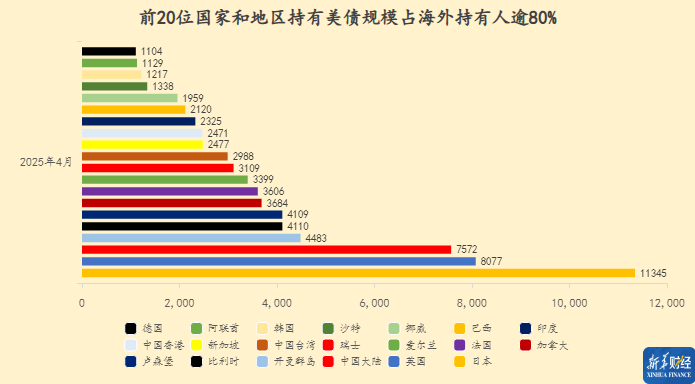
Core Viewpoint - The TIC report from the U.S. Treasury reveals that foreign holdings of U.S. Treasury securities reached $9.0134 trillion as of April, showing a year-over-year increase but a month-over-month decrease, with Japan, the UK, and China being the top holders [1][3]. Group 1: Foreign Holdings of U.S. Debt - As of April, foreign holdings of U.S. debt totaled $9.0134 trillion, an increase of $977.2 billion year-over-year but a decrease of $36.1 billion month-over-month [1]. - The top three holders of U.S. debt are Japan ($1.13 trillion), the UK ($807.7 billion), and China ($757.2 billion), with Japan and the UK increasing their holdings while China decreased its [1][3]. Group 2: Market Reactions and Trends - Since April, there has been significant market volatility attributed to a sentiment of "selling America," raising questions about whether this is a temporary shift or a long-term reallocation of global capital [5][7]. - The report indicates that 12 of the top 20 foreign holders reduced their U.S. debt holdings by a total of $125.2 billion, while 8 increased their holdings by $66.9 billion, suggesting mixed trends among foreign investors [3]. Group 3: Economic Implications - Concerns over U.S. fiscal issues have led to an increase in term premiums, as investors demand additional compensation for taking on term risk, which has affected the correlation between stocks and bonds [5][12]. - The long-term attractiveness of U.S. Treasuries may be challenged if fiscal imbalances are not addressed, potentially leading to higher yields on long-term bonds [12]. Group 4: Strategic Considerations - Japan's substantial holdings of U.S. debt are seen as a strategic asset for trade negotiations, although officials have stated they do not intend to use these holdings as leverage [10]. - The ongoing discussions about U.S. fiscal sustainability and its impact on Treasury yields highlight the delicate balance between maintaining investor confidence and addressing budget deficits [12].

华尔街到陆家嘴精选丨美债收益率止涨回调 市场消化穆迪降级影响?美国国债和企业债投哪个更好?黄仁勋宣布的“AI工业革命”有哪些蓝图?
Di Yi Cai Jing· 2025-05-20 01:26
Group 1: Market Reactions to Credit Rating Downgrade - The U.S. stock market experienced a slight increase, with the S&P 500 index rising for the sixth consecutive day despite Moody's downgrade of the U.S. credit rating from Aaa to Aa1 [1] - Following the downgrade, the 30-year U.S. Treasury yield initially surged to 4.995% and the 10-year yield to 4.521%, but both yields later retreated [1] - Analysts noted that the downgrade may lead investors to reassess the risk premium of U.S. assets, increasing concerns about the sustainability of U.S. long-term debt [1] Group 2: U.S. Treasury and Corporate Bonds - Short-term reactions to the downgrade may force some institutions to sell U.S. Treasuries, but the overall demand for U.S. debt remains strong due to higher yields compared to other developed countries [2] - The total U.S. debt remains at $36.2 trillion, with $8 trillion in bonds maturing since May, indicating that new debt issuance can absorb maturing funds without default risk [2] - The Federal Reserve's support for U.S. Treasuries helps maintain market liquidity and stabilizes corporate bonds, making them an attractive investment option [2] Group 3: AI and Technology Developments - NVIDIA announced its transformation into an "AI infrastructure company," launching several new products and partnerships aimed at building a trillion-dollar AI infrastructure market [3] - The introduction of upgraded systems and collaboration with companies like DeepMind and Hon Hai aims to enhance AI capabilities and support various industries, including automotive [3] - NVIDIA's CUDAx ecosystem is expected to become a core component of global AI infrastructure, with significant market potential [3] Group 4: Cybersecurity Sector Insights - Palo Alto Networks is expected to report higher quarterly sales driven by AI adoption and strong demand for cybersecurity solutions [5] - The company's stock has shown resilience, with a target price increase from $215 to $225, indicating a potential upside of 15.8% from its recent closing price [5] - The cybersecurity sector is recognized as essential for the digital age, with significant growth potential as companies increasingly prioritize security [5] Group 5: Stock Market Risk Premium - The Edmond de Rothschild Asset Management report highlights that the current risk premium in the U.S. stock market is too low, reducing its attractiveness [6] - The report suggests that ongoing economic risks from tariffs may impact certain sectors, while technology, healthcare, and consumer staples remain relatively insulated [7] - Analysts anticipate that the Federal Reserve may implement two rate cuts this year, which could influence stock market dynamics and risk premiums [7] Group 6: Netflix's Strong Performance - Netflix received a "buy" rating from Barron's, with its stock price rising 25% since April, significantly outperforming the S&P 500's 4% increase [8] - The company has shown resilience against tariff impacts and has expanded its user base to over 300 million subscribers, with a market capitalization nearing $500 billion [8] - Analysts expect Netflix's EBITDA to grow by 26% this year, indicating strong long-term growth potential despite a high price-to-earnings ratio [8]

关税背后的逆全球化与颠覆式创新
天天基金网· 2025-04-07 11:25
Group 1 - The article discusses the impact of the U.S. tariff policy on both the U.S. and global capital markets, highlighting the uncertainty it brings [2][5][6] - The U.S. government, under President Trump, has implemented a series of tariffs on various trade partners, with rates ranging from 10% to 49% depending on the country [3][4] - The article emphasizes the historical context of globalization and its effects on economic structures, noting that globalization has significantly benefited countries like China while disadvantaging others like Japan and Europe [9][11] Group 2 - The article outlines the concept of disruptive innovation, explaining how it challenges existing market structures and creates new opportunities for growth [17][20] - It identifies the winners and losers of disruptive innovation, where disruptors gain market share and consumer benefits, while traditional companies face declining profitability and potential layoffs [20][22] - The article also discusses the macro-level changes brought about by disruptive innovation, particularly in sectors like healthcare, where traditional inefficiencies persist despite attempts at disruption [22] Group 3 - The article analyzes market drivers, particularly interest rates and stock risk premiums, and their influence on investment decisions in the context of the current economic climate [24][25] - It highlights the importance of revenue growth and operating profit margins for companies, particularly in relation to their exposure to international markets amid tariff uncertainties [26][27] - The article concludes that political and macroeconomic factors will increasingly influence company valuations, necessitating a shift in how investors assess potential returns [29]