防风险

Search documents
兼顾“稳增长”与“防风险” 开年以来地方债券发行加速
Zheng Quan Ri Bao· 2026-02-08 17:14
Core Insights - The issuance of local government bonds has accelerated significantly this year, reflecting a more proactive fiscal policy aimed at enhancing efficiency and effectiveness [1][2] - As of February 8, approximately 14,430 billion yuan in local bonds have been issued, marking a 127.7% increase compared to the same period in 2025 [1] - The bond issuance includes about 5,020 billion yuan in new special bonds and approximately 5,567 billion yuan in refinancing special bonds for replacing existing hidden debts, accounting for 34.8% and 38.6% of the total, respectively [1] Group 1 - The rapid increase in local bond issuance is intended to release fiscal funds early, ensuring the commencement of key infrastructure projects and investments in the public welfare sector [1][2] - The issuance of bonds is expected to alleviate short-term repayment pressures on local governments, providing more room for fiscal policy adjustments [1] - The focus of bond issuance is on new productive forces, public welfare infrastructure, and safety sectors, with improved efficiency in the issuance mechanism [2] Group 2 - In January alone, approximately 8,633 billion yuan in local bonds were issued, a 54.8% increase compared to January 2025 [2] - The January issuance included about 3,677 billion yuan in new special bonds and approximately 2,543 billion yuan in refinancing special bonds, representing 42.6% and 29.5% of the total, respectively [2] - The issuance strategy aims to balance growth stabilization, public welfare, and risk prevention, with a clear emphasis on preventing and mitigating hidden debt risks [2]
今日视点:三方面发力巩固资本市场稳中向好势头
Xin Lang Cai Jing· 2026-02-01 23:04
Core Viewpoint - The China Securities Regulatory Commission (CSRC) emphasizes the importance of risk prevention, strong regulation, and promoting high-quality development in the capital market to maintain a stable and positive trend in the economy [1][5]. Group 1: Risk Prevention - The capital market has seen qualitative improvements and reasonable quantitative growth, but it still faces complex challenges, necessitating a focus on risk prevention [1][6]. - Continuous efforts are required to resolve risks in key areas, including the implementation of a normalized delisting mechanism to ensure timely exits from the market [7]. - A comprehensive risk monitoring and early warning system should be established using modern technology for real-time monitoring and precise analysis of abnormal trading [2][7]. - Strengthening market stability mechanisms is essential to prevent significant market fluctuations and to encourage long-term capital investment to enhance market resilience [2][7]. Group 2: Strong Regulation - Regulatory authorities have enhanced enforcement and improved regulatory effectiveness, aiming for a rigorous yet effective regulatory environment [8]. - A full-chain regulatory approach is necessary, ensuring accountability among all parties involved in the issuance and listing process, as well as ongoing supervision of listed companies [8]. - Collaboration with judicial authorities is crucial to create a comprehensive regulatory system that improves enforcement efficiency and effectiveness [8]. Group 3: High-Quality Development - Continuous reform and innovation in the capital market are vital for enhancing its inclusiveness, adaptability, and competitiveness, thereby promoting efficient resource allocation [9][10]. - Companies are encouraged to focus on their core businesses, increase R&D investments, and utilize mergers and acquisitions to improve development quality [10]. - The long-term goal is to consolidate the positive momentum in the capital market and create a new phase of high-quality development [5][10].
如何稳增长促转型?2026年银行业经营工作“划重点”
Shang Hai Zheng Quan Bao· 2026-02-01 18:15
2026年,银行经营工作怎么干?在低利率环境下,银行业如何稳增长、防风险、促转型,成为新一年经 营管理工作的核心命题。 近期,国有大行、股份行以及多家头部城商行、农商行相继召开2026年经营管理工作会议,聚焦服务实 体经济、优化业务结构、强化风险防控和推进数智化转型等重点任务,对全年经营工作"划重点"。 国有大行稳中求进服务实体是首位 从国有大行的2026年经营管理工作会议部署看,"稳中求进"仍是主基调,服务国家战略和实体经济被普 遍置于首要位置。 一方面,国有大行普遍将加大对重大战略、重点领域和薄弱环节的金融支持,围绕科技创新、普惠金融 等方向持续发力,做好金融稳定的"压舱石"。相关表述中,"专注主责主业""加大重点领域融资供给"为 高频词。 工商银行表示:突出主责主业,投资于物和投资于人紧密结合,加大贷款投放、债券投资力度,做深做 精"五篇大文章",全力服务"四稳";加力支持扩大内需、科技创新、中小微企业等重点领域,以及"十 五五"重大工程、重大项目;靠前服务"两重一薄",积极惠民生促消费,助力服务业扩能提质。 农业银行2026年将加大重点领域融资供给。坚持投资于物与投资于人紧密结合,持续加大"两重""两 ...
如何稳增长促转型? 2026年银行业经营工作“划重点”
Shang Hai Zheng Quan Bao· 2026-02-01 18:14
◎记者 黄坤 2026年,银行经营工作怎么干?在低利率环境下,银行业如何稳增长、防风险、促转型,成为新一年经 营管理工作的核心命题。 近期,国有大行、股份行以及多家头部城商行、农商行相继召开2026年经营管理工作会议,聚焦服务实 体经济、优化业务结构、强化风险防控和推进数智化转型等重点任务,对全年经营工作"划重点"。 国有大行稳中求进 服务实体是首位 从国有大行的2026年经营管理工作会议部署看,"稳中求进"仍是主基调,服务国家战略和实体经济被普 遍置于首要位置。 一方面,国有大行普遍将加大对重大战略、重点领域和薄弱环节的金融支持,围绕科技创新、普惠金融 等方向持续发力,做好金融稳定的"压舱石"。相关表述中,"专注主责主业""加大重点领域融资供给"为 高频词。 工商银行表示:突出主责主业,投资于物和投资于人紧密结合,加大贷款投放、债券投资力度,做深做 精"五篇大文章",全力服务"四稳";加力支持扩大内需、科技创新、中小微企业等重点领域,以及"十 五五"重大工程、重大项目;靠前服务"两重一薄",积极惠民生促消费,助力服务业扩能提质。 农业银行2026年将加大重点领域融资供给。坚持投资于物与投资于人紧密结合,持续 ...






三方面发力巩固资本市场稳中向好势头
Zheng Quan Ri Bao· 2026-02-01 16:16
Core Viewpoint - The China Securities Regulatory Commission (CSRC) emphasizes the importance of risk prevention, strong regulation, and promoting high-quality development in the capital market to maintain a stable and positive trend in the economy [1][4]. Risk Prevention - The capital market has seen qualitative improvements and reasonable quantitative growth, but it still faces complex challenges, necessitating a focus on risk prevention [1]. - Continuous efforts are required to resolve key area risks, including the reform of the delisting system to create a normalized delisting environment [1]. - A robust risk monitoring and early warning system should be established using modern technology for real-time monitoring and precise analysis of abnormal trading [2]. - Strengthening market stability mechanisms is essential to prevent significant market fluctuations and to encourage long-term capital investment [2]. Strong Regulation - Regulatory authorities have enhanced enforcement and improved regulatory effectiveness, aiming for a stringent yet effective regulatory environment [2]. - A comprehensive regulatory approach is necessary, ensuring accountability across all parties involved in the issuance and listing processes [3]. - Collaboration with judicial authorities is crucial for efficient enforcement and to enhance the effectiveness of regulatory actions [3]. - The application of new technologies in regulatory practices is encouraged to shift from reactive to proactive measures in identifying and addressing violations [3]. High-Quality Development - Continuous reform and innovation in the capital market are essential for enhancing its inclusiveness, adaptability, and competitiveness [4]. - There is a need to guide listed companies to focus on their core businesses and increase investment in research and development to improve overall quality [4]. - The long-term goal is to consolidate the positive momentum in the capital market and create a new phase of high-quality development [4].
打开专项债分配的“黑箱”
Changjiang Securities· 2026-01-31 08:57
1. Report Industry Investment Rating No investment rating information is provided in the report. 2. Core Viewpoints - The introduction of special new special-purpose bonds has changed the traditional allocation logic of special-purpose bonds, and the allocation logic has become more complex due to regional economic and fiscal differences and the balance between economic development and "Three Guarantees" [4][7][18]. - The allocation of new special-purpose bond quotas at the provincial level generally follows the logic of "following the projects", but in recent years, the explanatory power of objective factors, especially debt risk factors, has decreased, and more attention is paid to management performance and local application factors. Since 2020, the quota allocation has been "tailored to local conditions and precisely targeted", showing regional heterogeneity [9][75][81]. - The allocation of new special-purpose bond quotas at the municipal level is more flexible and difficult to fully explain with objective factors. It is speculated that the resource coordination of provincial governments for municipalities will further reduce the explanatory power of objective factors [9][85][88]. - Some provinces have significant deviations in the actual allocation of new special-purpose bond quotas from the theoretical values. Some economic provinces may receive more quotas due to major project construction, while some regions may receive more funds for debt resolution [10][90]. 3. Summary by Relevant Catalogs 3.1 Special-purpose Bonds as the Main Local Financing Method - The scale of special-purpose bonds has been continuously increasing. As of the end of 2025, the stock of local special-purpose bonds in China was 37 trillion yuan, accounting for nearly 70% of the total stock of local government bonds. The net financing of special-purpose bonds increased significantly in 2020 and 2024, and the issuance scale and stock are expected to continue to rise [19]. - Special-purpose bonds can be divided into new special-purpose bonds, refinancing special-purpose bonds, and replacement special-purpose bonds. There are also special refinancing special-purpose bonds and special new special-purpose bonds for debt resolution [21]. 3.2 Deviation between Special-purpose Bond Investment and Physical Workload - In 2024 and 2025, new special-purpose bond funds were mainly invested in transportation infrastructure, municipal and industrial park infrastructure, and other fields. However, there may be a situation where "money waits for projects", and the progress of some special-purpose bond funds in forming physical workload is slow [25][30]. 3.3 Debt Resolution Factors Becoming an Important Consideration in Special-purpose Bond Allocation - The spatial distribution of special-purpose bond stocks is uneven. Since 2023, the marginal changes have reflected the policy orientation of "risk prevention". The issuance of refinancing special-purpose bonds in the western region has increased rapidly, and the proportion of debt resolution funds in key provinces is relatively high [37]. 3.4 Process and Results of New Special-purpose Bond Quota Allocation - **Principles**: New special-purpose bond quota allocation mainly considers five factors: financial strength, debt risk, construction demand, capital efficiency, and local applications, and is adjusted by a fluctuation coefficient. Overall, it follows the principle of "rewarding the excellent and punishing the inferior", but also pays attention to risk prevention [8][47]. - **Results**: There is a positive correlation between the new special-purpose bond quota and the actual in - place investment in fixed assets, but there are also some deviations. The allocation of new special-purpose bond quotas can generally reflect the objective situation, but some provinces deviate from the trend, indicating that they may receive more special funds [53][57]. 3.5 Provincial Quota Allocation: From "Extensive Distribution" to "Precise Targeting" - The allocation of new special-purpose bond quotas at the provincial level generally follows the logic of "following the projects". In recent years, the explanatory power of objective factors has decreased, and more attention is paid to management performance and local application factors. Since 2020, the allocation logic has shown regional heterogeneity [9][75][81]. 3.6 Municipal Quota Allocation: From "Rewarding the Excellent and Punishing the Inferior" to "Overall Coordination" - The allocation of new special-purpose bond quotas at the municipal level is more flexible, and the overall explanatory power of objective factors is weaker. It is speculated that the resource coordination of provincial governments will further reduce the explanatory power of objective factors [85][88]. 3.7 Deviation Calculation: Which Provinces Receive More Special-purpose Bond Funds? - Provinces such as Shandong, Guangdong, Anhui, Tianjin, Gansu, and Xinjiang have a large upward deviation in the actual quota allocation from the theoretical value, while Shanghai, Jiangsu, and Zhejiang have a large downward deviation. Some economic provinces may receive more quotas for major project construction, and some regions may receive more funds for debt resolution [10][90].
吴清座谈会发声,定调七大要点
21世纪经济报道· 2026-01-30 14:23
Core Viewpoint - The core viewpoint emphasizes the importance of listed companies in the capital market, focusing on core business, improving governance, and enhancing the ability to return value to investors to support high-quality development of the capital market [1]. Group 1: High-Quality Capital Market Planning - The China Securities Regulatory Commission (CSRC) aims to compile and implement the "14th Five-Year" plan for the capital market with a focus on high quality, aligning strategic needs with practical possibilities and market demands with regulatory planning [2]. - The main line of work revolves around "risk prevention, strong regulation, and promoting high-quality development" to consolidate the market's stable upward trend [2]. Group 2: Suggestions from Listed Companies - Suggestions from representatives of listed companies focus on five key areas: 1. Optimize listing systems to better adapt to the needs of emerging industries and the transformation of traditional industries [2]. 2. Enhance capital operation efficiency to activate the merger and acquisition market [2]. 3. Introduce long-term capital to better match the long-cycle demands of industrial development [2]. 4. Improve return and governance mechanisms, urging companies to enhance operational norms and information disclosure [3]. 5. Support globalization by increasing policy support for the global development of listed companies [3]. Group 3: Key Points for Future Capital Market Development - Seven key points highlighted for the next steps in capital market construction include: 1. Focus on deepening comprehensive reforms in capital market financing and improving institutional inclusiveness and adaptability [5]. 2. Accelerate the implementation of reforms in the ChiNext (Growth Enterprise Market) [5]. 3. Continue to promote the implementation of reforms in the Sci-Tech Innovation Board [5]. 4. Enhance the convenience, flexibility, and attractiveness of refinancing systems [5]. 5. Promote the high-quality development of the Beijing Stock Exchange and the New Third Board [5]. 6. Strengthen the coverage and influence of multi-level markets [5]. 7. Actively support the construction of a modern industrial system and the development of new productive forces [5].


七大要点定调!吴清座谈会发声,勾勒资本市场“十五五”改革主线
2 1 Shi Ji Jing Ji Bao Dao· 2026-01-30 13:33
Group 1 - The core viewpoint emphasizes that listed companies are the foundation of the capital market, focusing on core business, improving governance, and enhancing the ability to return to investors to support high-quality development of the capital market [2] - The meeting aimed to discuss the main goals, strategic tasks, and key measures for the development of the capital market during the "14th Five-Year Plan" period [3][4] Group 2 - Suggestions from representatives of domestic and foreign listed companies focused on five main areas: optimizing the listing system, enhancing capital operation efficiency, introducing long-term funds, improving return and governance mechanisms, and supporting globalization [5][6][7][8] Group 3 - Seven key points were highlighted by the chairman, which will guide the next steps in capital market construction, including deepening comprehensive reforms in capital market financing, promoting the integration of the Beijing Stock Exchange and the New Third Board, and supporting the construction of a modern industrial system [9][10][11]
上海清算所召开2025年度风险管理委员会全体会议
Jin Rong Shi Bao· 2026-01-30 01:00
Core Insights - The Shanghai Clearing House held its 2025 Risk Management Committee meeting, focusing on enhancing risk management and supporting the construction of the Shanghai International Financial Center [1] - The Chairman emphasized the importance of "risk prevention, strong regulation, and promoting high-quality development" as the main theme for current work [1] - The meeting included discussions on improving the risk management system and analyzing risks associated with overseas clearing members [1] Group 1 - The Shanghai Clearing House aims to serve the central bank and contribute to the high-quality development of financial services [1] - The meeting featured 12 internal committee members and 14 external experts, highlighting collaboration between academia and industry [1] - A proposal to establish specialized committees for financial derivatives and bulk commodity centralized clearing risk management was approved [1] Group 2 - The Shanghai Clearing House plans to build a safe and efficient financial infrastructure, leveraging the Risk Management Committee and its specialized committees [2] - The goal is to create a resilient and vibrant financial market, contributing to the construction of a strong financial nation [2]
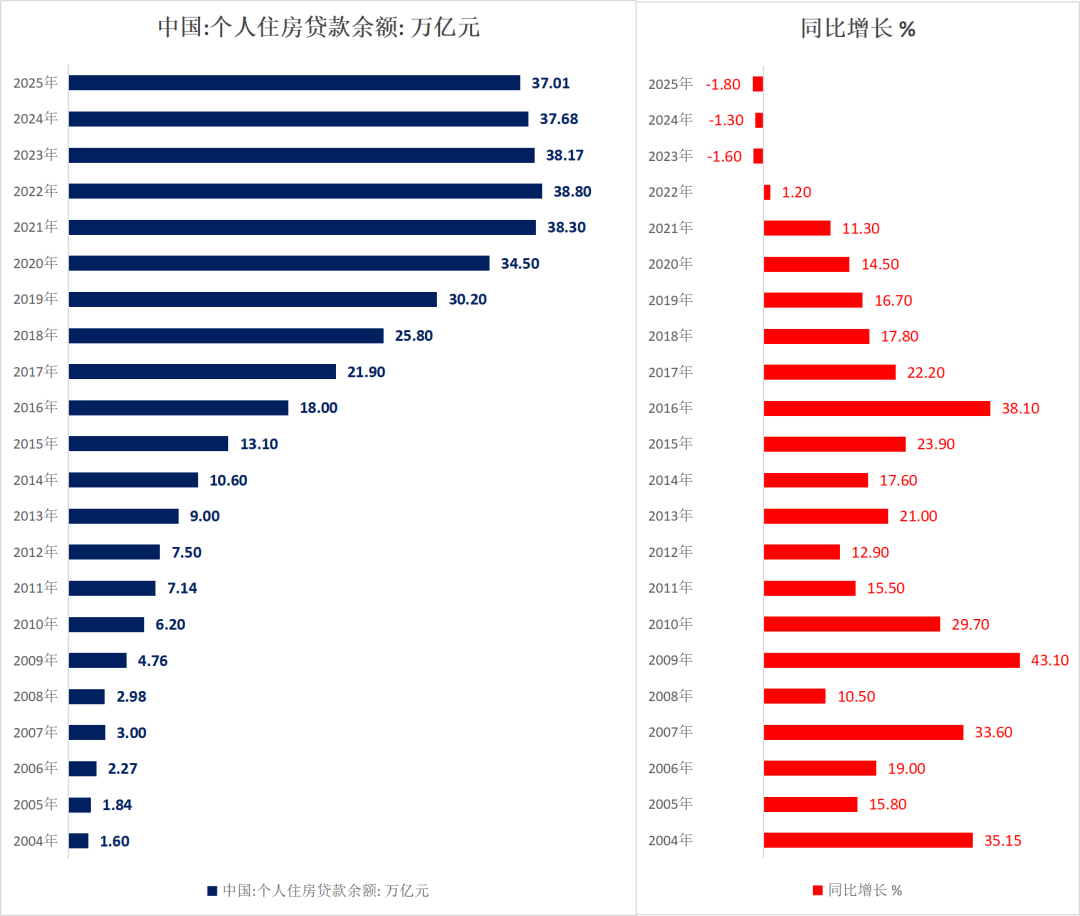
历年居民房贷趋势(2004-2025)
Xin Lang Cai Jing· 2026-01-29 12:12
Core Viewpoint - The Chinese residential mortgage market is experiencing a significant downturn, with a continuous decline in personal housing loan balances for three consecutive years, indicating a shift from rapid expansion to a contraction phase [1][10]. Group 1: Loan Balance Trends - As of the end of 2025, the balance of personal housing loans in China is projected to be 37.01 trillion yuan, reflecting a year-on-year decrease of 1.8% [1][10]. - The total residential loan amount is expected to reach 83.28 trillion yuan by the end of 2025, with a minimal year-on-year growth of 0.53%, marking the lowest growth rate in history [12]. - The balance of loans has decreased from a peak of 38.80 trillion yuan in 2022 to 37.01 trillion yuan in 2025, indicating a transition to a stock adjustment phase in the personal mortgage market [4][13]. Group 2: Historical Context - From 2004 to 2022, the loan balance surged from 1.60 trillion yuan to 38.80 trillion yuan, representing an increase of over 23 times, driven by leverage in the residential sector and rapid real estate market growth [4][13]. - The growth rate peaked at 43.10% in 2009 and 38.10% in 2016, corresponding to significant policy stimuli aimed at boosting the economy and real estate market [4][13]. Group 3: Factors Influencing the Decline - The decline in mortgage demand is attributed to several factors, including a deep adjustment in the real estate market (declining sales and weakening price expectations), a wave of early repayments by residents, tightened risk controls by financial institutions, and a policy shift from stimulating demand to stabilizing leverage and preventing risks [4][13]. - Short-term loan balances have decreased by 3.71%, marking the first decline since data collection began [5][14]. - Consumer loan balances have also seen a decline of 0.89%, indicating a broader trend of reduced borrowing among residents [7][16].