G60科创走廊

Search documents
城市24小时 | 经济第四大省,下一个五年目标定了
Mei Ri Jing Ji Xin Wen· 2025-11-18 16:02
Group 1: Zhejiang Province's Development Goals - The core goal of Zhejiang's 14th Five-Year Plan is to achieve high-quality development and significant progress in building a common prosperity demonstration zone, aiming to present a vivid picture of basic socialist modernization by 2030 [1][2] - By 2030, Zhejiang aims for its per capita GDP to approach that of developed economies, requiring an economic growth rate of around 5% over the next five years [2] - The province plans to achieve "one breakthrough" in innovation and establish "four basic constructions," including a strong education system, a robust technology sector, a talent-rich environment, and a modern industrial system unique to Zhejiang [1][2] Group 2: Focus on Technological Innovation - Technological innovation is identified as a new driver of economic growth, with high-tech industries' added value in Zhejiang increasing by 7.19 percentage points compared to 2020 during the 14th Five-Year Plan [2] - The province's R&D investment intensity is projected to rise from 2.77% in 2020 to approximately 3.5% by 2024, with total R&D investment exceeding 1 trillion yuan [2][3] - Artificial intelligence is highlighted as a core variable for future technological and industrial innovation, with plans to establish Zhejiang as a global hub for AI innovation [2][3] Group 3: Specific Targets for AI Development - Zhejiang has set three specific targets for AI development: achieving global leadership in core AI technologies and applications, nurturing competitive AI enterprises, and reaching a revenue of 1.2 trillion yuan in the core AI industry by 2030 [3]

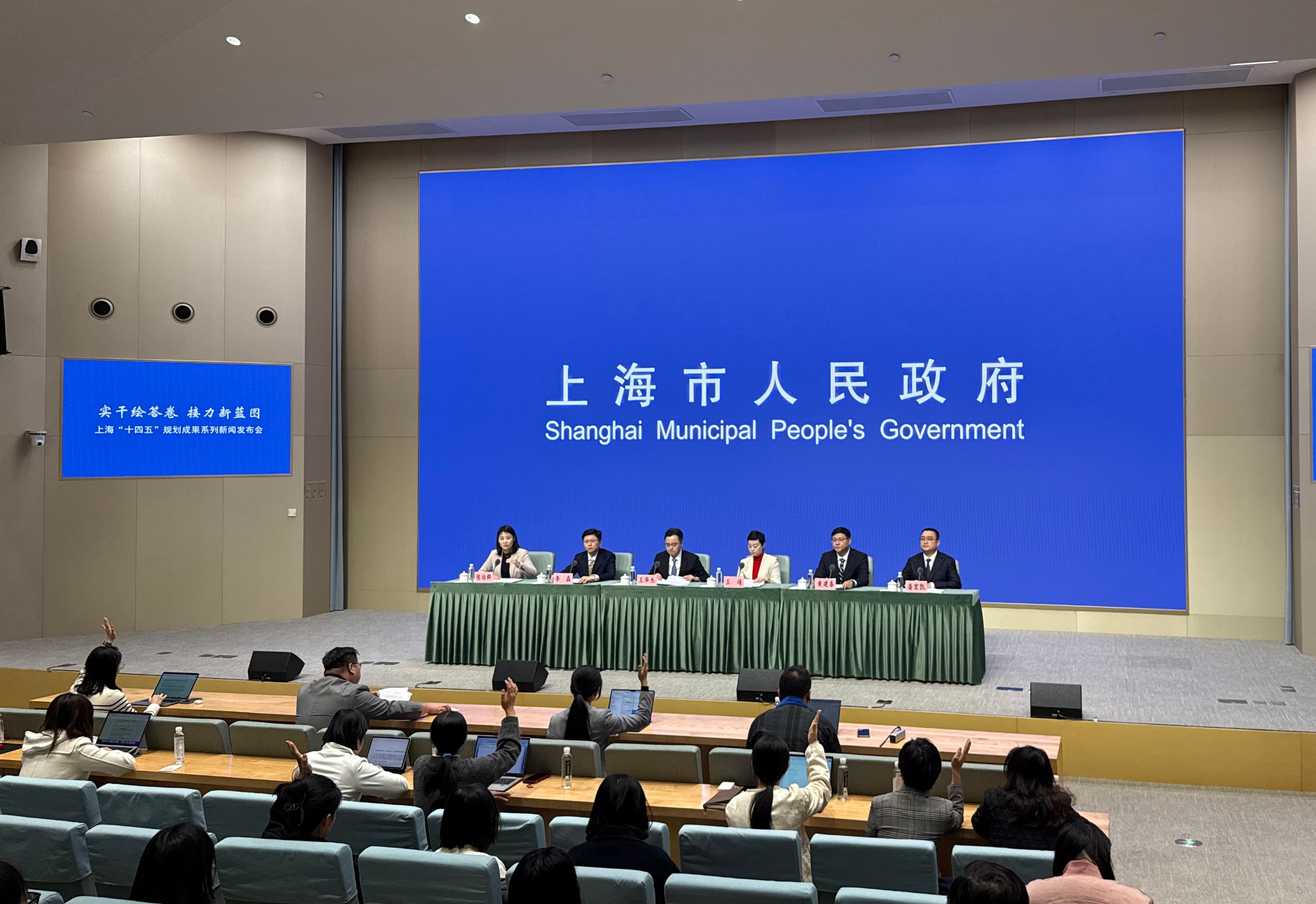
松江“十四五”构建“2+4”产业体系 多项核心指标位居上海前列
Guo Ji Jin Rong Bao· 2025-11-18 08:31
Core Viewpoint - The Shanghai government highlights the achievements of the Songjiang District during the "14th Five-Year Plan" period, focusing on its strategic positioning and development goals to build a modernized new Songjiang [1][3]. Group 1: Economic Development - Songjiang District has established itself as a key area for advanced manufacturing, new productivity, modern urban construction, and rural revitalization, achieving a GDP exceeding 220 billion yuan [3]. - The district has 1,758 industrial enterprises above designated size, maintaining the highest number in Shanghai, with industrial output value ranking second in the city [3]. - Songjiang's total import and export volume ranks second in Shanghai, with 83 recognized foreign-funded R&D centers, accounting for 10% of the city's total [3]. Group 2: Industrial Structure - The district is developing a "2+4" modern industrial system, focusing on two leading industries: new-generation information technology and high-end equipment, alongside four hundred billion-level characteristic industries [4]. - Songjiang is fostering a collaborative environment for service-oriented manufacturing, with the service sector expected to double and exceed 100 billion yuan during the "14th Five-Year" period [4]. Group 3: Innovation and Talent - The district has established a 30 billion yuan industrial investment fund to leverage social capital, resulting in over 400 billion yuan in investments and the successful listing of 15 companies [6]. - Songjiang has introduced over 20,000 urgently needed talents and ranks first among the five new cities in terms of young and highly educated population [6]. Group 4: Infrastructure and Transportation - The Songjiang hub, with 9 lines and 23 routes, connects to the Hu-Su-Hu high-speed railway, enhancing accessibility to 80% of cities in the Yangtze River Delta within 1-2 hours [6]. - Ongoing infrastructure projects include the comprehensive utilization of the old Hu-Kun railway line and the rapid construction of the northern section of the Hu-Song highway [6]. Group 5: Quality of Life and Social Development - The district has built and expanded 51 schools and established a new hospital, with the average life expectancy reaching 85.55 years [7]. - Songjiang has been recognized as a national rural revitalization demonstration county, leading in grain yield and pig production capacity in Shanghai [7]. Group 6: Cultural and Tourism Development - Songjiang is enhancing its cultural and tourism offerings, with projects like the Shanghai Happy Valley flagship store and the creation of national 5A scenic spots [8]. - The district's forest coverage rate is 19.28%, ranking second in Shanghai, and it has achieved 100% rural sewage treatment [8].
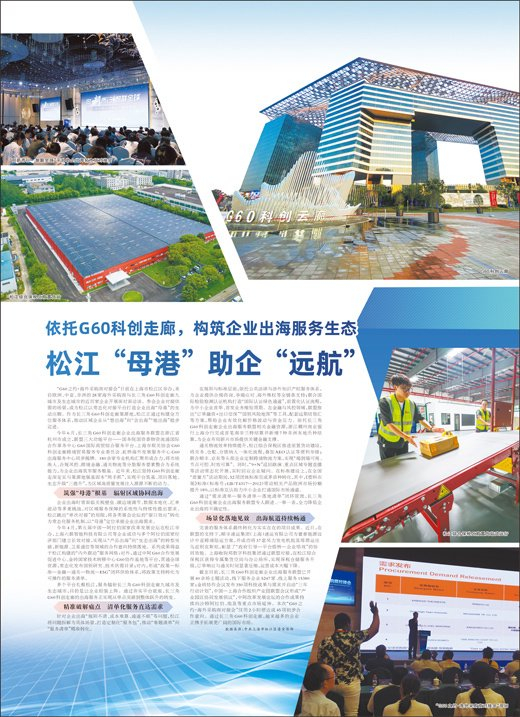
松江“母港”助企“远航”
Ren Min Wang· 2025-10-28 01:24
Core Insights - The "G60 Agreement: Overseas Buyers Matching Conference" was held in Shanghai, facilitating face-to-face discussions between 28 overseas buyers from Europe, Central Asia, and Africa and nearly 100 enterprises from the Yangtze River Delta G60 Science and Technology Innovation Corridor [3] - The event exemplifies the establishment of a regularized platform in Songjiang, aiming to transform the region into a "mother port" for enterprises looking to expand internationally [3][4] - The Long Triangle G60 Science and Technology Innovation Corridor is enhancing its service system to support local enterprises in their international ventures, transitioning from "wanting to go abroad" to "being able to go abroad" [3][4] Service Alliance and Platforms - In June, the Long Triangle G60 Science and Technology Innovation Corridor Enterprise Overseas Service Alliance was established, integrating over 180 professional institutions to provide comprehensive services for enterprises venturing abroad [3][5] - The alliance features three main functional platforms, including the G60 International Trade Comprehensive Service Platform and the G60 Overseas Service Center, which collectively enhance market access, compliance risk control, cross-border finance, and logistics [3][5][6] Systematic Support and Solutions - Songjiang is addressing challenges faced by enterprises, such as tariff barriers and data localization, by creating a systematic and sustainable service framework [4][6] - The alliance offers tailored "service packages" to address specific issues like unclear rules and high costs, transforming problem lists into actionable service lists [5][6] Financial and Logistical Enhancements - Financial tools such as "order financing + export credit insurance" and "country risk maps" have been introduced to help enterprises manage price fluctuations and funding pressures [6] - The efficiency of customs logistics is being improved through integrated processes and partnerships with leading logistics companies, ensuring visibility and control over cross-border shipments [6][8] Project Outcomes and Achievements - The service system has led to tangible project outcomes, such as the successful transportation of wind turbine components to Uzbekistan and enhanced warehousing services for local enterprises [8] - The G60 Overseas Service Alliance has conducted over 40 themed activities, serving more than 20,000 enterprises and facilitating numerous initial cooperation intentions during events like the recent conference [8][9]
金社平:把制度优势转化为发展优势——从全球视角看新时代中国特色社会主义的巨大优越性
Ren Min Ri Bao· 2025-10-23 06:50
Group 1 - China's economy is projected to reach approximately 140 trillion yuan by 2025, contributing around 30% to global economic growth [1][2] - The establishment of the G60 Science and Technology Innovation Corridor in the Yangtze River Delta has transformed the area into a hub for research, manufacturing, logistics, and services, with an expected economic output of 9 trillion yuan by 2024 [5][6] - The Chinese government emphasizes the importance of centralized leadership in economic planning and execution, which has been a key factor in the country's ability to implement long-term strategies effectively [2][4][6] Group 2 - The relocation of state-owned enterprises like China Huaneng Group and China Sinochem Holdings to Xiong'an New Area signifies a strategic move to enhance urban development and economic vitality in the region [1] - The successful implementation of the five-year planning system in China has been highlighted as a unique advantage, allowing for consistent and effective governance [3][4] - The focus on agricultural development, particularly in the apple industry in Yan'an, has significantly improved local livelihoods and created job opportunities for over 800,000 farmers [8][9]
金社平:把制度优势转化为发展优势
Ren Min Ri Bao· 2025-10-23 00:23
Group 1 - The article emphasizes the superiority of socialism with Chinese characteristics in the context of global changes, highlighting China's commitment to high-level opening up and high-quality development, which is expected to contribute around 30% to global economic growth during the 14th Five-Year Plan period [1][4] - China's economy is projected to reach approximately 140 trillion yuan by 2025, with an increase of over 35 trillion yuan in five years, showcasing its role as a "deterministic oasis" in the global economy [1][4] - The article discusses the importance of the centralized leadership of the Communist Party of China (CPC) in ensuring effective governance and economic stability, particularly during critical moments [2][4] Group 2 - The G60 Science and Technology Innovation Corridor in the Yangtze River Delta is highlighted as a successful example of industrial integration, with an economic total expected to reach 9 trillion yuan by 2024, contributing nearly 2.2% to global manufacturing [5][6] - The article notes that the G60 corridor has evolved from a highway into a comprehensive innovation ecosystem, linking research, manufacturing, logistics, and services [5][6] - The CPC's ability to implement long-term planning through five-year plans is presented as a unique advantage, allowing for consistent and effective governance that contrasts with the short-sighted policies of some other countries [3][4] Group 3 - The article illustrates the success of the apple industry in Yan'an, Shaanxi Province, which has transformed a formerly impoverished area into a thriving agricultural hub, benefiting over 800,000 farmers [8][9] - It emphasizes the importance of a people-centered development approach, ensuring that the benefits of economic growth are shared among the population [8][10] - The article concludes that China's socialist system is dynamic and effective, capable of driving high-quality development while contributing to global progress [10]
上海松江区党政代表团来苏州考察
Su Zhou Ri Bao· 2025-06-10 00:21
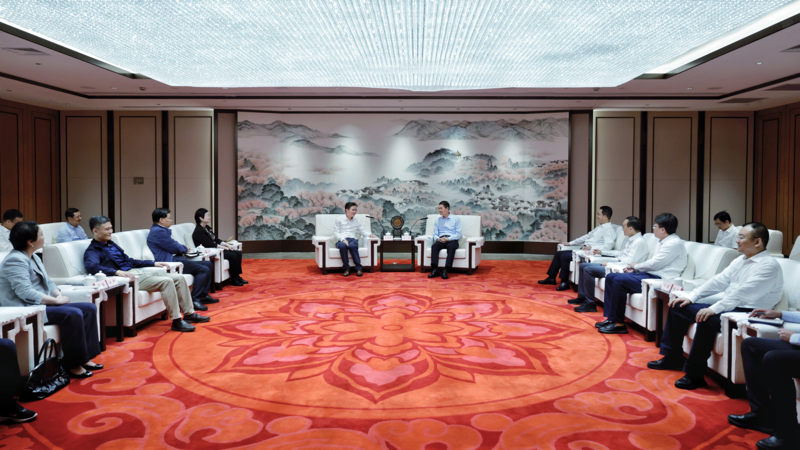
Group 1 - The meeting between the Suzhou and Songjiang delegations focused on strengthening cooperation and collaboration in innovation and industrial development, particularly through the G60 Science and Technology Innovation Corridor [3][4] - Suzhou officials expressed gratitude for Songjiang's support and highlighted the importance of learning from Songjiang's successful development practices [3][4] - Both parties emphasized the need for ongoing cultural exchanges and the establishment of long-term mechanisms to facilitate high-quality development in the Yangtze River Delta region [3][4] Group 2 - Songjiang officials acknowledged Suzhou's significant achievements in high-quality development and expressed a desire to adopt similar strategies [4] - The meeting underscored the importance of leveraging the opportunities presented by the Hongqiao International Open Hub to enhance industrial chain collaboration [4] - Both sides committed to deepening cooperation and enhancing the brand of the G60 Science and Technology Innovation Corridor to contribute to the integrated high-quality development of the Yangtze River Delta [4]
同频共振 长三角合力“强引擎”——深入推进长三角一体化高质量发展综述(中)
Xin Hua Ri Bao· 2025-06-03 23:09
Group 1 - The Yangtze River Delta (YRD) region, comprising three provinces and one city, accounts for nearly a quarter of China's economic output despite occupying less than 4% of the country's land area [1] - The region's innovation capacity is reflected in its rising regional innovation co-construction index, with total technology expenditure exceeding 250 billion yuan, representing over 25% of national local technology investment [1] - The YRD has a diverse industrial collaboration model, with 26 advanced manufacturing clusters making up nearly one-third of the national total [1][3] Group 2 - The G60 Science and Technology Corridor connects multiple cities, facilitating collaborative innovation across the YRD [2] - Research and development intensity in the region averages 3.77%, with PCT international patent applications accounting for 10.1% of the national total [3] - The YRD is home to 11% of the country's specialized and innovative "little giant" enterprises and 12% of unicorn companies [3] Group 3 - The "Digital Corridor" is emerging along the G50 highway, enhancing digital collaboration and innovation across the YRD [4] - The YRD's cities are collaborating in the integrated circuit industry, leveraging their respective strengths in chip design, manufacturing, and materials [4] Group 4 - The establishment of "flying land" parks demonstrates cross-regional collaboration, with significant industrial cooperation between cities like Nantong and Shanghai [6][7] - The New Suzhou-Chuzhou High-tech Zone has attracted over 300 industrial projects, with 80% coming from the YRD region [9] Group 5 - The Hai-Tai Yangtze River Tunnel, set to be completed by 2028, will significantly reduce travel time across the river, enhancing economic integration in the YRD [11] - The Nanjing metropolitan area is the first officially approved urban agglomeration, showcasing the region's commitment to coordinated development [11][15]
长三角高端装备新质领袖榜单评选启动
Zheng Quan Shi Bao Wang· 2025-05-24 07:17
Core Insights - The "New Quality Leading Future" high-end equipment leader list evaluation in the Yangtze River Delta region was officially launched on May 23, aiming to discover and cultivate "future unicorn" companies with high growth potential in the high-end equipment sector [1][2] - The high-end equipment industry is a key engine for the advancement of China's manufacturing towards high-end, intelligent, and green development, and is a significant area within the G60 Science and Technology Innovation Corridor's seven emerging industries [1][2] - The Yangtze River Delta region has been leading in high-end equipment manufacturing, with an export value of 261.16 billion yuan in 2024, accounting for 56.7% of the national total for similar products [1] Industry Development - The high-end equipment manufacturing sector is a core indicator of national comprehensive competitiveness and is essential for promoting high-quality economic development [2] - The G60 Science and Technology Innovation Corridor is facilitating the integration of cross-regional innovation chains, focusing on core technologies in fields such as robotics, new energy equipment, and intelligent transportation [2] - The collaboration among Shanghai, Jiangsu, Zhejiang, and Anhui has formed an industrial pattern led by Shanghai, which is expected to enhance the competitiveness of high-end equipment enterprises in the region [2] Local Initiatives - Dongjing Town is leveraging the collaborative effects of the G60 Science and Technology Innovation Corridor, possessing advantages in strategic planning, industrial layout, and transportation [3] - The town is witnessing the rapid emergence of industrial clusters related to intelligent robots, low-altitude economy, and smart terminals, with ongoing breakthroughs in technology and industrial application [3] - Dongjing aims to deepen the construction of an artificial intelligence characteristic town, providing a more open attitude, professional services, and a high-quality business environment to attract enterprises [3]
一体化发展!芜湖宣城明牌了
Guo Ji Jin Rong Bao· 2025-04-30 02:52
Core Viewpoint - The integration of Wuhu and Xuancheng is a strategic initiative aimed at enhancing regional economic collaboration and development, supported by government policies and infrastructure improvements [2][3][4]. Group 1: Policy and Government Support - The Wuhu-Xuancheng integration has been emphasized in the Anhui Province's "14th Five-Year Plan" and further reinforced by the recent government action plan [2]. - Continuous policy support ensures clear objectives and strong actions in the integration process, providing a solid institutional guarantee for regional collaboration [2][3]. Group 2: Economic Performance - Wuhu's GDP is projected to reach 512.05 billion yuan in 2024, growing by 6.4%, making it the second city in Anhui to surpass 500 billion yuan [3]. - Xuancheng's GDP is expected to exceed 205.35 billion yuan, with a growth rate of 5.8%, marking a significant economic milestone for the city [3][4]. Group 3: Infrastructure and Connectivity - The geographical proximity of Wuhu and Xuancheng, along with shared infrastructure like the Wuhu Xuanzhou Airport, enhances their economic integration and connectivity [3][4]. - The development of a comprehensive transportation network, including road, rail, and air, facilitates efficient resource flow and optimization between the two cities [3][4]. Group 4: Industrial Collaboration - Wuhu and Xuancheng possess unique industrial strengths that can complement each other, fostering collaborative development through shared resources and joint industrial parks [6]. - Wuhu has established a robust industrial base in automotive, robotics, and digital economy sectors, while Xuancheng is focusing on new energy and cultural tourism industries [4][6]. Group 5: Innovation and Technology - Wuhu is recognized as an "innovation city," with over 2,000 national high-tech enterprises and a strong emphasis on technological advancement [4][6]. - The G60 Science and Technology Corridor serves as a platform for both cities to enhance technological cooperation and innovation capabilities [6][7]. Group 6: Regional Integration and Future Prospects - The integration of Wuhu and Xuancheng into the Nanjing metropolitan area allows for better resource sharing and collaborative development in various sectors [7]. - The ongoing initiatives, such as the "Wuhu Jiuzi Science and Technology Innovation Bay," aim to position Wuhu as a significant industrial innovation center in the Yangtze River Delta [7].