x86架构

Search documents
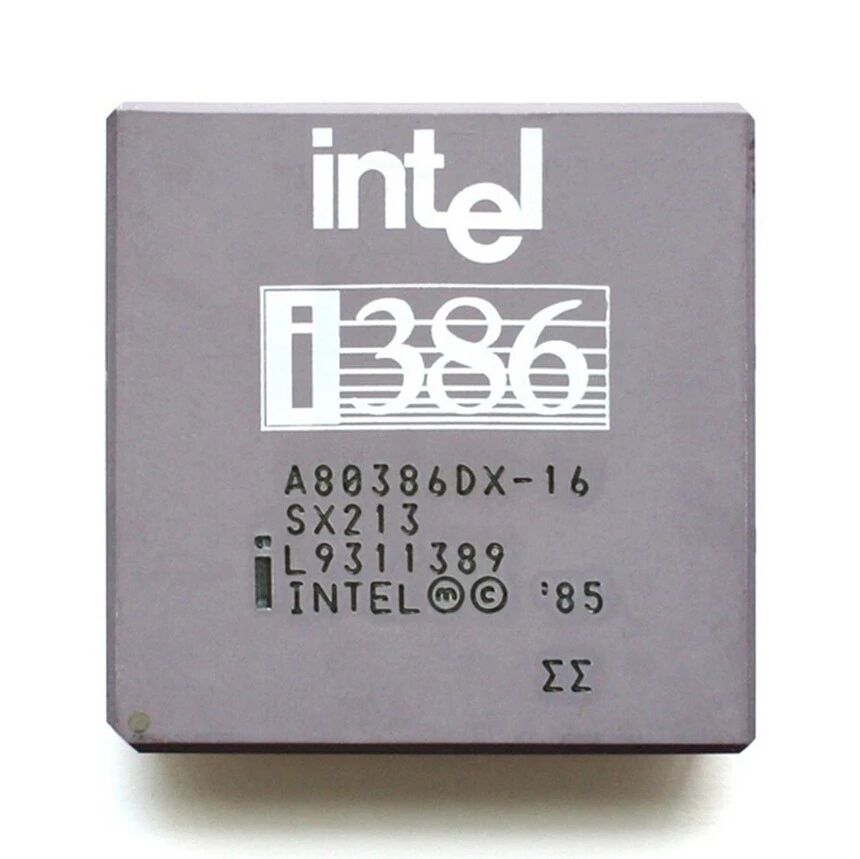
英特尔80386,40周岁了
半导体行业观察· 2025-10-20 01:47
Core Insights - The Intel 80386 processor, launched in October 1985, marked a significant turning point in personal computing as the first 32-bit chip in Intel's PC product line and the origin of the IA-32 instruction set [2][6] - The 80386 featured 275,000 transistors and operated at a frequency of up to 16 MHz, supporting a flat memory model and up to 4GB of address space, which laid the groundwork for true multitasking and virtual memory [2][5] - Compaq was the first company to release a computer with the Intel 80386, the Deskpro 386, in September 1986, which became a pivotal moment in the PC industry [3][11] Group 1: Technical Features and Innovations - The 80386 introduced several key architectural features, including protected mode, virtual 8086 mode, and hardware paging, enabling advanced multitasking capabilities [2][5] - The architecture allowed for the development of true Unix-like systems without complex workarounds, as demonstrated by the early Linux kernel targeting the 386 hardware [5][15] - The 80386's instruction set, IA-32, remained a cornerstone for Windows and most Linux distributions well into the 2010s [5][15] Group 2: Market Impact and Competition - The introduction of the 80386 came at a time when Intel faced significant pressure from competitors, as IBM had previously established a multi-vendor approach for its PCs [6][8] - The 80386's success was crucial for Intel, especially after experiencing losses in 1986 due to manufacturing issues, making its market performance vital for the company's future [11][15] - By the end of the 386 era, competitors like AMD and Chips & Technologies had increased clock speeds, sometimes surpassing Intel's offerings, highlighting the competitive landscape [13][15] Group 3: Legacy and Evolution - The 80386's architecture laid the foundation for the x86 architecture, which continues to influence modern computing, including smartphones and AI data centers [15] - The processor's design and features have persisted in various forms, with the IA-32 architecture being a significant part of Intel's legacy [5][15] - The 80386's introduction of a protected multitasking software platform was unprecedented and has had lasting implications for software development and operating systems [5][10]


Arm,势不可挡
半导体行业观察· 2025-09-24 02:54
Core Viewpoint - The article discusses the significant shift from x86 architecture to Arm architecture in the computing industry, highlighting the growing dominance of Arm in various sectors, including personal computers and data centers, driven by major companies like Apple and Microsoft [1][3][15]. Group 1: Industry Support for Arm - The Arm ecosystem has expanded significantly over the past decade, with numerous chip design companies emerging, unlike the x86 field, which is dominated by Intel and AMD [3][8]. - Major tech companies, including Apple, Qualcomm, and Amazon, are developing high-performance processors based on Arm architecture, indicating a robust industry shift [3][4][15]. - Nvidia's involvement in Arm, despite its investments in Intel, showcases the dual focus on both x86 and Arm architectures [3][16]. Group 2: Software Compatibility - Early attempts to run Windows on Arm faced significant challenges, with many popular applications unable to run natively, leading to slow translation processes [11][12]. - Apple's Rosetta 2 translation tool has successfully enabled seamless operation of x86 applications on Arm-based Macs, contrasting with Microsoft's earlier struggles [12][13]. - Recent improvements in Windows on Arm have led to better compatibility and the release of native versions of key applications, addressing previous software shortages [12][15]. Group 3: Future of Arm and x86 - The article predicts that Arm will continue to gain traction, with Qualcomm and Arm's CEOs forecasting that up to 50% of computer shipments could be based on Arm architecture within five years [15][20]. - Despite the rise of Arm, x86 is not expected to disappear quickly, as it remains entrenched in many legacy systems [19][20]. - The competition between Arm and x86 is driving innovation, with Intel and AMD increasing their investments to enhance power efficiency and performance [20].

英伟达50亿投英特尔,图啥?
Sou Hu Cai Jing· 2025-09-19 11:25
Core Insights - The article discusses the significant shift in the fortunes of Intel and NVIDIA, highlighting NVIDIA's rise as a leader in AI chips with a market capitalization of $4.28 trillion, while Intel struggles with a market cap of only $100 billion [2] - NVIDIA announced a $5 billion investment in Intel, representing approximately 4.6% of Intel's market cap prior to the announcement, at a price of $23.28 per share, which is a 6.5% discount to Intel's previous closing price [2] Collaboration Details - The partnership will focus on jointly developing customized data center and PC products to support large-scale, enterprise, and consumer applications, leveraging NVIDIA's NVLink technology to integrate NVIDIA's AI capabilities with Intel's CPU technology [3] - Intel will customize x86 architecture CPUs for NVIDIA, which will then integrate these chips into its AI infrastructure platform for market deployment [3][4] - The collaboration aims to provide NVIDIA access to Intel's enterprise customers, enhancing NVIDIA's presence in the enterprise data center market where it has seen limited progress [4] Historical Context - The article reflects on the historical dominance of Intel in the CPU market, particularly in the x86 architecture, and contrasts it with NVIDIA's current leadership in the AI chip sector [5][9] - It notes the strategic missteps of Intel in the past, such as rejecting Apple's request to produce chips for the iPhone, which led to Apple's shift towards ARM architecture [6][8] Market Dynamics - The current landscape is characterized by two main CPU architectures: ARM, known for its efficiency in mobile devices, and Intel's x86, which has been dominant in PCs and servers [9] - NVIDIA holds an 80% market share in the GPU sector suitable for AI processing but has relied on ARM designs for its CPU offerings [9][10] Future Opportunities - The collaboration is expected to create significant business opportunities, estimated between $25 billion to $50 billion annually, by integrating Intel's x86 CPUs with NVIDIA's GPU technology [10] - This partnership may enable NVIDIA to develop unprecedented integrated CPU+GPU products, potentially revolutionizing the notebook computing market [10] Competitive Landscape - The deal has negatively impacted competitors like ARM and AMD, with their stock prices declining following the announcement [11] - The strategic investment by NVIDIA is seen as a move to strengthen its position in the AI infrastructure space while gaining access to Intel's x86 ecosystem, rather than focusing on Intel's manufacturing capabilities [11][12]

史诗级和解:英特尔获老对手英伟达超350亿投资,股价创38年最大单日涨幅
AI前线· 2025-09-19 08:08
Core Viewpoint - NVIDIA is investing $5 billion in Intel to develop custom CPU and GPU integrated products, marking a significant collaboration between the two companies that were once rivals [2][3]. Group 1: Investment and Market Impact - If the investment passes regulatory approval, NVIDIA will become one of Intel's largest shareholders, owning approximately 4% of Intel's shares [3]. - Following the announcement, Intel's stock surged by about 28% at one point during trading, closing with a gain of approximately 22.77%, marking its best single-day performance in 38 years [3]. Group 2: Collaboration Details - The partnership aims to combine NVIDIA's AI computing and GPU technology with Intel's CPU technology and manufacturing capabilities to create a more powerful computing system [8][10]. - NVIDIA will utilize its NVLink technology to seamlessly connect its AI and GPU capabilities with Intel's CPU and x86 ecosystem, while Intel will develop custom x86 CPUs for NVIDIA's AI platform [11][13]. Group 3: Historical Context - Intel was once the dominant player in the chip industry, particularly in the PC market, while NVIDIA was primarily a GPU manufacturer [16]. - The relationship soured in the late 2000s due to disputes over patent licensing, leading to a prolonged rivalry [18][19]. - Over the years, NVIDIA has emerged as a leader in AI computing, while Intel has struggled to keep pace, particularly in the AI acceleration market [21]. Group 4: Future Prospects - The collaboration is seen as a potential turning point for Intel, providing a new direction in AI chip development and possibly redefining the AI PC landscape [22][24]. - Analysts suggest that this partnership could accelerate the development of AI infrastructure and personal computing products, benefiting both companies [22][24].

英伟达50亿美元战投英特尔 芯片“双英”历史性牵手
Jing Ji Guan Cha Wang· 2025-09-19 07:17
Core Viewpoint - Nvidia and Intel have announced a strategic partnership, with Nvidia investing $5 billion to acquire approximately 4% of Intel's shares, aiming to integrate Nvidia's AI capabilities with Intel's CPU technology for enhanced computing solutions [2][3]. Group 1: Strategic Partnership - Nvidia's investment in Intel will not affect its existing business relationships, particularly with TSMC, and it will continue to focus on its Arm architecture [2]. - The collaboration will leverage Nvidia's NVLink technology to create seamless connections between architectures, targeting large-scale computing and enterprise markets [2][3]. - Intel's CEO views the x86 architecture as foundational for modern computing, and the partnership is expected to innovate product offerings by combining Intel's manufacturing capabilities with Nvidia's AI strengths [3][4]. Group 2: Market Context - Intel is facing significant challenges, with a projected net loss of $18.8 billion in 2024, attributed to declining PC sales and lagging technology advancements [2][3]. - In contrast, Nvidia dominates the AI chip market with over 80% market share, while AMD has begun to surpass Intel in data center CPU sales for the first time [3][5]. - Following the announcement of the partnership, AMD's stock dropped over 5%, indicating investor concerns about increased competition in the CPU market [4]. Group 3: Future Projections - Nvidia plans to integrate custom x86 CPUs into its AI infrastructure, positioning itself as a significant customer for Intel's CPUs [4]. - The partnership is expected to generate annual revenue growth opportunities ranging from $2.5 billion to $50 billion for both companies [5].
185亿,国产CPU龙头要上市了
3 6 Ke· 2025-07-07 10:16
Core Viewpoint - The domestic CPU chip market is experiencing significant activity, with Shanghai Zhaoxin Integrated Circuit Co., Ltd. preparing for an IPO on the Sci-Tech Innovation Board, aiming to raise 4.169 billion yuan for new processor development and R&D projects [1][2]. Group 1: Company Overview - Zhaoxin Integrated was established in 2013 and is headquartered in Shanghai, with Shanghai United Investment holding a 50.07% stake [4]. - The company focuses on x86 architecture, which is crucial for compatibility with mainstream software ecosystems, positioning it favorably in the domestic CPU market [4][7]. - Zhaoxin has developed several microarchitecture generations, achieving significant domestic performance milestones, such as the KX-6000 series processor reaching a frequency of 3.0GHz [8]. Group 2: Financial Performance - Zhaoxin's revenue projections show a compound annual growth rate (CAGR) of 61.71%, with expected revenues of 3.4 billion yuan in 2022, 5.55 billion yuan in 2023, and 8.89 billion yuan in 2024 [1]. - Despite revenue growth, the company has reported net losses of 7.27 billion yuan, 6.76 billion yuan, and 9.51 billion yuan for the years 2022 to 2024, totaling approximately 23.54 billion yuan in losses [1][18]. - R&D expenses have been substantial, reaching 289.5% of revenue in 2022, and totaling 2.785 billion yuan over three years [16]. Group 3: Market Position and Competition - Zhaoxin's valuation is estimated at 18.5 billion yuan, significantly lower than competitors like Haiguang Information and Longxin Zhongke, which have market values of 328.4 billion yuan and 53.489 billion yuan, respectively [2]. - The x86 server market in China is projected to grow, with shipments expected to reach 4.47 million units by 2027, indicating a growing opportunity for Zhaoxin [14]. - The company faces intense competition from both domestic and international players, including Intel and AMD, who dominate over 90% of the global market share [15]. Group 4: Client Base and Revenue Sources - Zhaoxin's primary clients include major manufacturers like Lenovo, contributing significantly to its revenue, with the top five clients accounting for over 96% of total sales in recent years [12][13]. - The "Kaixian" series of processors, aimed at desktop and embedded devices, accounted for 86.32% of revenue in 2024, highlighting its importance to the company's growth [9]. Group 5: Industry Trends and Future Outlook - The recent policy changes in China, including the introduction of the "1+6" policy measures, aim to support tech companies like Zhaoxin, potentially easing the path for IPOs and funding [20]. - The ongoing push for domestic chip development aligns with national strategies, creating a favorable environment for companies like Zhaoxin to thrive [20].
苹果芯片,完成颠覆?
半导体行业观察· 2025-07-01 01:03
Core Viewpoint - Intel is facing significant challenges as it plans to shut down its automotive business and lay off employees, marking a difficult period in its transformation journey. Meanwhile, Apple is transitioning away from Intel chips, with macOS 26 Tahoe being the last version to support Intel architecture, indicating a shift towards Apple Silicon chips [1][22]. Group 1: Intel's Historical Context and Current Challenges - Intel has historically dominated the PC processor market with its x86 architecture, achieving significant milestones since the launch of its first microprocessor in 1971. The partnership with IBM in 1981 solidified its position in the market [4][6]. - The rise of AMD as a competitor has been notable, especially with AMD's Zen architecture significantly improving performance and market share, indicating a shift in competitive dynamics [5][6]. - Intel's recent struggles are attributed to delays in technology innovation, particularly with its 10nm and 7nm processes, allowing competitors like Apple to gain an advantage with their ARM-based M series chips [32][33]. Group 2: Apple's Rise and Impact on the Market - Apple's transition to ARM architecture began with the introduction of the M1 chip in 2020, which demonstrated performance comparable to high-end x86 processors while maintaining lower power consumption [18][19]. - The success of Apple's M series chips has led to a significant increase in ARM's market share in the PC segment, rising from 2% in Q3 2020 to 11.3% by Q1 2022 [22]. - Apple's dominance in the PC market is evident, with a 10.2% overall market share and 45% in AI-enabled PCs by Q4 2024, surpassing Intel's share [23]. Group 3: Competitive Landscape and Future Outlook - The success of Apple's M series has inspired other companies like Qualcomm and NVIDIA to enter the PC CPU market, with Qualcomm's Snapdragon X Elite showing significant performance improvements [24][28]. - NVIDIA is also re-entering the PC processor space with its upcoming ARM-based N1X chip, aiming to leverage its expertise in AI and GPU technology [30][31]. - The shift towards ARM architecture in the PC market is indicative of a broader trend, with domestic companies in China also developing ARM and RISC-V based processors, signaling a move towards a multi-architecture competitive landscape [34][36].
又有国产CPU厂商,冲刺科创板!
Zhong Guo Ji Jin Bao· 2025-06-18 10:45
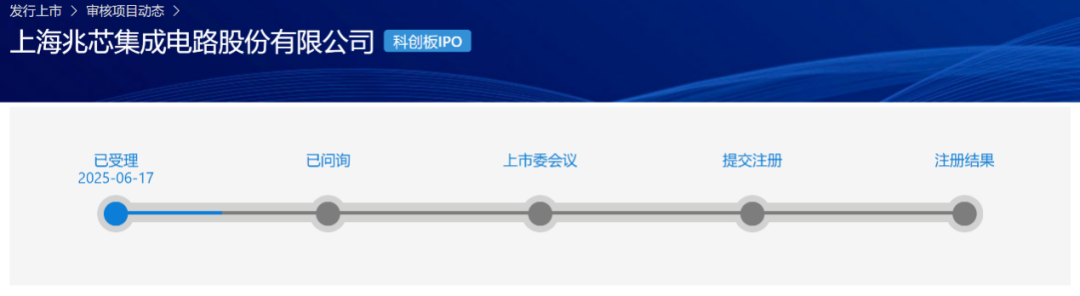
Core Viewpoint - The domestic CPU manufacturer Zhaoxin Integrated Circuit Co., Ltd. is planning to go public on the Sci-Tech Innovation Board, following other companies like Haiguang Information and Loongson Technology [1][3]. Company Overview - Zhaoxin Integrated is one of the six major domestic CPU manufacturers, with a cumulative loss of 2.354 billion yuan over the past three years. The company aims to raise 4.169 billion yuan through its IPO [3]. - The projected operating revenues for Zhaoxin Integrated from 2022 to 2024 are 340 million yuan, 555 million yuan, and 889 million yuan, respectively. The net profits attributable to shareholders for the same period are projected to be -727 million yuan, -676 million yuan, and -951 million yuan, indicating ongoing losses [3]. - The company is primarily focused on R&D investments to maintain technological advancement, which has led to significant financial losses. It is currently in a rapid development phase and faces risks related to sales expansion and market demand [3]. Shareholding Structure - Shanghai Lianhe Investment Co., Ltd., wholly owned by the Shanghai State-owned Assets Supervision and Administration Commission, holds 50.07% of Zhaoxin Integrated, making it the controlling shareholder. Via a partnership agreement, VIA Technologies holds 7.89% of the shares [3][4]. Competitive Landscape - Zhaoxin Integrated operates within a competitive environment dominated by global giants Intel and AMD, which maintain a duopoly in the x86 architecture processor market. Domestically, it faces competition from other CPU manufacturers like Huawei HiSilicon, Haiguang Information, and Loongson Technology [5][6]. - The company’s gross margin is projected to be 15.4% in 2024, significantly lower than the industry average of 50.49% and below Loongson Technology's 31.03% [5][6]. Financial Performance Comparison - In 2024, Haiguang Information is expected to generate revenues of 9.162 billion yuan with a net profit of 1.931 billion yuan, while Loongson Technology is projected to have revenues of 504 million yuan and a net loss of 625 million yuan. Zhaoxin Integrated's revenues are expected to be 889 million yuan with a net loss of 951 million yuan, indicating weaker performance compared to its competitors [6].


又有国产CPU厂商,冲刺科创板!
中国基金报· 2025-06-18 10:34
Core Viewpoint - The article discusses the IPO application of Shanghai Zhaoxin Integrated Circuit Co., Ltd. on the Sci-Tech Innovation Board, highlighting its financial struggles and competitive landscape in the CPU industry. Company Overview - Zhaoxin Integrated is one of the six major domestic CPU manufacturers in China, with a cumulative loss of 2.354 billion yuan over the past three years and plans to raise 4.169 billion yuan through the IPO [3][4]. Financial Performance - Projected revenues for Zhaoxin Integrated from 2022 to 2024 are 340 million yuan, 555 million yuan, and 889 million yuan, respectively. The net profits attributable to shareholders are projected to be -727 million yuan, -676 million yuan, and -951 million yuan for the same years [5]. - The company has not yet achieved profitability and has significant cumulative losses due to high R&D costs associated with CPU chip development [5]. Shareholding Structure - Shanghai Lianhe Investment Co., Ltd., wholly owned by the Shanghai State-owned Assets Supervision and Administration Commission, holds 50.07% of Zhaoxin Integrated's shares, making it the controlling shareholder [5]. - VIA Technologies holds 7.89% of Zhaoxin Integrated's shares, with various subsidiaries and related parties being considered as acting in concert [6][7]. Competitive Landscape - The global x86 architecture processor market is dominated by Intel and AMD, creating a duopoly. Domestically, Zhaoxin Integrated faces competition from other CPU manufacturers like Huawei HiSilicon, Hygon Information, and Loongson Technology [10]. - Zhaoxin Integrated's products are compatible with the x86 instruction set, while competitors like Huawei and Feiteng Information use ARM instruction sets, and Loongson Technology employs its own LoongArch instruction set [10]. Market Position and Challenges - Zhaoxin Integrated's projected gross margin for 2024 is 15.4%, significantly lower than the industry average of 50.49% and below Loongson Technology's 31.03% [10]. - In terms of operational performance, Zhaoxin Integrated's projected revenue for 2024 is 889 million yuan, with a net loss of 951 million yuan, indicating a weaker performance compared to Hygon Information, which is expected to generate 9.162 billion yuan in revenue and 1.931 billion yuan in net profit [11].

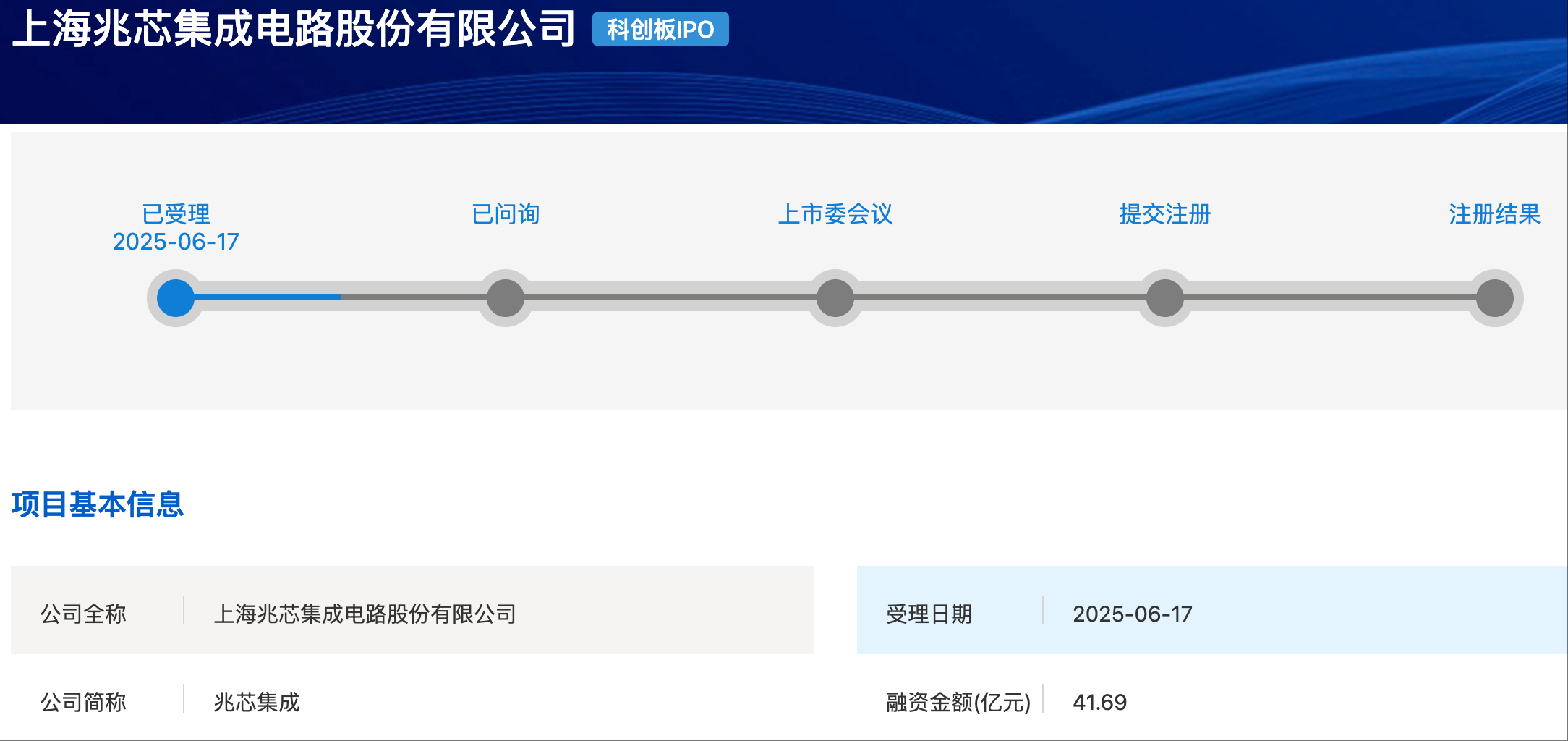
兆芯集成科创板IPO获受理 拟募资41.69亿元
Zheng Quan Shi Bao Wang· 2025-06-17 12:04
Core Viewpoint - Shanghai Zhaoxin Integrated Circuit Co., Ltd. has been accepted for an IPO on the Sci-Tech Innovation Board, aiming to raise 4.169 billion yuan [1] Company Overview - Zhaoxin Integrated specializes in the research, design, and sales of high-end general-purpose processors and supporting chips, focusing on x86 architecture CPUs, which are crucial for information security and the information industry in China [3][4] - The company is a leading domestic CPU design firm capable of serving multiple fields including desktop PCs, servers, workstations, and embedded systems, while maintaining compatibility with the x86 instruction set [3] Market Position - The x86 architecture processors dominate the desktop PC and server markets globally, primarily led by Intel and AMD, creating a duopoly [4] - Zhaoxin Integrated, along with other domestic firms like Haiguang Information and Loongson Technology, represents a growing segment of the CPU market, with Zhaoxin's products being compatible with the x86 instruction set [4] Performance and Financials - From 2022 to 2024, Zhaoxin Integrated's revenue is projected to grow from 340 million yuan to 889 million yuan, while net losses are expected to increase from 727 million yuan to 951 million yuan [5] - The company attributes its ongoing losses to significant R&D investments necessary for maintaining technological advancement in CPU development [5] IPO Utilization - The funds raised from the IPO will be allocated to projects including next-generation server processors, desktop processors, advanced process technology, and the establishment of a research and development center [5]