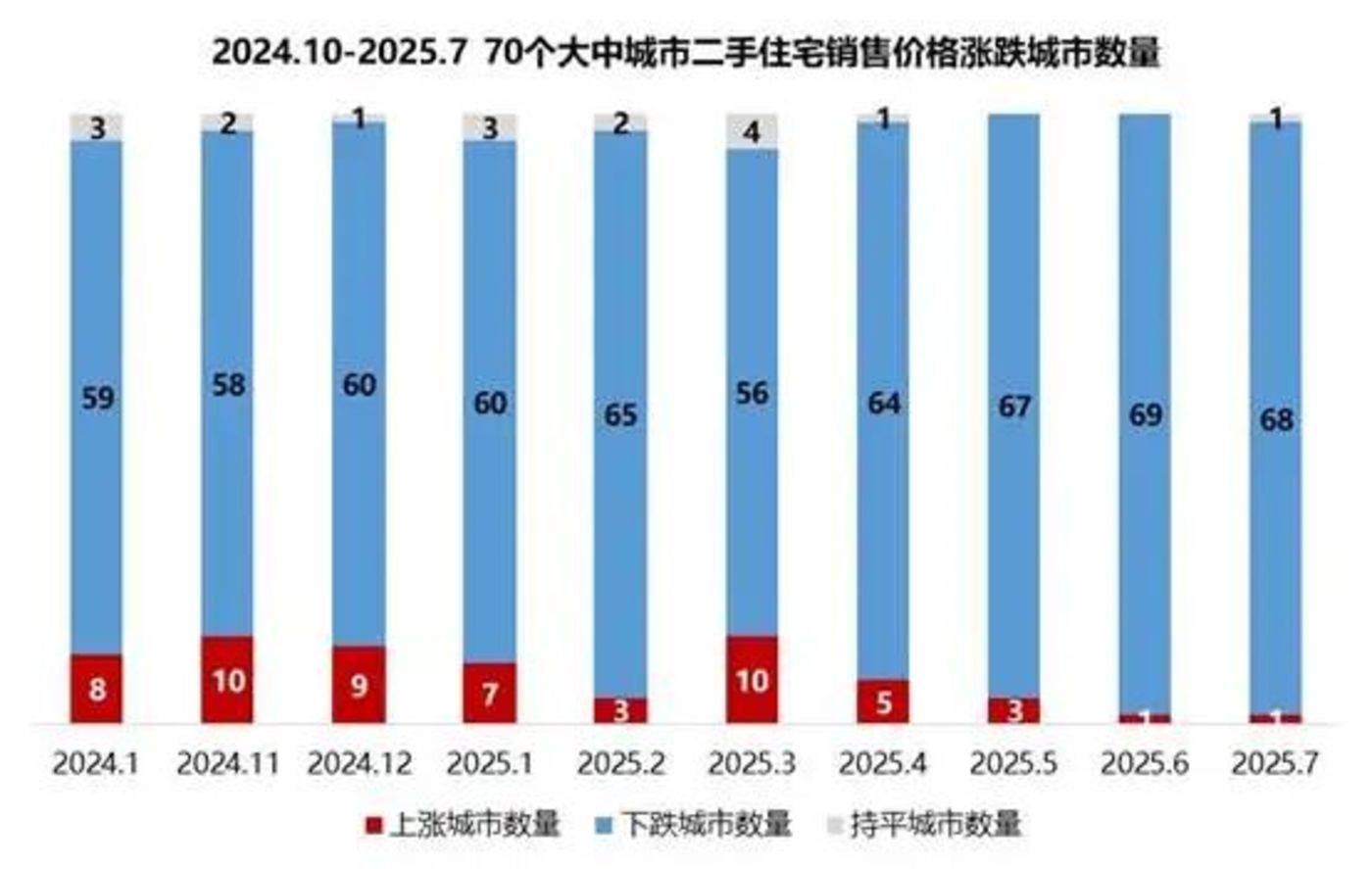
房地产市场调整

Search documents
李嘉诚的预言说对了!我国手握2套房的家庭,或将注定这3个结果
Sou Hu Cai Jing· 2025-08-24 10:25
Core Insights - The real estate market has shifted dramatically, leading to significant financial pressure on families owning multiple properties, as the once-booming market has turned into a challenging environment [1][3][4] Group 1: Market Trends - The myth of continuously rising property prices has been shattered, with the average price of second-hand homes in over a hundred cities declining for 29 consecutive months [1][3] - Notably, property prices in prime locations like central Shanghai have dropped over 30% from their peak, while some cities in Northeast China have seen prices halved to 6,500 yuan per square meter [3][4] Group 2: Financial Burdens - A significant portion of urban families, 41.5%, own two or more homes, facing wealth depreciation, especially in suburban and third- to fourth-tier city properties [3][4] - Holding costs are rising, with property management fees doubling compared to 20 years ago, and potential property taxes looming, which could add a 1.2% tax burden for multi-property owners [4][6] Group 3: Liquidity Issues - Selling properties has become increasingly difficult, with over 160,000 second-hand homes listed in major cities like Beijing and Shanghai, and even a 20% price cut may not attract buyers [6][7] - The rental market is also struggling, with saturation leading to challenges in finding tenants, particularly in third- and fourth-tier cities where younger populations are migrating to larger urban areas [6][7]


现在卖掉房子,是假“聪明”还是?内行人一席话道破真相
Sou Hu Cai Jing· 2025-08-23 06:10
Core Viewpoint - The real estate market is undergoing a significant adjustment, leading to a dilemma for many regarding whether to sell properties or hold onto them, with opinions divided between pessimists predicting price drops and optimists believing in a policy bottom [1][12]. Market Overview - The real estate market is currently in a deep adjustment phase, with urban housing vacancy rates soaring to 21.8%, far exceeding the internationally recognized reasonable level of 5% [4]. - Over half of the new residential properties in 70 major cities have seen year-on-year price declines, with the highest drop reaching 7.9% [4]. - The average transaction cycle for properties has extended to 97 days, indicating a significant decrease in liquidity [5]. Properties to Consider Selling - Old properties in third and fourth-tier cities should be approached with caution due to ongoing population outflow and industrial decline, which may lead to long-term depreciation [6]. - Properties with high debt pressure are concerning, as the average mortgage burden for Chinese households reached 41.3% in 2024, surpassing the international warning line of 40% [6]. - Non-owner-occupied "chicken rib" properties, especially if multiple similar properties are held, may be candidates for sale to optimize asset allocation [6]. Properties to Hold - High-quality properties in core cities, particularly first-tier and some strong second-tier cities, are recommended for retention due to their robust long-term value retention capabilities [7]. - Owner-occupied properties, especially first homes that serve essential living functions, should not be sold lightly [7]. - Properties benefiting from policy incentives, particularly those in urban renewal areas or meeting "good housing" standards, are likely to enjoy advantages from recent government measures [7]. Conclusion - There is no one-size-fits-all answer regarding whether to sell properties in the current market; decisions should be based on individual circumstances [10]. - The era of rising real estate prices is over, and the future market will exhibit more pronounced differentiation [12].
王石再次预测房价走势!前几次都很准,这回大概率又是对的
Sou Hu Cai Jing· 2025-08-22 21:07
Core Viewpoint - The real estate market is expected to undergo an adjustment period lasting at least three to five years, as predicted by industry leader Wang Shi, who emphasizes the need for a long process to de-leverage and eliminate bubbles after over two decades of prosperity [1][3]. Group 1: Market Adjustment - Wang Shi's prediction is based on extensive research of historical real estate bubbles in Japan and the United States, indicating that the current market adjustment is necessary to digest the existing bubble [3][5]. - The real estate market has experienced a continuous decline for 27 months since the peak in 2021, reinforcing the need for a prolonged adjustment period [3]. Group 2: Industry Restructuring - A significant reshuffling in the real estate industry is anticipated, where companies with high debt levels may face mergers, restructuring, or bankruptcy, while financially stable firms are more likely to survive [5]. - Many previously rapidly expanding real estate companies are currently facing severe debt crises, leading to potential bankruptcies [5]. Group 3: Future Market Outlook - Despite the challenges, Wang Shi remains optimistic about the future of the real estate market, suggesting a gradual return to healthy development rather than a hard landing like Japan's experience [5]. - The Chinese real estate market is characterized by strong government policy guidance, which is expected to continue supporting the market through favorable policies aimed at stabilizing prices [5][7]. Group 4: Price Trends and Consumer Guidance - Wang Shi's insights indicate that housing prices are unlikely to rebound quickly, and those expecting a rapid return to previous highs may need to adjust their expectations [7]. - There will be significant differentiation in price trends across cities, with core areas in first-tier cities likely to see stable or rising prices, while third and fourth-tier cities may continue to experience declines due to population outflows and high inventory [7]. - Buyers are advised to be cautious, avoiding oversupplied areas and considering the sale of less desirable properties while retaining high-quality assets in prime locations [7].
2025楼市巨变:马云预言显现,未来购房新趋势何在?
Sou Hu Cai Jing· 2025-08-22 11:01
Core Viewpoint - The Chinese real estate market is undergoing significant changes, with a notable decline in property prices and a shift in buyer sentiment, leading to a reevaluation of investment strategies [1][5][8] Group 1: Market Trends - Property prices in cities like Shenzhen and Shanghai have decreased by approximately 30%, while in some northeastern cities, prices have dropped to extremely low levels [1] - The total housing stock in China has surpassed 600 million units, far exceeding the current population demand of 1.4 billion, indicating a fundamental shift in supply and demand dynamics [1] - Urbanization is contributing to a decline in new housing demand, with projections indicating a decrease of 2.63 million elementary school students by 2026, further signaling a shrinking demand side [2] Group 2: Policy Changes - A dual-track system for affordable and commercial housing is being established, with plans to introduce 6 million affordable housing units over the next five years, affecting the commercial housing market [2] - The proportion of existing home sales has increased significantly, from 10.5% in 2020 to an expected 26.5% in 2024, reducing the risk of unfinished projects for buyers [4] Group 3: Buyer Sentiment - The mindset of buyers is shifting, with a notable decrease in the willingness of younger generations to purchase high-priced homes, leading to a buyer's market [4][5] - By 2025, the number of second-hand homes listed in 100 cities is expected to exceed 3 million, reflecting a significant change in purchasing intentions among the 90s generation [4] Group 4: Investment Opportunities - Certain types of properties are still considered valuable investments, including renovated older neighborhoods, quality properties in core areas, and well-equipped new homes [5][6] - Emerging areas with improving infrastructure are attracting young families and are seen as having significant appreciation potential, despite currently lower prices [8]

一线楼市“硬通货”神话破灭?单价5万跌至1.5万仍难变现
Sou Hu Cai Jing· 2025-08-20 12:23
Core Viewpoint - The real estate market in major cities is experiencing a significant downturn, with property values being reassessed and liquidity issues arising for many homeowners [1][3]. Group 1: Market Trends - Property prices in non-core areas of first-tier cities have rapidly declined, with new residential sales area dropping by 12.7% year-on-year in the first half of 2025, and the listing volume of second-hand homes increasing by over 30% [3]. - In a specific metro line area, new home prices peaked at nearly 50,000 yuan per square meter in 2020, but by 2024, owners were listing at 32,000 yuan per square meter, and developers were offering promotions starting at 18,000 yuan per square meter in 2025, yet sales remained sluggish [3][5]. Group 2: Buyer Sentiment - The decline in the real estate market is not solely due to reduced purchasing power; rather, there is a fundamental shift in buyer confidence. A survey indicated that the proportion of residents preferring to save increased by 2.3 percentage points, while those inclined to invest decreased [5]. - The mindset of potential buyers has shifted from "fear of missing out" to "fear of overpaying," leading to more cautious decision-making in the context of slowing income growth and a pressured job market [5][7]. Group 3: Supply and Demand Dynamics - The average urban household now owns more than 1.1 homes, indicating a transition from absolute housing shortage to structural oversupply, particularly in cities with population outflows and insufficient industrial support [7]. - The phenomenon of "having a price but no market" is becoming the norm, as the financial investment aspect of real estate diminishes, returning focus to the fundamental need for housing [7][9]. Group 4: Changing Buyer Priorities - In this transitional phase of the real estate market, genuine housing needs are becoming the primary driver of transactions, with factors such as education, commuting, and community environment taking precedence over speculative buying [7][9]. - Experts suggest that buyers should assess their real housing needs, stable repayment capabilities, and have realistic expectations regarding price fluctuations, as the price correction process reflects a return to value [9].
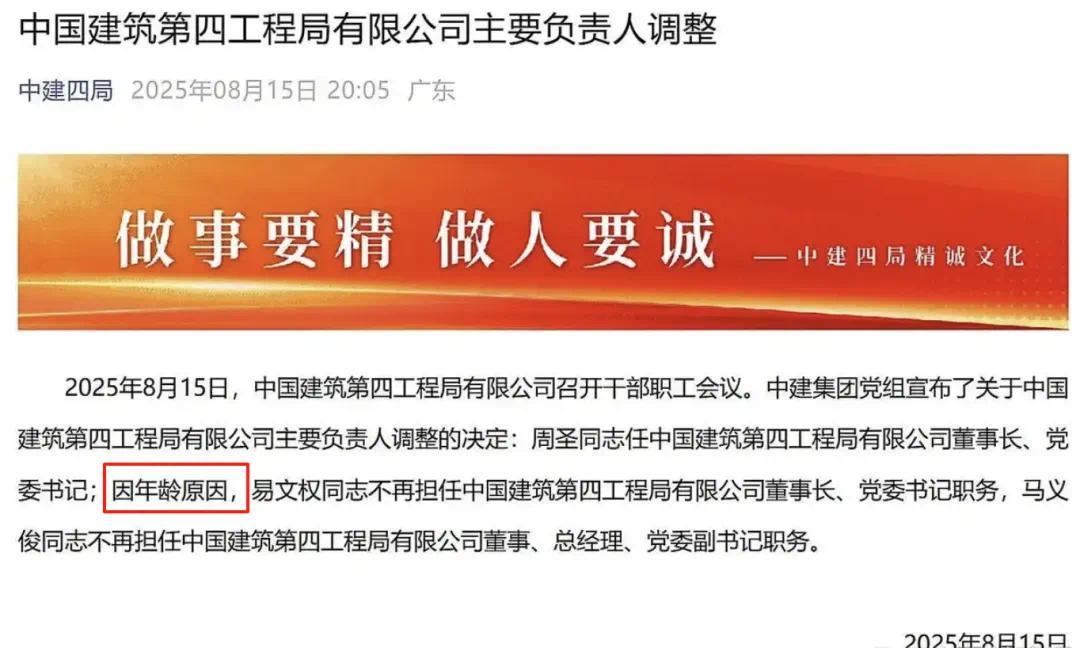
中建四局董事长、总经理同时调整
Mei Ri Jing Ji Xin Wen· 2025-08-19 16:30
Group 1 - The leadership of China State Construction Fourth Engineering Division (CSCEC Fourth Bureau) has undergone significant changes, with Yi Wenquan stepping down as Chairman and Party Secretary, and Zhou Sheng taking over the roles [1][3] - Zhou Sheng, aged 47, has a background in various managerial positions within the company, including General Manager of CSCEC Algeria and Deputy General Manager of CSCEC Third Bureau [1][3] - The official reason for the leadership change was initially stated as "due to age reasons," but this wording was later removed from the announcement [1][3] Group 2 - CSCEC Fourth Bureau has notable projects in the construction sector, including landmark buildings such as Guangzhou East Tower and Shenzhen Kingkey 100, but lacks a strong real estate development brand compared to its peers [3][5] - The company has rebranded its real estate development platform to CSCEC Fourth Bureau Urban Development Investment Co., aiming to adapt to the challenging real estate market [3][5] - The company reported total assets of approximately 171.7 billion yuan and a net profit of 758.2 million yuan for 2024, ranking sixth among its peers in terms of net profit [5][6] Group 3 - Zhou Sheng emphasized the need for structural adjustments and system rebuilding to expand business opportunities, focusing on optimizing human resource management and enhancing employee performance [7] - The company aims to explore new business markets, particularly in project management, urban renewal, and urban operation, to drive growth [4][7]
2025房企中报前瞻 绩优者呈现三大特征
Zheng Quan Ri Bao· 2025-08-19 08:06
Core Viewpoint - The real estate industry is undergoing a deep adjustment period, with over 60% of listed companies expected to report losses in the first half of 2025, indicating significant challenges for the sector [1][2]. Group 1: Industry Performance - As of August 18, 2025, 72 real estate companies listed on A-shares released their mid-year performance forecasts, with 46 companies expected to incur losses, accounting for over 60% [1]. - In July 2025, the National Bureau of Statistics reported a narrowing decline in housing prices across major cities, suggesting a potential stabilization in the market, although the industry remains in a state of adjustment [2]. - The highest expected loss for a single company in the first half of 2025 is projected to be between 10 billion to 12 billion yuan, indicating a worsening situation compared to the previous year [2]. Group 2: Characteristics of Profitable Companies - Despite the overall downturn, some companies like Poly Developments, Hangzhou Binjiang Group, and Longfor Group are expected to maintain positive net profits, with Poly Developments projecting a net profit of 2.735 billion yuan, down 63.15% year-on-year [4]. - The profitable companies exhibit three main characteristics: successful project deliveries, stable operational business contributions, and regional advantages in favorable markets [4][5]. - Longfor Group reported a significant increase in operational revenue, achieving approximately 14.15 billion yuan in the first half of 2025, marking a historical high for the company [4]. Group 3: Market Dynamics and Future Outlook - The real estate market is still experiencing pressure, with a calculated inventory of 30.927 million square meters in 50 key cities, leading to a depletion cycle of approximately 21.82 months [7]. - The end of rapid growth in development business compels companies to accelerate their transformation towards operational business, seeking new growth points [7]. - Industry experts anticipate that policies aimed at market recovery will continue to be implemented, focusing on urban village renovations and high-quality housing supply, which may provide opportunities for companies to stabilize cash flow and enhance operational income [8].
王石再次预测楼市走向?前面几次都对了,这回大概率又对了!
Sou Hu Cai Jing· 2025-08-18 08:51
在风云变幻的楼市中,万科创始人王石的每一次发声,都如同掷地有声的重锤,引人深思。与那些粉饰太平的言论不 同,他的观点总是直指核心,不留情面。最近,他又抛出了一枚"重磅炸弹"——"年轻人,与其买房,不如租房","国内 楼市,还会经过较长时间的调整","还能坚持的房企,不足三分之一"。在对未来楼市的预测中,他的话无疑再次成为了 众人瞩目的焦点。 05、买房人要理性:机会在"理智"之后 王石提醒购房者,要保持理性,机会往往蕴藏在冷静的思考之后。他强调,房地产的角色已经发生了根本性的转变。过 去,房子被视为一种"资产",一种"赚钱的工具",而现在,它更多地回归到"居住需求"和"生活品质"的本质。买房的逻辑 也随之改变,不再是为了追求升值,而是为了获得一份"安心居住"的归属感。"抄底"不再是一种稳赚不赔的游戏。 未来的购房决策,需要更加注重"品质、品牌、风险",切莫再盲目迷信房价上涨的神话。尤其是在楼市转型的大背景 下,许多房子仅仅是"居住的工具",未必能成为保值增值的"资产"。买房不仅要考虑未来的升值空间,更要审视自身能 否承受房价下跌的风险。只有做好了充分的心理准备,才能在楼市的变局中保持清醒,做出明智的选择。 0 ...
李嘉诚王健林说中了!中国手握“2套房”以上的家庭,今年起,或注定3个结果
Sou Hu Cai Jing· 2025-08-18 06:21
Core Viewpoint - The real estate market is experiencing significant declines in property values, driven by various economic and demographic factors, leading to a shift in consumer behavior and investment strategies [2][4][12]. Group 1: Market Trends - Nationally, the sales area of new commercial housing decreased by 4.0% year-on-year from January to July [4]. - In Shenzhen, those who believed in a market rebound have seen losses of around 10% this year [4]. - Property prices have dropped over 30% in some areas, with average prices falling from over 90,000 to over 60,000 [4]. Group 2: Economic Factors - Income levels have declined due to the pandemic, leading to reduced purchasing power and increased financial strain on individuals [4][5]. - The aging population is increasing, with over 310 million elderly people, leading to a decrease in housing demand as many retirees may sell their homes to improve their quality of life [5]. - The declining birth rate is contributing to a supply-demand imbalance in the housing market [5]. Group 3: Changing Consumer Behavior - Younger generations are increasingly opting for renting over buying, with changing societal norms around marriage and homeownership [7]. - The introduction of policies allowing rental rights for school admissions has further shifted perceptions about homeownership [7]. - Economic uncertainty has led to decreased confidence in purchasing homes, with potential buyers hesitant to commit due to fears of job stability and income [7][8]. Group 4: Market Liquidity - The current market is characterized by a significant oversupply of properties, with many listings remaining unsold for months [8]. - In major cities, properties in core areas have seen price reductions of around 30% from peak levels [8]. - The secondary housing market is facing challenges, with a large number of listings and limited buyer interest, particularly in less desirable locations [8]. Group 5: Holding Costs - The costs associated with owning multiple properties are rising, including maintenance fees and potential new taxes [9][10]. - New regulations are expected to increase transparency in property taxation, which may lead to higher costs for landlords [9][10]. Group 6: Strategic Recommendations - For first-time buyers, it is advised to focus on personal housing needs rather than market fluctuations, as current conditions may offer favorable purchasing opportunities [12]. - Investors are cautioned to reconsider their strategies, as most properties will primarily serve as residences rather than investment vehicles [12]. - Those holding multiple properties should reassess their asset management strategies, considering selling underperforming assets and leveraging quality properties for rental income [13][15].

7月房价数据揭晓:楼市深度调整,市场静待新转机
Sou Hu Cai Jing· 2025-08-16 15:23
Group 1: Market Trends - The latest data from the National Bureau of Statistics indicates a significant adjustment in the real estate market, with only 6 cities experiencing a month-on-month increase in new residential property prices, the lowest since the implementation of major policies last September [1] - From January to July, real estate development investment decreased by 12.0% year-on-year, while the sales area and sales revenue of new residential properties fell by 4.0% and 6.5%, respectively, highlighting a weakening effect of the "price for volume" strategy [1] - The area of new housing starts saw a substantial decline of 19.4%, further exacerbating market pessimism [1] Group 2: Performance of Major Cities - Shanghai stands out as the only first-tier city with a continuous month-on-month increase in new residential property prices for 10 consecutive months, with July sales reaching 31.4 billion yuan, where luxury properties contributed 41% of total sales [4] - In contrast, Beijing's market remains weak despite some luxury projects boosting sales, while Guangzhou has not seen any month-on-month price increases for 10 months, and Shenzhen continues to experience a widening decline [4] - Among 31 major second-tier cities, only Urumqi and Changchun reported month-on-month price increases, with cities like Chengdu and Hangzhou also facing declines [4] Group 3: Policy Responses - Despite efforts from central and local governments to stabilize the market, the response has been lukewarm, with policies such as expanding affordable housing supply in population inflow cities failing to reverse the downward trend [5] - Beijing's recent easing of purchase restrictions outside the Fifth Ring Road did not address more impactful measures like core area restrictions or mortgage rates, leading to perceptions of passive rather than proactive policy adjustments [5] - The recovery of market confidence faces multiple challenges, including limited effectiveness of the "price for volume" strategy in the second-hand market and weak demand in the new housing market [5]