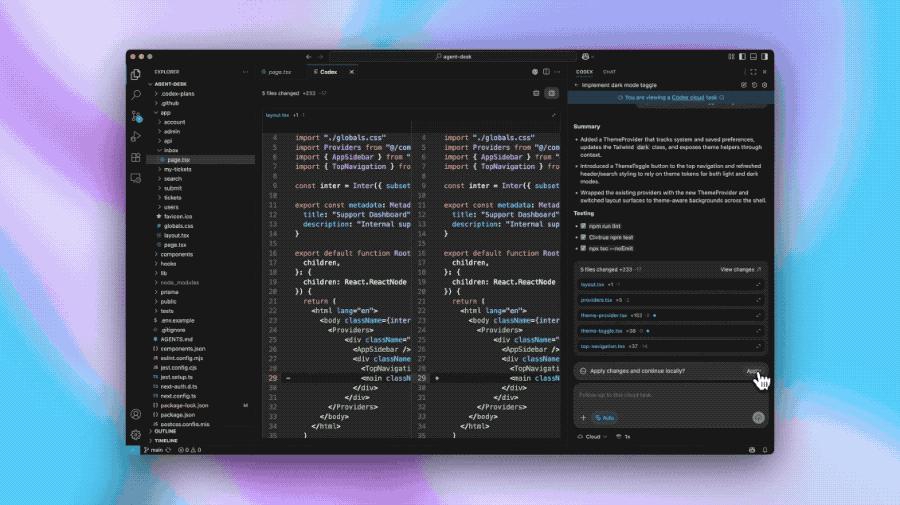
AI编程

Search documents
能连续干活超30小时!Claude发起AI编程新一轮竞赛
Di Yi Cai Jing Zi Xun· 2025-09-30 04:13
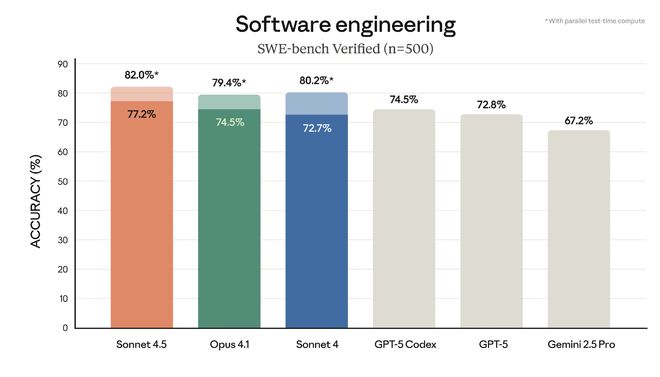
Core Insights - Anthropic has launched Claude Sonnet 4.5, claiming it to be the "best programming model in the world," with significant advancements in agent construction, computer usage, reasoning, and mathematical capabilities [1] - The timing of the release is strategic, occurring just before OpenAI's annual developer conference, following OpenAI's recent introduction of GPT-5-Codex [1] - Sonnet 4.5 can maintain over 30 hours of sustained attention on complex, multi-step tasks, setting a new industry standard [1] Performance Metrics - In the SWE-bench Verified test, Claude Sonnet 4.5 achieved the highest industry score, surpassing GPT-5-Codex by 7.5 percentage points [3] - On the OSWorld benchmark for open-ended tasks, Sonnet 4.5 leads with a 61.4% approval rating, up from 42.2% just four months prior [3] Comparative Analysis - Performance comparison shows Sonnet 4.5 excelling in various categories: - Agentic coding: 77.2% [5] - SWE-bench Verified: 82.0% [5] - Computer use OSWorld: 61.4% [5] - Sonnet 4.5 demonstrates superior domain-specific knowledge and reasoning capabilities in finance, law, medicine, and STEM compared to older models [5] Product Enhancements - The update includes user experience improvements such as a "checkpoint" feature for saving progress and a revamped terminal interface [6] - A notable new feature, "Imagine with Claude," allows real-time software generation without pre-written code, showcasing potential future applications [6] Industry Reception - Industry leaders have endorsed Sonnet 4.5, highlighting its excellent coding performance and significant improvements in long-term task handling [7] - The pricing for Sonnet 4.5 remains consistent with its predecessor, offering a cost-effective solution for developers [8] Financial Performance - Anthropic has raised $13 billion in funding, achieving a valuation of $183 billion, making it the fourth most valuable unicorn globally [8] - The company reported an annualized revenue exceeding $5 billion by August 2025, a substantial increase from $1 billion at the beginning of the year [8] Challenges - Despite its advancements, Anthropic faces challenges, including user complaints about a perceived decline in model quality and a subsequent trust crisis among developers [9]

刚刚,Claude Sonnet 4.5重磅发布,编程新王降临
3 6 Ke· 2025-09-30 01:32
Core Insights - Anthropic has officially released Claude Sonnet 4.5, which is defined as the world's strongest code model, showcasing significant breakthroughs in agent construction, computer usage, reasoning, and mathematical capabilities [2][3]. Performance and Benchmarking - Sonnet 4.5 achieved top performance in various authoritative tests, including a 77.2% score in SWE-bench Verified for real software coding capabilities, and a 61.4% score in OSWorld for simulating real computer tasks, up from 42.2% in the previous version [4][10][13]. - The model demonstrated a 100% success rate in high school math competitions and improved performance in graduate-level reasoning and multilingual Q&A [4][10]. New Features and Product Upgrades - The release includes significant updates across the Claude product line, such as the introduction of "Checkpoints" in Claude Code, allowing users to save progress and revert to earlier states [6]. - Claude API has added context editing features and memory tools, enabling agents to run longer and handle more complex tasks [6][34]. Developer Resources - A new core resource, Claude Agent SDK, has been introduced, providing foundational capabilities for building intelligent agents [8][9]. - The SDK is designed to support a wide range of applications beyond coding, facilitating the development of autonomous agents for complex tasks [32]. Safety and Alignment - Sonnet 4.5 is noted for its improved alignment and safety features, significantly reducing harmful behaviors and enhancing defenses against prompt injection attacks [28][31]. - The model is released under the AI Safety Level 3 framework, incorporating various protective measures, including classifiers for sensitive content [31]. Pricing and Access - The pricing for Sonnet 4.5 remains consistent with Sonnet 4, set at $3 per million tokens for input and $15 per million tokens for output [35]. - The model is accessible through multiple channels, including Claude API, Amazon Bedrock, and Google Cloud Vertex AI [37]. Industry Impact - Claude Sonnet 4.5 is positioned as a powerful tool for developers and professionals in fields such as finance, medicine, and research, marking a significant advancement in AI capabilities and safety [40].

科技融入餐饮:海底捞“火锅+AI编程”成亲子消费新热点
Qi Lu Wan Bao Wang· 2025-09-27 01:34
Core Insights - Haidilao has opened an innovative concept store in Beijing, collaborating with AI education brand Yuan Programming to create an "AI Enlightenment Base" for children, allowing parents to enjoy hot pot while their kids learn technology [1][3] Group 1: Store Features - The store features a transparent kitchen, welcoming robots, a dessert station, and a cocktail bar, enhancing the dining experience with technology [1] - The children's area includes four high-tech installations that teach programming concepts through interactive play, such as obstacle-avoiding cars and balance challenges [3] Group 2: Customer Experience - The store achieved a table turnover rate exceeding 6 during its opening weekend, indicating high customer interest and engagement [5] - The concept integrates AI education into the dining experience, transforming traditional family meals into interactive learning opportunities [3][5] Group 3: Future Plans - Haidilao plans to expand this "hot pot + AI education + entertainment" model to other sectors, including tourism and retail, aiming to integrate technology into everyday life [5]


估值 30 亿美元后,Replit CEO的判断:SaaS、App、代码平台,谁先失速?
3 6 Ke· 2025-09-25 00:54
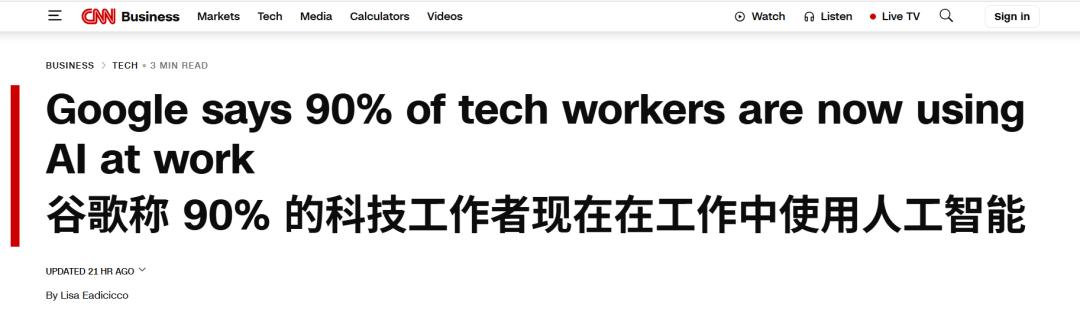
Core Insights - Replit, a startup in the AI programming field, announced a $250 million funding round, achieving a valuation of $3 billion [1] - A survey by Google's DevOps Research and Assessment (DORA) revealed that 90% of software engineers globally use AI programming tools in their daily work [1][2] - The traditional software development process is undergoing fundamental changes due to the rapid adoption of AI tools, which are outpacing the existing development ecosystem [2] Group 1: Challenges in Current Development Ecosystem - Replit's CEO, Amjad Masad, identified three fundamental issues in the current development ecosystem: 1. Over-segmentation of SaaS platforms, which cannot support automated processes [3] 2. The interaction methods of apps interrupt continuous execution [10] 3. Code platforms focus on rewriting rather than deployment, leading to challenges in getting results online [10][22] - Traditional software operations divide work into independent tools, forcing users to switch between them, which AI is beginning to disrupt [6][9] Group 2: Replit's Vision and Approach - Replit aims to create a platform where code can be directly run, deployed, and generated as APIs, transforming the traditional coding process into a complete delivery workflow [7][29] - The focus is on enabling users to create functional systems using just a browser, emphasizing the importance of results over mere code writing [8][29] - Replit's strategy is to provide "full-stack capabilities" not just for programmers but for future AI users, allowing for task delegation to intelligent systems [9][29] Group 3: The Shift from Apps to AI Agents - The rise of AI is leading to a shift from passive apps to proactive AI agents that can autonomously execute tasks without user intervention [17][19] - Users are increasingly finding that effective solutions lie in automated processes rather than traditional app interfaces [15][18] - Amjad Masad highlighted that AI agents can perform tasks such as document organization automatically, reducing the need for manual input [18][19] Group 4: Closing the Loop in Code Platforms - Many traditional code platforms facilitate faster coding but struggle with deployment and usability, creating a gap in the product lifecycle [22][23] - Replit's approach is to connect every step from writing to running and using code, creating a seamless workflow [26][29] - The emphasis is on making programming accessible to a broader audience, allowing anyone to turn ideas into usable products without needing extensive technical knowledge [27][29] Group 5: The Role of AI in Future Workflows - The integration of AI into workflows is shifting the focus from human labor to automated processes, with AI taking on more decision-making and execution roles [32][36] - Replit's internal operations have evolved to rely on AI as a core component rather than a supplementary tool, streamlining processes significantly [33][35] - The future organizational structure may prioritize flexibility and AI-driven task completion over traditional job roles, emphasizing the importance of effective AI utilization [37][38] Conclusion: Redefining Software Development - The next generation of platforms is not just about improving efficiency for engineers but redefining who can create and how those creations are utilized [39][40] - The focus is shifting from merely writing code to developing intelligent systems capable of task management and execution [42] - The evolution of SaaS, apps, and code platforms is not about disappearance but transformation into AI-driven solutions [43]
GenAI系列报告之64暨AI应用深度之三:AI应用:Token经济萌芽
Shenwan Hongyuan Securities· 2025-09-24 12:04
Investment Rating - The report does not explicitly provide an investment rating for the industry Core Insights - The report focuses on the commercialization progress of AI applications, highlighting significant advancements in various sectors, including large models, AI video, AI programming, and enterprise-level AI software [4][28] - The report emphasizes the rapid growth in token consumption for AI applications, indicating accelerated commercialization and the emergence of new revenue streams [4][15] - Key companies in the AI space are experiencing substantial valuation increases, with several achieving over $1 billion in annual recurring revenue (ARR) [16][21] Summary by Sections 1. AI Application Overview: Acceleration of Commercialization - AI applications are witnessing a significant increase in token consumption, reflecting faster commercialization progress [4] - Major models like OpenAI have achieved an ARR of $12 billion, while AI video tools are approaching the $100 million ARR milestone [4][15] 2. Internet Giants: Recommendation System Upgrades + Chatbot - Companies like Google, OpenAI, and Meta are enhancing their recommendation systems and developing independent AI applications [4][26] - The integration of AI chatbots into traditional applications is becoming a core area for computational consumption [14] 3. AI Programming: One of the Hottest Application Directions - AI programming tools are gaining traction, with companies like Anysphere achieving an ARR of $500 million [17] - The commercialization of AI programming is accelerating, with several startups reaching significant revenue milestones [17][18] 4. Enterprise-Level AI: Still Awaiting Large-Scale Implementation - The report notes that while enterprise AI has a large potential market, its commercialization has been slower compared to other sectors [4][25] - Companies are expected to see significant acceleration in AI implementation by 2026 [17] 5. AI Creative Tools: Initial Commercialization of AI Video - AI video tools are beginning to show revenue potential, with companies like Synthesia reaching an ARR of $100 million [15][21] - The report highlights the impact of AI on content creation in education and gaming [4][28] 6. Domestic AI Application Progress - By mid-2025, China's public cloud service market for large models is projected to reach 537 trillion tokens, indicating robust growth in AI applications domestically [4] 7. Key Company Valuation Table - The report provides a detailed valuation table for key companies in the AI sector, showcasing significant increases in their market valuations and ARR figures [16][22]




海外教育科技过亿元融资观察:六起大单勾勒的投资风向
3 6 Ke· 2025-09-23 01:11
Core Insights - The education technology sector is experiencing a tightening in investment, with fewer financing cases and a decline in valuation systems, indicating a more cautious approach from capital compared to the peak during the pandemic [1][21] - Despite the overall cautious environment, significant financing rounds are still occurring, particularly for companies with essential value and technological barriers [1][21] Group 1: Major Financing Events - AMBOSS, a medical education platform, completed a €2.4 billion financing round, marking its largest funding to date, with plans for an IPO [5][7] - AI programming company Windsurf (formerly Codeium) raised $2.6 billion, with its valuation soaring to $28.5 billion, reflecting strong investor confidence in its transition from a tool to a platform [3][4] - Manabie, an education SaaS provider, secured $23 million in B-round financing, highlighting structural opportunities in Southeast Asia's low penetration market [8][10] - Knowunity, a learning platform, raised €27 million in B-round financing, emphasizing the appeal of user-generated content combined with AI capabilities [11][13] - Eruditus, focused on executive education, completed a $130 million refinancing round, showcasing the global demand for high-level education [14][16] - Lingokids, a children's interactive learning platform, announced a $120 million financing round, driven by the large market potential in early childhood education [17][19] Group 2: Trends and Market Dynamics - The trend indicates that capital is not withdrawing entirely but is instead becoming more selective, focusing on projects with essential needs and technological advantages [1][21] - The education technology financing landscape has shifted from a broad investment strategy during the pandemic to a more selective approach, prioritizing companies with clear user value and differentiation [21] - Companies that are positioned in essential markets, have global expansion potential, and leverage AI for efficiency and personalization are attracting significant investment [21]
7小时连续重构不掉线,一骑绝尘的Claude终于遇到对手:Greg Brockman亲自解读AI编程重大突破
3 6 Ke· 2025-09-17 08:00
Core Insights - OpenAI has launched GPT-5-Codex, a refined variant of GPT-5 designed specifically for AI-assisted programming tools, which shows improved performance in coding tasks and dynamic thinking time [1][5][36] - The release of GPT-5-Codex marks a significant shift in the "coding agents" landscape, challenging the dominance of competitors like Anthropic [2][5] - OpenAI's focus on integrating research with product development has led to significant advancements in coding capabilities, with GPT-5-Codex achieving a score of 74.5% on SWE-bench, nearly matching GPT-5's score [6][36] Product Development and Features - The Codex team has worked diligently to create a multi-faceted agent capable of functioning as a software engineer, integrating various tools and interfaces such as Codex CLI and IDE extensions [6][7][18] - GPT-5-Codex exhibits enhanced endurance for complex tasks, capable of working continuously for up to seven hours, showcasing its ability to handle intricate code refactoring [8][36][37] - The model's design emphasizes a balance between speed and intelligence, allowing it to respond quickly to simple tasks while maintaining the capability for complex decision-making [36][37] Competitive Landscape - Over the past year, Anthropic has established a strong position in the coding scene, with revenues reaching $5 billion and a market cap of $183 billion, prompting OpenAI to intensify its efforts in the coding domain [5][29] - OpenAI's historical focus on programming, dating back to the original Codex release in 2021, has laid the groundwork for its current advancements and competitive strategies [5][12][14] Future Directions - The future vision for AI in programming includes a multi-agent system where numerous agents operate under human supervision, creating significant economic value [39][40] - OpenAI is committed to addressing safety and alignment issues as it develops more capable coding agents, ensuring that human operators maintain control over AI actions [39][40] - The company anticipates that advancements in AI will not only enhance coding efficiency but also unlock new capabilities in various fields, including medicine and materials science [41][42]
腾讯40%新增代码已由AI完成,OpenAI也公布大动作
Xuan Gu Bao· 2025-09-16 23:21
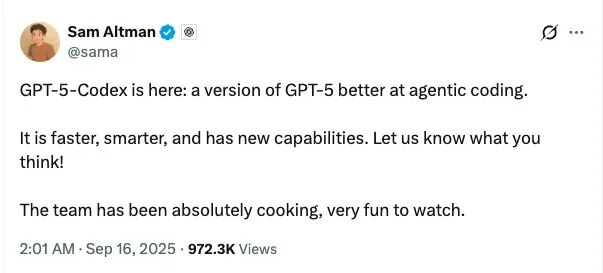
Group 1 - Tencent's products have over 40% of new code generated by AI, with 35% of tasks reviewed by AI, leading to a 34% increase in monthly delivery by programmers and a 10% reduction in delivery cycles [1] - OpenAI's GPT-5-Codex, released on September 16, has quickly captured 40% of the traffic of its predecessor Codex within two and a half hours of launch [1] - AI programming is the highest penetration scenario for both consumer and business sectors, with 47% of surveyed U.S. adults using AI in daily programming and over 60% of enterprises employing AI in programming tasks [1] Group 2 - The global AI programming market is projected to reach between $64.8 billion and $105.6 billion in the medium to long term, driven by an increase in user base as foundational model capabilities improve [2] - Low-code AI programming tools like Lovable and Replit can generate complete applications based on natural language requirements, expanding the user base from professional developers to all product developers, with GitHub estimating 1 billion such users by 2030 [2] Group 3 - Zhuoyi Information is identified as a leading domestic AI programming company, promoting the free trial of its SnapDevelop (IDE+AI) 2026 version [3] - Zhongke Chuangda's Rubik Studio AI programming tool supports multiple mainstream programming languages and enhances coding efficiency through features like code generation, completion, detection, solution generation, and software engineering testing [3]

OpenAI发布GPT-5-Codex:独立编码7小时,能动态调整资源,token消耗更少
Founder Park· 2025-09-16 03:24
Core Insights - OpenAI has released a new model specifically designed for programming tasks, named GPT-5-Codex, which is a specialized version of GPT-5 [3][4] - GPT-5-Codex features a "dual-mode" capability, being both fast and reliable, with improved responsiveness for both small and large tasks [5][6] - The model can execute large-scale refactoring tasks for up to 7 hours continuously, showcasing its efficiency [7] Performance and Features - In SWE-bench validation and code refactoring tasks, GPT-5-Codex outperformed the previous model, GPT-5-high, achieving an accuracy rate of 51.3% compared to 33.9% [9][10] - The model dynamically adjusts resource allocation based on task complexity, reducing token consumption by 93.7% for simpler tasks while doubling the processing time for more complex requests [12][13] - GPT-5-Codex has significantly improved code review capabilities, with incorrect comments dropping from 13.7% to 4.4% and high-impact comments increasing from 39.4% to 52.4% [16][18] Integration and User Experience - The model supports multi-modal interactions, including terminal vibe coding, IDE editing, and GitHub integration, catering to various developer preferences [32] - OpenAI emphasizes the importance of "harnessing" the model, integrating it with infrastructure to enable real-world task execution [29][34] - The user experience is enhanced with a response time of less than 1.5 seconds for code completion, crucial for maintaining developer productivity [30] Competitive Landscape - The release of GPT-5-Codex intensifies the competition in the programming AI space, with various domestic and international players developing similar programming agents [45][46] - Notable competitors include Cursor, Gemini CLI, and Claude Code, which focus on execution capabilities and seamless integration with development environments [51][52] - The market is rapidly evolving, with many companies racing to establish their programming AI solutions, indicating a significant shift in software development practices by 2030 [43][54]
GPT-5编程专用版发布,独立连续编程7小时,简单任务提速10倍,VS Code就能用
3 6 Ke· 2025-09-16 02:01
Core Insights - OpenAI has launched the GPT-5-Codex specialized model, which supports independent continuous programming for up to 7 hours [1][2] - The new model features a dynamic routing mechanism that allows real-time adjustments during task execution, enhancing its ability to handle complex tasks [2][5] - GPT-5-Codex has shown a nearly 20% improvement in success rates for code refactoring tasks compared to the original GPT-5 [5] Performance Enhancements - The model exhibits "true dynamic thinking" capabilities, significantly reducing output token counts for simple tasks by 93.7%, resulting in a 10-fold speed increase [8] - For complex tasks, it takes twice as long for reasoning, editing, and testing, with output token counts increasing by 102.2% [8] - The error comment rate during code review has decreased from 13.7% to 4.4%, while the proportion of high-impact comments has risen from 39.4% to 52.4% [11] Ecosystem Upgrades - OpenAI has restructured the entire Codex product system, introducing features like image input support and a task tracking to-do list for complex tasks [14] - The new IDE extensions integrate Codex into popular editors like VS Code and Cursor, allowing seamless cloud and local task management [14] - Performance improvements in cloud infrastructure have reduced median completion times for tasks by 90% [15] Market Positioning - The timing of this upgrade coincides with a decline in user subscriptions for Claude Code, positioning OpenAI to capture market share in AI programming [16] - There is a suggestion for Microsoft to upgrade its Copilot, indicating competitive pressures in the AI programming space [18]