债转股

Search documents
新力金融涨2.08%,成交额2.27亿元,主力资金净流入1981.33万元
Xin Lang Cai Jing· 2025-08-29 03:08
Group 1 - The core viewpoint of the news is that Xinli Financial has shown significant stock performance and financial growth in recent months, with a notable increase in share price and trading volume [1][2] - As of August 29, Xinli Financial's stock price increased by 33.61% year-to-date, with a 3.58% rise in the last five trading days and a 14.97% increase over the past 20 days [1] - The company has been active in the market, appearing on the "Dragon and Tiger List" six times this year, with the most recent net buy of 22.84 million yuan on July 17 [1] Group 2 - Xinli Financial, established on June 27, 2007, is located in Hefei, Anhui Province, and was listed on December 8, 2000 [2] - The company's main business segments include financing leasing (57.66%), microloans (21.69%), software and IT services (9.38%), pawn services (5.03%), financing guarantees (4.59%), supply chain services (1.65%), and online lending information intermediary services (0.00%) [2] - As of June 30, the number of shareholders decreased by 5.98% to 79,700, while the average circulating shares per person increased by 6.36% to 6,436 shares [2] Group 3 - Xinli Financial has distributed a total of 143 million yuan in dividends since its A-share listing, with 10.25 million yuan distributed over the past three years [3]

华泰证券跌2.03%,成交额16.38亿元,主力资金净流出2.31亿元
Xin Lang Zheng Quan· 2025-08-27 06:21
Group 1 - The core viewpoint of the news is that Huatai Securities experienced a decline in stock price on August 27, with a drop of 2.03% to 21.71 CNY per share, and a total market capitalization of 195.98 billion CNY [1] - Year-to-date, Huatai Securities' stock price has increased by 26.07%, with a 0.65% rise over the last five trading days, an 8.23% increase over the last 20 days, and a 31.34% increase over the last 60 days [2] - The company reported a net profit of 3.64 billion CNY for the first quarter of 2025, representing a year-on-year growth of 58.97% [2] Group 2 - Huatai Securities has a diverse revenue structure, with wealth management contributing 40.85%, international business 34.58%, institutional services 11.74%, other services 9.37%, and investment management 3.45% [2] - The company has distributed a total of 41.54 billion CNY in dividends since its A-share listing, with 12.64 billion CNY distributed in the last three years [3] - As of March 31, 2025, Huatai Securities had 223,800 shareholders, a decrease of 0.69% from the previous period [2][3]

方大特钢跌2.03%,成交额3977.38万元,主力资金净流入117.48万元
Xin Lang Cai Jing· 2025-08-27 02:52
Company Overview - Fangda Special Steel is located in Qingshan Lake District, Nanchang City, Jiangxi Province, and was established on September 16, 1999. It was listed on September 30, 2003. The company primarily engages in the production and sales of automotive leaf springs, spring flat steel, black metal smelting, and its rolling processing products, as well as iron concentrate production and sales. The main business revenue composition is 64.45% from steel sales and 35.55% from other sales [1]. Stock Performance - As of August 27, Fangda Special Steel's stock price decreased by 2.03%, trading at 5.78 CNY per share, with a total market capitalization of 13.37 billion CNY. The stock has increased by 43.85% year-to-date, but has seen a decline of 5.86% over the last five trading days and a slight decrease of 1.53% over the last 20 days. In the last 60 days, the stock price has risen by 38.68% [1]. Financial Performance - For the first half of 2025, Fangda Special Steel reported an operating income of 8.694 billion CNY, a year-on-year decrease of 21.71%. However, the net profit attributable to shareholders increased by 148.75% to 405 million CNY [2]. Shareholder Information - As of June 30, 2025, the number of shareholders for Fangda Special Steel was 85,000, a decrease of 4.08% from the previous period. The average circulating shares per person increased by 4.25% to 27,205 shares [2]. Dividend Distribution - Since its A-share listing, Fangda Special Steel has distributed a total of 12.898 billion CNY in dividends, with 308 million CNY distributed over the last three years [3]. Institutional Holdings - As of June 30, 2025, the top ten circulating shareholders include Hong Kong Central Clearing Limited, which holds 26.5383 million shares, an increase of 2.5366 million shares from the previous period. Other notable shareholders include China Europe Era Pioneer Stock A and Southern CSI 1000 ETF, with varying changes in their holdings [3].

林荣雄策略:周一见 牛且“慢”
2025-08-25 09:13
Summary of Conference Call Records Industry Overview - The current market is experiencing a liquidity-driven bull market, with the index recently surpassing 3,800 points, marking a near ten-year high. However, there is a lack of rigorous data and logical support for expectations of reaching 4,000 points in the short term [2][3] - The market is in a delicate state, influenced by regulatory attitudes, which seem to downplay the impact of stock market sentiment and avoid a rapid bull market transition [5] Key Points and Arguments - **Market Dynamics**: The current liquidity bull market is primarily driven by institutional funds transitioning from debt to equity, with a high requirement for valuation and fundamental matching. This limits the upward potential of the liquidity-driven market [6] - **Sector Performance**: Significant structural changes are noted, particularly in the ChiNext and technology sectors, which have shown strong performance. The bank and micro-cap stock strategies may have reached their peak, while the Hong Kong tech sector is expected to catch up [8] - **Macroeconomic Conditions**: The third quarter shows strong external demand but weak internal demand, with declines in manufacturing, real estate, and retail sales. Price levels are stabilizing at low points, potentially due to companies reducing expansion in response to anti-competitive pressures [9] - **Investment Trends**: Institutional funds are flowing into low-position growth sectors like semiconductors and domestic computing power, with margin trading balances reaching 2.1 trillion yuan, significantly impacting market style shifts [10][12] Additional Important Insights - **Regulatory Influence**: The regulatory environment is crucial, as the authorities aim to maintain control over the market to prevent a rapid bull market from turning into a speculative bubble [5] - **Future Market Outlook**: The market has seen a 40% increase since September, with a 25% rise since early April. There is a call for a slower market pace to achieve a sustainable bull market [7] - **Hong Kong Tech Sector**: The Hong Kong tech sector is currently undervalued, with expectations of a rebound as interest rates are anticipated to decrease, alleviating pressure from rising HIBOR [15] - **U.S. Federal Reserve's Role**: The Fed's recent statements indicate a clear expectation of a rate cut in September, but there are mixed views internally regarding the economic outlook and monetary policy direction [16][17] Conclusion - The market is characterized by a complex interplay of liquidity, regulatory oversight, and macroeconomic conditions. Investors are advised to remain cautious and focus on regulatory developments and mid-year financial reports to better assess future market trends [7][10]
金能科技股份有限公司关于2025年半年度业绩说明会召开情况的公告
Zhong Guo Zheng Quan Bao - Zhong Zheng Wang· 2025-08-23 17:53
Group 1 - The company held an investor briefing on August 22, 2025, to discuss the basic situation and operational results for the first half of 2025 [3][5]. - The meeting was conducted in an interactive online format, allowing investors to engage with the management team [2][4]. - Key participants included the Chairman, independent directors, and the Secretary of the Board and CFO [4]. Group 2 - The company plans to actively expand into emerging markets such as Southeast Asia and South America, which is expected to significantly boost the sales of its olefin products [7]. - To enhance gross and net profit margins, the company will focus on market expansion, high-value product development, and cost reduction strategies [7]. - The company is committed to converting its remaining 9.564 billion yuan of convertible bonds before the upcoming maturity, with plans to repay if conversion does not occur [7].

金能科技: 金能科技股份有限公司关于2025年半年度业绩说明会召开情况的公告
Zheng Quan Zhi Xing· 2025-08-22 16:24
本次投资者说明会以网络互动形式召开,公司管理层针对 2025 年半年度的 基本情况及经营成果等问题与投资者进行了互动交流和沟通。 二、说明会召开的时间、地点 金能科技股份有限公司 关于 2025 年半年度业绩说明会召开情况的公告 本公司董事会及全体董事保证本公告内容不存在任何虚假记载、误导性陈述 或者重大遗漏,并对其内容的真实性、准确性和完整性承担个别及连带责任。 一、说明会类型 证券代码:603113 证券简称:金能科技 公告编号:2025-081 债券代 码:113545 债券简称:金能转债 说明会于 2025 年 8 月 22 日(星期五)下午 14:00-15:00 通过上证路演中心 (网址:http://roadshow.sseinfo.com/)进行网络互动交流。 三、参加人员 投资者以网络提问形式,就所关心的问题与公司参会人员进行了沟通交流。 五、会议主要内容 本次 2025 年半年度业绩说明会的主要内容详见附件。 董事长:秦庆平先生 独立董事:武恒光先生 董事会秘书、财务总监:王忠霞女士 四、投资者参加方式 尊敬的投资者,您好!未来,公司将根据公司发展战略的需要,制定、实施 国际化经营战略,引 ...
房企债务重组进程显著加速
Bei Jing Ri Bao Ke Hu Duan· 2025-08-21 22:29
Group 1 - The core viewpoint of the article highlights a significant acceleration in the debt restructuring process of real estate companies in the second half of the year, with 16 out of 60 distressed companies completing some form of restructuring by early August 2023 [1][2] - The restructuring trend has shifted from "extension" to "debt reduction," with companies utilizing asset swaps and cash buybacks to alleviate long-term debt pressure [1][3] - As of early August, 42 out of 60 distressed companies have disclosed their debt restructuring progress, indicating a more proactive approach compared to previous years [1][2] Group 2 - Among the 16 companies that completed debt restructuring, 8 had their plans approved this year, showcasing a notable increase in the pace of restructuring [2] - The current market conditions have led creditors to adjust their expectations for debt recovery, favoring restructuring over bankruptcy to improve debt repayment rates [2][4] - The debt reduction strategies employed by companies, such as debt-to-equity swaps, have resulted in some firms reducing their debt levels by over 50% [3][4] Group 3 - Several companies have shown signs of operational improvement and sales recovery, indicating a new phase of risk clearance in the real estate sector [5][6] - For instance, Sunac China reported a continuous increase in sales for three consecutive months, with sales figures showing significant year-on-year growth [6] - The Chinese government has implemented various measures to stabilize the real estate market, which is expected to facilitate a quicker return to normal operations for companies post-restructuring [6]

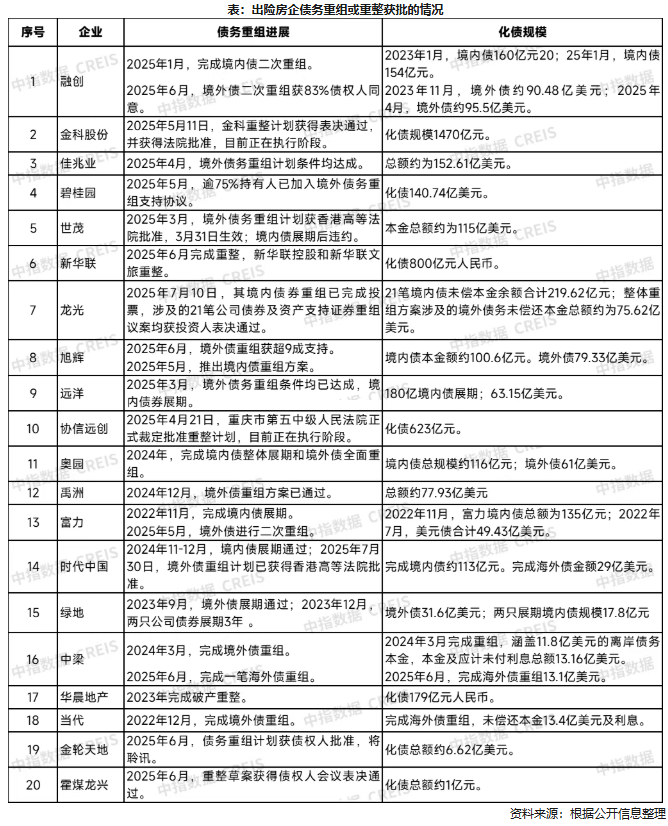
20家房企债务重组,化债规模已超12000亿元
Di Yi Cai Jing· 2025-08-21 13:55
Group 1 - The debt restructuring process for real estate companies has become smoother in 2023, with significant progress reported in both domestic and overseas debt restructuring [1][5] - As of early August 2025, approximately 60 distressed real estate companies have announced debt restructuring or corporate reorganization progress, with 20 companies having their debt restructuring or reorganization approved, totaling over 12,000 billion RMB in debt reduction [5][6] - Major companies that have completed domestic and overseas debt restructuring include Sunac, Aoyuan, Yuanyang, Times China, and Longguang, while companies like CIFI, Kaisa, Yuzhou Properties, Shimao, Greenland, and Country Garden have received approval for overseas debt restructuring [5][6] Group 2 - The mainstream options for debt restructuring among real estate companies include cash buybacks, debt extensions, and debt-to-equity swaps, with many companies opting for debt-to-equity swaps to preserve capital [6] - Sunac has become the first major developer to convert all its dollar bonds into equity in its overseas debt restructuring plan, which involves approximately 95.5 billion USD [6] - The average debt reduction ratio for most distressed companies is around 70%, as many are facing tight cash flows and reduced asset values [6]

深陷内斗,汇源何去何从
经济观察报· 2025-08-20 10:22
Core Viewpoint - Beijing Huiyuan is facing significant challenges in its restructuring process due to disputes with its major shareholder, Zhuji Wenshenghui, which raises uncertainties about its future prospects [2][4]. Disputes and Allegations - On August 14, Beijing Huiyuan accused its controlling shareholder, Zhuji Wenshenghui, of procedural violations during a temporary shareholders' meeting held on August 11, claiming that the meeting was conducted unilaterally and that their representative was silenced [2][3]. - Beijing Huiyuan has publicly stated that Zhuji Wenshenghui has not fulfilled its commitment to inject 1.6 billion yuan, having only contributed 7.5 billion yuan, which constitutes 22.8% of the registered capital [6][3]. - The company also raised concerns regarding a capital reserve plan proposed by Zhuji Wenshenghui, arguing that it could deprive creditors of their rights and force them into accepting equity compensation [6][9]. Legal Actions - Beijing Huiyuan has initiated legal proceedings against Zhuji Wenshenghui and Wensheng Asset Management, which have been accepted by the court [9]. - Legal experts suggest that if the allegations are proven true, Zhuji Wenshenghui may face legal consequences for failing to meet its capital contribution obligations [10][11]. Restructuring Background - In 2022, Beijing Huiyuan underwent a restructuring process, with Wensheng Asset committing to inject 1.6 billion yuan in exchange for a 70% stake, with Zhuji Wenshenghui holding 60% [13][14]. - The restructuring aimed to revitalize the brand and included plans for market expansion and potential A-share listing within three to five years [13]. Business Performance - Following the restructuring, Beijing Huiyuan reported revenues of 11.59 billion yuan in the second half of 2022, with losses of 840 million yuan, and projected revenues of 27.45 billion yuan and 24.75 billion yuan for 2023 and 2024, respectively [16]. - The company has made strategic adjustments, including appointing a new executive and focusing on core juice products, while also targeting the lower-tier market for expansion [16][18]. Management Changes - In July 2024, the CEO was dismissed for serious violations of financial management regulations, coinciding with a planned acquisition by a major shareholder [17]. - The management transition has raised questions about the company's strategic direction and operational stability [17][18].

最新LP梳理系列:(六)银行
FOFWEEKLY· 2025-08-20 10:10
Core Viewpoint - The article discusses the evolving landscape of private equity investment in China, particularly focusing on the role of banks as Limited Partners (LPs) and their investment strategies in response to regulatory changes and market dynamics [4][5]. Group 1: Characteristics of Bank Investments - Banks exhibit a low risk appetite, prioritizing safety and stable cash flows over high-risk investments, which leads them to prefer funds with strong risk control measures [6]. - High liquidity requirements dictate that banks favor investment products with a clear exit strategy, typically preferring fund durations of 3-5 years [7][8]. - Compliance and the quality of investment managers are critical for banks, which tend to favor state-owned or well-established firms with a proven track record [9]. Group 2: Overall Asset Allocation of Banks - In 2025, over half of bank funds are directed towards bank-affiliated General Partners (GPs), with a significant preference for collaborations with state-owned management firms, reflecting a cautious and concentrated investment strategy [10]. Group 3: Recent Changes in Bank Investment Activity - The banking sector has seen a notable increase in investment activity, particularly due to the expansion of the AIC pilot policy, which has facilitated greater internal fund circulation and collaboration among banks [12]. - By the end of 2023, the total assets of five AICs reached 582.6 billion, with projections indicating a potential increase in equity investment scale from 23.3 billion to 58.3 billion [14]. Group 4: Investment Preferences and Trends - The top five sectors for bank LP investments include energy and minerals, automotive transportation, manufacturing, information technology, and consumer goods, indicating a diverse investment strategy [17]. - Banks are increasingly focusing on GPs that demonstrate strong regulatory compliance, government resource integration, and risk management capabilities, often preferring to invest within their own banking ecosystem [19]. Group 5: Notable Bank LP Investment Events - Significant investment events in 2025 include: - China Bank Asset Management's investment of 4.999 billion in May 2025 [21] - ICBC Investment's investment of 2.499 billion in April 2025 [21] - Other notable investments include amounts ranging from 0.999 billion to 9.999 billion across various GPs [21]. Group 6: Active Bank LPs Overview - A list of active bank LPs includes ICBC Financial Asset Investment Co., Bank of China Asset Management, and others, highlighting the geographical distribution and institutional affiliations of these entities [22][23].