十四五规划

Search documents
学习二十届四中全会公报:公报里的“十五五”线索有哪些?
Soochow Securities· 2025-10-23 12:01
Group 1: Background and Goals of the 15th Five-Year Plan - The 15th Five-Year Plan is influenced by eight environmental changes, including three international changes: global trade relations restructuring, increased geopolitical uncertainties, and intensified global technological competition[4] - Domestic changes include a shift from reliance on external demand to internal demand, with the new economy expected to account for over 18% of GDP by 2024[4] - The plan aims for a nominal GDP growth rate of no less than 5.5% during the 15th Five-Year period, with actual GDP growth needing to be at least 4.7%[5] Group 2: Key Work Areas and Priorities - The 15th Five-Year Plan emphasizes a modern industrial system, with a focus on intelligent, green, and integrated development, and aims to maintain a reasonable proportion of manufacturing[6] - The importance of domestic demand, particularly consumption, is highlighted, with a new emphasis on the relationship between consumption and investment[7] - The plan includes a commitment to improving social welfare and advancing common prosperity, with a focus on basic, inclusive, and safety-oriented social services[8]
二十届四中全会公报极简版,来了!
Zhong Guo Xin Wen Wang· 2025-10-23 10:17
Core Points - The 20th Central Committee's Fourth Plenary Session was held in Beijing from October 20 to 23, 2025, where the "Suggestions on Formulating the 15th Five-Year Plan for National Economic and Social Development" were reviewed and approved [1] Group 1: Achievements and Goals - The "14th Five-Year Plan" major goals are nearing successful completion, with significant achievements in economic strength, technological capability, and overall national power [2] - The "15th Five-Year Plan" period is identified as a critical phase for solidifying the foundation of socialist modernization and fully unleashing development potential [3] - The plan emphasizes the need for high-quality development, with significant improvements in technological self-reliance and breakthroughs in comprehensive reforms [6] Group 2: Guiding Principles - The guiding principles include maintaining a focus on economic construction, promoting high-quality development, and ensuring the comprehensive governance of the Party [4][5] - The plan outlines six key principles, including the Party's comprehensive leadership and prioritizing the people's needs [5][6] Group 3: Major Deployments - Twelve important deployments were made, including building a modern industrial system, accelerating technological self-reliance, and enhancing the domestic market [6][7][8][9][10][11][12][13] - The plan aims for significant advancements in economic strength, technological capability, and overall national influence by 2035, with a target of achieving a per capita GDP at the level of moderately developed countries [6] Group 4: Current Situation and Policy - The current economic and social development goals for the year must be firmly achieved, with macro policies needing to maintain momentum and adapt as necessary [14][15] - Emphasis is placed on ensuring livelihood security and maintaining safety and stability [16][17]
中国共产党第二十届中央委员会第四次全体会议公报
Xin Hua She· 2025-10-23 08:56
全会听取和讨论了习近平受中央政治局委托所作的工作报告,审议通过了《中共中央关于制定国民经济 和社会发展第十五个五年规划的建议》。习近平就《建议(讨论稿)》向全会作了说明。 全会充分肯定党的二十届三中全会以来中央政治局的工作。一致认为,中央政治局认真落实党的二十大 和二十届历次全会精神,坚持稳中求进工作总基调,完整准确全面贯彻新发展理念,统筹推进"五位一 体"总体布局,协调推进"四个全面"战略布局,统筹国内国际两个大局,统筹发展和安全,进一步全面 深化改革,扎实推动高质量发展,推进社会主义民主法治建设,加强宣传思想文化工作,切实抓好民生 保障和生态环境保护,维护国家安全和社会稳定,开展深入贯彻中央八项规定精神学习教育、纵深推进 全面从严治党,加强国防和军队现代化建设,做好港澳工作和对台工作,深入推进中国特色大国外交, 推动经济持续回升向好,"十四五"主要目标任务即将胜利完成。隆重纪念中国人民抗日战争暨世界反法 西斯战争胜利80周年,极大振奋民族精神、激发爱国热情、凝聚奋斗力量。 新华社北京10月23日电 中国共产党第二十届中央委员会第四次全体会议公报 (2025年10月23日中国共产党第二十届中央委员会第四次全 ...
北玻股份“十四五”答卷:让世界看见中国玻璃
2 1 Shi Ji Jing Ji Bao Dao· 2025-10-23 08:45
Core Viewpoint - The article highlights the significant advancements and contributions of North Glass Co., Ltd. during the "14th Five-Year Plan" period, emphasizing its role in promoting high-quality development in the glass processing industry through innovation and technology [2]. Group 1: Company Innovations - North Glass has achieved breakthroughs in intelligent manufacturing of tempered glass technology, with its fourth-generation high-end tempering furnace setting new industry standards in temperature control and cooling systems [3]. - The company has developed a leading position in the photovoltaic continuous furnace market, with cumulative sales exceeding 400 units during the "14th Five-Year Plan" period [4]. - North Glass has successfully created a 24-meter ultra-long glass coating production line, addressing challenges in high vacuum stability and valve reliability, achieving world-leading performance in key indicators [4]. Group 2: Major Projects and Applications - The company's glass processing products have been utilized in numerous iconic buildings, including the National Grand Theatre, Beijing Daxing International Airport, and the Apple flagship store, showcasing its capabilities in high-end architectural glass [5]. - Notable projects include the world's largest single glass window at the Taikang Group Building, measuring 50.869 square meters, and the innovative glass facade at the Beijing Urban Sub-center Library [5][6]. - North Glass is also set to supply complex curved glass for the OPPO global headquarters, demonstrating its expertise in intricate glass shapes and high precision [5]. Group 3: Environmental and Efficiency Initiatives - The company has developed energy-efficient fan technology that meets and exceeds national efficiency standards, contributing to the "dual carbon" goals of reducing energy consumption and promoting green development [6]. - North Glass has integrated its product matrix to enhance industry automation, developing various automated systems for glass processing that improve efficiency and reduce costs for end-users [7]. Group 4: Future Outlook - The company aims to continue deepening technological innovation and optimizing its industrial structure to contribute to a more efficient, low-carbon, and sustainable industrial future [7].


透过“洋女婿”“中国通”视角看外国人“方便来、留得住、融得好”
Yang Shi Wang· 2025-10-23 08:24
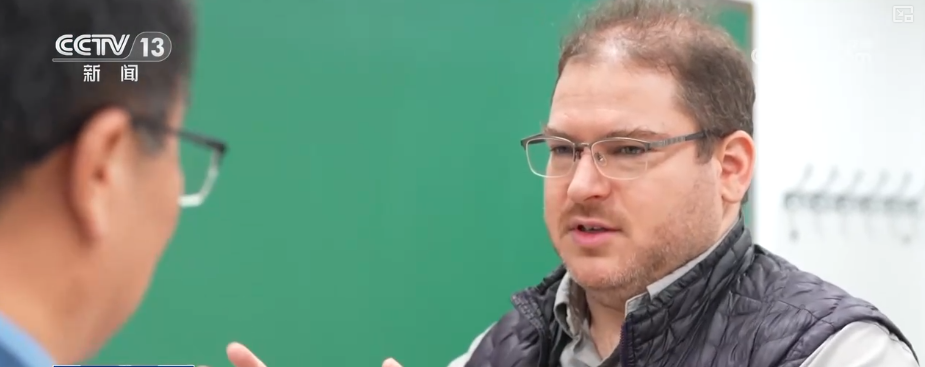
Core Insights - The article highlights the increasing convenience and opportunities for foreigners living in China, driven by various visa policies and the rapid development of the internet [2][4][6][16]. Group 1: Visa Policies and Foreign Experience - The introduction of transit visa-free policies has made it easier for foreigners' families to visit, as exemplified by Jamie's parents learning to use Chinese apps during their stay [4]. - Jamie expresses a desire to apply for a "five-star card" to settle permanently in China, indicating a positive shift in foreign perceptions of living in the country [8]. Group 2: Economic Opportunities and Growth - The rapid development of China's internet has provided a fertile ground for entrepreneurship, reinforcing Jamie's commitment to long-term residence in China [6]. - The article mentions that the number of foreigners willing to come to China has increased, with many returning to share their positive experiences and encourage others to explore business opportunities [13]. Group 3: China's Open Policies - China's ongoing efforts to enhance openness include reducing the negative list for foreign investment, eliminating restrictions in the manufacturing sector, and steadily advancing service industry pilot programs [16]. - The National Immigration Administration has introduced over 50 new measures to facilitate the entry and integration of foreigners, reflecting a commitment to making China more accessible [16].
财经老王丨生活在中国 老外如何 “不见外”?
Yang Shi Xin Wen Ke Hu Duan· 2025-10-23 03:10
Core Insights - The article discusses the changes in the lives of foreigners in China during the "14th Five-Year Plan" period, highlighting personal experiences of expatriates and the impact of China's policies on their lives [1][10]. Group 1: Personal Experiences of Foreigners - Jamie, a Canadian expatriate, expresses how the introduction of transit visa-free policies has made it easier for his family to visit him in Beijing, showcasing a significant change in accessibility [3]. - Jamie's parents have adapted to using Chinese apps like WeChat and Alipay, indicating a growing comfort with technology and daily life in China [3]. - Jamie is applying for a "five-star card" to settle permanently in China, reflecting his commitment to living in the country long-term [4]. Group 2: Growth of International Influence - Fang Haoming, an Iraqi journalist, highlights the increasing number of foreigners willing to visit China, noting that many return to share their positive experiences and encourage others to explore opportunities in China [8]. - Fang's work in media has gained significant traction, with his videos achieving over 100 million views, demonstrating the rising international interest in China's narrative [6]. Group 3: Policy Changes and Openings - The article outlines China's ongoing efforts to enhance foreign investment and residency, including the reduction of the negative list for foreign investment and the complete removal of restrictions in the manufacturing sector [10]. - Over 50 new measures have been introduced by the National Immigration Administration to facilitate the entry and integration of foreigners in China, emphasizing the country's commitment to creating a welcoming environment [10].

省份“三季报”陆续出炉,湖北暂以GDP增速6.0%领跑
Sou Hu Cai Jing· 2025-10-23 02:10
Core Insights - Hubei Province's GDP reached 44,875.62 billion yuan in the first three quarters, with a year-on-year growth of 6.0%, outperforming both the previous year and the national average by 0.8 percentage points [2] Economic Performance - Hubei's economic growth is leading among provinces, with significant contributions from consumer spending, fixed asset investment, and exports, which grew by 5.2%, 6.5%, and 30.8% respectively [2] - In comparison to national averages, Hubei's consumer spending, investment, and export growth rates exceeded by 0.7, 7.0, and 23.7 percentage points respectively [2] Industrial Growth - The industrial added value in Hubei increased by 7.7%, with high-tech manufacturing growing by 13.5%, contributing 26.7% to the overall industrial growth [3] - Investment in high-tech industries rose by 8.3%, outpacing total investment growth by 1.8 percentage points, while R&D expenses in large industrial enterprises increased by 8.9% [3] Export Dynamics - Key export drivers included computers and components, integrated circuits, and lithium-ion batteries, with growth rates of 20.7%, 35.2%, and 120% respectively, collectively boosting total export growth by 4.5 percentage points [3] Strategic Planning - Hubei aims to complete its "14th Five-Year Plan" goals, with a target of exceeding a total economic output of 60 trillion yuan by 2024, and a long-term goal of reaching approximately 90 trillion yuan by 2030 [4]
大国五年丨“十四五”,改变你我生活
Xin Hua She· 2025-10-23 01:54
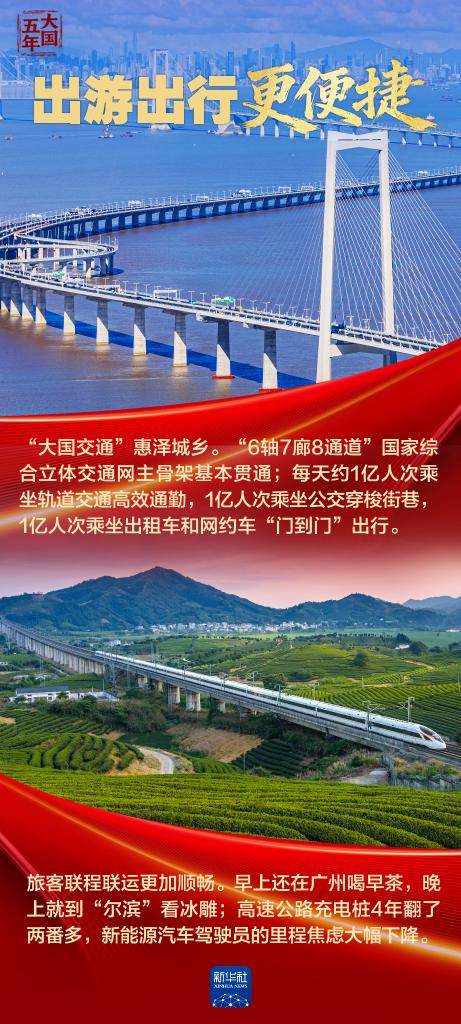
Core Points - The article emphasizes the achievements made during the "14th Five-Year Plan" period, highlighting improvements in the quality of life for the Chinese population, including better transportation, healthcare, and environmental conditions [1][2]. Group 1: Infrastructure and Services - A total of 5,510 "quarter-hour" convenient living circles have been established, serving over 125 million residents [7]. - Over 95% of administrative villages now have direct access to express delivery services, enhancing logistics from farms to consumers [7]. - The national number of regional medical centers has reached 125, benefiting over 400 million people through cross-province medical billing [11]. Group 2: Economic Growth and Consumption - The consumer market remains the second largest globally, with service consumption growing rapidly; residents' service expenditure reached 46.1% [9]. - The grain production has achieved a continuous increase for 21 years, with the national grain output expected to exceed 1.4 trillion jin in 2024 [22]. Group 3: Education and Talent Development - Basic education has achieved balance in 2,895 counties, with preschool enrollment rates at 92% and higher education enrollment rates at 60.8% [15]. - Higher education institutions have produced 55 million graduates, with vocational education supplying over 70% of new high-skilled talent for modern industries [17]. Group 4: Environmental Improvements - By 2024, PM2.5 concentration in cities is projected to drop to 29.3 micrograms per cubic meter, with good air quality days reaching 87.2% [19]. - Approximately 2,000 high-emission vehicles have been eliminated during the "14th Five-Year Plan," contributing to environmental protection efforts [21]. Group 5: Cultural and Community Development - There are 3,248 public libraries and nearly 44,000 community cultural institutions, with public cultural services increasingly accessible online [27]. - The number of television users has surpassed 1 billion, and online video users have reached 1.09 billion, indicating a vibrant cultural landscape [28].
城市24小时 | 三季度“出分”,湖北暂时“领跑”
Mei Ri Jing Ji Xin Wen· 2025-10-22 15:40
Economic Performance - Hubei Province achieved a GDP of 44,875.62 billion yuan in the first three quarters, with a year-on-year growth of 6.0%, surpassing the national average by 0.8 percentage points [2] - Hubei's economic growth rate accelerated by 0.2 and 0.3 percentage points compared to the previous year and the same period last year, respectively [2] Economic Drivers - The three main drivers of Hubei's economic growth include retail sales totaling 19,533.95 billion yuan (up 5.2%), fixed asset investment increasing by 6.5%, and exports reaching 4,351.0 billion yuan (up 30.8%) [2][3] - Hubei's industrial output value increased by 7.7%, with high-tech manufacturing growing by 13.5%, contributing 26.7% to the overall industrial growth [3] Investment and Innovation - High-tech industry investment in Hubei rose by 8.3%, outpacing total investment growth by 1.8 percentage points [3] - R&D expenses for large industrial enterprises increased by 8.9% from January to August, accelerating by 0.9 percentage points compared to the previous year [3] Future Goals - Hubei aims to achieve an economic total of over 60 trillion yuan by the end of the "14th Five-Year Plan" period, with a target growth rate of around 6% for this year [4] - By 2030, Hubei plans to reach an economic total of approximately 90 trillion yuan, establishing itself as a key strategic hub in Central China [5]
“十四五”·答卷|文脉赓续 绘就高质量发展新图景
Yang Shi Wang· 2025-10-22 13:54
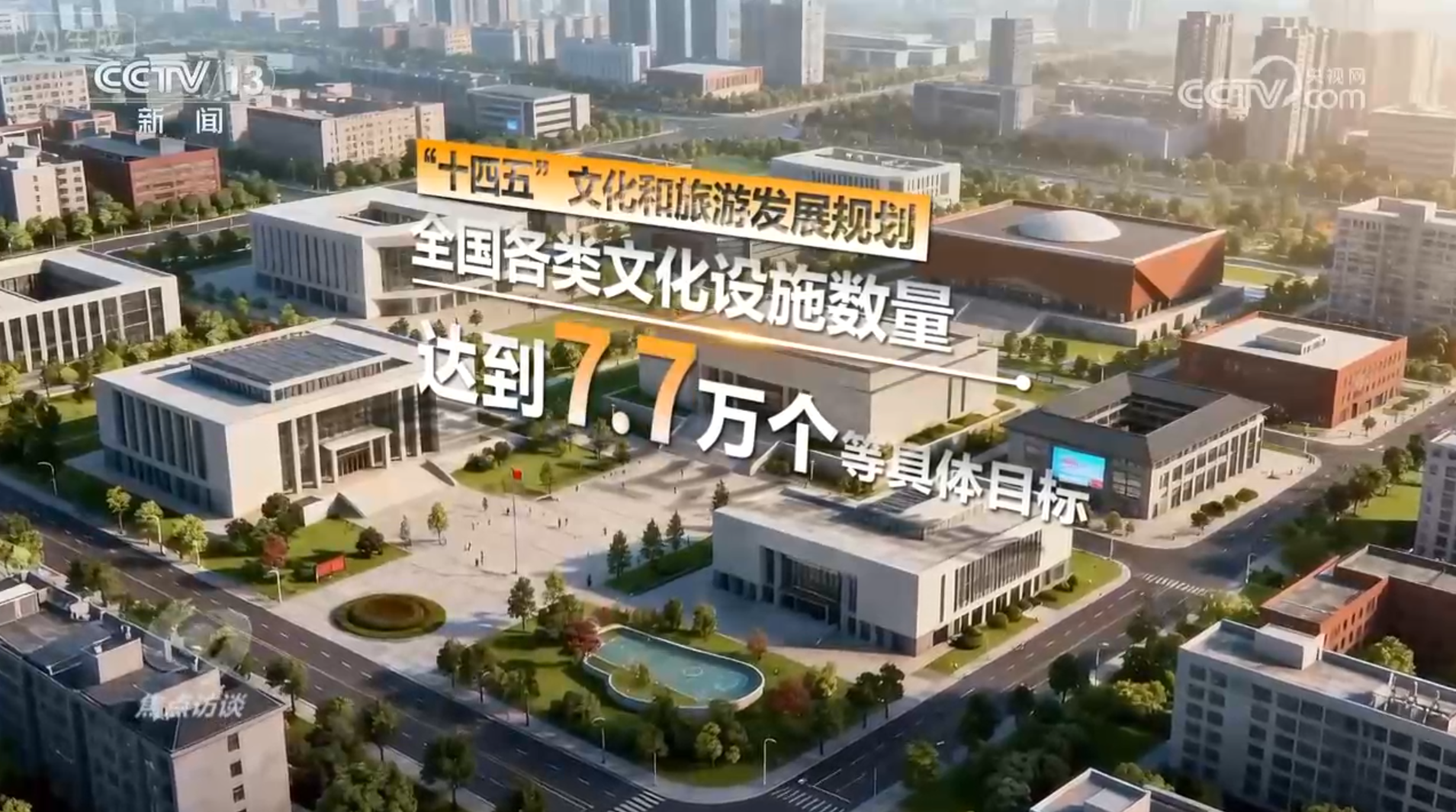
Core Insights - The "14th Five-Year Plan" emphasizes the development of socialist advanced culture and the enhancement of national cultural soft power, focusing on improving social civilization, public cultural service levels, and modern cultural industry systems [1][3] Public Cultural Services - The plan aims for a more balanced public cultural service layout, significantly improved service levels, and diversified service supply methods, with breakthroughs in digital and intelligent development [1][3] - By the end of 2024, there will be 3,248 public libraries and nearly 44,000 cultural institutions at the county level, providing more cultural service options for the public [3] - The expected annual circulation of public libraries is projected to reach 1 to 1.1 billion by 2025, with actual figures reaching 1.34 billion by 2024, surpassing the target [3] Cultural Industry Growth - The cultural industry has seen significant growth, with revenues reaching 19.14 trillion yuan in 2024, a 37.7% increase from 2020, indicating an average annual growth rate exceeding 8% [7][10] - The number of large-scale cultural enterprises has increased to 78,000, up by 1,300 from 2020, reflecting a shift from traditional models to innovative integrations [7][10] - The cultural industry's contribution to GDP has increased, indicating a broader market space and solid demand foundation for cultural industry development [7][10] Integration of Culture and Technology - The deep integration of culture and technology has become a key driver for the cultural industry's growth, with new business models emerging in digital creativity, online audio-visual, and digital publishing [10] - The rise of "Guochao" (national trend) culture has revitalized traditional crafts and industries, such as the ceramics industry in Jingdezhen, which has an annual output value exceeding 90 billion yuan [11][13] Cultural Heritage and Tourism - The integration of cultural heritage protection and tourism development has led to increased visitor numbers at cultural sites, enhancing the overall cultural experience [15][17] - The "cultural tourism" model has evolved, with immersive digital tourism products providing deeper engagement with local culture and heritage [15][17]