国产化替代

Search documents
军工ETF(512660)连续2日资金净流入近4亿元,装备现代化与信息化升级将持续推进
Mei Ri Jing Ji Xin Wen· 2026-01-13 05:11
Group 1 - The defense and military industry is a core support for national security, characterized by strong policy drivers and long-term certainty, with modernization and information upgrades continuing to advance [1] - By 2025, the national defense budget is projected to reach 1,784.665 billion yuan, with a growth rate of 7.2%, while the military electronics market is expected to reach 501.2 billion yuan [1] - Key development areas in the industry include high-end radar, satellite communications, and unmanned combat systems, with leading companies benefiting from accelerated equipment deployment and deepening domestic substitution, resulting in safety premiums and dual performance drivers [1] Group 2 - The aviation equipment sector is a significant component of the defense and military industry, with the low-altitude economy expected to exceed 1.5 trillion yuan, demonstrating counter-cyclical defense characteristics and strategic allocation value [1] - The military ETF (512660) tracks the CSI Military Index (399967), which selects the top ten military group holdings and related listed company securities from the Shanghai and Shenzhen markets, covering various military fields such as aviation, aerospace, shipbuilding, weaponry, military electronics, and satellites [1] - This index primarily allocates to the aviation equipment and military electronics sectors, exhibiting a small and mid-cap style [1]
清华系芯片巨头上市,开盘飙涨近五成
是说芯语· 2026-01-13 01:58
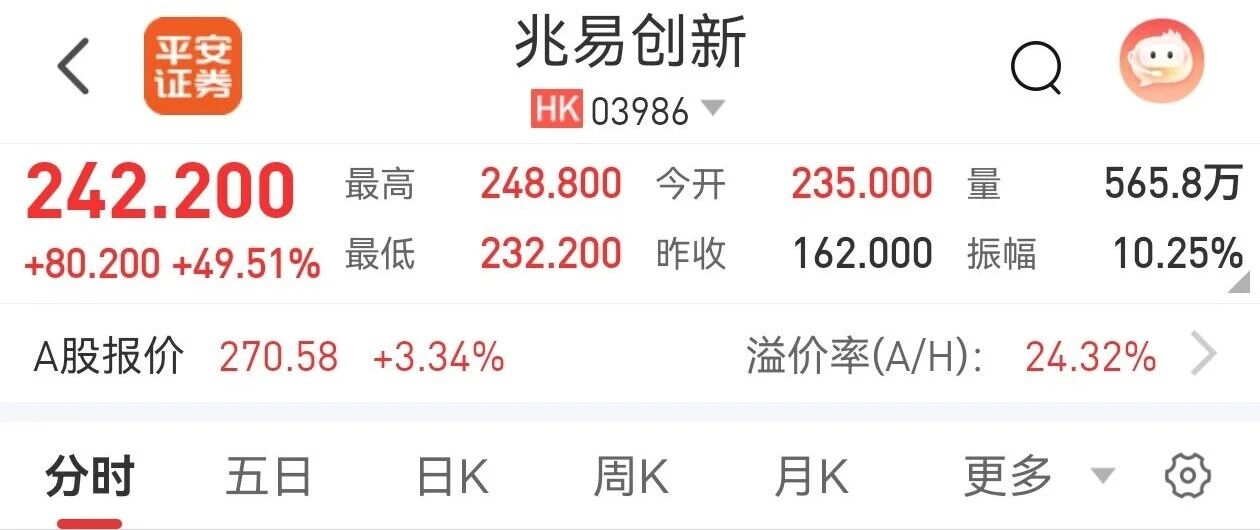
Core Viewpoint - 兆易创新 has officially listed on the Hong Kong Stock Exchange, marking a new chapter in its "A+H" dual capital market strategy, enhancing its international financing capabilities and competitive position in the semiconductor industry [1][5]. Group 1: Company Overview - 兆易创新 is a leading chip design company specializing in storage chips and microcontrollers, founded in 2005 by Tsinghua University alumni [6][10]. - The company has expanded its product offerings from specialized storage chips to a diversified range of chip products, including Flash memory, niche DRAM, MCUs, analog chips, and sensor chips [7]. Group 2: Market Position - According to Frost & Sullivan, 兆易创新 ranks among the top ten global integrated circuit design companies in four key areas: - NOR Flash: 2nd globally, 1st in China - SLC NAND Flash: 6th globally, 1st in China - Niche DRAM: 7th globally, 2nd in China - MCU: 8th globally, 1st in China [8]. Group 3: Financial Performance - The global offering price for 兆易创新 was set at HKD 162.00 per share, with the stock opening at HKD 235.00, reflecting a significant increase of 45.06% from the issue price, resulting in a market capitalization of approximately HKD 163.74 billion (about RMB 146.5 billion) at the opening [5]. Group 4: Strategic Initiatives - 兆易创新 is focused on creating a comprehensive ecosystem for "perception, storage, computing, control, and connectivity," providing integrated chip solutions for emerging industries such as humanoid robots, electric vehicles, and smart wearable devices [9]. - The company is also strategically investing in upstream and downstream sectors of the industry, including stakes in leading domestic wafer testing companies and investments in edge AI chip design firms [9].

先进封装胶膜体量虽小,但本土化率都不足15%
势银芯链· 2026-01-13 01:51
Core Viewpoint - The advanced packaging market is experiencing significant growth driven by the increasing demand for AI and computing power, leading to a supply-demand imbalance in the global advanced packaging market, which is projected to reach approximately $45 billion in 2024, accounting for about 55% of the total semiconductor packaging market [2]. Market Growth - The global advanced packaging market is expected to grow to around $80 billion by 2030, with a compound annual growth rate (CAGR) of 9.4% from 2024 to 2030, becoming a core component in the value upgrade of the semiconductor industry [2]. - The Chinese advanced packaging market is predicted to reach approximately 39.9 billion RMB in 2022, with a CAGR of about 15%, significantly higher than the global average growth rate, indicating a "blue ocean" market potential [2]. Key Materials Demand - DAF films and underfill materials are essential in packaging processes, with DAF films used to connect chips to substrates and underfill materials widely applied in FC and BGA packaging processes to ensure reliability and stability [3]. - The Chinese DAF film market is expected to exceed 1 billion RMB by 2026, with a CAGR exceeding 12% [3]. - The global underfill market is projected to grow at a CAGR of 10.48%, reaching $721 million in 2024 and surpassing $1.443 billion by 2031, with China's market performance expected to exceed the global average [3]. Domestic Market Landscape - The DAF film and underfill markets are currently dominated by foreign companies, with domestic firms like Debang Technology, Yonggu Technology, and others just beginning to enter the DAF film market [5]. - Debang Technology is leading in domestic production, with its underfill materials solutions continuously improving and achieving small batch deliveries by mid-2025 [9]. - Other domestic companies, such as Hans New Materials and Yonggu Technology, are also making strides in the underfill product line, with Hans focusing on chip packaging adhesives [13]. Production Capacity - Debang Technology has achieved small batch deliveries of DAF products, while other companies like Yonggu Technology have limited production capacity for DAF films [13]. - The emerging player, Juting Xincai, is expected to enhance local supply chain convenience and contribute to the localization of advanced packaging materials, aligning with the explosive growth in computing power demand [13].

2025年中国氦气液化器行业发展历程、产业链图谱、市场规模、竞争格局及发展趋势分析:国产化替代需求迫切[图]
Chan Ye Xin Xi Wang· 2026-01-13 01:38
关键词:氦气液化器行业发展历程、氦气液化器产业链图谱、氦气液化器市场规模、氦气液化器竞争格 局、氦气液化器发展趋势 一、概述 氦气液化器即氦液化器,是一种利用低温制冷循环,将气态氦气冷却至其液化温度(标准大气压下约为 4.2K,即-268.95℃)以下,实现氦气液化的专用低温设备。按液化能力不同,氦气液化器可以分为小型 液化器、中型液化器和大型液化器。 氦气液化器分类 二、发展历程 1959年国内首次实现液氦制取,标志技术从理论走向实验验证,当时设备以小型实验装置为主,核心部 件与工艺依赖进口,应用局限于国防军工与前沿科研,尚未形成产业化能力。近年来,我国氦气液化器 核心技术攻关取得突破,大型氦液化技术逐步缩小与国际差距,自主知识产权设备在大科学装置、工业 气体项目中实现应用,在政策驱动与市场需求双重作用下,国产替代加速,行业集中度提升,中小企业 向专精特新方向转型,产业生态逐步完善,同时,氦气回收-液化-提纯闭环系统成为发展重点,企业通 过产业链整合提升竞争力,形成"设备+服务+气体供应"的一体化模式。 中国氦气液化器行业发展历程 内容概要:氦被称为最不活泼的元素,常态下呈无色、无味的气态,其存在形式主要分 ...


研判2025!中国紫外共振拉曼仪行业工作原理、发展历程、产业链、市场规模及未来趋势分析:国产技术从“跟跑”向“并跑”“领跑”转型[图]
Chan Ye Xin Xi Wang· 2026-01-12 01:19
Core Insights - The ultraviolet resonance Raman spectrometer (UVRRS) is a high-end research instrument that enhances signals and avoids fluorescence interference, playing a crucial role in advancing fundamental research in materials and biochemistry [1][6] - The market size for China's UVRRS industry is projected to reach approximately 459 million yuan in 2024, representing a year-on-year growth of 13.33% [6] Industry Overview - UVRRS operates on the principle of resonance Raman effect, utilizing ultraviolet light (e.g., 266nm, 248nm) as an excitation source, significantly enhancing Raman signals while suppressing fluorescence background interference [2][3] - The technology is applicable in various research areas, including biomolecules, catalysts, and nanomaterials, enabling precise analysis of molecular structures and dynamics [2] Industry Development History - The development of China's UVRRS industry has gone through four stages: initial development in the 1970s-80s, breakthroughs in the 1990s to early 2000s, rapid growth from the early 2000s to 2015, and maturity and industrialization from 2016 to present [3][4] - Key milestones include the first domestic UV Raman spectrometer developed in 1997 and the establishment of a joint laboratory with Beijing Zhuoli Hanguang in 2008, leading to commercial production [3][7] Market Size - The UVRRS is essential for advancing research in protein structure analysis, drug interactions, catalyst characterization, and defect analysis in new energy materials [6] - The projected market size for 2024 indicates a significant growth trajectory, reflecting the increasing demand for advanced research tools [6] Key Companies and Institutions - The Chinese Academy of Sciences Dalian Institute of Chemical Physics is a leading technology source, having developed the first domestic UV Raman spectrometer and achieved breakthroughs in deep ultraviolet Raman technology [7][9] - Beijing Zhuoli Hanguang Instrument Co., Ltd. is the leading domestic company in the UVRRS field, collaborating closely with the Dalian Institute to develop advanced systems and achieve commercial production [9][10] Industry Development Trends 1. **Technological Innovation and Performance Breakthroughs**: The industry is expected to focus on core technology innovations, enhancing device performance towards higher precision and intelligence, with potential integration of AI for real-time spectral analysis [11][12] 2. **Expansion of Application Fields**: As technology matures, UVRRS applications will extend into areas such as gene editing and environmental monitoring, with customized detection modules for specific materials [12][13] 3. **Domestic Replacement and Ecosystem Construction**: The industry aims to accelerate the localization of core components, with increasing domestic production rates for high-precision lasers and detectors, fostering a collaborative innovation ecosystem [13][14]

银河证券:港股将在外部流动性压力与内部政策支撑间寻求平衡
Zheng Quan Shi Bao Wang· 2026-01-12 00:29
Core Viewpoint - The probability of interest rate cuts by the Federal Reserve is decreasing, which is putting pressure on Hong Kong stocks. The market is expected to seek a balance between external liquidity pressures and internal policy support [1] Group 1: Sector Recommendations - The technology sector remains a long-term investment focus, with potential for upward movement due to multiple favorable factors such as price increases in the supply chain, mergers and acquisitions, and domestic substitution [1] - The consumer sector is likely to continue benefiting from policy support, and current valuations are relatively low, indicating significant medium to long-term upside potential [1] - The metals sector is influenced by changes in international geopolitical dynamics [1]

【投资视角】启示2025:中国防火墙行业投融资及兼并重组分析(附投融资汇总、产业基金和兼并重组等)
Qian Zhan Wang· 2026-01-11 06:08
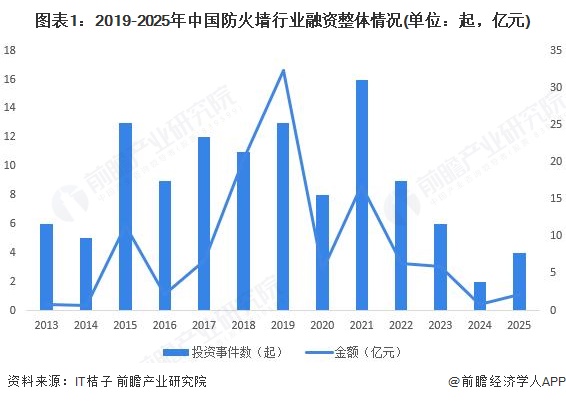
Core Insights - The firewall industry in China has seen limited investment activity, with a peak in 2021, where 16 financing events occurred, totaling 1.68 billion RMB. However, by 2024, only 2 events were recorded, amounting to 80 million RMB [1][2]. Investment Trends - Investment rounds are primarily concentrated in early stages, specifically angel and A rounds, with 18 angel investments and 34 A round investments recorded by November 2025. This trend is driven by the industry's shift towards intelligent and cloud-native transformations, attracting capital for innovative technologies [2][3]. - The majority of financing activities are concentrated in Beijing and Zhejiang, with 47 and 35 events respectively, followed by Jiangsu and Shanghai with 17 and 9 events [5]. Focus Areas - Investment direction is increasingly focused on the integration of AI and zero-trust architecture, reflecting the industry's evolving technological landscape [7]. Investor Landscape - The primary investors in the firewall industry are investment firms, with notable entities including CRRC Capital, China Electric Fund, and PwC Capital [11]. Industry Funds - Several industry funds are dedicated to the firewall sector, including the 360 Enterprise Security Venture Fund (1 billion RMB) and the China Internet Investment Fund (100 billion RMB), among others [13]. Mergers and Acquisitions - Mergers and acquisitions in the firewall industry are infrequent, primarily consisting of horizontal mergers aimed at enhancing business capabilities [14][15].
反倾销背景下的二氯二氢硅:高科技产业的“隐形关键材料”
材料汇· 2026-01-10 15:49
Core Viewpoint - The Ministry of Commerce announced an anti-dumping investigation into imported dichlorodihydrosilane from Japan, highlighting its strategic importance in China's high-tech industry chain and aiming to create a fair competitive environment for domestic industries [2]. Industry Significance - The anti-dumping investigation is expected to curb unfair trade practices, facilitating technological research and capacity release for domestic companies, thus accelerating the localization process of dichlorodihydrosilane and ensuring supply chain security for high-end industries like semiconductors and photovoltaics [2]. Overview of Dichlorodihydrosilane - Dichlorodihydrosilane, also known as dichlorosilane, is a colorless gas at room temperature and pressure, characterized by high danger and high reactivity. Its hazardous properties include flammability, toxicity, and poor thermal stability, while its high value comes from its use as a silicon source precursor in semiconductor manufacturing [5][6]. Technical Aspects - The production of dichlorodihydrosilane involves various methods, with a focus on achieving high purity to meet the stringent requirements of advanced semiconductor processes. The main methods include disproportionation, reduction, synthesis, and recovery, with disproportionation and recovery being the most widely used due to their advantages [8][9][10]. Applications - Dichlorodihydrosilane is a key material in high-tech industries, particularly in semiconductor manufacturing, where it is used in chemical vapor deposition (CVD) processes and for producing silicon-based precursors. Its applications extend to photovoltaics and the synthesis of special materials [12]. Market Dynamics - The global market for dichlorodihydrosilane is expanding steadily, driven by growth in the semiconductor industry and technological innovations in electronics. The demand is further boosted by developments in renewable energy technologies such as solar photovoltaics and electric vehicles [14][15]. Competitive Landscape - The high-end electronic-grade dichlorodihydrosilane market has been dominated by a few overseas companies, particularly Shinetsu Chemical from Japan, which holds over 50% of the global market share. However, domestic companies like Tangshan Sanfu are making strides in achieving large-scale production and quality validation for their products [17][18][19].



航发团队攻坚半导体真空设备,多款产品性能对标国际标杆,完成数千万天使轮融资|硬氪首发
3 6 Ke· 2026-01-10 11:30
在市场拓展方面,「芯航微」的产品已进入国内知名第三代半导体碳化硅外延设备企业及高端质谱仪厂 商,并实现了二十余台产品的批量交付。公司通过共享航空发动机制造平台与供应链资源,在控制成本 的同时保障产品的一致性与可靠性,其产品定价低于进口产品,且供货显著短于国外厂商交货期。 为进一步构建产能与研发壁垒,「芯航微」已在上海松江区建立2000平方米的研发与生产基地,包含万 级洁净室总装线、性能测试实验室及MAX80、MAX300两条装配支线,当前年产能超过1200台。公司 于2024年通过ISO9001国际质量体系认证,并已完成多项实用新型与发明专利的申请与布局。 作者 | 林晴晴 编辑 | 袁斯来 硬氪获悉,芯航微(上海)科技有限公司(下称「芯航微」)已于近期完成数千万元天使轮融资,本轮 融资由宇杉资本和上海道禾投资共同参与,此前公司曾获得险峰长青的种子轮投资。据悉,本轮融资将 主要用于涡轮分子泵产线扩建、半磁悬浮及全磁悬浮系列产品的持续研发,以及市场推广与团队扩充。 「芯航微」成立于2023年,是一家专注于半导体、高端科学仪器、光伏等工业领域真空零部件设计、研 发与生产的高科技企业。公司核心团队来自中国航发商用航 ...
趋势研判!2025年中国智能卫星平地系统行业产业链全景、发展现状及未来发展趋势分析:北斗融合赋能精准农业,百亿蓝海引领智能升级[图]
Chan Ye Xin Xi Wang· 2026-01-10 02:06
Core Insights - The smart satellite leveling system, centered on GNSS high-precision positioning, is experiencing steady growth supported by national satellite communication policies, with a projected market size of approximately 8.5 billion yuan in 2024, primarily driven by agricultural demand [1][8]. Industry Overview - The smart satellite leveling system integrates GNSS high-precision positioning with RTK real-time differential technology, enabling automated adjustments for ground leveling [2]. - The system can be categorized based on various dimensions, including core navigation systems (e.g., Beidou, GPS), positioning technologies (e.g., RTK, CORS), and application scenarios (e.g., agriculture, engineering, water conservancy) [2]. Policy Support - The Chinese government has implemented multiple policies to promote the satellite communication industry, encouraging the integration of satellite technology across various sectors, which provides a robust policy framework for the smart satellite leveling system [3][4]. Industry Chain Analysis - The industry chain consists of upstream core components, midstream system integration, and downstream application services, with a notable focus on high-precision positioning navigation components [4][5]. - The upstream market includes GNSS boards, RTK modules, and hydraulic components, with a domestic production rate exceeding 85% for Beidou multi-frequency chips [5]. Market Demand - The primary demand driver for the smart satellite leveling system is the construction of high-standard farmland, with significant government initiatives aimed at enhancing agricultural productivity [6][8]. - By 2024, over 80 million mu of new and upgraded high-standard farmland is expected to be developed, significantly boosting the market for smart satellite leveling systems [6]. Current Industry Status - The satellite navigation and positioning service industry is projected to reach a total output value of 575.8 billion yuan in 2024, reflecting a year-on-year growth of 7.39% [8]. - The smart satellite leveling system industry is entering a high-growth phase, characterized by accelerated technological iteration and increasing domestic production [8]. Competitive Landscape - The industry is dominated by domestic leaders such as Shanghai Lianshi Navigation and Huace Navigation, which are focusing on system integration and terminal manufacturing [9]. - The competition is shifting towards providing comprehensive solutions that integrate hardware, algorithms, and data services, with a notable trend of domestic brands replacing foreign ones in the market [9]. Future Development Trends - The industry is expected to see deepening technological integration, with advancements in AI and multi-sensor technologies enhancing operational efficiency [10][11]. - The focus will shift towards a complete industrial ecosystem, with an emphasis on standardization and modularization of products [11]. - Application scenarios are expanding beyond traditional sectors to include ecological restoration and renewable energy, with a transition towards integrated service models [12].