
太空数据中心

Search documents
“太空数据中心”成AI必争之地?马斯克与贝佐斯互掐,Altman也想插一脚
美股研究社· 2025-12-12 11:07
Core Viewpoint - The article discusses the emerging competition in the space of AI data centers, driven by tech billionaires like Elon Musk and Jeff Bezos, who are exploring the potential of deploying AI computing capabilities in orbit to address the growing energy consumption challenges on Earth [4][6]. Group 1: Industry Trends - The trend of moving data centers to space aims to overcome physical limitations on Earth, particularly the significant power requirements for AI model training and inference [6]. - Supporters envision a future where satellites equipped with AI chips operate in orbit, powered by abundant solar energy, and transmit processed data back to Earth [6]. - The potential for space-based data centers is highlighted by the fact that satellites can harness solar energy at a rate 30% stronger and up to six times more total energy than on Earth, while also benefiting from near-zero temperatures for cooling [7]. Group 2: Key Players - Elon Musk's SpaceX plans to utilize upgraded Starlink satellites for AI computing, potentially valuing the company at $800 billion [4]. - Jeff Bezos's Blue Origin is also developing technology for orbital AI data centers, with significant progress on the New Glenn rocket project [8]. - Other tech leaders, including OpenAI's Sam Altman and Google's executives, are exploring opportunities in this space, with Google planning to deploy test satellites carrying AI chips by early 2027 [9][10]. Group 3: Challenges and Considerations - Despite the promising outlook, there are significant engineering challenges and cost-effectiveness questions regarding the deployment of data centers in space [5][11]. - Technical hurdles include temperature management, radiation protection, and the transmission of large data volumes back to Earth without delays [11]. - The skepticism surrounding the feasibility of space-based data centers is rooted in concerns about whether they can compete with terrestrial facilities, especially as ground-based power limitations are alleviated [12].


马斯克引全球关注,史上最大IPO将至?目标估值1.5万亿美元!
Xin Lang Cai Jing· 2025-12-12 09:19
Core Insights - SpaceX is preparing for an IPO with a fundraising target exceeding $30 billion and a valuation goal of approximately $1.5 trillion, which would make it the largest IPO in history [2][3] Group 1: IPO Details - The IPO is driven by the strong growth of the Starlink satellite internet service and advancements in the development of the Starship rocket for lunar and Mars missions [3] - Part of the funds raised from the IPO is expected to be used for developing space data centers, including the purchase of necessary chips [3] Group 2: Market Impact - Following the news of SpaceX's IPO plans, stock prices of other aerospace companies increased, with EchoStar rising by 12% before closing up 6%, and Rocket Lab gaining 3.6% [4] Group 3: Valuation and Financial Performance - SpaceX's valuation has seen rapid growth, reaching approximately $800 billion, and is competing with OpenAI for the title of the most valuable private company [5] - The company's valuation has doubled from $180 billion at the end of 2023 to $400 billion in July 2023, and again to $800 billion in a short span [5] - Despite a high valuation, SpaceX's expected revenue for this year is $15 billion, which is less than a quarter of Tesla's nearly $98 billion revenue last year [6]

马斯克官宣!SpaceX将于明年上市,估值目标高达1.5万亿美元
Sou Hu Cai Jing· 2025-12-12 05:36
Core Insights - SpaceX is planning to go public with a target valuation of $1.5 trillion, aiming to break the record for the largest IPO in history, surpassing Saudi Aramco's $29 billion raised in 2019 [1][3] - The IPO is expected to occur in mid to late 2026, with a fundraising goal exceeding $30 billion [1][3] - The valuation exceeds Tesla's current market cap of approximately $1.48 trillion, despite SpaceX's projected revenue of $15 billion in 2025, which is less than one-sixth of Tesla's expected revenue for 2024 [1][3] Business Model and Revenue Streams - SpaceX's valuation is supported by two main components: the profitable Starlink satellite internet service and the ambitious Starship project [3][6] - Starlink has become a significant revenue source, contributing over 80% of the company's total revenue, with an expected revenue of $15 billion in 2025 and projected growth to $22-24 billion in 2026 [3][6] - The Starship project aims to facilitate large-scale satellite deployment and transport to the Moon and Mars, although recent structural issues have delayed its development [4][6] Strategic Considerations - The decision to pursue an overall IPO rather than splitting off the more profitable Starlink business reflects a strategic choice by Elon Musk to maintain synergies between the two projects [6][7] - The interdependence of Starlink's cash flow and Starship's development is seen as a critical factor in the company's growth narrative [7] Future Investments and Market Reactions - The funds raised from the IPO are expected to be directed towards developing space data centers, which could leverage solar energy and advanced cooling technologies [9] - The market has reacted positively to the news, with stocks of companies involved in the space industry experiencing significant increases following the announcement [9][11] - Early investors in SpaceX are anticipated to see substantial returns from the IPO, with Musk's personal wealth potentially increasing dramatically if the company achieves its valuation goals [11]
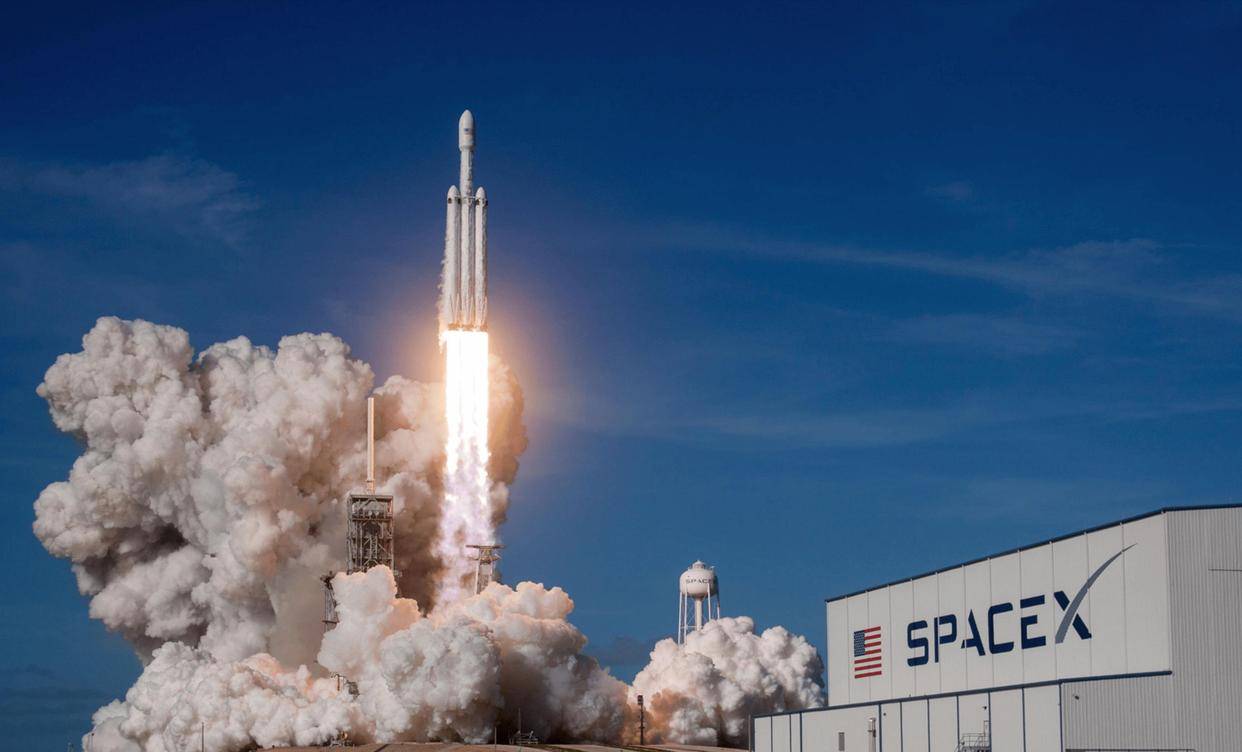
马斯克回应SpaceX计划上市报道:“准确无误”
智通财经网· 2025-12-12 02:52
Core Insights - Elon Musk hinted at a potential IPO for SpaceX, with reports suggesting a 2026 listing and a valuation of approximately $800 billion, aiming to raise over $30 billion [1] - Musk disputed the $800 billion valuation, stating that NASA's revenue will account for less than 5% of total income next year, emphasizing that commercial Starlink is the primary revenue source [1] - Insider reports indicate a target valuation of around $1.5 trillion, with a potential fundraising of about $40 billion if 5% of shares are sold, surpassing the record set by Saudi Aramco's IPO [1] Financial Projections - SpaceX is expected to generate approximately $15 billion in revenue in 2025, increasing to between $22 billion and $24 billion in 2026, primarily driven by the Starlink business [2] - Ark Invest projects SpaceX's enterprise value could reach around $2.5 trillion by 2030, with a Monte Carlo simulation providing three valuation scenarios: a base case of $2.5 trillion, a pessimistic case of $1.7 trillion, and an optimistic case of $3.1 trillion [2] Government Relations - Musk may gain a strong ally in the U.S. government's space program with Jared Isaacman likely to become the next NASA administrator, following a committee vote [3] - SpaceX is a major contractor for NASA, but there have been criticisms regarding delays in the Artemis lunar program, with Musk publicly criticizing NASA's acting administrator [3] - Isaacman's re-nomination suggests a restoration of relations between Trump and Musk, indicating potential support for SpaceX's initiatives [3]
国仪量子科创板IPO获受理;史上首次“太空轨道大模型训练”完成;浙江省脑机接口重大科技专项与创新联合体将开启——《投资早参》
Mei Ri Jing Ji Xin Wen· 2025-12-12 00:32
Market News - US stock indices closed mixed, with the Dow Jones up 1.34%, the Nasdaq down 0.25%, and the S&P 500 up 0.21%. Major tech stocks mostly declined, with Oracle down over 10%, Google down over 2%, and Tesla and Nvidia down over 1% [1] - International oil prices fell, with WTI crude down 0.96% at $57.91 per barrel and Brent crude down 1.01% at $61.58 per barrel. In contrast, international gold prices rose, with spot gold up 1.06% at $4273.16 per ounce and COMEX gold futures up 1.87% at $4303.9 per ounce [1] - European stock indices closed higher, with Germany's DAX up 0.68%, France's CAC40 up 0.79%, and the UK's FTSE 100 up 0.49% [1] Industry Insights - Starcloud, a startup, successfully trained a large language model in space using Nvidia's H100 and plans to build a 5 GW solar-powered orbital data center. The CEO stated that energy costs for the orbital data center could be 10 times lower than ground-based centers [2] - The satellite communication industry is expected to exceed 200-400 billion yuan by 2030, with an annual compound growth rate of 10%-28%. The industry is at a critical turning point from "concept validation" to "scale application" [3] - Guoyi Quantum Technology's IPO was accepted, aiming to raise 1.17 billion yuan for high-end scientific instrument industrialization and quantum technology research. The company has 129 patents related to its main business [3] - The quantum computing industry is expected to reach a market size of hundreds of billions by 2025-2030, driven by technological breakthroughs and market demand. Key stocks include Keda Guokai and Deep Technology [4] - The "Intelligent Connection Future" Brain-Computer Interface International Conference will be held, focusing on the establishment of a brain-computer interface industry cluster and the initiation of international standards for the technology [5] - The global brain-computer interface medical application market is projected to reach $40 billion by 2030 and $145 billion by 2040, with significant potential in treating neurological disorders [6]
“太空数据中心”成AI必争之地?马斯克与贝佐斯互掐,Altman也想插一脚
硬AI· 2025-12-11 11:32
Core Viewpoint - The competition between Elon Musk's SpaceX and Jeff Bezos's Blue Origin to develop orbital AI data centers is intensifying, aiming to leverage heavy rockets to address the significant energy consumption issues on Earth [2][3]. Group 1: Industry Overview - The trend of moving AI data centers to space is driven by the need to alleviate the physical limitations on Earth, particularly the enormous power requirements for AI model training and inference [6]. - Supporters believe that orbital data centers can harness solar energy more efficiently, with satellites potentially receiving 30% more solar intensity and up to six times the total solar energy compared to Earth [6]. - The concept of relocating resource-intensive infrastructure off Earth has been around for years, but advancements in launch and satellite costs are approaching a critical point [6]. Group 2: Key Players - SpaceX plans to utilize an upgraded version of its Starlink satellites to support AI computing loads, potentially increasing its valuation to $800 billion [3]. - Blue Origin is developing the New Glenn rocket, which is designed to launch large numbers of satellites into orbit, with expectations that orbital data centers could become cost-effective within 20 years [9]. - Other tech leaders, including OpenAI and Google, are also exploring opportunities in this emerging market, with Google planning to deploy test satellites carrying AI chips by early 2027 [11]. Group 3: Challenges and Risks - Significant technical challenges remain, including temperature management, cosmic radiation protection, and the transmission of vast amounts of data back to Earth without delays [13]. - Skeptics argue that the costs and risks associated with space-based data centers are underestimated, particularly when compared to ground facilities that may benefit from improved power and resource availability [13]. - Achieving the necessary scale for orbital data centers will require thousands of satellites, posing high demands on current launch capabilities and cost management [13].

首富又要“上天”,梦想价值10.6万亿
3 6 Ke· 2025-12-11 08:13
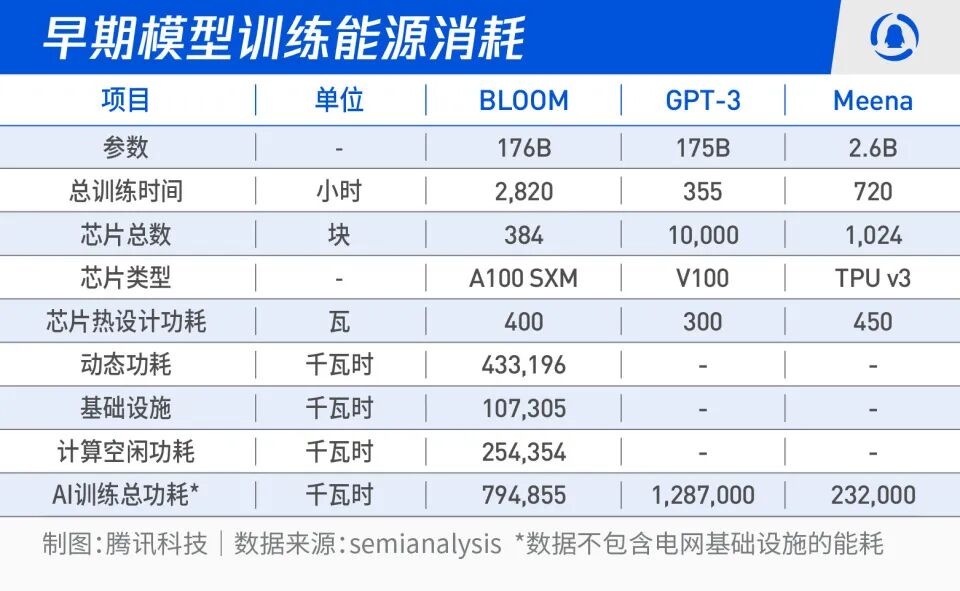
Core Viewpoint - Elon Musk plans to take SpaceX public in 2026 with an estimated valuation of approximately $1.5 trillion, aiming to raise over $30 billion, which would make it the largest IPO in history, surpassing Saudi Aramco's $29.4 billion in 2019 [1] Group 1: Space-Based AI Computing - Musk introduced the concept of "space AI computing" at the Baron Capital annual investor conference, suggesting that within five years, running AI training and inference in space will become the most cost-effective solution [2] - The unique environmental characteristics of space, such as constant sunlight and vacuum conditions, could significantly reduce energy and cooling costs associated with AI infrastructure on Earth [2][5] - The energy consumption of training large AI models, such as GPT-5, is substantial, with electricity costs being a major factor [3] Group 2: Technical Challenges - Space-based computing faces challenges such as heat dissipation and radiation exposure, which require technological breakthroughs to ensure economic viability [6][7] - The cost of transporting a 200MW orbital data center to space is estimated to be between $5 billion and $7.5 billion, significantly lower than building a similar facility on Earth [6] Group 3: Market Response and Valuation - Morgan Stanley highlighted that the revaluation of SpaceX is driven by the expansion of its commercial boundaries, with "orbital data centers" becoming a new narrative for AI infrastructure [8] - Cathie Wood's Ark Invest has begun valuing SpaceX as a high-growth software and AI infrastructure company, projecting significant revenue growth from both Starlink and orbital data centers [10] Group 4: Competitive Landscape - Other companies, including Blue Origin and OpenAI, are also exploring space-based AI computing, indicating a competitive environment [12][14] - Amazon's Project Kuiper, which plans to deploy 3,200 satellites, poses a direct challenge to SpaceX, although it relies on traditional cloud infrastructure [15] Group 5: Regulatory and Strategic Considerations - Regulatory issues, such as space debris management and international spectrum coordination, could impact SpaceX's progress in the coming years [15] - Musk's strategy integrates Tesla's chip capabilities, xAI models, Starlink bandwidth, and Starship capacity, targeting the expensive resource of low-cost computing in the AI era [16]
太空算力破圈,SpaceX推进IPO,卫星ETF易方达(563530)备受关注
Xin Lang Cai Jing· 2025-12-11 06:45
Core Viewpoint - SpaceX plans to launch an IPO in mid to late 2026, aiming to raise over $30 billion with a valuation of approximately $1.5 trillion, which could reshape the satellite industry capital landscape [1] Group 1: Financial Projections - The company expects revenues of $15 billion in 2025, increasing to $22-24 billion in 2026 [1] Group 2: Strategic Focus - Elon Musk has emphasized three main directions: satellite operations, Starship rockets, and space data centers [1] Group 3: Industry Impact - The $1.5 trillion valuation sets a new ceiling for commercial aerospace, pressuring global operators to accelerate low Earth orbit constellation deployments to compete with Starlink's bandwidth and cost advantages [1] - The introduction of space data centers into capital narratives may create a new "space computing" sector, driving satellite manufacturers to transition towards high-computing, radiation-resistant server technologies [1] - The commercialization of direct satellite connections for mobile devices will lead to a restructuring of spectrum and roaming agreements between terrestrial operators and satellite companies [1] - The competitive landscape is evolving from "launch + connectivity" to "launch + connectivity + computing," potentially re-evaluating the synergistic value between high-altitude satellites and low Earth orbit constellations [1] Group 4: Investment Opportunities - The E Fund Satellite ETF (563530) tracks the CSI Satellite Industry Index, which has a high application sector proportion aligning with long-term industry development trends, offering significant growth potential and resilience [1] - The concentration of leading companies in the industry suggests that early-stage leaders may benefit more from industry growth [1] - The comprehensive coverage of the industry chain allows for participation in the overall industry beta [1]
太空算力开启商业航天新篇章!卫星ETF(159206)持续创新高!
Xin Lang Cai Jing· 2025-12-11 06:40
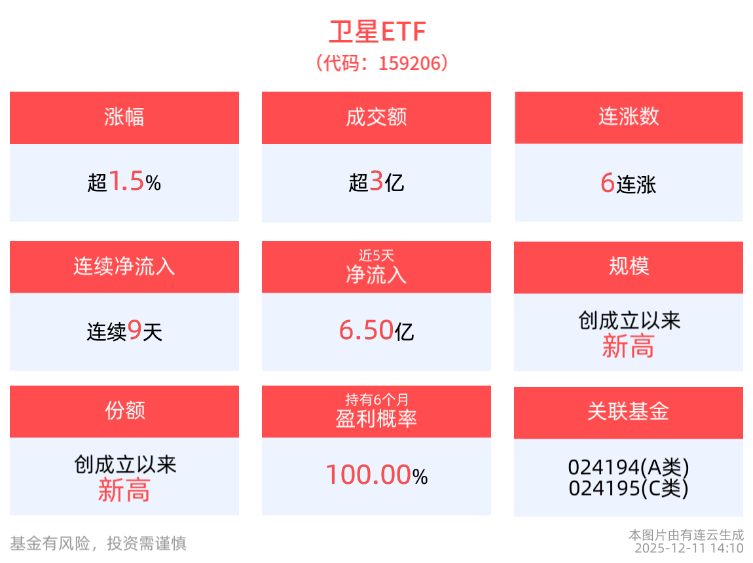
值得关注的是,SpaceX拟最快于2026年中后期IPO,募资超300亿美元,估值约1.5万亿美元,资金将用于太空数据中心 及芯片采购。结合马斯克近期多次强调卫星运营、星舰火箭及太空数据中心三大方向,卫星组网与太空算力的想象空 间有望进一步打开。 截至12月11日14:10,卫星ETF(159206)上涨1.51%,冲击6连涨。成分股普天科技(002544)涨停,臻镭科技(688270)涨 超17%,信科移动(688387)涨超15%,佳缘科技(301117)、国盾量子(688027)等个股跟涨。 | 序号 | 代码 | 名称 | 涨跌幅 ▼ | 成交量 | 成公餐加 | | --- | --- | --- | --- | --- | --- | | 7 | 688270 | 臻镭科技 | 17.69% | 3153万 | 27.36亿 | | 2 | 688387 | 信科移动-U | 15.67% | 2.19亿 | 18.04亿 | | 3 | 002544 | 普天科技 | 10.00% | 7254万 | 23.57 亿 | | 4 | 301117 | 佳缘科技 | 9.30% | 2323万 | ...
太空算力破圈,卫星ETF易方达(563530)标的指数盘中涨近2%,再创年内新高
Mei Ri Jing Ji Xin Wen· 2025-12-11 04:30
Group 1 - The satellite sector experienced a significant rise, with the China Satellite Industry Index increasing by 1.9%, reaching a new annual high, led by companies like Zhenlei Technology and Western Superconducting, both gaining over 5% [1] - SpaceX plans to conduct an IPO by mid-2026, aiming to raise over $30 billion with an estimated valuation of approximately $1.5 trillion, which will fund space data centers and chip procurement [1] - SpaceX projects revenues of $15 billion in 2025, increasing to between $22 billion and $24 billion in 2026, indicating a strong growth trajectory in satellite operations and space data centers [1] Group 2 - The China Satellite Industry Index includes 50 listed companies across satellite manufacturing, launching, and application sectors, characterized by high application end ratios and concentrated industry leaders, aligning with long-term industry development trends [2] - The E Fund Satellite ETF (563530) tracks this index, providing investors with a streamlined way to capitalize on opportunities in the satellite industry [2]