
战略性新兴产业

Search documents
永杰新材与奥科宁克签署战略合作协议,同步推进股权收购
Zheng Quan Shi Bao Wang· 2026-01-25 09:37
Core Viewpoint - Yongjie New Materials (603271) has signed a strategic cooperation agreement with Arconic Corporation to explore collaboration in supply chain, technology research and development, capital synergy, market expansion, and talent cultivation to enhance core competitiveness and global industry influence [1] Group 1: Strategic Cooperation - The partnership aims to build a resilient, efficient, and customer-oriented global supply chain and capacity coordination system, enhancing operational resilience and providing reliable, cost-effective, and responsive joint solutions for customers [2] - Both companies will prioritize integrating each other into their global supply chains under reasonable commercial conditions, ensuring support during capacity bottlenecks or urgent demands [2] Group 2: Technological Collaboration - The companies plan to jointly invest resources in forward-looking technology research and development, focusing on new materials and processes applicable in emerging fields such as new energy, high-end equipment, AI, and robotics [2] - They aim to promote technology exchange and knowledge sharing while participating in the establishment of global technical standards and ecological construction in relevant fields [2] Group 3: Acquisition and Market Position - Yongjie New Materials intends to acquire 100% of Arconic's Qinhuangdao and 95% of its Kunshan operations, which are significant in the aluminum processing industry [3] - The acquisition is expected to enhance the company's industry position, technical capabilities, and customer resources, while improving the product structure of the acquired companies [4] Group 4: Synergy and Innovation - The integration of the two companies is anticipated to create strong synergies, enhancing overall innovation capabilities and accelerating technology iteration and product upgrades [4] - This collaboration will help the company expand its high-quality customer base in strategic emerging industries, aligning new supply with market demand trends [4]
长三角青吴嘉高新技术产业开发区来了!系全国首个跨省域高新区
Xin Lang Cai Jing· 2026-01-25 08:39
Core Viewpoint - The establishment of the first cross-provincial high-tech industrial development zone in China, named the Yangtze River Delta Qingwu Jia High-tech Industrial Development Zone, has been approved, aiming to leverage regional technological resources and focus on strategic emerging industries [1]. Group 1 - The high-tech zone spans an area of 19.54 square kilometers, incorporating three regions: Shanghai's Qingpu, Jiangsu's Wujiang, and Zhejiang's Jiashan [1]. - The development will prioritize three strategic emerging industries: digital industry, intelligent manufacturing, and green new materials, along with two characteristic industries: headquarters economy and green scientific innovation services, forming a "3+2" industrial development pattern [1].
固定资产投资增速居副省级城市首位
Xin Lang Cai Jing· 2026-01-24 17:36
Core Viewpoint - Chengdu is accelerating the construction of "Five Centers and Five Places" and increasing infrastructure investment to enhance connectivity and urban development [1][2] Group 1: Infrastructure Development - Chengdu is focusing on major infrastructure projects, including the construction of suburban railways such as Chengde Line and Chengmei Line, with significant progress being made [1] - The operational mileage of rail transit is expected to exceed 750 kilometers by 2025, with several new lines set to open, maintaining a leading position nationally [1] - The construction of key railway projects, including the Chengdu section of the Chengyu Middle Line Railway and the Sichuan-Tibet Railway, is accelerating, enhancing the functionality of the Tianfu Station transportation hub [1] Group 2: Project Planning and Strategic Focus - The city is actively planning for the "14th Five-Year Plan" by strengthening project reserves, focusing on advanced manufacturing, public welfare, new infrastructure, and ecological protection [2] - Chengdu aims to transform project plans into tangible outcomes, ensuring that each project serves as a solid support for a strong start to the "14th Five-Year Plan" [2]
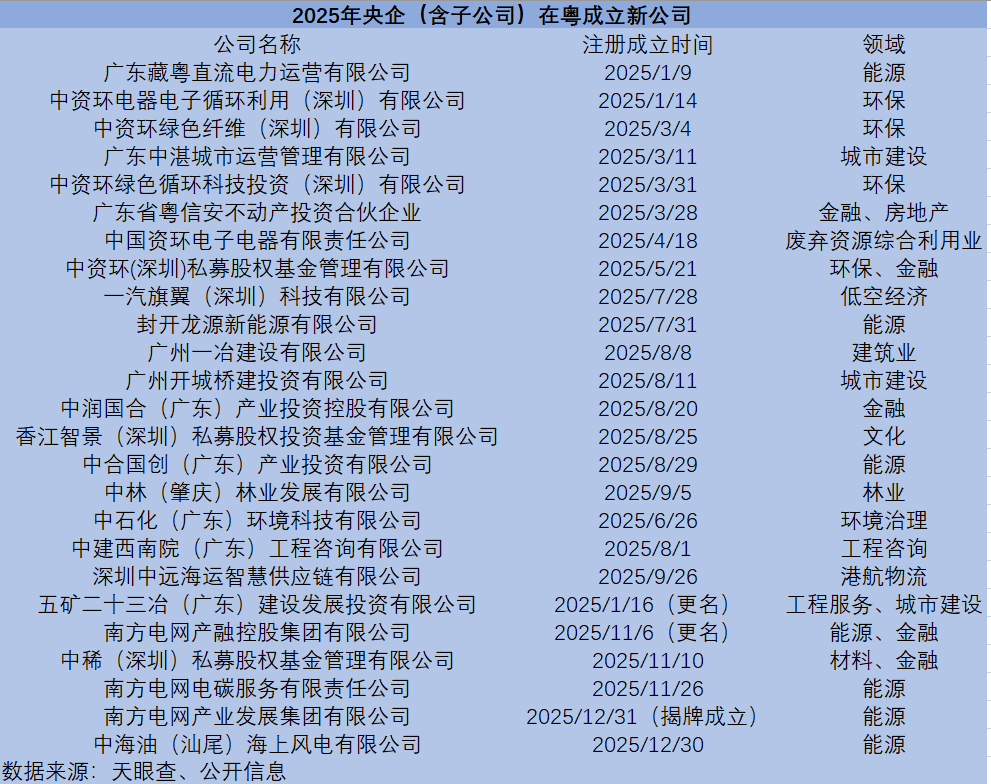
央企重仓广东,一年内至少25家新公司落地
2 1 Shi Ji Jing Ji Bao Dao· 2026-01-24 09:04
Core Viewpoint - Central enterprises are increasingly establishing new companies in Guangdong, reflecting a strong commitment to long-term investment and collaboration with local economies, particularly in strategic emerging industries and green technologies [1][5][6]. Group 1: Central Enterprises' Activities - In 2025, at least 25 central enterprises (including subsidiaries) established new companies in Guangdong, with ongoing activities into 2026 [3][4]. - Southern Power Grid established three wholly-owned subsidiaries in Guangzhou in late 2025, with a planned investment of 180 billion yuan for fixed assets in 2026, focusing on new power systems and emerging industries [2][6]. - China Resources Recycling Group and China Rare Earth Group are among the new entrants, setting up multiple subsidiaries in various cities, including Shenzhen [3][4]. Group 2: Investment Focus - Central enterprises are prioritizing strategic emerging industries, with an average annual investment growth rate exceeding 20% [6][8]. - The establishment of companies like China Rare Earth Group's subsidiaries in Shenzhen aims to align with local industry needs, particularly in artificial intelligence and new energy vehicles [6][7]. - The focus on green and low-carbon technologies is evident, with companies like China Resources Recycling and South Power Carbon Company working on carbon management and recycling initiatives [8][9]. Group 3: Regional Development - Guangzhou and Shenzhen are the primary cities attracting central enterprises for new business expansions and headquarters [4][5]. - The collaboration between central enterprises and local governments is enhancing the business environment and market potential in Guangdong [5][9]. - Various sectors are being targeted, including construction, energy, environmental protection, and digital technology, showcasing the depth and breadth of central-local cooperation [4][5].


央企重仓广东,一年内至少25家新公司落地
21世纪经济报道· 2026-01-24 08:08
Core Viewpoint - The article highlights the increasing collaboration between central enterprises (央企) and local governments in Guangdong, emphasizing the establishment of new companies and projects that contribute to the local economy and strategic development in various sectors [1][4]. Group 1: Central Enterprises' Activities in Guangdong - In 2025, at least 25 central enterprises (including subsidiaries) established new companies in Guangdong, indicating a strong trend of investment and long-term commitment to the region [2][4]. - The establishment of new companies by central enterprises is seen as a strategic move to foster long-term growth and development in Guangdong, particularly in the Greater Bay Area [1][4]. - Notable companies established include Guangdong Cangyue Direct Current Power Operation Co., Ltd. and China Resources Recycling Group, which focus on energy, environmental protection, and urban development [2][4]. Group 2: Investment Trends and Focus Areas - Central enterprises are increasingly investing in strategic emerging industries, with an annual investment growth rate exceeding 20%, aligning with Guangdong's rich application scenarios and innovative regulatory environment [8][10]. - The focus on low-altitude economy and green technology is evident, with companies like FAW Qiyu and China Rare Earth Group establishing operations in Shenzhen to support these sectors [8][9]. - The collaboration between central enterprises and local governments is seen as a way to enhance resource allocation and promote sustainable development, particularly in carbon management and recycling industries [9][10]. Group 3: Economic Impact and Future Outlook - The establishment of new companies and projects by central enterprises is expected to significantly impact local economies, providing resources, technology, and management expertise [1][4]. - The ongoing trend of central enterprises setting up in Guangdong reflects a recognition of the region's business environment and market potential, signaling a commitment to long-term partnerships [6][10]. - As central enterprises continue to expand their presence in Guangdong, the collaboration is likely to deepen, fostering innovation and economic growth across various sectors [6][10].



提升发展能级 打造重要增长极 云南省出台34条政策措施推动滇中新区高质量发展
Xin Lang Cai Jing· 2026-01-24 05:11
Core Viewpoint - The Yunnan provincial government has issued 34 specific measures to support the high-quality development of the Yunnan Central New Area, aiming to enhance its development capabilities, deepen reform and innovation, and accelerate the construction of a modern city, thereby becoming a significant growth engine for the province's economy [1] Group 1: Enhancing Industrial Competitiveness - The policy focuses on accelerating the transformation and upgrading of traditional industries such as petrochemicals and metallurgy, promoting the extension of industrial chains towards deep processing and terminal manufacturing, and creating billion-level industrial clusters [2] - Key industries to be developed include semiconductor materials and equipment, new energy battery materials, non-ferrous and precious metal materials production, and green food processing [2] - The initiative also aims to cultivate strategic emerging industries such as low-altitude economy, biomanufacturing, and new materials, and establish public service platforms for pharmaceutical R&D outsourcing and contract processing outsourcing [2] Group 2: Deepening Reform and Innovation - The policy grants greater autonomy to the New Area, delegating provincial economic management powers according to the principle of "maximal delegation" [3] - It supports the establishment of innovation incubation demonstration bases and offshore innovation and entrepreneurship bases for overseas talents, with financial incentives for newly recognized national key laboratories and technology innovation centers [3] - The initiative encourages the relocation of national and provincial applied research institutions to the New Area and supports pilot projects for mixed-use land reform [3] Group 3: Enhancing Open Cooperation - The policy supports Kunming Changshui International Airport in conducting international transit pilot projects and the development of cross-border e-commerce and bonded logistics in the Kunming Comprehensive Bonded Zone [3] - It aims to strengthen direct export capabilities for foreign trade entities and establish a transaction settlement center for fruits and seafood in South Asia and Southeast Asia [3] - The initiative promotes collaboration with other national-level new areas to explore industrial planning alignment and resource integration [3] Group 4: Improving Urban Functionality and Quality - The policy encourages the composite utilization of urban above-ground and underground spaces, promotes park city construction, and accelerates urban renewal to address shortcomings in education, healthcare, and culture [4] Group 5: Strengthening Element Guarantee - The provincial government will allocate annual incentive funds for high-quality development, and the municipal government will provide financial support to the New Area [4] - Revenue from the transfer and leasing of state-owned land use rights will be fully retained for the New Area's development funding [4] - The policy includes financial support for key construction projects and aims to facilitate land acquisition and development processes [4]
2025年我国共授权发明专利97.2万件 人工智能专利有效量居全球前列
Ren Min Ri Bao· 2026-01-24 02:09
Core Viewpoint - The report highlights the significant progress in China's intellectual property (IP) landscape by 2025, emphasizing the increase in both the quantity and quality of patents, with a focus on high-value inventions and the need for regulatory improvements in trademark practices [1][7]. Group 1: Patent Statistics - In 2025, China authorized 972,000 invention patents, received 78,000 PCT international patent applications, and registered 4.206 million trademarks [1]. - By the end of 2025, the effective number of domestic invention patents reached 5.32 million, with a high-value invention patent ownership rate of 16 per 10,000 people [1]. - The effective number of high-value invention patents in China reached 2.292 million, accounting for 43.1% of the total effective invention patents, an increase of 2.9 percentage points compared to the end of the 13th Five-Year Plan [2]. Group 2: Innovation Quality and Regional Highlights - The fastest growth in effective invention patents is observed in fields such as information technology management methods, computer technology, and medical technology, with artificial intelligence patents ranking among the top globally [2]. - By the end of 2025, the Yangtze River Delta, Beijing-Tianjin-Hebei, and Guangdong regions accounted for approximately two-thirds of the total effective invention patents in China, with 1.734 million, 916,000, and 899,000 patents respectively [2]. Group 3: Trademark Regulation and Protection - In 2025, the IP department handled 57,000 patent infringement administrative cases, with a social satisfaction rate for IP protection rising to 82.81 points [3]. - The government aims to strengthen regulations against malicious trademark registration and hoarding, with new measures to prevent non-use-based trademark applications [3]. Group 4: International IP Disputes and Support - As of the end of 2025, 99 overseas IP dispute response guidance platforms were established, providing over 4,800 consultations and recovering losses of 2.75 billion yuan for companies facing international IP disputes [4]. Group 5: Patent Utilization and Quality Improvement - In 2025, patent transfer and licensing registrations reached 697,000, a year-on-year increase of 13.7%, with the industrialization rate of enterprise invention patents at 54% [5]. - The report emphasizes the need to shift focus from quantity to quality in patent applications, with plans to eliminate financial support during the application and authorization stages [5][7].
央企重仓广东:一年落地超20家 偏好创新业务
2 1 Shi Ji Jing Ji Bao Dao· 2026-01-23 15:52
Core Viewpoint - Central enterprises are increasingly establishing new companies in Guangdong, reflecting a strategic focus on long-term development and collaboration with local economies, particularly in the Greater Bay Area [1][5]. Group 1: Central Enterprises' Activities - In 2025, at least 25 new companies were established by central enterprises (including subsidiaries) in Guangdong, indicating a robust trend of investment and collaboration [5]. - The establishment of physical companies by central enterprises signifies a commitment to long-term growth and resource integration in the region [1][5]. - Notable companies established include Guangdong Cangyue Direct Current Power Operation Co., Ltd. and China Resources Recycling Group, which focus on energy and environmental sectors [2][3]. Group 2: Investment Trends - Southern Power Grid announced an investment of 180 billion yuan for fixed asset investments in 2026, marking a record high for five consecutive years, focusing on new power systems and quality service improvements [3]. - Central enterprises are increasingly investing in strategic emerging industries, with an average annual investment growth rate exceeding 20% [6][8]. - The focus on green and low-carbon initiatives is evident, with companies like China Resources Recycling and Zhonglin (Zhaoqing) Forestry Development Co., Ltd. engaging in carbon management and environmental technologies [8]. Group 3: Regional Economic Impact - The influx of central enterprises into Guangdong is a recognition of the region's business environment, market potential, and strategic importance [6]. - Cities like Guangzhou and Shenzhen are becoming key hubs for central enterprise activities, attracting new business developments and innovation headquarters [5][6]. - The collaboration between central enterprises and local governments is fostering a diverse industrial ecosystem, enhancing the depth and breadth of cooperation [5][6]. Group 4: Innovation and Technology - Central enterprises are leveraging Guangdong's rich application scenarios and innovative regulatory frameworks to test new technologies and products [6][7]. - Companies like China First Automobile Works are focusing on low-altitude economy initiatives, with significant advancements in electric vertical takeoff and landing (eVTOL) aircraft technology [6]. - The establishment of platforms for high-tech applications, such as rare earth materials, is crucial for advancing Shenzhen's high-tech and green energy sectors [7][8].
大连跻身东北首个万亿之城,为东北振兴注入动能
Zhong Guo Xin Wen Wang· 2026-01-23 15:10
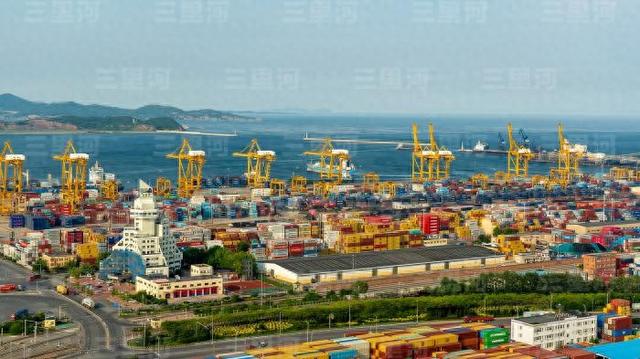
Core Insights - Dalian has become the first city in Northeast China to achieve a GDP exceeding 1 trillion yuan, reaching 10,002.1 billion yuan in 2025, with a year-on-year growth of 5.7% at constant prices [1][3]. Economic Contributions - The industrial economy and port economy are significant contributors to Dalian's growth, with the industrial sector accounting for 60% of GDP growth in 2023 [4]. - Dalian's petrochemical industry is a key player, projected to reach a production value of 425.6 billion yuan in 2024, ranking first in Northeast China and fourth nationally [4]. - The port economy is vital, with Dalian Port ranking fourth globally in the Container Port Performance Index for 2020-2024 [5][7]. Emerging Industries - Dalian is fostering new economic drivers, with a new generation information technology industry forming a 200 billion yuan cluster and advancements in the new energy sector [8]. - Strategic emerging industries now account for 15% of GDP, indicating a shift towards innovation and modernization [8]. Regional Impact - Dalian's success is seen as a potential catalyst for the revitalization of Northeast China, with expectations to attract more investment and talent [9]. - The city aims to serve as a model for other cities in the region, demonstrating a pathway from traditional industry to emerging sectors [9]. Future Goals - Dalian's government has set a target for GDP growth of over 5% in the upcoming years, indicating a commitment to sustained economic development [10].
2026保险业前瞻:“报行合一”有望带动行业费用率改善
2 1 Shi Ji Jing Ji Bao Dao· 2026-01-23 14:37
Core Viewpoint - The 2026 regulatory work meeting of the National Financial Regulatory Administration established the financial regulatory tone for the "14th Five-Year Plan" period, emphasizing the continuous promotion of "reporting and operation integration" in the insurance industry and the adjustment of predetermined interest rates [1] Group 1: Trends in the Insurance Industry - The insurance industry is expected to exhibit three core trends in 2026: low upper limits on predetermined interest rates for traditional insurance, the rise of dividend insurance as a market mainstream due to its "fixed income + floating" characteristics, and the strategic position of insurance funds as "patient capital" [1] - Dividend insurance is gaining popularity as it effectively balances the risk of interest margin losses for insurance companies and the inflation resistance needs of customers, with a current predetermined interest rate research value of 1.89% [2][3] - The sales of dividend insurance are closely linked to investment yield rates and competing product yields, with the decline in bank deposit rates making dividend insurance more attractive to residents [4] Group 2: Reporting and Operation Integration - The "reporting and operation integration" initiative has been implemented in the auto insurance sector and is now being extended to non-auto insurance areas, which is expected to fundamentally change the industry's cost competition model [5][6] - This integration is anticipated to improve industry expense ratios, reduce overall operating costs, and enhance insurance companies' ability to price risks accurately [7] - The competition in the bancassurance channel is expected to shift from a focus on fees and products to a competition based on professional capabilities and comprehensive services [8] Group 3: Strategic Investment Directions - The meeting highlighted the importance of cultivating "patient capital" to support the development of new productive forces, with insurance funds being well-suited for long-term, stable funding support [9] - Infrastructure and real estate, along with private equity, are expected to become key areas for alternative investments by insurance funds, aligning with their investment characteristics [10] - Insurance companies are encouraged to increase their equity investment in strategic emerging industries, focusing on sectors like 5G, artificial intelligence, healthcare, and new consumption, which are seen as having significant growth potential [11]