算力概念

Search documents
亿田智能跌2.00%,成交额1.80亿元,主力资金净流出946.13万元
Xin Lang Cai Jing· 2025-09-17 06:57
Company Overview - Yitian Intelligent Kitchen Appliances Co., Ltd. is located in Shaoxing City, Zhejiang Province, and was established on September 25, 2003. The company was listed on December 3, 2020. Its main business involves the research, production, and sales of integrated stoves and other modern kitchen appliances [1]. Financial Performance - As of July 31, the company reported a total revenue of 1.74 billion yuan for the first half of 2025, representing a year-on-year decrease of 49.09%. The net profit attributable to shareholders was -71.69 million yuan, a significant decline of 507.01% year-on-year [2]. - The company has distributed a total of 425 million yuan in dividends since its A-share listing, with 307 million yuan distributed over the past three years [2]. Stock Performance - On September 17, Yitian's stock price decreased by 2.00%, closing at 57.29 yuan per share, with a trading volume of 180 million yuan and a turnover rate of 1.84%. The total market capitalization is 10.39 billion yuan [1]. - Year-to-date, Yitian's stock price has increased by 195.95%, with a 10.19% rise over the last five trading days, an 8.30% increase over the last 20 days, and a 45.22% increase over the last 60 days [1]. Shareholder Information - As of July 31, the number of shareholders increased to 7,623, a rise of 12.20%. The average number of circulating shares per person decreased by 10.87% to 22,217 shares [2]. Market Activity - The company has appeared on the "Dragon and Tiger List" once this year, with the most recent appearance on February 17, where it recorded a net purchase of 4.99 million yuan. The total purchases amounted to 95.15 million yuan, accounting for 14.29% of the total trading volume, while total sales reached 90.15 million yuan, making up 13.54% of the total trading volume [1]. Industry Classification - Yitian Intelligent is classified under the household appliances sector, specifically in kitchen appliances, and is associated with concepts such as DeepSeek, computing power, artificial intelligence, Alibaba, and East Data West Calculation [2].

大名城涨2.00%,成交额1.23亿元,主力资金净流出423.35万元
Xin Lang Cai Jing· 2025-09-17 03:23
Core Insights - The stock price of Daming City increased by 2.00% on September 17, reaching 4.08 CNY per share, with a trading volume of 1.23 billion CNY and a market capitalization of 9.649 billion CNY [1] Financial Performance - For the first half of 2025, Daming City reported revenue of 1.589 billion CNY, a year-on-year increase of 28.93%, while net profit attributable to shareholders decreased by 77.04% to 33.407 million CNY [2] - The company has cumulatively distributed 763 million CNY in dividends since its A-share listing, with 69.748 million CNY distributed over the past three years [3] Shareholder Information - As of June 30, 2025, Daming City had 52,800 shareholders, a decrease of 2.40% from the previous period, with an average of 0 circulating shares per shareholder [2] - The second-largest shareholder, Hong Kong Central Clearing Limited, held 231 million shares, a decrease of 431,200 shares compared to the previous period [3] Stock Market Activity - Daming City has seen a stock price increase of 12.09% year-to-date, with a 16.24% rise over the last five trading days, 23.26% over the last 20 days, and 30.35% over the last 60 days [1] - The company has appeared on the "Dragon and Tiger List" once this year, with a net purchase of 30.921 million CNY on April 9 [1]

美国8月零售销售意外强劲,关注美联储利率决议
Hua Tai Qi Huo· 2025-09-17 03:06
Report Industry Investment Rating No information provided Core Viewpoints - China's domestic policy expectations are rising, with potential incremental policies and fiscal stimulus to address external pressures. The US inflation outlook is clearer, and the Fed is likely to restart the interest rate cut cycle in September. Attention should be paid to the subsequent interest rate cut path and the performance of the US real estate market. In the commodity market, there are opportunities for multi - allocation of industrial products and precious metals [1]. - Different commodity sectors have different characteristics. The black and new energy metal sectors are sensitive to domestic supply - side factors, while precious metals and agricultural products are related to overseas inflation expectations. There are also "anti - involution" opportunities in some chemical products. Precious metals are suitable for multi - allocation as the Fed is about to restart the interest rate cut cycle [2]. - For commodities and stock index futures, it is recommended to allocate industrial products and precious metals on dips [3]. Summary by Relevant Catalogs Market Analysis - China: In August, external pressure increased marginally, with weakened exports to the US but resilience in non - US exports. To address this, the government has frequently mentioned stable - growth policies. New social financing and loans increased in August, and the M2 - M1 gap reached a four - year low. The economic data in August showed characteristics of "slow industry, weak investment, and light consumption", and more policies are expected. The stock market had a good performance on September 16, with more than 3,500 stocks rising, and the robot concept stocks booming. Domestic commodity futures mostly rose [1]. - US: The August ISM manufacturing index contracted for the sixth consecutive month, with new orders improving and the price index falling again. The CPI increased year - on - year, while the PPI growth slowed. The new non - farm payrolls and unemployment rate in August were both worse than expected, supporting the Fed's interest rate cut. Retail sales in August increased by 0.6% month - on - month, better than expected. The Fed is likely to restart the interest rate cut cycle in September, and attention is on the subsequent interest rate cut path. The US CBO significantly lowered the economic growth forecast for this year, and the Trump administration announced a reduction in Japanese automobile import tariffs [1]. Commodity Analysis - Black and new energy metal sectors are sensitive to domestic supply - side factors. The black sector is still dragged down by downstream demand expectations. The long - term supply limitation in the non - ferrous sector remains unresolved, but the marginal supply has slightly increased recently. The energy sector has a relatively loose supply in the medium - term as OPEC + plans to increase production in October. In the chemical sector, the "anti - involution" space of some products is worth attention. Agricultural products are driven by short - term tariffs and inflation expectations but need fundamental signals and are affected by Sino - US negotiations. Precious metals are suitable for multi - allocation as the Fed is about to restart the interest rate cut cycle [2]. Strategy - For commodities and stock index futures, it is recommended to allocate industrial products and precious metals on dips [3]. Important News - The Ministry of Commerce and other nine departments issued policies to expand service consumption, including opening up the service industry at a high level and expanding open - pilot areas in relevant fields [1][5]. - Sino - US economic and trade talks in Madrid reached a basic framework consensus on issues such as resolving the TikTok problem, reducing investment barriers, and promoting economic and trade cooperation [1][5]. - The stock market on September 16 had a good performance, with more than 3,500 stocks rising, and the robot concept stocks booming. Gold prices reached a record high. US retail sales in August were unexpectedly strong, and the Fed's interest rate decision - making list was finalized. The Trump administration announced a reduction in Japanese automobile import tariffs [1][5].
午评:创业板指半日跌0.32% 机器人概念股逆势爆发
Xin Lang Cai Jing· 2025-09-16 03:45
Core Viewpoint - The market showed divergence in early trading, with the three major indices experiencing a pullback after an initial rise, while certain sectors, particularly robotics and computing power stocks, saw significant gains [1] Market Performance - The total trading volume in the Shanghai and Shenzhen markets reached 1.48 trillion, a decrease of 25.1 billion compared to the previous trading day [1] - Over 2800 stocks in the market experienced an increase [1] - The Shanghai Composite Index fell by 0.10%, the Shenzhen Component Index decreased by 0.26%, and the ChiNext Index dropped by 0.32% [1] Sector Highlights - Computing power stocks surged, with key players like Zhongke Shuguang, Shenghong Technology, and Haiguang Information reaching historical highs [1] - Robotics concept stocks showed strong performance, with multiple stocks hitting the daily limit, including Wanxiang Qianchao and Junsheng Electronics [1] - The unified market concept stocks were active, with New Ning Logistics hitting the daily limit [1] Declining Sectors - The non-ferrous metals sector experienced a collective pullback [1] - The previously strong pork sector saw a significant decline, with Tianyu Biological hitting the daily limit down [1] - Sectors such as e-commerce, unified market, and robotics showed the highest gains, while non-ferrous metals, pork, and battery sectors faced the largest declines [1]

昆仑万维跌2.03%,成交额11.49亿元,主力资金净流出9122.35万元
Xin Lang Cai Jing· 2025-09-16 02:55
Core Viewpoint - Kunlun Wanwei's stock price has shown fluctuations with a recent decline, while the company has experienced significant revenue growth but also a substantial net loss in the latest reporting period [1][3]. Financial Performance - As of June 30, 2025, Kunlun Wanwei reported a revenue of 3.733 billion yuan, representing a year-on-year increase of 49.23%. However, the net profit attributable to shareholders was -856 million yuan, a decrease of 119.86% compared to the previous year [3]. - The company's stock price has increased by 6.60% year-to-date, with notable gains of 5.53% over the last five trading days, 11.29% over the last 20 days, and 24.87% over the last 60 days [2]. Shareholder and Market Activity - As of June 30, 2025, the number of shareholders decreased by 2.55% to 149,000, while the average number of circulating shares per person increased by 4.53% to 8,418 shares [3]. - The company has appeared on the "Dragon and Tiger List" twice this year, with the most recent appearance on August 22, where it recorded a net purchase of 328 million yuan [2]. Business Segments - Kunlun Wanwei's main business segments include: - Internet advertising (38.37%) - Opera search services (18.51%) - Short drama platform (15.61%) - Overseas social networking (13.92%) - Gaming (6.40%) - Social entertainment platform (4.27%) - AI software technology (1.75%) - Other businesses (1.16%) [2]. Institutional Holdings - As of June 30, 2025, significant institutional shareholders include: - Hong Kong Central Clearing Limited, holding 21.7781 million shares (an increase of 3.7053 million shares) - E Fund's ChiNext ETF, holding 21.2685 million shares (an increase of 50,900 shares) - Huatai-PB's CSI 300 ETF, holding 15.5687 million shares (an increase of 174,370 shares) [4].

北京君正跌2.01%,成交额15.55亿元,主力资金净流出9405.33万元
Xin Lang Zheng Quan· 2025-09-16 02:50
Core Viewpoint - Beijing Junzheng's stock price has shown significant growth this year, with a 20.29% increase, while recent trading days have also seen notable gains [1][2]. Company Overview - Beijing Junzheng Integrated Circuit Co., Ltd. specializes in the research and sales of microprocessor chips, smart video chips, storage chips, and analog chips, with a revenue composition of 61.56% from storage chips, 26.87% from computing chips, and 10.84% from analog and interconnect chips [1][2]. - The company was established on July 15, 2005, and went public on May 31, 2011 [1]. Financial Performance - For the first half of 2025, Beijing Junzheng reported a revenue of 2.249 billion yuan, reflecting a year-on-year growth of 6.75%, and a net profit attributable to shareholders of 203 million yuan, up 2.85% year-on-year [2]. - Cumulatively, the company has distributed 439 million yuan in dividends since its A-share listing, with 183 million yuan distributed over the past three years [3]. Shareholder Information - As of June 30, 2025, the number of shareholders increased to 93,400, with an average of 4,502 circulating shares per person, a decrease of 5.38% from the previous period [2][3]. - Major shareholders include E Fund's ChiNext ETF and Hong Kong Central Clearing Limited, with notable changes in their holdings [3].

润泽科技涨2.20%,成交额2.55亿元,主力资金净流入942.88万元
Xin Lang Cai Jing· 2025-09-16 02:05
Core Insights - Runze Technology's stock price increased by 2.20% on September 16, reaching 54.37 CNY per share, with a total market capitalization of 888.59 billion CNY [1] - The company has seen a year-to-date stock price increase of 4.90%, with a 5-day increase of 5.74% and a 60-day increase of 18.53% [1] - For the first half of 2025, Runze Technology reported a revenue of 2.496 billion CNY, a year-on-year growth of 15.31%, while net profit attributable to shareholders decreased by 8.73% to 882 million CNY [2] Financial Performance - The company has cumulatively distributed 2.623 billion CNY in dividends since its A-share listing, with 2.606 billion CNY distributed over the past three years [3] - As of June 30, 2025, the top ten circulating shareholders include Hong Kong Central Clearing Limited and various ETFs, with notable changes in shareholdings [3] Market Activity - The net inflow of main funds was 9.4288 million CNY, with significant buying and selling activity observed [1] - Runze Technology's stock has appeared on the "Dragon and Tiger List" once this year, with a net buying of 260 million CNY on February 21 [1] Business Overview - Runze Technology, established on June 27, 2007, and listed on April 24, 2015, primarily operates in data center services, with IDC business contributing 64.67% and AIDC business 35.33% to its revenue [1][2] - The company is categorized under the communication services sector, with involvement in various concepts such as DeepSeek and computing power [2]

数据看盘算力股龙虎榜多席位联动 外资、一线游资与机构现分歧
Sou Hu Cai Jing· 2025-09-15 12:18
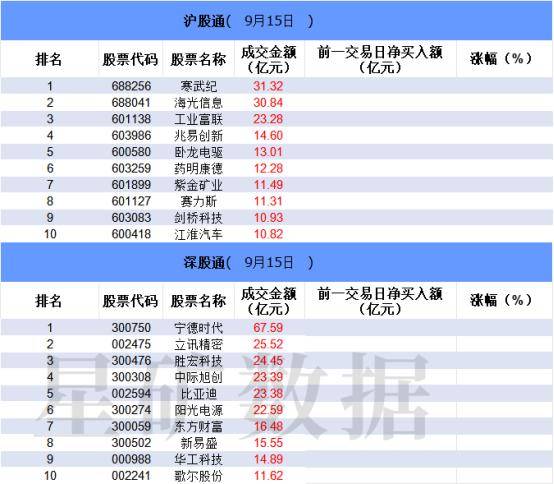
Summary of Key Points Core Viewpoint - The total trading volume of the Shanghai and Shenzhen Stock Connect reached 287.3 billion, with Cambricon and CATL leading in trading volume for the Shanghai and Shenzhen markets respectively [1]. Trading Volume - The total trading amount for the Shanghai Stock Connect was 130.77 billion, while the Shenzhen Stock Connect was 156.54 billion [2]. Top Trading Stocks - In the Shanghai Stock Connect, Cambricon ranked first with a trading volume of 3.132 billion, followed by Haiguang Information and Industrial Fulian [3]. - In the Shenzhen Stock Connect, CATL led with a trading volume of 6.759 billion, followed by Luxshare Precision and Shenghong Technology [3]. Sector Performance - The transportation equipment sector saw the highest net inflow of funds, amounting to 2.977 billion, while the electronic sector experienced the largest net outflow of 8.911 billion [4][5]. ETF Trading - The Tianhong ChiNext ETF (159977) saw a significant increase in trading volume, with a 145% increase compared to the previous day, making it the top performer [9]. - The Rare Metals ETF (562800) also experienced a substantial increase of 142% in trading volume [9]. Futures Positioning - All four major futures contracts (IH, IF, IC, IM) saw both long and short positions reduced, with a notable decrease in short positions for the IC contract [13]. Institutional Trading Activity - Institutional trading was active, with significant purchases in automotive stocks and a notable buy of 597 million in Cambricon by one institution [15]. - Several battery-related stocks faced substantial selling pressure from institutions, including a sell-off of 207 million in Shangtai Technology [16]. Quantitative Trading Activity - Quantitative funds showed active trading, with Cambricon receiving a buy of 125 million from one quantitative seat, while another seat sold 203 million [18].


午后直线封板,发生了什么?
Zheng Quan Shi Bao· 2025-09-15 08:45
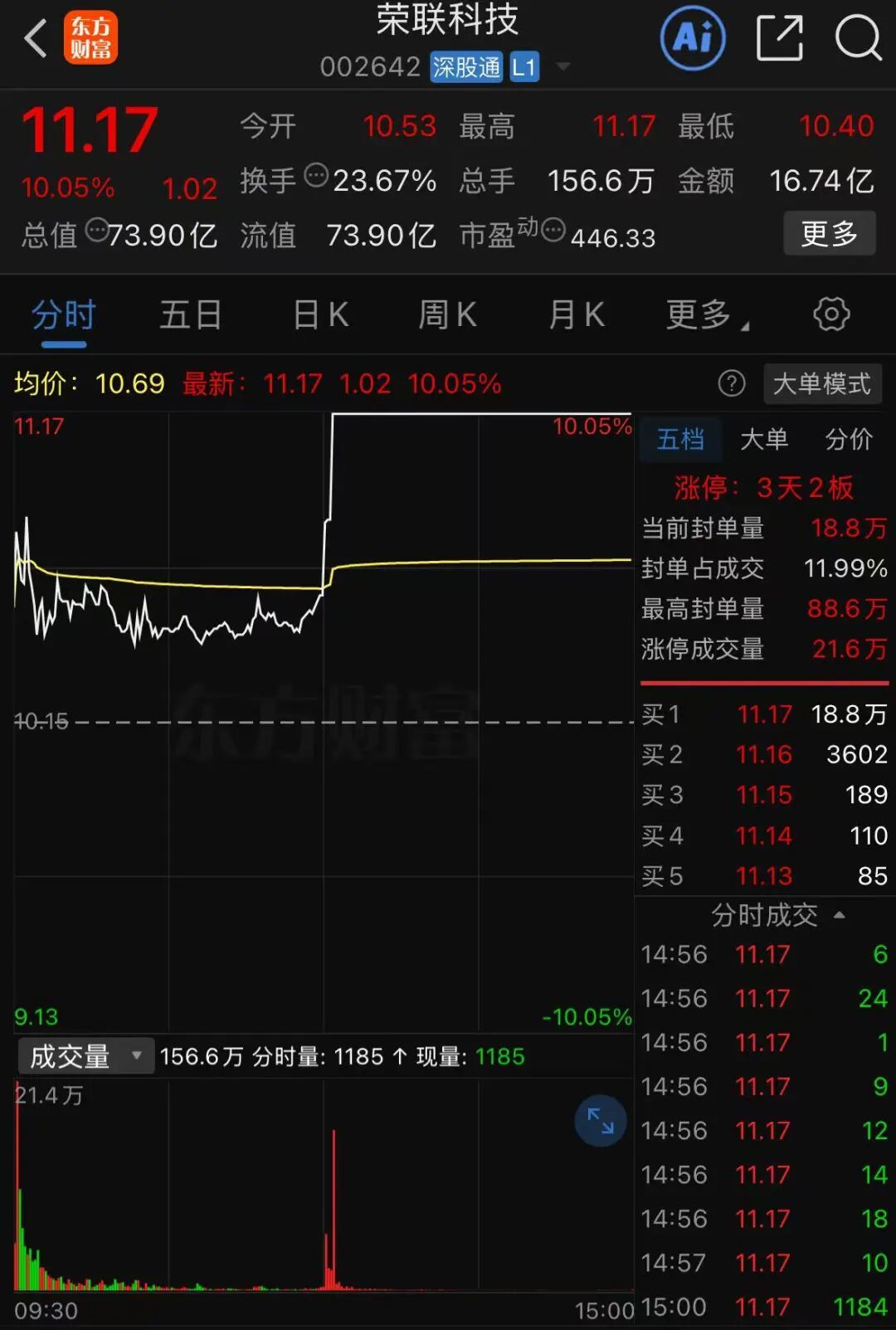
Core Viewpoint - The recent surge in A-share computing power concept stocks, particularly in companies like Ronglian Technology and Data Port, is attributed to significant capital expenditure guidance from major domestic firms, indicating a potential turning point in the data center sector driven by AI advancements [1][3][5]. Group 1: Market Movements - A-share computing power concept stocks experienced notable movements, with Data Port and Ronglian Technology hitting their daily price limits, while other companies like Yitian Intelligent and Huicheng Technology also saw significant gains [1][5]. - Ronglian Technology's stock opened at 10.53 and reached a high of 11.17, closing with a 10.05% increase, indicating strong trading activity with a turnover rate of 23.67% [2]. Group 2: Capital Expenditure Insights - Major domestic companies, including Tencent and Alibaba, reported substantial increases in capital expenditure, with Tencent's spending up 119% and Alibaba's up 220% in Q2, reflecting a strong commitment to AI infrastructure [3][8]. - Alibaba has invested over 100 billion yuan in AI infrastructure and product development over the past four quarters, with plans to continue a 3-year capital expenditure target of 380 billion yuan [3]. Group 3: Industry Trends - The data center sector is poised for growth, similar to the previous surge in the liquid cooling segment, as AI technology rapidly evolves and reshapes the industry landscape [5][8]. - The global capital expenditure (CAPEX) for cloud service providers like Microsoft, Amazon, and Google is expanding, with projected growth rates of 33.74% to 26.13% from 2021 to 2024, indicating a robust investment environment [8]. - The "East Data West Calculation" initiative aims to optimize resource allocation between regions, potentially unlocking new growth opportunities for the industry [8][9]. Group 4: Policy and Market Outlook - Recent reports indicate that the AI cloud market in China is expected to reach 22.3 billion yuan by the first half of 2025, supported by favorable policies aimed at avoiding redundant construction in the sector [6]. - The industry is undergoing a transformation towards greener practices, with increasing pressure for energy-efficient projects and stricter energy audits, which may lead to a more rational competitive landscape [9].

午后直线封板!A股算力概念突然异动,发生了什么?
天天基金网· 2025-09-15 08:38
Core Viewpoint - The article discusses the recent surge in the A-share market, particularly focusing on the structural changes and opportunities within the data center and AI sectors, driven by significant capital expenditures from major companies like Tencent and Alibaba [5][9]. Group 1: Market Movements - A-share market has seen notable movements in the computing power concept stocks, with companies like Data Port and Ronglian Technology experiencing sharp increases, including a limit-up on Ronglian Technology [3][6]. - The computing power sector is compared to the previous liquid cooling sector, indicating it is on the verge of a breakout, with significant gains observed in related stocks [6]. Group 2: Capital Expenditure Trends - Major companies are ramping up capital expenditures, with Tencent and Alibaba reporting increases of 119% and 220% respectively in Q2 this year, and Alibaba planning to invest over 100 billion yuan in AI infrastructure and products [5][9]. - The report highlights that the capital expenditure (CAPEX) for major cloud service providers like Microsoft, Amazon, and Google is expected to grow significantly, with projected CAGR of 33.74% from 2021 to 2024 [9]. Group 3: AI and Data Center Dynamics - The rapid development of AI technology is reshaping the data center industry, with increasing demand for AI-driven services expected to be the main growth driver [6][9]. - The Chinese AI cloud market is projected to reach 22.3 billion yuan by the first half of 2025, supported by favorable policies aimed at avoiding redundant construction in the industry [7]. Group 4: Policy and Industry Outlook - The "East Data West Calculation" initiative is expected to provide a clear direction for the scalable and intensive development of data centers, combining low-cost resources in the west with high market demand in the east [9]. - The "dual carbon" policy context is pushing for a transformation in data centers towards greener practices, which may lead to increased capital expenditure pressures in the short term [10].