
公募基金高质量发展

Search documents
公募基金二季度加仓47只银行股!持股市值激增508亿元,招行获966只基金重仓
Jin Rong Jie· 2025-07-26 17:10
Group 1 - The A-share market has shown significant differentiation recently, with multiple stocks doubling in value and specific sectors frequently receiving institutional fund increases [1] - The banking, communication, and non-bank financial sectors have become key allocation directions for public funds in the second quarter [1] - Technology and pharmaceutical thematic funds have also seen net inflows, indicating ongoing investor interest in these specific areas [1] Group 2 - The banking sector has been favored by institutions, with 47 out of 58 bank stocks held by public funds receiving increases in holdings [2] - Notably, Minsheng Bank and Industrial Bank saw over 10 million shares added, with the total number of shares in the banking sector increasing by 3.065 billion shares and market value rising by 50.82 billion yuan [2] - The China Securities Regulatory Commission's new guidelines on public fund performance benchmarks are expected to guide capital allocation towards the previously underweighted banking sector [2] Group 3 - The technology and pharmaceutical thematic funds displayed clear signs of capital flow differentiation in the second quarter [3] - Despite a return rate of -4.06%, the Yongying Advanced Manufacturing Fund received a net subscription of 1.491 billion shares, with its C share size reaching 10.869 billion yuan by the end of the quarter [3] - Conversely, some pharmaceutical funds experienced net redemptions despite strong returns, indicating a "take profit" behavior among investors [3] Group 4 - The China Europe Digital Economy Fund saw its A/C scale surge from 11.7 million yuan in the first quarter to 152.7 million yuan in the second quarter, with significant adjustments in its top ten holdings [4] - The Changcheng Prosperity Growth Fund also experienced a substantial increase in scale, rising from 7.034 million yuan to 32 million yuan, a 357% increase quarter-on-quarter [4]
财经观察丨第二批新型浮动费率基金获批,开售在即!首批26只募集规模超250亿元
Sou Hu Cai Jing· 2025-07-24 13:26
Group 1 - The second batch of 12 new floating fee rate fund products has been registered by the CSRC and will be launched soon, with the first sales expected next week [1] - The fee structure for these funds includes three tiers: 1.2% (benchmark), 1.5% (upward adjustment), and 0.6% (downward adjustment), similar to the first batch [1][3] - The second batch includes 8 funds that are all-market stock selection and 4 industry-themed funds focusing on sectors like manufacturing and healthcare [3] Group 2 - The first batch of 26 new floating fee rate funds has successfully been established, raising a total of 25.865 billion yuan, with the largest fund raising 2.082 billion yuan [4] - Fund managers are optimistic about the development prospects of floating fee rate products and plan to launch more in the future, indicating a trend towards regular registration of such products [4][6] - The new floating fee rate funds will implement a performance-based fee structure, allowing for a more personalized fee arrangement based on individual investor performance [5] Group 3 - The CSRC aims to promote the floating management fee model for newly established actively managed equity funds, targeting a minimum of 60% of such funds to adopt this model within a year [5] - This shift represents a significant trend in the public fund industry, moving from a focus on scale to a focus on returns, thereby reforming the traditional business model of fund companies [5][6]

招商基金名将翟相栋唯一在管产品增聘经理,或将离任转战私募
Nan Fang Du Shi Bao· 2025-07-24 13:07
Core Viewpoint - The announcement from China Merchants Fund regarding the appointment of Lu Wenkai as a co-manager for the China Merchants Advantage Enterprise Mixed Securities Investment Fund indicates a strategic adjustment aimed at optimizing the research and investment team for long-term planning and resource allocation [2][10]. Fund Manager Change - Lu Wenkai has been appointed as a co-manager alongside the original manager Zhai Xiangdong for the China Merchants Advantage Enterprise Mixed Securities Investment Fund [3]. - The change is described as a normal adjustment based on the company's needs for effective product management and research team optimization [2][10]. Performance and Background of Zhai Xiangdong - Under Zhai Xiangdong's management, the fund's scale increased from less than 40 million to over 10 billion, reaching 100.17 billion by the end of 2024, a nearly 30-fold increase from 3.4 billion at the end of 2022 [4]. - The fund achieved a return of 115.81% during Zhai's tenure, with an annualized return of 26.84%, ranking fifth among 2,901 similar funds [4]. Investment Strategy - Zhai Xiangdong employed a high-yield configuration strategy, focusing on growth industries driven by expectations and performance, with a significant emphasis on the TMT sector [5]. - The new manager, Lu Wenkai, is expected to adopt a mean-reversion strategy, focusing on cyclical and valuation bottoms, while maintaining a diversified portfolio across various sectors [8][10]. Industry Trends - The personnel change reflects a broader transformation within the public fund industry, where the trend of "de-starring" and transitioning to team-based management is becoming more prevalent [9]. - The emphasis on maintaining investment strategy continuity aligns with regulatory guidance aimed at enhancing the stability and diversity of research teams within fund companies [9][10].

市场强势格局持续演绎,牛市旗手券商ETF基金(515010)强势六连阳
Mei Ri Jing Ji Xin Wen· 2025-07-24 03:23
Group 1 - The core viewpoint of the articles indicates a strong performance in the A-share market, with the securities sector leading the gains, while certain sectors like optical modules and solar thermal power are lagging behind [1] - The securities ETF fund (515010) has seen a rise of 1.68%, with its constituent stocks, such as Jinlong Co., hitting the daily limit, indicating robust investor interest in the sector [1] - Analysts from Zhongtai Securities highlight a shift in investor strategy from trading to holding, suggesting a more sustainable growth pattern for the securities sector compared to previous market rallies [1] Group 2 - The securities ETF fund (515010) tracks the CSI All Share Securities Company Index and is noted for its low management and custody fee rate of 0.2%, making it an attractive investment option for those bullish on the securities sector [2] - The article emphasizes that the current market conditions may lead to increased capital inflow into underrepresented non-bank sectors, with securities firms likely to benefit from this trend [1]
非银金融25Q2重仓持股分析及板块最新观点:保险持仓显著回升,券商持仓仍严重欠配-20250723
CMS· 2025-07-23 06:33
Investment Rating - The report maintains a recommendation for the securities and insurance sectors, indicating a positive outlook despite potential challenges from trade friction and economic pressures [6]. Core Insights - The non-bank financial sector saw a significant increase in holdings, with the insurance sector's holdings rising to 1.54%, up 0.63 percentage points from the previous quarter, while the brokerage sector's holdings reached 0.90%, up 0.36 percentage points [5][21]. - The total market value of public funds reached 6,285.3 billion, with a year-on-year increase of 10% and a quarter-on-quarter increase of 7% [2]. - The insurance sector is benefiting from a recovery in premium income, with a cumulative premium income of 30,602 billion from January to May, reflecting a year-on-year growth of 3.8% [20]. Summary by Sections Public Fund Market Size - In Q2 2025, the total net value of funds was 33.7 trillion, with a year-on-year increase of 10% and a quarter-on-quarter increase of 7% [10]. - The non-monetary fund scale was 19.5 trillion, up 11% year-on-year and 7% quarter-on-quarter [10]. High Dividend Stock Holdings Analysis - The holdings of banks, electric equipment, transportation, public utilities, oil and petrochemicals, and coal showed varied changes, with bank holdings increasing by 16% [16]. Non-Bank Sector Holdings Analysis Brokerage Sector - The brokerage sector's holdings increased to 0.90%, with a 58% rise in shareholding volume to 669 million shares [18][19]. - The average daily trading volume for equity funds reached 1.49 trillion, a year-on-year increase of 57% [18]. Insurance Sector - The insurance sector's holdings increased significantly, with a notable rise in individual stock holdings for major companies like China Ping An and China Taiping [21]. - The insurance sector's holdings are still below the standard allocation of 1.91%, indicating potential for further investment [21]. Investment Recommendations - The report suggests focusing on key brokerage firms such as CITIC Securities and Guotai Junan, as well as insurance companies like China Taiping and China Ping An, due to their potential for growth in the current market environment [6].




规模 与持有人双向奔赴 公募规模创34万亿元新高
Shang Hai Zheng Quan Bao· 2025-07-21 19:58
Core Insights - The public fund industry in China has seen its total assets exceed 34 trillion yuan by the end of Q2 2025, marking a historical high, with both equity and bond funds experiencing growth [1][4] - The increase in fund size reflects a growing trust from investors, but it also brings greater responsibility for fund managers [4] Fund Size Changes - As of the end of Q2 2025, approximately 12,000 funds had a combined size of 34.05 trillion yuan, an increase of 2.24 trillion yuan from the end of Q1 2025 [1][5] - Bond funds have rebounded, surpassing 10 trillion yuan, with an increase of 865.3 billion yuan (8.74%) from Q1 2025 [1][6] - Money market funds also saw a significant increase, growing by 950.5 billion yuan (7.32%) [1][6] Equity Fund Performance - By the end of Q2 2025, the size of pure index equity funds reached 4.02 trillion yuan, up 7.41% from Q1 2025 [1][5] - Despite a recovery in performance, ordinary equity funds experienced a decrease in size by 107 million yuan [1][5] Specialized Fund Growth - Commodity funds and Funds of Funds (FOF) led the market in growth rates, increasing by 48% and 10% respectively, reaching sizes of 268.3 billion yuan and 165 billion yuan [2] - Notable growth was observed in specific ETFs, particularly those linked to the CSI 300 index, which saw increases exceeding 30 billion yuan [3] High-Performing Funds - Actively managed equity funds that performed well in Q2 2025, such as Changcheng Pharmaceutical Industry Select Mixed Fund and Yongying Technology Smart Select Mixed Fund, saw significant growth in size, increasing by 304.7% and 364% respectively [3]
A股十年变迁: 公募基金十年蝶变:机构化进程加速 被动型基金崛起
Zheng Quan Shi Bao· 2025-07-17 00:23
Core Insights - The Chinese public fund market has undergone significant transformation over the past decade, evolving from "quantity expansion" to "quality improvement," becoming a crucial pillar for wealth management and capital market development [7][8][9]. Fund Market Growth - The total asset value of public funds in China increased from 4.45 trillion yuan in 2014 to over 32 trillion yuan by 2024, marking a growth of 626% [8]. - The number of funds rose from fewer than 1,900 in 2014 to 12,400 by 2024, a 550% increase [8]. - As of June 30, 2023, the number of funds reached 12,900, maintaining an asset value above 32 trillion yuan, indicating ongoing market expansion and stability [8]. Product Diversification - The variety of public fund products has significantly increased, now including ETFs, REITs, FOFs, and alternative investments, with FOFs and REITs emerging from non-existence to notable presence [8][9]. - QDII funds, which invest in overseas markets, grew from fewer than 90 funds and under 50 billion yuan in asset value in 2014 to over 300 funds and more than 530 billion yuan by 2024 [8]. Investment Strategy Evolution - Public funds have diversified their investment strategies, with ETFs expanding from broad-based to sector and thematic investments, and quantitative strategies evolving to include various tools [9]. - The growth of fixed-income funds, particularly bond funds, reflects a strong demand for stable return products amid economic uncertainties [10][11]. Bond Fund Expansion - Bond funds have seen the most significant growth, with their share and asset value increasing substantially over the past decade. By the end of 2024, bond funds accounted for 31.42% of total fund shares and 32.62% of asset value, both up over 24 percentage points from ten years prior [11]. Rise of Passive Investment - The market share of passive investment funds, particularly ETFs, has grown significantly. ETF numbers increased from 107 in 2014 to over 1,000 by 2024, with asset value rising from 256 billion yuan to 3.73 trillion yuan [13]. - The shift towards passive investment is attributed to changing market conditions and investor sentiment, with a growing preference for low-cost, transparent investment options [13]. Investor Structure Changes - The investor base has shifted towards institutional investors, with their share of net asset value rising from 31.07% in 2014 to 48.49% by 2024, while individual investors' share decreased [14]. - The institutionalization trend is particularly pronounced in bond funds, where institutional ownership increased from 53.08% to 82.46% over the same period [14]. Long-term Investment Opportunities - Over 400 funds have achieved over 100% returns since 2015, with a significant number being mixed equity and flexible allocation funds [16]. - The average asset value of these long-term funds increased from 1.065 billion yuan in 2014 to 2.226 billion yuan by mid-2025, indicating a trend towards medium-sized funds performing better [17].

中加基金董事长变更
Zhong Guo Ji Jin Bao· 2025-07-16 05:05
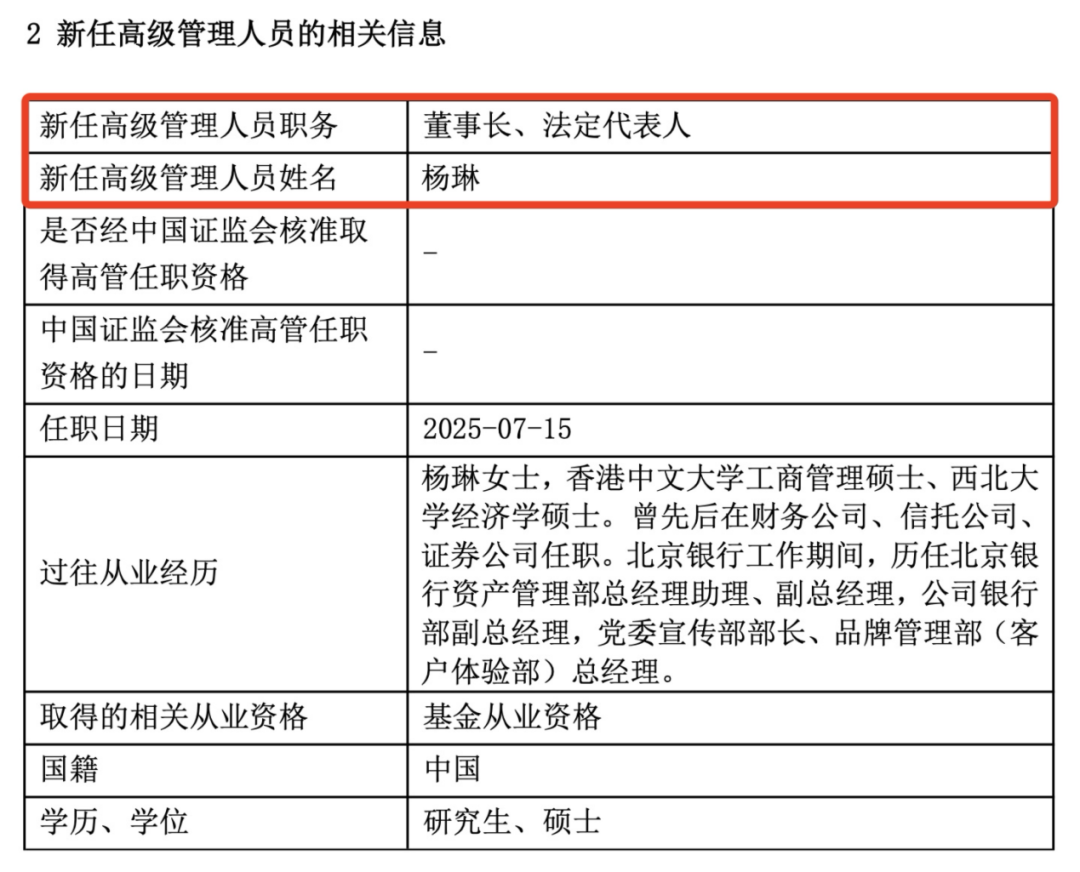
Group 1 - The core point of the article is the appointment of Yang Lin as the new chairman of Zhongjia Fund, following the departure of the previous chairman, Xia Yuanyang, due to work arrangements [1][3] - Zhongjia Fund was established in March 2013 and is a bank-affiliated fund company, with Beijing Bank as its largest shareholder [1][7] - As of the end of the first quarter, Zhongjia Fund's non-monetary fund management scale exceeded 110 billion yuan [1][8] Group 2 - Yang Lin is the fourth chairman of Zhongjia Fund and has a background in Beijing Bank, where she held various senior positions [4][5] - The fund's product structure is primarily focused on fixed-income products, with bond fund scale reaching 112.42 billion yuan, accounting for over 98% of its non-monetary fund scale [10] - Zhongjia Fund faces challenges in expanding its equity fund scale and improving retail channel construction, as many of its equity funds are classified as "mini funds" with low asset sizes [10]
管理业绩殿后却忙着发新扩容 华安基金靠什么“高质量发展”
Sou Hu Cai Jing· 2025-07-16 04:17
Core Viewpoint - The China Securities Regulatory Commission has released the "Public Fund High-Quality Development Action Plan," aiming to shift the focus of fund companies from "scale" to "returns," marking a turning point for high-quality industry development [2] Fund Issuance and Performance - New fund issuance has shown signs of fatigue, with Huazhong Fund having three new products in the fundraising period as of July 15, including the Huazhong Consumption Opportunity Stock Initiated A and C, and the Huazhong National Aerospace Industry ETF [2] - The recently completed Huazhong Competitive Advantage Mixed A fund had a subscription fee of up to 1.20% and a redemption fee of up to 1.50%, indicating high costs for investors [2] - Since 2022, Huazhong Fund has experienced a decline in fundraising scale, with issuance amounts of 465.85 billion, 329.17 billion, and 217.55 billion for 2022, 2023, and 2024 respectively, representing year-on-year decreases of 50.90%, 29.34%, and 33.91% [4] Management Performance - The Action Plan emphasizes the need for fund companies to establish a compensation management system linked to fund investment returns, aiming to enhance investor satisfaction [5] - Huazhong Fund's management performance has been disappointing, with its stock funds underperforming compared to peers over the past year, three years, and five years [5][7] - The average return of Huazhong Fund's stock funds over the past year was 18.91%, below the industry average of 20.61%, and over the past three years, it suffered a decline of 14.04%, nearly double the average of -9.27% for similar funds [5][7] Industry Context - The fund industry is experiencing a contradiction between its growth and the poor investment experience of retail investors, highlighting the need for a return to investor-centric principles [9] - The Action Plan aims to optimize product supply structure and facilitate a transition from relative ranking pursuits to enhancing the real holding experience for investors [9]
中邮基金总经理张志名:以改革为笔 绘就公募基金高质量发展新图景
Cai Jing Wang· 2025-07-10 16:00
Core Viewpoint - The public fund industry is undergoing a significant reform that aims to reshape the underlying logic of the industry and directly impacts millions of investors [1][2] Group 1: Challenges Faced by Small and Medium-sized Fund Companies - Small and medium-sized fund companies are experiencing development challenges that stem from structural contradictions accumulated during the industry's extensive growth phase [1] - There is an over-reliance on core fund managers, leading to instability in performance and client trust when key personnel leave [1] - The lack of bargaining power on the liability side forces many small companies to cater to short-term assessment requirements, resulting in a mismatch between asset management logic and liability realities [2] Group 2: Significance of the Reform - The reform is seen as a key to resolving the challenges faced by the industry, aiming to establish a new industry framework centered on investor interests [2] - The core objective of the reform is to create a long-term interest binding mechanism that aligns the demands of fund company executives, fund managers, and investors [2] Group 3: Recommendations for Future Development - There is a consensus on increasing the proportion of equity investments, but the definition of "equity assets" needs further clarification [3] - Establishing a performance-based floating fee mechanism is crucial, designed to incentivize managers while ensuring risk-sharing with investors [3] - Strengthening performance benchmarks will provide clear guidance for fund companies' strategic focus, allowing them to avoid homogenized competition [3] Group 4: Cost Management and Governance - A balanced approach to reducing fund investment costs is necessary, focusing on both fee reduction and sustainability [4] - Optimizing governance mechanisms is essential for the long-term health of the industry, with a need to establish a performance assessment system centered on long-term investment returns [4] Group 5: Future Industry Landscape - The reform will lead to a new ecological structure in the industry, with a shift towards platform-based asset management and binding sales incentives to investor interests [5] - The differentiation between large platform companies and small fund companies will become more pronounced, with the latter focusing on specialization and differentiation [5] - The reform process requires a gradual approach to avoid unnecessary risks, emphasizing the importance of a steady transition [5] Group 6: Ultimate Goals of the Reform - The essence of public funds is to manage others' wealth responsibly, and high-quality development hinges on aligning fiduciary responsibilities with investment objectives [6] - The ultimate goal of the reform is to ensure that the industry can effectively support residents' wealth management and the development of the real economy [6]