人工智能泡沫

Search documents
OpenAI 生意做大了,奥尔特曼口碑更差了
3 6 Ke· 2025-10-20 03:56
Core Insights - OpenAI's CEO Sam Altman faces criticism for the decision to allow adult content on ChatGPT, which will adopt a content rating system similar to the American film classification system, prioritizing safety for minors while offering more freedom to adult users [1][3][4] - The company's valuation has reached $500 billion, surpassing SpaceX, driven by aggressive infrastructure expansion strategies, including partnerships with Oracle and Nvidia for data centers and AI chips [5][6][7] - Despite the high valuation, OpenAI's revenue is projected at only $13 billion this year, with significant losses, raising concerns about its ability to generate positive cash flow before 2029 [6][8] Company Strategy - OpenAI aims to secure sufficient data center capacity through innovative financing methods, such as equity trades with suppliers like Nvidia, to support its ambitious goal of building 250GW of computing power by 2033, which could cost over $10 trillion [7][9] - The company is focused on becoming a leading personal AI subscription service provider, with current annual recurring revenue of $13 billion, primarily from ChatGPT subscriptions [8][9] Market Concerns - There are growing worries about a potential bubble in the AI sector, drawing parallels to the 1990s internet infrastructure boom, where over-investment led to significant industry losses [11][12] - Critics highlight that the rapid growth of AI infrastructure may outpace demand, leading to a concentration of returns that could eliminate many competitors [9][10] - The criticism also extends to the negative impacts of AI development on labor and environmental resources, as highlighted in the book "Empire of AI," which critiques OpenAI's operational practices [13][14][16]


《华尔街日报》:能源股正形成最狂热的 AI 泡沫 --- The Frothiest AI Bubble Is in Energy Stocks - WSJ
2025-10-19 15:58
Summary of Key Points from the Conference Call Industry Overview - The focus is on the energy sector, particularly on companies with no revenue that are experiencing inflated valuations due to speculation related to artificial intelligence (AI) [5][18]. Core Insights and Arguments - There is a significant concern that the real excess in market valuations is occurring within energy stocks rather than technology stocks, which are often profitable [4][5]. - A group of non-revenue-generating energy companies has collectively reached a market capitalization exceeding $45 billion, driven by expectations that tech companies will eventually purchase power from them [5][6]. - Oklo, a nuclear startup backed by OpenAI's CEO Sam Altman, has seen its shares rise approximately eightfold this year, resulting in a market cap of around $26 billion, making it the largest U.S. public company with no revenue in the past 12 months [6][7]. - Analysts predict that Oklo will not generate substantial revenue until 2028, as it is still in the development phase of small modular nuclear reactors [7][18]. - Another zero-revenue company, Fermi, debuted with a valuation of roughly $19 billion, making it one of the largest no-revenue companies at IPO, alongside Rivian and Corvis [8][9]. - Fermi plans to build 11 gigawatts of power capacity but has only secured equipment for 5% of this goal and lacks binding customer contracts [10][12]. Additional Important Points - Companies developing smaller "micro-modular" nuclear reactors are also seeing high valuations despite not generating revenue, with Nano Nuclear Energy valued at over $2 billion and Terra Innovatum exceeding $1 billion [13]. - Some companies, like NuScale Power and Plug Power, generate revenue but are not expected to turn a profit for several years, with projections indicating profitability may not occur until 2030 [15]. - The speculative nature of investments in energy companies is partly due to the high valuations of profit-generating firms, which have seen significant stock price increases [16]. - There is a historical precedent for zero or minimal revenue companies failing to deliver on their promises, as seen with electric vehicle startups that went public in 2020 [17]. - If the AI bubble bursts, energy companies without revenue are likely to experience the most significant declines, as they lack financial buffers [18].
人工智能到底是不是泡沫?回答业内最大问题的一个实用框架
3 6 Ke· 2025-10-19 10:16
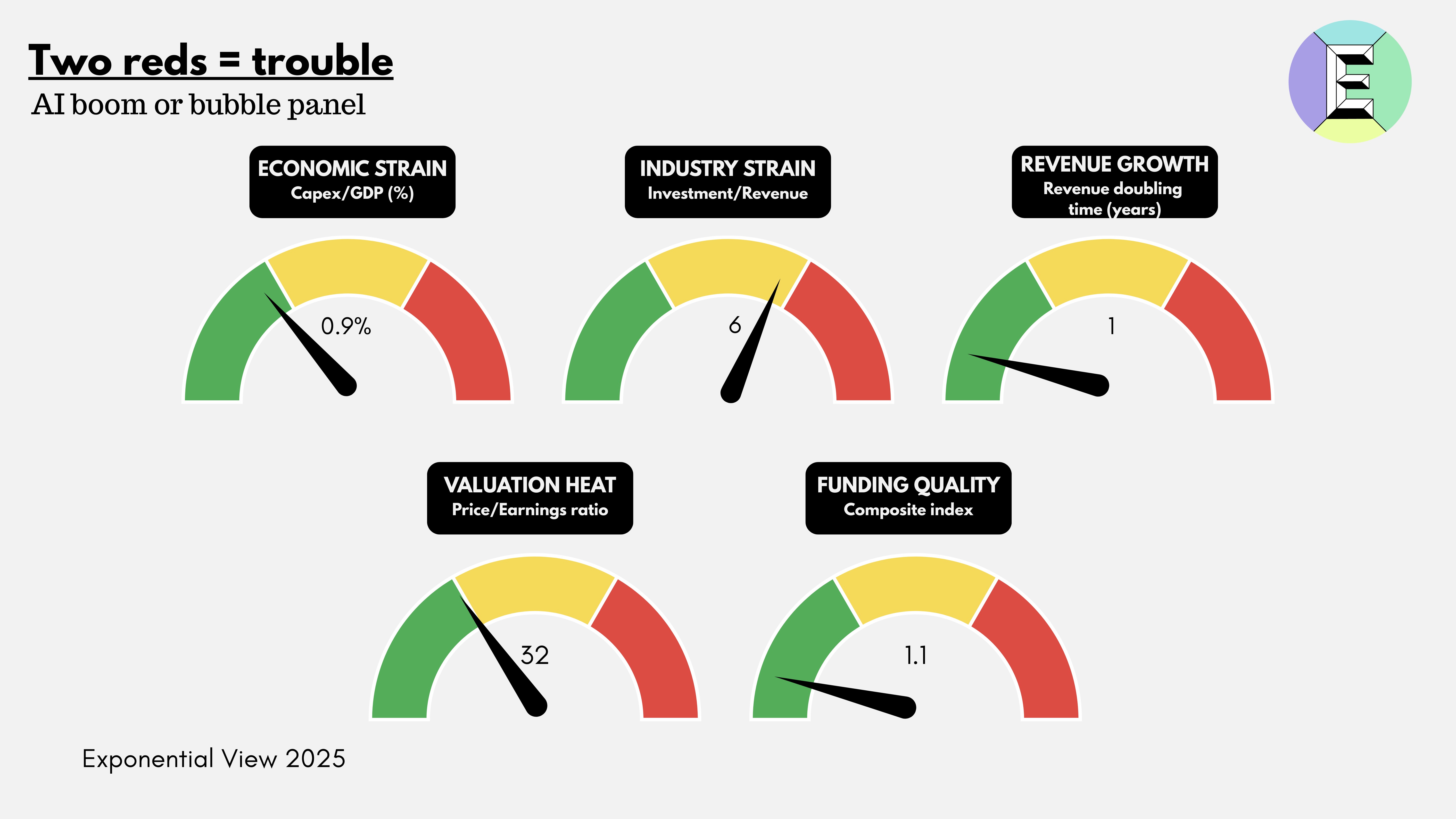
Core Viewpoint - The article argues that the current state of artificial intelligence (AI) is not a bubble, but there are potential danger signals that need to be monitored through a framework of five indicators [1][2][6]. Group 1: Definition and Historical Context of Bubbles - Bubbles are not just financial phenomena but also cultural products, often associated with greed and folly [7]. - Historical examples of bubbles include the South Sea Bubble, the Roaring Twenties stock market, and the 2008 housing market crash, each characterized by overvaluation and subsequent collapse [9][10]. - The article defines a bubble as a situation where stock values drop by 50% from their peak and remain low for at least five years [10][13]. Group 2: Current AI Investment Landscape - Since the launch of ChatGPT, capital expenditures by large-scale cloud service providers have more than doubled, raising questions about the sustainability of such spending [14][16]. - Morgan Stanley predicts that AI infrastructure spending will reach $3 trillion by 2029, indicating significant investment momentum [17]. Group 3: Five Indicators Framework - The five indicators to assess the AI landscape are: 1. Economic Pressure: Evaluates whether current investment levels are distorting the economy [18]. 2. Industry Pressure: Assesses if industry revenues align with capital expenditures [30]. 3. Revenue Growth: Measures the speed of revenue growth relative to investment [35]. 4. Valuation Heat: Analyzes how high valuations are compared to historical standards [39]. 5. Quality of Capital: Examines the source and structure of funding supporting the industry [46]. Group 4: Economic Pressure - Current AI investment is at approximately 0.9% of U.S. GDP, projected to rise to 1.6% by 2030, indicating it is currently in the green zone but may soon enter the yellow zone [23][27]. Group 5: Industry Pressure - The capital expenditure to revenue ratio for generative AI is currently six times, indicating significant pressure, but this is not yet a warning sign as demand for AI services remains high [33]. Group 6: Revenue Growth - Generative AI revenue is expected to grow significantly, with estimates suggesting it could reach $1 trillion by 2028, indicating strong growth potential [38]. Group 7: Valuation Heat - Current market valuations are not as extreme as during the internet bubble, with the Nasdaq's P/E ratio around 32, which is lower than the peak of 72 during the internet boom [42][44]. Group 8: Quality of Capital - The quality of capital in the AI sector appears stable, with major companies generating substantial cash flow to support investments, although there are concerns about future funding gaps [49][51]. Group 9: Conclusion - The analysis suggests that generative AI is in a demand-driven, capital-intensive growth phase rather than a bubble, but vigilance is required as certain indicators may signal a shift towards instability in the future [52][54].




万亿美元豪赌,Open AI创始人:泡沫化的故事很诱人
2 1 Shi Ji Jing Ji Bao Dao· 2025-10-19 00:42
Core Insights - Oracle's revenue for Q1 FY2026 increased by 12% to $14.9 billion, with cloud computing revenue growing by 28% to $7.2 billion, while software revenue declined by 1% to $5.7 billion, indicating mixed performance [1] - Oracle signed contracts worth billions with three clients in the first quarter, and expects to secure more multi-billion dollar contracts in the coming months, with remaining performance obligations (RPO) potentially exceeding $500 billion [1] - Following the earnings report, Oracle's stock surged by nearly 36%, marking its largest single-day increase ever, adding $244 billion to its market capitalization, which reached $922 billion [1] Company Developments - The market is increasingly betting on companies investing heavily in AI and building data centers, with Nvidia and OpenAI leading the charge alongside Oracle [2] - Nvidia is investing approximately $50 billion in Intel and plans to add around $100 billion to its collaboration with OpenAI, reflecting a strong upward trend in AI semiconductor and infrastructure stocks [2] Market Sentiment - There is growing concern among investors and industry professionals about a potential AI bubble, which could pose a significant risk to the global economy [5] - OpenAI's CEO, Sam Altman, acknowledged the presence of some bubble-like conditions in the AI sector but differentiated OpenAI's genuine technological advancements and business progress from the broader market trends [7][8] Industry Dynamics - OpenAI is at the center of complex collaborations with major tech companies, including Nvidia and AMD, which are intertwined through various investment and procurement agreements [9] - The rapid rise in valuations of AI tech companies is partly attributed to "financial engineering," raising concerns about the sustainability of these valuations [10] Supply Chain Insights - TSMC reported better-than-expected earnings and raised its revenue growth forecast for 2025 to nearly 35%, indicating strong demand for AI-related products [11] - TSMC's chairman noted robust demand signals from AI clients, reinforcing confidence in the long-term growth of AI technologies [11] Historical Context - The current surge in AI investment is reminiscent of the late 1990s internet bubble, but experts suggest it may not lead to systemic risks [13] - The historical context of the internet bubble highlights the potential for over-investment outpacing actual demand, which could lead to a similar scenario in the AI sector [14]



万亿美元豪赌 Open AI创始人:泡沫化的故事很诱人
2 1 Shi Ji Jing Ji Bao Dao· 2025-10-19 00:34
Group 1: Oracle's Financial Performance - Oracle's revenue for Q1 FY2026 increased by 12% to $14.9 billion, with cloud computing revenue growing by 28% to $7.2 billion [1] - The company signed contracts worth billions with three clients in the first quarter, and the remaining performance obligation (RPO) may exceed $500 billion [1] - Following the earnings report, Oracle's stock surged by nearly 36%, marking the largest single-day increase in its history, adding $244 billion to its market capitalization [1] Group 2: AI Market Dynamics - Concerns are rising among investors and entrepreneurs about a potential AI bubble, which could become a global economic risk [2] - OpenAI's CEO Sam Altman acknowledged some areas of AI may be experiencing bubble-like conditions, while asserting that OpenAI itself is making genuine progress [4][5] - The intertwining relationships among major tech companies, including OpenAI, NVIDIA, and AMD, are creating complex financial arrangements that may distort true demand [5][6] Group 3: Semiconductor Industry Insights - TSMC reported better-than-expected earnings and raised its revenue growth forecast for 2025 to nearly 35%, indicating strong AI demand [6][7] - TSMC's chairman noted robust demand from AI clients, with a significant increase in processing requirements for large language models [7] Group 4: Historical Context and Future Outlook - The current surge in AI investment is reminiscent of the late 1990s internet bubble, but experts suggest it may not pose a systemic risk [8] - The infrastructure built during the internet bubble laid the groundwork for future technological advancements, similar to the current AI landscape [9] - Companies face a dilemma between expanding production capabilities and managing costs, with potential risks associated with overestimating AI demand [9]

AI 并非存在一个泡沫,而是三个
3 6 Ke· 2025-10-19 00:03
Core Viewpoint - The article discusses the existence of multiple bubbles in the AI sector, highlighting the potential risks and opportunities for companies involved in AI investments and implementations [3][4][5]. Group 1: Types of Bubbles - The first bubble identified is an asset or speculative bubble, where AI-related companies like Nvidia and Tesla have inflated valuations, with Nvidia's P/E ratio at 50 and Tesla's at 200 despite revenue declines [3][4]. - The second bubble is an infrastructure bubble, characterized by massive investments in AI infrastructure without guaranteed future demand, reminiscent of historical overbuilding in the railroad and internet sectors [4]. - The third bubble is a hype bubble, where the promises of AI technology exceed its current capabilities, with a study indicating that 95% of AI pilot projects fail to deliver returns [4][7]. Group 2: Implications for Companies - Companies are advised not to panic in response to the bubble discussions, as the speculative and infrastructure bubbles may not directly impact most organizations [6]. - The hype bubble, however, presents a critical insight: the failure of many AI projects is often due to incorrect application rather than a lack of value in AI itself [7][8]. - Historical parallels are drawn to the internet bubble, where despite the collapse, companies that focused on building value through technology thrived [8]. Group 3: Value Creation Strategies - Successful companies should adopt a problem-oriented approach to identify friction points within their operations that AI can address [9]. - A balanced portfolio of AI initiatives should be developed, considering short-term and long-term investments, with a focus on integrating AI solutions across business functions [9][10]. - The key to thriving in the AI landscape is a systematic approach to value extraction, emphasizing clear objectives and immediate action [10]. Group 4: Opportunities Amidst the Bubble - The AI bubble may present unique opportunities for pragmatic practitioners, such as access to abundant venture capital and talent, as well as lower costs due to overcapacity in infrastructure [11]. - Companies can strategically leverage the bubble to acquire tools and technologies at reduced prices, while others bear the capital risks [11][12]. - The distraction caused by bubble discussions can provide a competitive advantage for companies that continue to focus on systematic AI implementation [12].



虚惊一场?美国银行板块收复前一日部分失地
Di Yi Cai Jing· 2025-10-18 00:32
Core Viewpoint - The U.S. banking sector is experiencing a rebound following the release of strong earnings reports from several financial institutions, which has helped stabilize bank stocks and uplift major U.S. stock indices after a recent sell-off driven by concerns over bad loans and global economic outlook [1][3]. Group 1: Market Reactions - Following the disclosure of bad loan issues by regional banks Zions Bancorporation and Western Alliance Bancorp, investor concerns about potential risks in the credit market intensified, leading to a significant drop in the SPDR S&P Regional Banking ETF by 6.2%, marking its largest single-day decline since April 10 [2]. - The S&P 500 financial services sector also fell by 2.8%, the largest single-day drop since April, with all major financial stocks closing lower [2]. - The Chicago Board Options Exchange Volatility Index (VIX) surged past 25 points, reaching its highest closing level since April 24, indicating increased market volatility [2]. Group 2: Earnings Reports - Strong earnings reports from Truist Financial, Regions Financial, and Fifth Third Bank helped alleviate market fears, with Fifth Third Bank reporting a 14% increase in net profit to $608 million and an earnings per share (EPS) of $0.91, while its loan loss provisions were lower than expected [3]. - Fifth Third Bank's loan loss provisions increased by 23% to $197 million, but were below the anticipated $245 million, and the bank expects a decrease in charge-off rates in the fourth quarter [3]. Group 3: Broader Economic Concerns - There is growing concern that the recent credit issues could lead to a wave of bad loans and asset write-downs, reminiscent of the Silicon Valley Bank incident in 2023, with market sentiment described as being clouded by fear and panic [4]. - Investors are assessing whether the recent pressures in the U.S. credit market will impact valuations across various markets, particularly in light of concerns over inflated valuations driven by AI-related stock market gains [5]. - The recent bankruptcy cases in the automotive sector have reignited worries about banks' lending standards, with indications that there may be more underlying issues in the credit market [6]. Group 4: Regulatory Environment - Regulatory scrutiny remains high, with ongoing inquiries into banks' exposure to commercial real estate risks and their liquidity positions, reflecting a cautious approach in the post-Silicon Valley Bank environment [7]. - Recent borrowing through the Federal Reserve's Standing Repo Facility (SRF) reached nearly $15 billion, the largest borrowing since the pandemic, indicating banks' need for liquidity support [7].

硅谷万亿AI投资:繁荣表象下的泡沫隐忧
Zhong Guo Jing Ying Bao· 2025-10-17 20:29
Core Insights - OpenAI has engaged in a series of high-value partnerships, including agreements with Nvidia, AMD, Oracle, and Broadcom, totaling over $1 trillion in planned investments, which has sparked both excitement and concerns about potential market bubbles [1][2][3] - The current investment frenzy in the AI sector is characterized by excessive optimism, with many projects' valuations significantly deviating from their actual worth, raising questions about the sustainability of such high valuations [1][4] - OpenAI's valuation has skyrocketed to $500 billion, surpassing SpaceX, driven by its extensive agreements with major tech companies, despite the company not yet being profitable [3][4] Investment Dynamics - OpenAI's collaborations have led to substantial stock price increases for partner companies, such as Oracle's stock rising 36% and AMD's stock increasing by 35% following their respective agreements [2][5] - The investment models employed, such as Nvidia's $100 billion investment in data centers, create a closed-loop funding cycle where funds are recycled back into hardware purchases, raising concerns about self-reinforcing valuation narratives [5][6] - The trend of "investment for orders" has been likened to the internet bubble era, where companies inflate their valuations through circular funding mechanisms, potentially leading to unsustainable market conditions [6][7] Market Structure and Risks - The concentration of capital in foundational AI models and infrastructure, which is projected to account for 68% of global AI infrastructure investment in 2024, has led to a neglect of application-level investments that generate actual returns [4][8] - The formation of a "triangular alliance" among major players like OpenAI, Nvidia, and Oracle may create monopolistic conditions that stifle competition and innovation, further complicating the market landscape [6][7] - Experts express concerns that the current AI investment landscape mirrors past bubbles, with high leverage and speculative behavior potentially leading to significant market corrections if expectations are not met [7][8]

万亿美元豪赌,AI泡沫警报大作
2 1 Shi Ji Jing Ji Bao Dao· 2025-10-17 13:23
Group 1: Oracle's Financial Performance - In the first fiscal quarter of 2026, Oracle's revenue grew by 12% to $14.9 billion, with cloud computing revenue increasing by 28% to $7.2 billion [1] - SaaS revenue reached $3.8 billion, growing by 11%, while software revenue declined by 1% to $5.7 billion, indicating a mixed overall performance [1] - Oracle's signed projects worth hundreds of billions of dollars have generated significant market excitement, with expectations of additional multi-billion dollar contracts in the coming months [1] Group 2: Market Reaction and AI Investment - Following the earnings report, Oracle's stock price surged by 41% intraday and closed nearly 36% higher, marking the largest single-day increase in its history, adding $244 billion to its market capitalization [1] - The market is betting on companies increasing AI investments and heavily building data centers, with Nvidia and OpenAI also leading in this space [1] Group 3: AI Bubble Concerns - There are growing concerns among investors and entrepreneurs about a potential AI bubble that could trigger global economic risks [2] - OpenAI's CEO, Sam Altman, acknowledged some areas of AI may be experiencing bubble-like conditions but emphasized that OpenAI is making genuine progress in technology and business development [4][5] Group 4: Industry Dynamics and Collaborations - OpenAI is at the center of complex collaborations with major tech companies like Nvidia, AMD, and Oracle, creating intricate relationships in computing power and capital [6] - The intertwining of investments and customer relationships has led to inflated revenue expectations for several companies, with some projections exceeding current revenues by multiples [6] Group 5: Financial Engineering and Market Skepticism - Experts in Silicon Valley are wary of the potential distortion of true industry demand due to complex financing arrangements, labeling some transactions as "round-tripping" or "vendor financing" [7] - Altman acknowledged the unprecedented nature of these investments and loans but pointed out the rapid revenue growth of OpenAI, despite the company not yet being profitable [8] Group 6: Semiconductor Demand and AI Growth - TSMC reported better-than-expected earnings and raised its revenue growth forecast for 2025 to nearly 35%, reflecting strong AI demand [8] - TSMC's role as a key manufacturer for high-end AI chips positions it favorably in the growing AI market, with strong signals from clients regarding demand [8][9] Group 7: Historical Context and Future Outlook - The current AI investment surge is compared to the late 1990s internet bubble, with concerns about timing and demand growth potentially leading to a similar outcome [10] - Despite the potential for a valuation correction in AI, the foundational infrastructure being built may support future growth in mobile internet and cloud computing [10] Group 8: Strategic Decisions for AI Companies - Companies pursuing AI opportunities face the dilemma of whether to expand production or adopt a wait-and-see approach, which could impact their market positioning [11] - The primary drivers of AI growth are currently stable tech giants, which are likely to maintain growth even if the hype subsides, while smaller energy companies without revenue may face severe risks [11]
全球股市集体反弹,黄金突破4200
Sou Hu Cai Jing· 2025-10-17 00:18
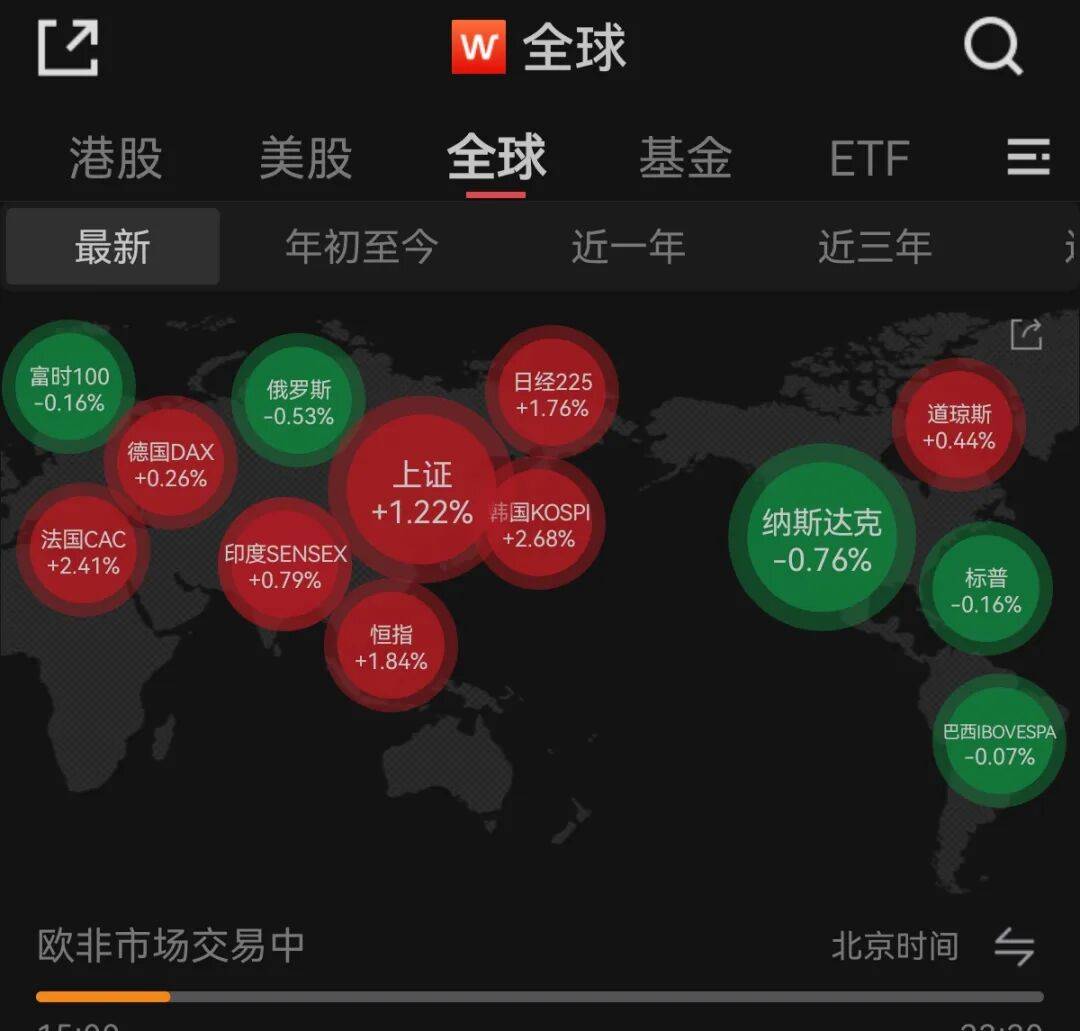
Group 1 - Federal Reserve Chairman Jerome Powell hinted at a potential 25 basis point rate cut later this month, boosting market sentiment and leading to a collective rebound in global stock markets [1] - Bloomberg strategist Garfield Reynolds noted that the Fed's dovish stance is driving a new round of dollar weakness, paving the way for gold-centered hedging strategies [3] - Asian stock markets rose on October 15, with the European Stoxx 50 index up 1.27%, Germany's DAX index up 0.2%, and France's CAC40 index showing a daily increase of 2% [3] Group 2 - The Shanghai Composite Index rose by 1.22%, returning to the 3900-point level, with nearly 4400 stocks in the market gaining [7] - The Hang Seng Index closed up 1.83% at 25,906.01 points, marking an increase of 464.66 points [7] - Pre-market trading in the US saw ASML shares rise by 3.5%, with Q3 orders exceeding expectations at €5.4 billion and net sales at €7.52 billion [8] Group 3 - Spot gold prices surpassed $4200 per ounce, increasing nearly 1.4% as market expectations for two more rate cuts by the Fed this year, combined with recent trade comments from Trump, fueled safe-haven buying [8] - Spot silver prices rose over 2% during the day, with the London market facing liquidity issues, leading to a global chase for silver and pushing benchmark prices above New York futures prices [10]