供应链多元化

Search documents
关税乌云下的越南中企,观望之际加速出货
Hu Xiu· 2025-04-24 04:05
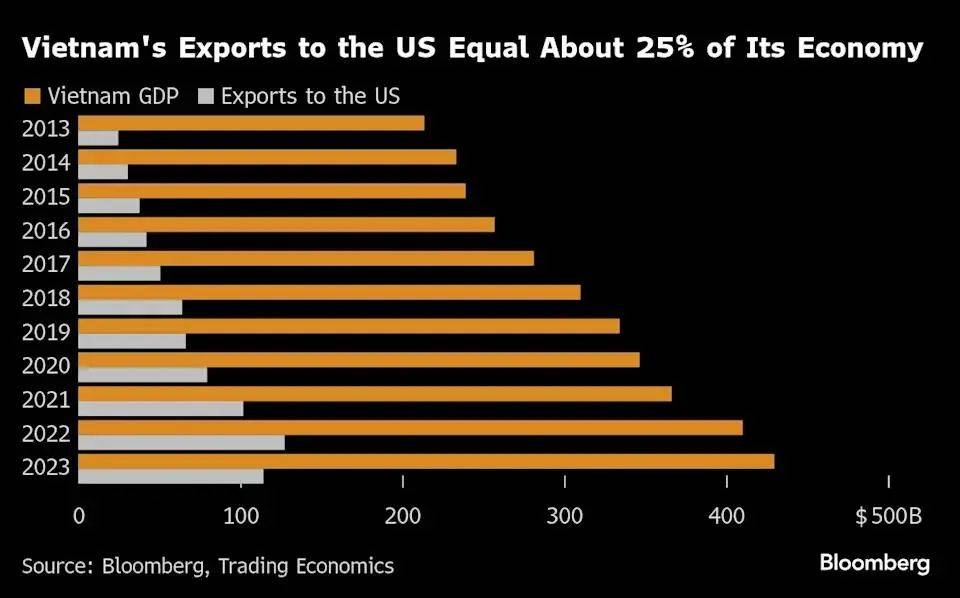
Core Points - The U.S. government announced a 46% reciprocal tariff on Vietnam, which has raised concerns among Chinese businesses operating in Vietnam, although the implementation has been postponed for 90 days [1][4][12] - Vietnamese companies are actively seeking to diversify their supply chains and explore new trade partnerships, particularly with Europe and other developing countries, in response to the trade tensions [6][40] - The potential impact of the tariffs could significantly harm Vietnam's export-driven economy, as exports to the U.S. account for approximately 30% of Vietnam's total exports and 25% of its GDP [8][11][12] Group 1: Business Operations and Strategies - Chinese companies in Vietnam, such as those in the packaging industry, are currently not making drastic changes to their production plans despite the tariff announcement [4][16] - Companies are preparing for potential impacts by expediting shipments and negotiating with clients to mitigate losses [12][15][30] - The Vietnamese government is engaging in negotiations with the U.S. to reduce the proposed tariffs and has expressed willingness to lower tariffs on U.S. goods to zero [17][19][20] Group 2: Economic Impact and Trade Relations - The tariffs could lead to a 3.5% reduction in Vietnam's economic output by 2026 under optimistic scenarios, effectively halving the country's growth rate [12][21] - Vietnam's export economy, particularly in sectors like ceramics and agricultural products, is heavily reliant on the U.S. market, with some local industries facing increased tariffs on their exports [13][14][15] - The Vietnamese government is taking steps to strengthen its trade relationships with both the U.S. and China, aiming to maintain a balance in its foreign relations [40][41] Group 3: Investment Trends - Chinese investment in Vietnam has surged, with registered investments reaching $4.47 billion in 2023, a 77.6% increase from the previous year [22] - The focus of Chinese investments is shifting from traditional manufacturing to high-tech and renewable energy sectors, indicating a diversification of investment strategies [22][23] - The presence of Chinese companies in Vietnam is expected to continue growing, as they seek to mitigate risks associated with U.S.-China trade tensions [29][44]

深圳外贸一季度“V型反弹”:高基数下释放企稳信号
2 1 Shi Ji Jing Ji Bao Dao· 2025-04-23 11:24
南方财经全媒体记者 欧雪 深圳报道 在经历了年初的短暂承压后,深圳外贸在3月强势回升。 深圳海关4月22日披露数据显示,今年一季度深圳市进出口总值9901亿元,同比微降2.8%。但单月指标 呈现明显回暖态势,前2个月深圳进出口同比下降10.4%,3月进出口迅速回升同比增速达12.3%,高于 全国平均水平,其中进口增速更飙升至17.2%。 值得关注的是,在去年高基数和今年美国滥施关税的双重压力下,深圳前2个月进出口规模仍均处于历 史同期第二高位,3月进出口总额更是实现两位数增长,展现了深圳外贸的较强韧性。 "整体来看,深圳3月份的外贸表现较为出色。"然而,中国(深圳)综合开发研究院区域发展规划研究 四所所长王振告诉记者,在当前复杂的国际贸易形势下,尤其是美国滥施关税下,我们仍需深入分析关 税政策变化对深圳外贸的具体冲击和影响,以更好地应对未来的挑战。 到3月份,深圳锂电池、电动汽车等"新三样"产品增速仍旧较快,电子元件等中间品保持增长。值得注 意的是,"新三样"产品中,锂电池出口56.8亿元,增长42.8%,电动汽车出口30.4亿元,增长154.3%。 此外,记者注意到,深圳外贸市场格局迎来新变化。2024年, ...
中国手机霸屏印度:前五占四 苹果隐身
Zhong Guo Jing Ying Bao· 2025-04-21 13:23
Core Insights - The Indian smartphone market experienced an 8% year-on-year decline in Q1 2025, with total shipments reaching 32.4 million units, primarily due to weak consumer demand and high channel inventory from late 2024 [1][2] - Chinese smartphone brands continue to dominate the Indian market, holding a 70% market share, with four out of the top five brands being Chinese [1][3] Market Performance - Vivo led the market with 7 million units shipped and a 22% market share, followed by Samsung with 5.1 million units (16% market share), and Xiaomi with 4 million units (12% market share) [3][4] - OPPO and realme also showed growth, with OPPO achieving a 5% increase in shipments and realme growing by 3% [3][4] Brand Strategies - Vivo's success is attributed to a balanced product portfolio and effective channel execution, while OPPO leveraged its retail channel strengths [3][4] - Xiaomi faced a 38% decline in shipments due to high inventory and conservative channel sentiment, despite a stable performance from its Redmi 14C 5G model [4] Market Dynamics - The overall market decline has led to a reliance on retail and distribution networks to drive sales, with channel incentive programs and offline promotions becoming crucial for market share competition [1][2] - The Indian smartphone manufacturing share is increasing, supported by government initiatives and a growing local market [6][7] Future Outlook - The smartphone market in India is expected to see moderate growth in 2025, influenced by fluctuating demand and the ongoing impact of changing tariff policies [8][9] - Brands like Apple and Samsung are focusing on higher average selling prices (ASP) and user upgrade intentions to navigate the challenging market environment [9]
关于关税:外资投行的一些视角
淡水泉投资· 2025-04-16 06:14
重要提示:本材料不构成任何形式的要约、承诺或其他法律文件,亦非任何投资、法律或财务等方面的专业建议。过往业绩不预示 未来表现。投资须谨慎。 关税是近期市场普遍关心的话题,我们整理了一些外资投行的观察视角,以供参考。 截至本文发布,美国总统特朗普表示,他正考虑对进口汽车和零部件关税实施临时豁免的可能性, 以便让汽车企业有更多时间在美国建立生产设施。 在此之前,特朗普称豁免电子产品关税只是一项 临时措施,这些产品将被即将实施的行业关税所覆盖。 局势正在以分钟级速度演变。 关税政策能重振美国的就业吗? 有外资报告援引学术研究结果显示,特朗普关税政策或对美国就业存在负面影响。关税税率每提高10个 百分点,受保护行业的就业岗位将增加0.2-0.4%;而关税驱动成本每上升1个百分点,就业岗位会减少 0.3-0.6%。考虑美国的经济体量,意味着关税保护对制造业就业的提振作用不足10万个岗位,而由此带 来的成本压力对下游就业的拖累效应则高达约50万个岗位。 企业应对关税风险的五种常见策略 外资投行基于观察企业应对上一轮关税争端的经验,总结出面对关税风险企业通常可以采取的五种应对 策略。在最新的关税政策下,部分策略是否还能继续 ...
iPhone价格或飙涨?特朗普挥舞“关税大棒”,苹果公司两天市值蒸发3.88万亿元,面临艰难选择
Mei Ri Jing Ji Xin Wen· 2025-04-06 05:43
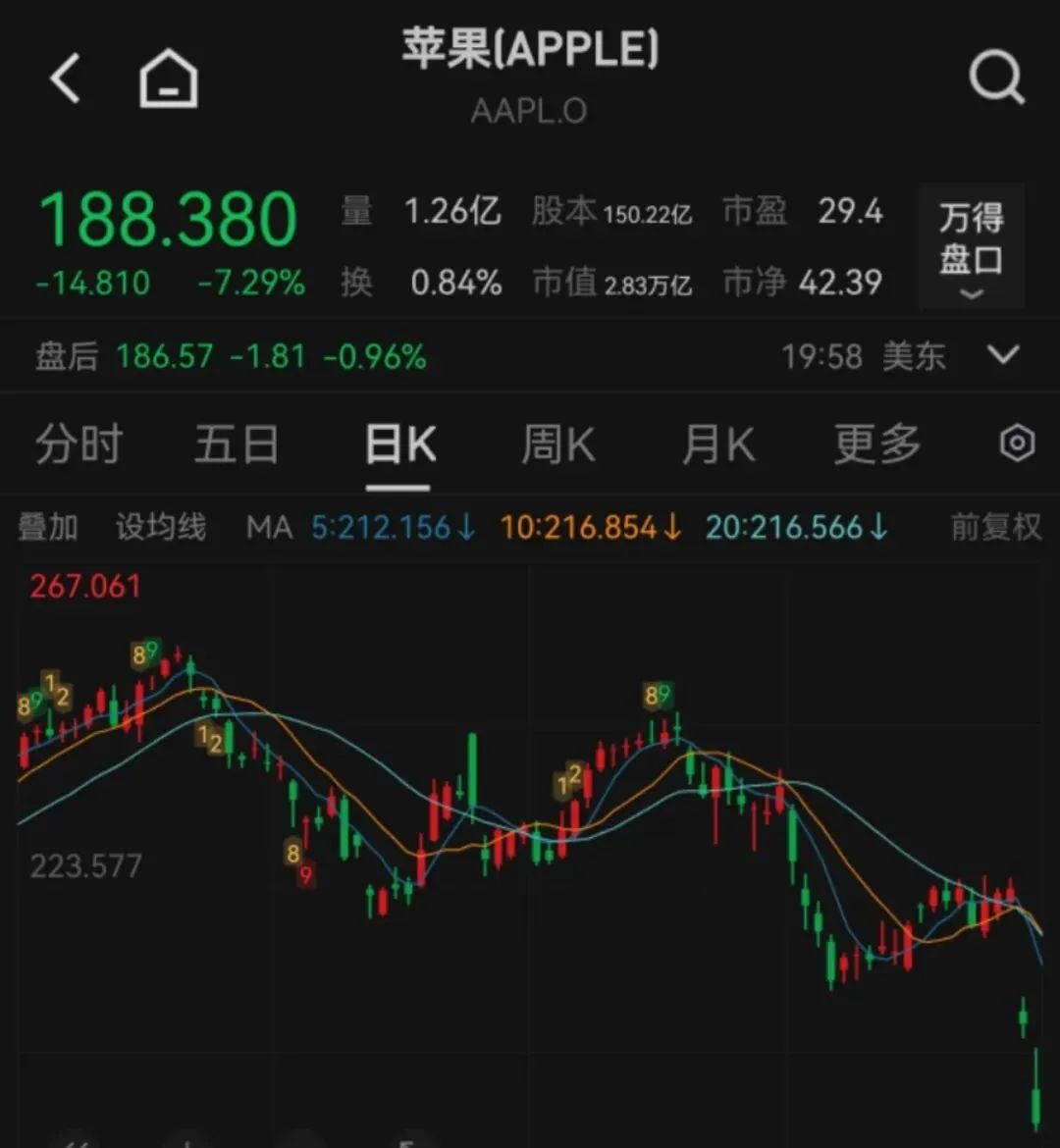
Core Viewpoint - The announcement of "reciprocal tariffs" by President Trump has led to a significant decline in Apple's stock price, resulting in a market value loss of approximately $533.36 billion (around 3.88 trillion RMB) over two trading days, making it one of the hardest-hit companies in this downturn [1]. Group 1: Impact of Tariffs on Apple - Apple assembles 90% of its phones in China, which poses a challenging decision for the company: absorb the tariff costs or pass them on to consumers [3]. - Morgan Stanley estimates that the tariffs could increase Apple's annual costs by about $8.5 billion. If Apple fully transfers these costs to consumers, the retail price of the iPhone 16 Pro Max in the U.S. could rise from $1,599 to $2,300 (approximately 16,750 RMB) [3]. Group 2: Supply Chain Diversification Efforts - During Trump's first term, Apple began diversifying its supply chain by relocating some production to India and Vietnam, and expanding production lines in Malaysia and Thailand. However, the new tariffs on Southeast Asian countries could severely impact Apple's supply chain [5]. - In February, Apple committed to investing over $500 billion in the U.S. over the next four years, including establishing new AI server factories in Texas and a new chip manufacturing facility in Arizona, in an effort to persuade the Trump administration to exclude its products from the tariff list [5]. Group 3: Challenges in U.S. Manufacturing - A senior stock analyst noted that building a new factory in the U.S. takes four to five years, and the country currently lacks the necessary infrastructure and labor force to support technology manufacturing [7].

Aterian(ATER) - 2024 Q4 - Earnings Call Transcript
2025-03-19 00:49
Financial Data and Key Metrics Changes - Aterian reported net revenue for Q4 2024 at $24.6 million, a decline of 25% from $32.8 million in Q4 2023, primarily due to SKU rationalization and lower liquidation levels of high-cost inventory [42] - Adjusted EBITDA for Q4 2024 was essentially break-even, improving by 98.5% from an adjusted EBITDA loss of $5.6 million in Q4 2023 [47][41] - The net loss for Q4 2024 was $1.3 million, an improvement of approximately 83.1% from a loss of $7.7 million in the year-ago quarter [46] Business Line Data and Key Metrics Changes - The company streamlined its product portfolio to focus on six foundational brands, which has improved efficiency and ROI [18] - Gross margin for Q4 2024 increased to 63.4% from 51% in the year-ago quarter, driven by SKU rationalization and product mix [43] - Contribution margin for Q4 2024 was 19.4%, a significant improvement from negative 0.8% in the previous year [44] Market Data and Key Metrics Changes - Aterian's revenue is primarily derived from e-commerce marketplaces, with a focus on Amazon, Walmart, and Target Plus [12] - The company plans to expand its market presence in 2025, targeting growth in the UK and additional channels [25][26] Company Strategy and Development Direction - Aterian's strategy for 2025 includes channel and geographic expansion, new product launches, and a focus on consumable products [24][28] - The company aims for net revenue growth of 5% to 7% in 2025, with an expected increase of 9% to 12% on a comparable basis, excluding discontinued SKUs [22][49] - Aterian has initiated a two-year share repurchase program of up to $3 million, reflecting confidence in the company's future [35][56] Management's Comments on Operating Environment and Future Outlook - Management expressed optimism about the company's ability to navigate challenges, including tariffs, and expects to achieve break-even adjusted EBITDA in 2025 [30][52] - The company is focused on diversifying its supply chain away from China, aiming to reduce reliance from 75% to 50% by the end of 2026 [32][34] - Management noted that consumer behavior has not shown significant softness, and the diversified brand portfolio positions the company well to handle potential market volatility [92][93] Other Important Information - Aterian's operational improvements in 2024 have led to a 91% reduction in adjusted EBITDA losses, indicating effective strategic initiatives [41] - The company is committed to long-term growth, projecting a CAGR of 10% to 12% from 2025 to 2027 [54] Q&A Session Summary Question: Performance of SKUs on Target Plus during Black Friday - Management indicated that the steam mop performed well on Target Plus, and they plan to expand SKU offerings gradually based on performance [65] Question: Guidance for Q1 and seasonal dynamics - Management explained that new product launches and channel expansions are expected to drive stronger sales in the second half of the year, leading to a relatively weaker Q1 [71][73] Question: Impact of tariffs and pricing strategy - Management clarified that while tariffs are expected to increase costs, they believe they can mitigate some of these through price adjustments, with a projected price increase of 7% to 10% [76][78] Question: Long-term growth targets and consumer behavior - Management discussed that the three-year growth targets are driven by new product launches and channel expansions, and they have not observed significant changes in consumer behavior despite broader economic concerns [85][90]

体育用品2025
麦肯锡咨询· 2025-03-16 10:13
Investment Rating - The report does not explicitly provide an investment rating for the sporting goods industry, but it indicates a cautious optimism among executives, with 44% feeling optimistic about 2025 [29][70]. Core Insights - The sporting goods industry has maintained a growth rate of 7% annually from 2021 to 2024, but this is expected to slow to 6% from 2024 to 2029 due to economic challenges and cautious consumer behavior [29][70]. - The report highlights the dual agenda of companies focusing on both profitability and revenue growth amidst a challenging environment [29][70]. - A significant opportunity exists in addressing the 1.8 billion people globally who do not meet the World Health Organization's recommended activity levels, representing a market potential equivalent to twice the adult population of India [33][36][48]. Summary by Sections Executive Summary - The sporting goods industry faces a challenging environment with a projected annual growth rate of 6% from 2024 to 2029, influenced by economic factors and consumer caution [29][70]. - Despite challenges, 44% of industry executives express optimism for 2025, indicating a cautious confidence in navigating opportunities [29][70]. Key Themes - The industry is experiencing a shift in consumer behavior, with a growing divide between active and inactive consumers, creating both challenges and opportunities for brands [37][39]. - The rise of challenger brands has led to a market share reshuffle, with established companies like Adidas and Nike losing ground to new entrants [39][52]. - The demand for live fitness experiences has surged, with 81% of consumers participating in live fitness classes, indicating a shift towards community-oriented fitness solutions [42][53]. Market Dynamics - The report emphasizes the need for companies to balance revenue growth with productivity improvements in response to a cautious consumer landscape [70][75]. - Geopolitical uncertainties and potential tariff increases pose significant risks, necessitating strategic adjustments in supply chain management [72][88]. - Sustainability remains a priority, but the focus has shifted due to external pressures, with only half of executives prioritizing sustainability compared to two-thirds the previous year [89][90].
Cactus(WHD) - 2024 Q4 - Earnings Call Transcript
2025-02-28 02:52
Financial Data and Key Metrics Changes - For Q4 2024, total revenue was $272 million, down 7.2% sequentially, with adjusted EBITDA of $93 million, also down 7.6% sequentially, resulting in adjusted EBITDA margins of 34.1% [8][11][15] - GAAP net income for the quarter was $57 million, compared to $62 million in Q3 2024, driven by lower revenues in both segments [16][17] - Adjusted net income and earnings per share were $57 million and $0.71 per share, respectively, down from $63 million and $0.79 per share in Q3 2024 [17][18] Business Line Data and Key Metrics Changes - Pressure control segment revenues were $177 million, down 4.5% sequentially, with operating income decreasing by $1.7 million or 3.3% [12] - Spoolable technology segment revenues were $96 million, down 11.2% sequentially, with operating income decreasing by $7.4 million or 22.4% [13] - Adjusted segment EBITDA for pressure control decreased by $0.5 million or 0.8% sequentially, while spoolable technology segment adjusted EBITDA decreased by $7.3 million or 17.1% [12][14] Market Data and Key Metrics Changes - The company ended the year with a cash balance of $343 million, an increase of approximately $39 million from the previous quarter [19] - The public or Class A ownership of the company averaged 85% and ended the quarter at 86% [16] Company Strategy and Development Direction - The company aims to ramp up production at its new facility in Vietnam and introduce new products to enhance value in both segments [28][36] - Focus on international expansion and diversification of revenue sources, targeting a long-term goal of 40% international revenue contribution [30][36] Management's Comments on Operating Environment and Future Outlook - Management expressed confidence in outperforming underlying activity levels in the US market despite trade policy uncertainties [42][43] - The company anticipates a strong rebound in customer activity in the second and third quarters of 2025, with expectations for increased international orders [30][36] Other Important Information - The board approved a quarterly dividend of $0.13 per share, to be paid in March [23] - The company made a cash tax payment of approximately $25 million in January related to deferred 2024 federal taxes [21] Q&A Session Summary Question: Outlook for US activity in the next few quarters - Management is confident in their ability to outgrow underlying activity levels, anticipating a US rig count in the 550 to 560 range [42][43] Question: Margin headwind comparison between Bossier City and China - Historical costs were at least 35% higher for the Bossier facility compared to the Far East supply chain, with increasing tariffs expected to impact costs [45][46] Question: Game plan for mitigating tariff impacts - The company has flexibility between its facilities in Vietnam and Bossier City to mitigate tariff impacts, with a focus on vertical manufacturing capabilities [57][60] Question: Commercialization of H2S solutions - The H2S product is commercialized, with shipments expected to begin in March or April, targeting the Middle East market [68][70] Question: Spoolable technology growth in 2025 - The company is optimistic about growth in spoolable technology, despite a flat completion activity outlook, with international growth potential remaining strong [80][86] Question: International growth opportunities in pressure control - Management acknowledged progress in international growth but refrained from providing specific details on opportunities in regions like Argentina and the Middle East [95][96]