
全国统一大市场建设

Search documents
解读:2025年12月份CPI同比涨幅继续扩大 PPI同比降幅收窄
Guo Jia Tong Ji Ju· 2026-01-09 03:00
Group 1: CPI Analysis - The Consumer Price Index (CPI) increased by 0.2% month-on-month and 0.8% year-on-year, with the core CPI rising by 1.2% year-on-year, indicating a recovery in consumer demand as New Year's approaches [1][2][3] - The month-on-month increase in CPI was primarily driven by rising prices of industrial consumer goods, excluding energy, which rose by 0.6%, contributing approximately 0.16 percentage points to the CPI increase [2] - Food prices rose by 1.1% year-on-year, with significant increases in fresh vegetables (18.2%) and fresh fruits (4.4%), contributing approximately 0.17 percentage points to the year-on-year CPI increase [3] Group 2: PPI Analysis - The Producer Price Index (PPI) rose by 0.2% month-on-month, marking the third consecutive month of increase, with the growth rate expanding by 0.1 percentage points compared to the previous month [4] - The month-on-month PPI increase was supported by improved supply-demand dynamics, with notable price increases in coal mining (1.3%) and lithium-ion battery manufacturing (1.0%) [4] - Year-on-year, the PPI decreased by 1.9%, but the decline rate narrowed by 0.3 percentage points, reflecting positive changes in certain industries due to ongoing macroeconomic policies [4]
国家统计局:12月锂离子电池制造价格上涨1.0%
Guo Jia Tong Ji Ju· 2026-01-09 02:55
Core Insights - The Producer Price Index (PPI) increased by 0.2% month-on-month, marking the third consecutive month of growth, with the growth rate expanding by 0.1 percentage points compared to the previous month [1] - Year-on-year, the PPI decreased by 1.9%, but the decline rate narrowed by 0.3 percentage points from the previous month, indicating positive changes in certain industries due to effective macro policies [1] Group 1: Price Changes in Key Industries - The improvement in supply and demand structure has led to price increases in several key industries, including a 1.3% rise in coal mining and washing, and a 0.8% increase in coal processing, both of which have risen for five consecutive months [1] - The price of lithium-ion battery manufacturing increased by 1.0%, and cement manufacturing prices rose by 0.5%, both showing growth for three consecutive months [1] - The price of complete electric vehicles shifted from a 0.2% decrease last month to a 0.1% increase this month [1] Group 2: Market Competition and Price Adjustments - The construction of a unified national market is progressing, leading to a continuous narrowing of year-on-year price declines in related industries [1] - The optimization of market competition order has resulted in a narrowing of price declines in coal mining and washing, lithium-ion battery manufacturing, and photovoltaic equipment and components manufacturing by 2.9, 1.2, and 0.4 percentage points respectively, with these industries experiencing narrowing declines for five, four, and nine consecutive months [1]
国家统计局:12月光伏设备及元器件制造价格降幅比上月收窄0.4个百分点
Guo Jia Tong Ji Ju· 2026-01-09 02:55
资讯编辑:陈群 021-26096771 资讯监督:乐卫扬 021-26093827 资讯投诉:陈跃进 021-26093100 PPI同比下降1.9%,降幅比上月收窄0.3个百分点。国内各项宏观政策持续显效,部分行业价格呈现积极 变化。 全国统一大市场建设纵深推进,相关行业价格同比降幅持续收窄。市场竞争秩序不断优化,煤炭开采和 洗选业、锂离子电池制造、光伏设备及元器件制造价格降幅比上月分别收窄2.9个、1.2个和0.4个百分 点,已分别连续收窄5个月、4个月和9个月。 国家统计局城市司首席统计师董莉娟解读2025年12月份CPI和PPI数据。 免责声明:Mysteel发布的原创及转载内容,仅供客户参考,不作为决策建议。原创内容版权归Mysteel所有,转载需取得Mysteel书面授 权,且Mysteel保留对任何侵权行为和有悖原创内容原意的引用行为进行追究的权利。转载内容来源于网络,目的在于传递更多信息,方 便学习与交流,并不代表Mysteel赞同其观点及对其真实性、完整性负责。 ...
国家统计局:12月份CPI同比上涨0.8% PPI降幅收窄
Sou Hu Cai Jing· 2026-01-09 02:25
Group 1: Consumer Price Index (CPI) Insights - In December, the CPI increased by 0.2% month-on-month and 0.8% year-on-year, with the core CPI rising by 1.2% year-on-year, indicating a recovery in consumer demand driven by policies to boost consumption and the upcoming New Year holiday [1][2] - The rise in CPI was primarily influenced by a 1.1% increase in food prices, with fresh vegetables and fruits seeing significant price hikes of 18.2% and 4.4% respectively, contributing to a greater upward impact on the CPI [2] - Energy prices decreased by 3.8%, with gasoline prices dropping by 8.4%, while the core CPI has maintained a growth rate above 1% for four consecutive months [2] Group 2: Producer Price Index (PPI) Insights - The PPI rose by 0.2% month-on-month, marking the third consecutive month of increases, with a narrowing year-on-year decline of 1.9%, indicating improvements in supply-demand dynamics in certain industries [3][4] - Key industries such as coal mining and lithium-ion battery manufacturing experienced price increases, with coal mining prices rising for five consecutive months [3] - Input factors led to a mixed price trend in the domestic non-ferrous metals and petroleum sectors, with domestic prices for non-ferrous metals rising due to international price increases, while oil extraction and refining prices fell due to declining international crude oil prices [3][4]
解读:12月份CPI同比涨幅继续扩大,PPI同比降幅收窄
Guo Jia Tong Ji Ju· 2026-01-09 01:57
Group 1: CPI Analysis - The Consumer Price Index (CPI) increased by 0.2% month-on-month and 0.8% year-on-year, with the core CPI rising by 1.2% year-on-year, indicating a recovery in consumer demand as the New Year approaches [1][2][3] - The month-on-month increase in CPI was primarily driven by rising prices of industrial consumer goods, excluding energy, which rose by 0.6%, contributing approximately 0.16 percentage points to the CPI increase [2] - Food prices rose by 1.1% year-on-year, with significant increases in fresh vegetables (18.2%) and fresh fruits (4.4%), contributing approximately 0.17 percentage points to the year-on-year CPI increase [3] Group 2: PPI Analysis - The Producer Price Index (PPI) rose by 0.2% month-on-month, marking the third consecutive month of increase, with the growth rate expanding by 0.1 percentage points compared to the previous month [4] - The month-on-month PPI increase was supported by improved supply-demand dynamics, with notable price increases in coal mining (1.3%) and lithium-ion battery manufacturing (1.0%) [4] - Year-on-year, the PPI decreased by 1.9%, but the decline rate narrowed by 0.3 percentage points, reflecting positive price changes in certain industries due to ongoing macroeconomic policies [5]
国家统计局:12月国内金饰品价格上涨5.6%
21世纪经济报道· 2026-01-09 01:56
Group 1 - The consumer price index (CPI) increased by 0.2% month-on-month and 0.8% year-on-year, with core CPI rising by 1.2% year-on-year, indicating a recovery in consumer demand as the New Year approaches [1][3] - The increase in CPI was primarily driven by rising prices in non-energy industrial consumer goods, which rose by 0.6%, contributing approximately 0.16 percentage points to the month-on-month CPI increase [1] - Food prices rose by 1.1% year-on-year, with significant increases in fresh vegetables (18.2%) and fresh fruits (4.4%), contributing to the overall CPI increase [3] Group 2 - The producer price index (PPI) rose by 0.2% month-on-month, marking the third consecutive month of increases, with the growth rate expanding by 0.1 percentage points compared to the previous month [4] - Key industries such as coal mining and lithium-ion battery manufacturing saw price increases due to improved supply-demand dynamics, with coal prices rising for five consecutive months [4] - Year-on-year, PPI decreased by 1.9%, but the decline rate narrowed by 0.3 percentage points, indicating positive changes in certain sectors due to ongoing macroeconomic policies [5]


国家统计局解读2025年12月份CPI和PPI数据
Guo Jia Tong Ji Ju· 2026-01-09 01:49
2025年12月份CPI同比涨幅继续扩大 PPI同比降幅收窄 ——国家统计局城市司首席统计师董莉娟解读2025年12月份CPI和PPI数据 CPI同比上涨0.8%,涨幅比上月扩大0.1个百分点,回升至2023年3月份以来最高,同比涨幅扩大主要是 食品价格涨幅扩大拉动。食品价格上涨1.1%,涨幅比上月扩大0.9个百分点,对CPI同比的上拉影响比上 月增加约0.17个百分点。食品中,鲜菜和鲜果价格涨幅分别扩大至18.2%和4.4%,对CPI同比的上拉影响 比上月合计增加约0.16个百分点;牛肉、羊肉和水产品价格分别上涨6.9%、4.4%和1.6%,涨幅均有扩 大;猪肉价格下降14.6%,降幅略有收窄。能源价格下降3.8%,降幅比上月扩大0.4个百分点,其中汽油 价格降幅扩大至8.4%。扣除食品和能源价格的核心CPI同比上涨1.2%,涨幅连续4个月保持在1%以 上。服务价格上涨0.6%,影响CPI同比上涨约0.25个百分点。其中,家庭服务价格上涨1.2%;房租价格 下降0.3%。扣除能源的工业消费品价格上涨2.5%,影响CPI同比上涨约0.63个百分点。其中,金饰品价 格涨幅继续扩大至68.5%;家用器具和家庭日用 ...
国家统计局:2025年12月份CPI同比涨幅扩大主要是食品价格涨幅扩大拉动
Yang Shi Wang· 2026-01-09 01:48
Group 1: CPI Analysis - The Consumer Price Index (CPI) increased by 0.2% month-on-month and 0.8% year-on-year, with the core CPI (excluding food and energy) rising by 1.2% year-on-year [1][2][3] - The month-on-month increase in CPI was primarily driven by rising prices of industrial consumer goods, which increased by 0.6%, contributing approximately 0.16 percentage points to the CPI [2] - Food prices rose by 1.1% year-on-year, with significant increases in fresh vegetables (18.2%) and fresh fruits (4.4%), contributing approximately 0.17 percentage points to the CPI [3] Group 2: PPI Analysis - The Producer Price Index (PPI) rose by 0.2% month-on-month, marking the third consecutive month of increase, with the growth rate expanding by 0.1 percentage points [4][5] - The year-on-year PPI decreased by 1.9%, but the decline was narrower by 0.3 percentage points compared to the previous month, indicating some positive price changes in certain industries [5] - Key industries such as coal mining and lithium-ion battery manufacturing saw price increases, while international commodity price fluctuations affected the domestic prices of non-ferrous metals and petroleum-related industries [4][5]
国家统计局:12月CPI同比上涨0.8% PPI环比涨幅扩大
Guo Jia Tong Ji Ju· 2026-01-09 01:47
Group 1: Consumer Price Index (CPI) Insights - In December 2025, the national Consumer Price Index (CPI) increased by 0.8% year-on-year, with urban areas rising by 0.9% and rural areas by 0.6% [1][3][22] - Food prices rose by 1.1%, while non-food prices increased by 0.8%. The prices of consumer goods went up by 1.0%, and service prices saw a 0.6% increase [1][3][24] - The core CPI, excluding food and energy, rose by 1.2%, marking a continuous increase for four months [22][24] Group 2: Producer Price Index (PPI) Insights - In December 2025, the Producer Price Index (PPI) decreased by 1.9% year-on-year, but the decline was narrower than the previous month by 0.3 percentage points. Month-on-month, the PPI increased by 0.2%, with the growth rate expanding by 0.1 percentage points [12][13][27] - The prices of industrial producers' outgoing products were influenced by a 2.1% decline in production materials, which affected the overall PPI level [16][21] - The prices of coal mining and washing, as well as lithium-ion battery manufacturing, showed positive changes, with respective increases of 1.3% and 1.0% month-on-month [25][27] Group 3: Price Changes in Specific Categories - In December, the prices of food, tobacco, and alcohol rose by 0.8% year-on-year, contributing approximately 0.24 percentage points to the CPI increase [6][22] - Fresh vegetable prices surged by 18.2%, while fresh fruit prices increased by 4.4%, significantly impacting the CPI [6][24] - The prices of industrial producer inputs, particularly in the construction materials and non-metallic categories, saw a decline of 6.4% year-on-year [19][21] Group 4: Overall Economic Context - The expansion of domestic demand and consumption policies continued to show effects, with increased consumer demand leading to a rise in the CPI [22][23] - The overall industrial production prices reflected a mixed trend, with some sectors experiencing price increases due to improved supply-demand structures [25][27] - The overall economic environment is characterized by a combination of rising consumer prices and declining producer prices, indicating a complex economic landscape [22][27]
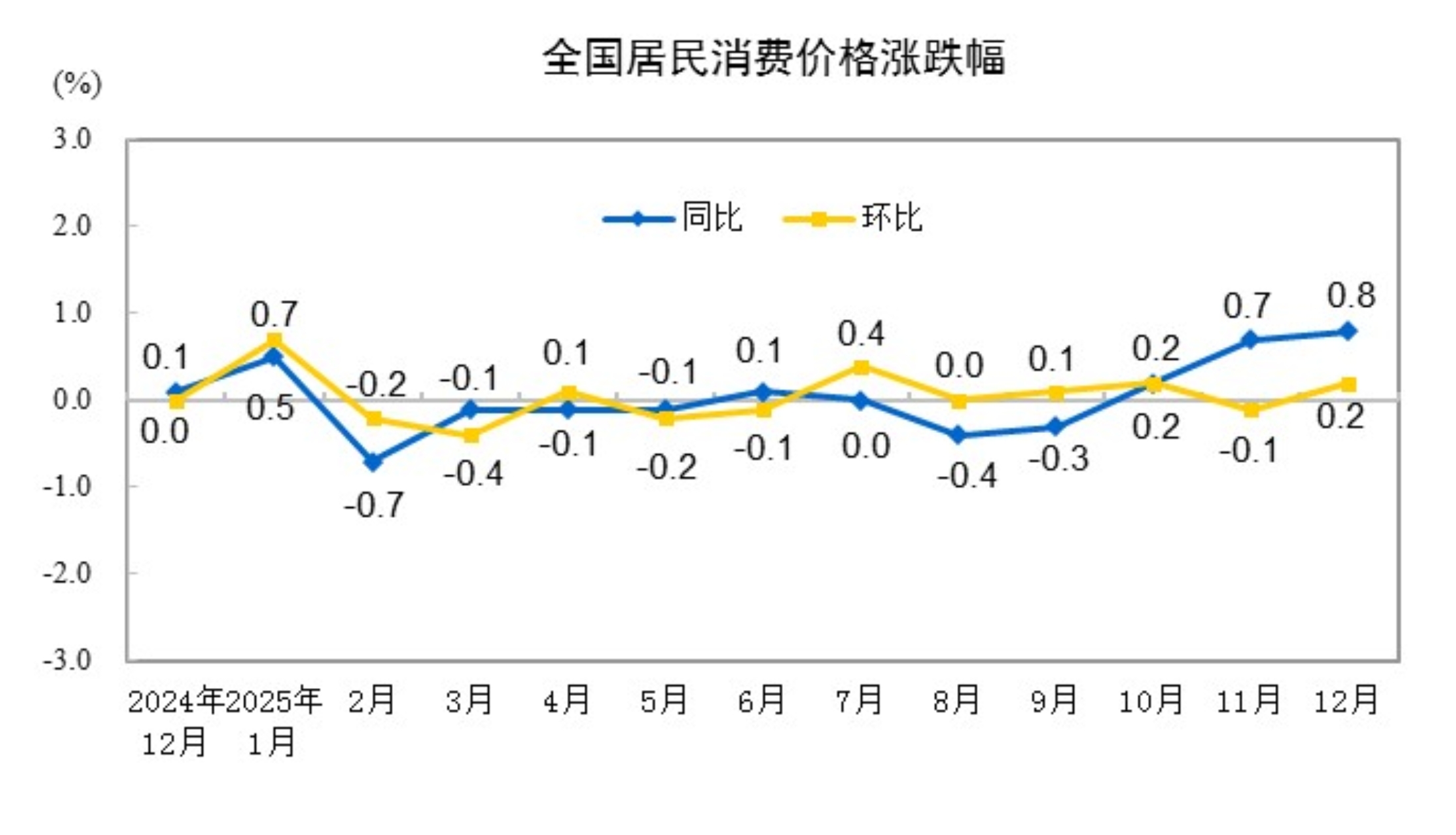
国家统计局:2025年12月份CPI同比涨幅继续扩大 PPI同比降幅收窄
智通财经网· 2026-01-09 01:43
Group 1: CPI Analysis - The Consumer Price Index (CPI) increased by 0.2% month-on-month and 0.8% year-on-year in December 2025, with the core CPI (excluding food and energy) rising by 1.2% year-on-year [1][2][3] - The month-on-month increase in CPI was primarily driven by rising prices of industrial consumer goods, which increased by 0.6%, contributing approximately 0.16 percentage points to the CPI [2] - Food prices rose by 1.1% year-on-year, significantly impacting the CPI, with fresh vegetables and fruits seeing price increases of 18.2% and 4.4%, respectively [3] Group 2: PPI Analysis - The Producer Price Index (PPI) rose by 0.2% month-on-month, marking the third consecutive month of increases, with the year-on-year decline narrowing to 1.9% [1][4][5] - Key industries such as coal mining and lithium-ion battery manufacturing saw price increases, with coal mining prices rising by 1.3% and lithium-ion battery prices by 1.0% [4] - The year-on-year decline in PPI was mitigated by improved market conditions and the implementation of macroeconomic policies, with certain sectors like coal mining and battery manufacturing experiencing reduced price declines [5]