
可控核聚变

Search documents
“可控核聚变”热潮背后
经济观察报· 2026-01-17 06:13
Core Viewpoint - The A-share "nuclear fusion" concept companies may face a long performance gap before commercial power generation is realized, despite recent funding and technological breakthroughs in the sector [4]. Group 1: Market Dynamics - On January 15, 2026, the implementation of the "Atomic Energy Law" encouraging controlled nuclear fusion coincided with a market style shift, leading investors to focus on the "controlled nuclear fusion" sector as a potential new market leader [2]. - Recent funding activities, such as Shanghai Xinghuan Fusion Technology's completion of a 1 billion yuan Series A financing, have set records for domestic private fusion companies, indicating strong investor interest [2][16]. - Several listed companies in the "nuclear fusion concept" category, including China First Heavy Industries and China Nuclear Engineering, experienced significant stock price increases, but many issued announcements clarifying that they currently have minimal related revenue [3][25]. Group 2: Technological Advancements - The nuclear fusion industry is seeing advancements in technology, with breakthroughs in high-temperature superconducting magnets, which are crucial for achieving the necessary magnetic field strength for fusion [11][18]. - The energy density of nuclear fusion is significantly higher than that of nuclear fission, with 1 gram of deuterium-tritium fusion fuel releasing energy equivalent to 11.2 tons of standard coal, making it a promising solution for future energy needs [9]. - The development of compact fusion reactors is being facilitated by high-temperature superconductors, which allow for smaller and more cost-effective designs compared to traditional fusion reactors [11]. Group 3: Challenges and Future Outlook - Despite optimism in the investment community, significant challenges remain, including material durability under extreme conditions, tritium supply issues, and the need for high-throughput neutron sources for testing new materials [20][21]. - The timeline for commercial nuclear fusion is projected to extend to around 2050, with various milestones set for experimental and demonstration reactors in the coming decades [24][28]. - The current market for nuclear fusion equipment is expected to grow significantly, with estimates suggesting an annual scale of 266 billion yuan by 2035, but achieving this will require overcoming substantial technical and operational hurdles [27].



“可控核聚变”热潮背后
Jing Ji Guan Cha Wang· 2026-01-17 05:08
Core Viewpoint - The implementation of the "Encouragement and Support for Controlled Nuclear Fusion" in the Atomic Energy Law of China is expected to drive investment and interest in the nuclear fusion sector, marking a potential shift in market focus from commercial aerospace and AI applications to nuclear fusion technology [2][3]. Investment and Market Dynamics - The A-share market experienced a style switch, with funds moving away from previously favored sectors like commercial aerospace and AI applications towards the "controlled nuclear fusion" sector, driven by recent positive industry news [2]. - Significant investments have been made in the nuclear fusion sector, including a record A-round financing of 1 billion yuan by Shanghai Xinghuan Fusion Technology Co., which indicates strong investor interest [2][14]. - Companies like China First Heavy Industries and China Nuclear Engineering have seen their stock prices surge, reflecting market enthusiasm for nuclear fusion concepts, despite these companies warning of limited current revenue from related projects [3][21]. Technological Advancements - The nuclear fusion industry is witnessing breakthroughs in technology, such as the successful excitation of high-temperature superconducting magnets to 20.8 Tesla, which is crucial for enhancing fusion power density [2][16]. - The development of high-temperature superconductors is making commercial nuclear fusion more feasible by allowing for smaller and more cost-effective fusion devices [9][10]. Energy Demand and Supply - The increasing demand for energy, particularly driven by AI and data centers, is creating a sense of urgency for alternative energy sources like nuclear fusion, which is seen as a potential solution to the looming energy supply challenges [4][5]. - The energy density of nuclear fusion is significantly higher than that of traditional fossil fuels and nuclear fission, making it an attractive option for future energy needs [6][12]. Market Projections - The global nuclear fusion equipment market is projected to reach an annual scale of 266 billion yuan by 2035, indicating substantial future market potential despite current challenges in achieving commercial viability [23]. - The timeline for achieving commercial nuclear fusion is optimistic, with expectations for experimental reactors by 2030 and commercial reactors by 2050 [25]. Challenges and Risks - Despite the optimism, significant challenges remain, including material durability under extreme conditions, tritium supply issues, and the need for advanced testing facilities to validate new materials [17][18][19]. - The current state of nuclear fusion technology is still in the experimental phase, and companies are facing a long path to commercial viability, with many listed companies clarifying that their current revenues from fusion-related activities are minimal [21][22].


政策立法筑基、技术突破提速 万亿聚变能源赛道竞逐正酣
Zhong Guo Zheng Quan Bao· 2026-01-17 01:45
Core Insights - Controlled nuclear fusion is transitioning from conceptualization to engineering and commercialization, marking a significant shift in the industry [1][8] - The Chinese government has established a regulatory framework and policy support for nuclear fusion, indicating a move towards a structured development phase [2][8] - The industry is experiencing a surge in technological breakthroughs and capital investment, particularly in regions like Anhui, Sichuan, and Shanghai, which are forming a "golden triangle" for fusion energy [4][5] Policy and Legislative Framework - The implementation of the Atomic Energy Law on January 15, 2026, signifies a milestone in the regulatory landscape for nuclear fusion [2] - The establishment of the "Fusion Financial Institutions Alliance" aims to foster innovation and ecosystem development in fusion energy [2] Technological Advancements - Significant progress has been made in key fusion devices such as EAST, BEST, and the Chinese Circulating Three and Four, with milestones like EAST achieving 1 billion degrees Celsius for 1066 seconds [3][4] - The focus of research has shifted from basic studies to engineering applications, with expectations that early adopters of successful technologies will dominate the emerging trillion-dollar market [2][3] Regional Development - Anhui is central to fusion energy development, hosting major facilities and nearly 60 related enterprises, with a projected budget of over 2 billion yuan for the BEST device in 2025 [4] - Sichuan is concentrating on manufacturing core components for fusion devices, while Shanghai is leveraging its capital and expertise to tackle critical technologies [5][6] Commercialization Efforts - Private enterprises are diversifying their approaches to fusion energy, seeking to bypass traditional barriers and reduce costs significantly [6][7] - Innovations such as the hydrogen-boron fusion process are being explored, with companies like New Energy Group making strides in this area [7] Investment and Market Outlook - The industry is expected to see increased policy and financial support directed towards mature technologies with high commercial value by 2030 [8] - The next five years are anticipated to be crucial for technological iterations in the fusion energy sector, as companies aim to secure competitive advantages [8]
核聚变能产业大会来了,信息密集
Shang Hai Zheng Quan Bao· 2026-01-17 00:48
Core Insights - The 2026 Nuclear Fusion Energy Technology and Industry Conference marked a significant event in the nuclear fusion energy sector, showcasing the industry's growing interest and potential for investment opportunities [1][2] - The conference highlighted a transition of nuclear fusion energy from a scientific concept to a viable energy source, driven by international collaboration and advancements in AI technology [2][6] Group 1: Conference Highlights - The conference attracted over 1,500 professionals from academia, research institutions, and industry, indicating a strong interest in nuclear fusion energy [1][2] - A series of significant achievements were announced, including the "artificial sun" EAST setting a world record of "one billion degrees for a thousand seconds" and the launch of the BEST project [3][6] - The Hefei Future Fusion Energy Venture Capital Fund was established with an initial scale of 1 billion yuan, aimed at supporting key technologies and core aspects of the fusion industry [3][4] Group 2: Industry Developments - Hefei has become a hub for nuclear fusion energy, hosting leading scientific facilities and research platforms, such as EAST and CRAFT [2][3] - The conference saw the formation of a Fusion Finance Institution Alliance, involving 15 financial institutions to guide social capital towards long-term R&D and early engineering projects [5][6] - The conference emphasized the importance of attracting young talent to the fusion sector, with the establishment of the Xiyuan Fund to support youth research projects [5][6] Group 3: Market Opportunities - The conference highlighted a strong demand for collaboration and orders, with over 120 planned procurement projects for 2026, amounting to nearly 10 billion yuan [7][8] - The nuclear fusion sector is projected to see a significant increase in investment, with an estimated 70 billion yuan in new secondary market investments expected in 2025 [7][8] - The total capital expenditure for announced projects in the fusion sector has approached 200 billion yuan, indicating a growing market potential as commercial fusion progresses [7][8]
政策立法筑基 技术突破提速 万亿聚变能源赛道竞逐正酣
Zhong Guo Zheng Quan Bao· 2026-01-16 21:58
Core Insights - Controlled nuclear fusion is transitioning from conceptualization to engineering and commercialization, marking a significant shift in the industry [1][8] - The establishment of the "Fusion Financial Institutions Alliance" and the implementation of the Atomic Energy Law in 2026 are pivotal for the development of fusion energy in China [2][3] - The industry is entering a critical decade, with a trillion-level energy market on the horizon, driven by technological breakthroughs and policy support [1][8] Policy and Legislative Framework - The implementation of the Atomic Energy Law on January 15, 2026, signifies a move towards a regulated framework for fusion energy development [2] - The "14th Five-Year Plan" emphasizes controlled nuclear fusion as a key future industry, aligning with recent legislative efforts [2] Technological Advancements - Major breakthroughs in fusion technology include EAST achieving 1 billion degrees Celsius for 1066 seconds and the development of the BEST device, which aims for the first global fusion energy demonstration by 2027 [3][4] - The Chinese Circulation No. 3 has reached a dual billion-degree operation, enhancing the prospects for fusion energy commercialization [3] Regional Development and Industry Structure - A "golden triangle" of fusion industry development is forming in Anhui, Sichuan, and Shanghai, each focusing on different aspects of the fusion energy supply chain [4][5] - Anhui is central to fusion research with key facilities like EAST and BEST, while Sichuan focuses on manufacturing core components, and Shanghai targets high-temperature superconducting technologies [4][5] Commercialization Efforts - Private enterprises are increasingly involved in fusion energy, exploring alternative technological routes to avoid the lengthy development cycles of traditional methods [6][7] - Companies like Xianhuan Energy and Nengyuan Qidian are making significant strides in developing cost-effective fusion technologies, with some aiming for commercial viability by 2027 [6][7] Investment and Market Outlook - The fusion energy sector is expected to attract substantial investment, with a shift towards supporting mature technologies with high commercial value by 2030 [7][8] - The next five years are anticipated to be crucial for technological iterations in the industry, as private companies seek to gain a competitive edge [7][8]
以强磁场与AI为翼 助力中国聚变能源加速产业化
Zhong Guo Zheng Quan Bao· 2026-01-16 20:47
Core Insights - The article discusses the advancements in nuclear fusion technology in China, particularly focusing on the Chengdu Nuclear Fusion Industry Corridor and the achievements of the Southwestern Institute of Physics (西物院) in developing the Chinese Circulation No. 3, which has reached significant milestones in fusion research [1][2]. Group 1: Technological Advancements - The Chinese Circulation No. 3 is the largest and highest-parameter magnetic confinement fusion device in China, achieving the first domestic "double hundred million degrees" and "million ampere billion degree high confinement mode operation," with fusion triple product reaching 10^20 [2]. - High-temperature superconducting magnets are identified as a core technology for enhancing magnetic field strength, which is crucial for effective plasma control and commercializing fusion energy [1][2]. - AI technology has been integrated into plasma control, allowing for near "autonomous driving" capabilities in managing plasma stability, significantly increasing energy confinement time [4]. Group 2: Industrial Development - The Southwestern Institute of Physics plays a pivotal role in the fusion industry by driving the localization of key components and achieving international standards in fusion technology, including the development of the first wall prototype for the ITER project [3]. - The institute is also fostering international collaboration, positioning the Chinese Circulation No. 3 as a satellite device for ITER and enhancing China's influence in global fusion research [3]. Group 3: Future Plans and Goals - The Southwestern Institute of Physics aims to achieve commercial fusion energy by 2045, with a roadmap that includes the construction of a demonstration reactor by that year, and plans to start fusion energy burning experiments by 2027 [6][7]. - The focus will remain on high-temperature superconducting technology, with a target of achieving 20 Tesla in large magnet engineering applications, while addressing challenges in the mechanical structure and quench protection technology [5][7]. - Collaboration with various stakeholders, including state-owned enterprises and universities, is essential for developing a closed-loop system for research, validation, and commercialization of fusion technology [5][7].
71位全球顶尖科学家将齐聚迪拜!探讨人工智能等前沿议题
Nan Fang Du Shi Bao· 2026-01-16 14:32
Group 1 - The World Leading Scientists Summit (WLS) and the World Government Summit (WGS) will hold a joint summit in Dubai from February 1 to 3, featuring 71 top scientists, including 39 Nobel laureates [1][2] - The theme of the summit is "Fundamental Science: Addressing the Challenges of Humanity's Future," focusing on four key topics: the integration of artificial intelligence and fundamental science, the co-evolution of scientific progress and social development, global collaboration in open science, and the future of scientific cooperation systems [1] - The summit aims to enhance the UAE's position as a "global scientific hub" through extensive scientific collaboration [1] Group 2 - The World Government Summit, held annually in Dubai since 2013, aims to drive global governance transformation through innovation and technology, with over 6,000 participants last year and an expected attendance of 40 heads of state and over 500 government ministers this year [2] - The joint summit model is expected to create new opportunities for resource linkage and collaboration, enhancing the depth and breadth of engagement between the two events [2]
斩获数亿天使轮融资,可控核聚变赛道迎来“心脏级”新玩家
Xin Lang Cai Jing· 2026-01-16 13:32
Core Insights - Chao Magnetic Energy (Shanghai) Technology Co., Ltd. has completed a multi-hundred million yuan angel round financing led by Dingfeng Kechuang, with participation from several well-known institutions [1][14] - The company focuses on superconducting magnets, which are critical components in magnetic confinement nuclear fusion devices, accounting for 20% to 50% of the costs in Tokamak systems [1][14] - The financing will be used for the development and testing of a 25T high-temperature superconducting magnet system, building a pilot platform, recruiting top talent, and enhancing collaboration with domestic and international fusion devices [1][14] Company Focus - Chao Magnetic Energy was incubated by top Chinese research institutions, establishing a strong academic foundation and forward-looking vision [16] - The founder and CEO, Wang Chao, has extensive experience in superconducting magnet research and industrialization, aiming to lead the company in rapid development within the controlled nuclear fusion sector [2][16] Technological Pathway - The company aims to achieve breakthroughs in magnetic field strength, which is crucial for creating a more stable, efficient, and compact "magnetic cage" for future commercial fusion reactors [1][19] - The performance of magnetic confinement fusion devices is closely related to magnetic field strength, with a significant reduction in device size and cost achievable through advancements in this area [19][20] Market Potential - The global nuclear fusion market is projected to reach $496.55 billion by 2030 and exceed $1 trillion by 2050, driven by advancements in high-temperature superconducting technology [10][23] - China's roadmap for fusion energy development includes milestones such as starting fusion energy burning experiments in 2027 and building the first commercial demonstration reactor by around 2045 [23][24] Regional Development - Shanghai is emerging as a hub for fusion industry investment and technology, with significant capital and industrial advantages [11][24] - The integration of research and industry in regions like Hefei and Chengdu is fostering a complete closed-loop from basic research to engineering transformation, enhancing China's competitiveness in the global fusion race [24]
大涨!四万亿砸中赛道
Ge Long Hui A P P· 2026-01-16 08:51
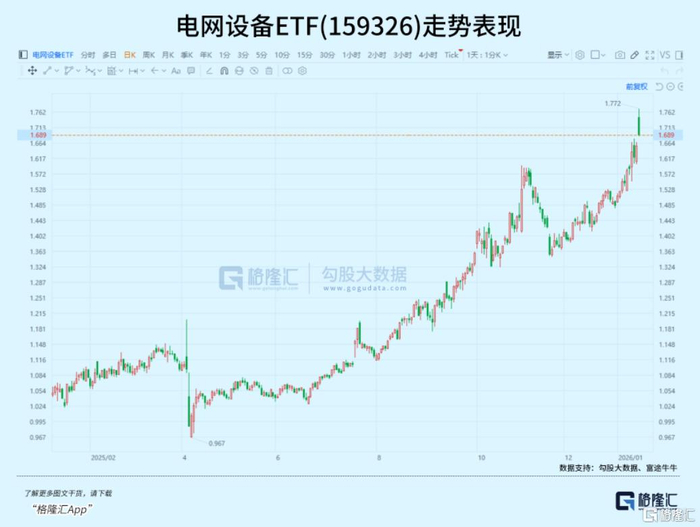
Group 1 - The core message highlights a significant investment plan by the State Grid, with a projected fixed asset investment of 4 trillion yuan during the 14th Five-Year Plan, representing a 40% increase compared to the previous plan [3] - The investment in the power grid is expected to create a clear growth space for the industry over the next five years, focusing on green transformation and the construction of a new power system [7] - The unique ETF for power grid equipment has seen substantial capital inflow, with over 24.39 billion yuan in net inflow in the past five days, indicating strong market interest [8][10] Group 2 - The demand for power grid equipment is expected to surge due to the rapid growth of AI and data centers, which are projected to consume a significant portion of electricity in the coming years [11][12] - The structural shortage of power transformers in North America, exacerbated by aging infrastructure and high demand, presents a lucrative opportunity for Chinese suppliers [15][18] - The global average annual investment in power grids is projected to reach 500 billion USD from 2022 to 2030, with Chinese companies likely to benefit significantly from this trend [18]
中超控股(002471.SZ):公司暂无特种电缆和高温合金精密铸件等产品可用于可控核聚变
Ge Long Hui· 2026-01-16 06:52
Group 1 - The company, Zhongchao Holdings (002471.SZ), stated on the investor interaction platform that it currently does not have special cables and high-temperature alloy precision castings available for controlled nuclear fusion applications [1]
