
大语言模型

Search documents
腾讯任命OpenAI前研究员姚顺雨为首席AI科学家
3 6 Ke· 2025-12-18 03:44
Group 1 - Tencent has made a significant organizational adjustment by establishing new departments: AI Infra, AI Data, and Data Computing Platform [1][2] - Vinces Yao, a former OpenAI researcher, has been appointed as the Chief AI Scientist in the CEO's office and will lead the AI Infra and Large Language Model departments [1][2] - The restructuring aims to unify the internal model team and enhance Tencent's AI capabilities, which have already seen over 30 new models launched in the past year [2] Group 2 - The newly formed AI Data and Data Computing Platform departments will focus on building data and evaluation systems for large models and integrating data intelligence with big data and machine learning [2] - Tencent has emphasized its commitment to hiring AI and technology talent, planning to add 28,000 internship positions over three years, with 60% of these roles targeting technical talent [2]


腾讯AI战略再提速 ,姚顺雨领衔大语言模型研发
2 1 Shi Ji Jing Ji Bao Dao· 2025-12-17 12:27
Core Viewpoint - Tencent has made significant adjustments to its AI model organization structure, focusing on enhancing foundational research and engineering capabilities in the AI era [1][2]. Group 1: Organizational Changes - Tencent has established new departments: AI Infra, AI Data, and Data Computing Platform, to strengthen its AI model research and engineering capabilities [1]. - Yao Shunyu has been appointed as the Chief AI Scientist, overseeing both the AI Infra department and the large language model department, reporting to the company's president [1][2]. - The restructuring emphasizes the integration of data capabilities, with the new AI Data and Data Computing Platform departments prioritizing data cleaning, evaluation systems, and big data platform integration [1]. Group 2: Strategic Focus - The recent adjustments mark a shift from algorithm development to a stronger emphasis on computing power and data, reinforcing Tencent's engineering advantages while enhancing AI model research capabilities [2]. - Tencent aims to improve the efficiency of AI model development and align with its broader AI strategic layout [2]. Group 3: Market Position and Competition - Tencent's mixed Yuan model has been implemented in over 900 internal business scenarios, including Tencent Meeting and WeChat [3]. - Over 90% of Tencent engineers are utilizing the internal code assistant CodeBuddy, with an AI code adoption rate of 50% [3]. - Tencent is actively upgrading its mixed Yuan model and expanding its top-tier R&D talent, while also integrating AI capabilities into major platforms like WeChat and QQ to increase user engagement [3]. - Competitors like Alibaba and ByteDance are also intensifying their investments in AI infrastructure and user engagement strategies, indicating a competitive landscape in the AI sector [3].
腾讯“坐不住”了,官宣大牛负责AI
首席商业评论· 2025-12-17 12:16
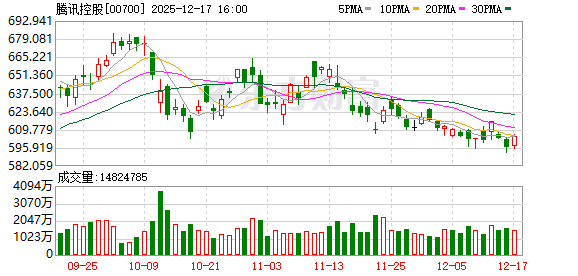
Core Viewpoint - Tencent has appointed Vinces Yao as the Chief AI Scientist, marking a strategic focus on AI research and development within the company [1][4]. Group 1: Organizational Changes - Tencent has recently undergone an organizational adjustment, establishing new departments: AI Infra, AI Data, and Data Computing Platform [3]. - Vinces Yao, a graduate of Tsinghua University and Princeton University, has a strong background in machine learning and large-scale language models, which is a key reason for his appointment [3]. Group 2: Competitive Landscape - Tencent's latest model, Tencent HY 2.0, features a mixed expert architecture and has been integrated into various products and cloud services [4]. - The competition in the AI field is intensifying, with Alibaba's Qwen series and Google's Gemini models posing significant challenges to Tencent [7]. Group 3: Impact of Vinces Yao's Appointment - Yao's experience at OpenAI emphasizes the importance of models' capabilities in real-world environments, which is crucial for differentiating next-generation AI products [8][9]. - His core philosophy focuses on enhancing the intelligence execution capabilities of models, which could benefit all of Tencent's business lines, particularly WeChat [9]. Group 4: Market Reaction - As of December 17, 2025, Tencent's stock price was approximately HKD 605.00, reflecting a cautious optimism from investors regarding the company's core business growth and AI strategy [10]. - The stock has shown resilience despite recent fluctuations, supported by expectations of recovery in Chinese tech stocks and ongoing investments in AI [10]. Group 5: Talent Acquisition Strategy - Tencent is actively recruiting top AI talent from ByteDance, indicating a sense of urgency in enhancing its AI capabilities [11]. - Yao has already contributed to recruiting additional talent from various AI firms, signaling Tencent's commitment to strengthening its foundational technology in AI [11]. Group 6: Future Outlook - Yao's role as a bridge between research and product implementation is expected to lead to substantial improvements in Tencent's AI capabilities, which is reflected in the slight increase in stock price following the announcement [12].

腾讯大模型团队架构调整 前OpenAI研究员姚顺雨任要职
Di Yi Cai Jing· 2025-12-17 09:01
腾讯并未披露Vinces Yao的中文名或过往履历。不过,记者了解到,Vinces Yao即为数月前入职腾讯的 姚顺雨,他毕业于清华和普林斯顿大学,曾任OpenAI研究员,是OpenAI首批智能体产品Operator与 Deep Research的核心贡献者。 据36氪,腾讯近期完成了一次组织调整,正式新成立AI Infra部、AI Data部、数据计算平台部。12月17 日下午发布的内部公告中,腾讯表示,Vinces Yao将出任"CEO/总裁办公室"首席AI科学家,向腾讯总裁 刘炽平汇报;他同时兼任AI Infra部、大语言模型部负责人,向技术工程事业群总裁卢山汇报。 (文章来源:第一财经) ...
L3自动驾驶量产元年,离L4的梦想又近了一步
3 6 Ke· 2025-12-17 08:43
Core Insights - The Ministry of Industry and Information Technology has approved the commercial operation of L3 autonomous driving for the first time in China, allowing vehicles to operate under specific conditions with the system taking over driving tasks [1] - The approval includes two models: Changan Deep Blue SL03 and Arcfox Alpha S6, marking a significant step towards the mass production of L3 autonomous vehicles by 2026 [1] - The responsibility for accidents occurring while the system is activated will primarily fall on the car manufacturers, emphasizing the importance of accountability in this new phase of autonomous driving [1] Industry Developments - Major automotive companies in China, including Huawei, Chery, and GAC Group, are targeting the implementation of L3 conditional autonomous driving by 2025, with several already obtaining testing licenses [4][5] - Companies like XPeng Motors and Chery have announced plans to launch L3 autonomous vehicles, with XPeng aiming for L4 capabilities by 2026 [4] - The L3 level is seen as a crucial transition from "assisted driving" to "fully autonomous driving," with L4 expected to allow vehicles to operate without human intervention in designated areas [1][4] Technological Advancements - The automotive industry is experiencing a shift towards integrating AI and advanced technologies into autonomous driving systems, with companies developing models that enhance perception, planning, and control [9][12] - The introduction of VLA (Visual Language Action) models is expected to significantly improve the capabilities of autonomous driving systems, providing better scene understanding and decision-making [9][15] - The competition among automakers is intensifying, with a focus on developing proprietary technologies that enhance vehicle performance and safety, particularly in complex driving scenarios [17][18] Future Outlook - The approval of L3 autonomous driving is viewed as a pivotal moment in the evolution of transportation, setting the stage for ongoing exploration and innovation in the field [19] - The industry is expected to continue evolving, with a focus on balancing self-research and collaboration to maintain technological leadership while managing costs [18][19] - As the market for autonomous vehicles grows, the emphasis will shift from merely achieving autonomous capabilities to ensuring the safety and reliability of these systems in real-world conditions [17][19]

罗福莉首秀前,小米突然发布,代码全球最强,总体媲美DeepSeek-V3.2【附实测】
3 6 Ke· 2025-12-17 02:51
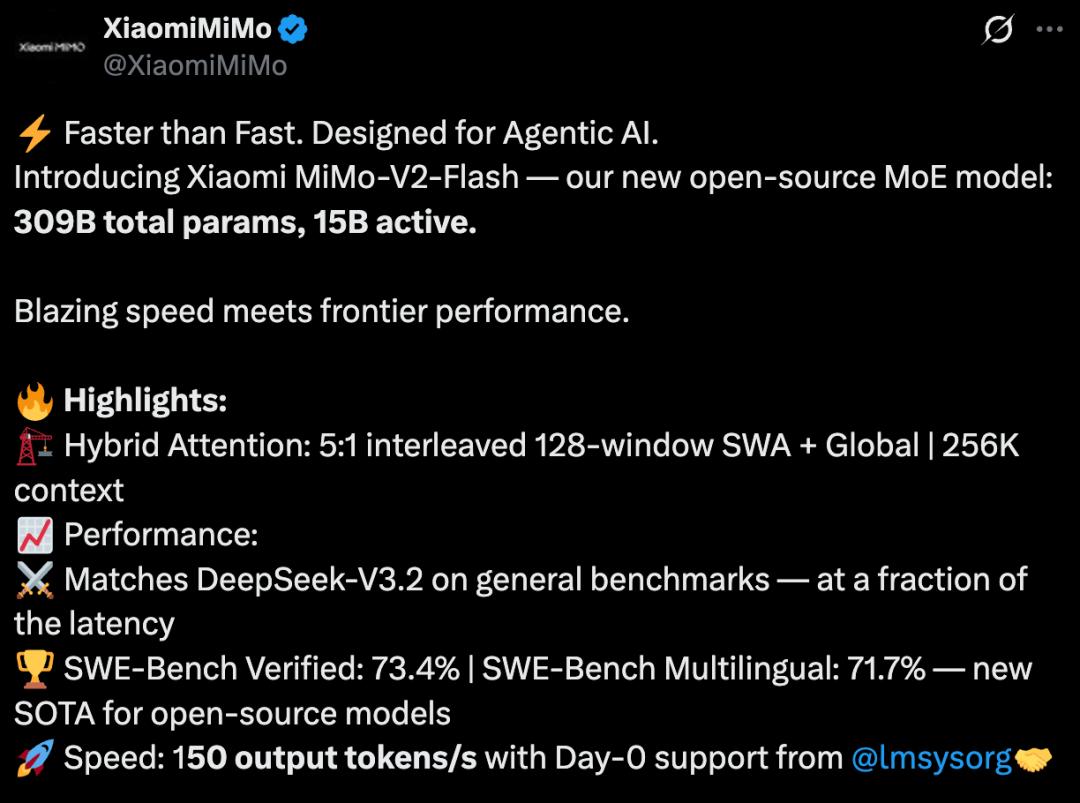
智东西12月17日报道,今天,小米发布并开源了最新MoE大模型MiMo-V2-Flash,总参数309B,激活参数15B。今日上午,小米2025小米人车家全生态合 作伙伴大会上,Xiaomi MiMO大模型负责人罗福莉将首秀并发布主题演讲。 该模型专为推理、编码和Agent场景构建,支持混合思维模式,允许用户切换模型是"思考"还是即时回答。它能一键生成功能齐全的HTML网页,并与 Claude Code、Cursor和Cline等氛围编码框架协同。该模型提供256k上下文窗口,能够完成数百轮Agent交互和工具调用的任务。 基准测试结果显示,MiMo-V2-Flash的性能基本与DeepSeek-V3.2相当,仅在不使用任何工具辅助的"人类最后一场考试"和创意文本生成评估ARENA- HARD中略逊色于DeepSeek-V3.2,但时延更小。 在多个Agent测评基准上,MiMo-V2-Flash位列全球开源模型Top 2;代码能力测评超过所有开源模型,比肩标杆闭源模型Claude 4.5 Sonnet,但推理价格 仅为其2.5%且生成速度提升至2倍。 MiMo-V2-Flash能以每秒150个token的速 ...


英伟达成开源新王?Nemotron 3全新混合专家架构,推理效率升4倍
机器之心· 2025-12-16 08:55
机器之心编辑部 英伟达的自研大模型,刚刚有了大版本的更新。 北京时间今天凌晨,英伟达发布了 Nemotron 3 系列开放模型,共三种规模,分别为 Nano、Super 和 Ultra : 英伟达认为,随着企业从单一模型聊天机器人转向协同工作的多智能体 AI 系统,开发者正面临通信开销高、上下文漂移以及推理成本居高不下等挑战。同时,能 够支撑复杂工作流自动化的模型,必须具备足够的透明性与可解释性,才能赢得开发者与企业的信任。 其中 Nemotron 3 Nano 已在 Hugging Face 上线,是目前计算成本效率最高的模型,针对软件调试、内容摘要、AI 助手工作流和信息检索等任务进行了优化,可显 著降低推理成本。该模型采用独特的混合 MoE 架构,在效率与可扩展性方面实现了显著提升。 Nemotron 3 Nano 的总参数规模为 316 亿,激活参数规模为 32 亿(包含嵌入层为 36 亿)。在每次前向推理过程中,其激活的参数数量不到上代 Nemotron 2 Nano 的一半,却实现了更高的准确率。 与 Nemotron 2 Nano 相比,Nemotron 3 Nano 实现了最高 4 倍的 To ...

计算机行业周报:MistraiAI发布Devstral2系列,GPT-5.2定义专家级智能-20251216
Huaxin Securities· 2025-12-16 07:36
Investment Rating - The report maintains a "Buy" rating for the companies mentioned, indicating a positive outlook for their performance in the market [10]. Core Insights - The release of MistralAI's Devstral2 series marks a significant advancement in AI programming tools, enhancing the capabilities of open-source programming agents and providing a dual solution for enterprise and localized needs [3][23]. - OpenAI's launch of the GPT-5.2 model series represents a major milestone in general artificial intelligence, showcasing superior performance in various benchmark tests, particularly in complex knowledge-based tasks [4][35]. - The AI infrastructure sector is experiencing robust growth, as evidenced by Broadcom's substantial orders for Google's TPU products, which are expected to address the industry's efficiency challenges [7][61]. Summary by Sections 1. Computing Power Dynamics - The computing power rental prices remain stable, with specific configurations priced at 28.64 CNY/hour for Tencent Cloud and 31.58 CNY/hour for Alibaba Cloud [21]. - MistralAI's Devstral2 series, featuring a flagship model with 123 billion parameters, is designed for code generation and complex codebase exploration, significantly pushing the boundaries of AI programming capabilities [3][23]. 2. AI Application Dynamics - Perplexity's weekly usage increased by 10.58%, indicating growing engagement with AI applications [32]. - The GPT-5.2 series, launched by OpenAI, includes various models tailored for different tasks, achieving remarkable results in benchmark tests and demonstrating enhanced capabilities in handling complex tasks [4][35]. 3. AI Financing Trends - Fal.ai completed a $140 million Series D funding round, raising its valuation to $4.5 billion, solidifying its position in the AI content generation infrastructure [48][49]. 4. Investment Recommendations - Broadcom's CEO disclosed that Anthropic has placed orders totaling $21 billion for Google's TPU products, reflecting strong demand in the AI chip market [7][61]. - The report suggests focusing on companies like Weike Technology and Nengke Technology, which are positioned to benefit from the expanding AI infrastructure and applications [8][62].


2026年汽车智能化投资策略
2025-12-16 03:26
Summary of Conference Call Records Industry Overview - The conference call discusses the **smart automotive industry**, focusing on the evolution of autonomous driving technologies and investment strategies from 2026 to 2030 [1][2][4][7]. Key Points and Arguments Industry Development Stages - The smart automotive industry has undergone several key phases: - **2014-2017**: Initial phase focusing on L1 to early L2 technologies, primarily using low-cost monocular cameras for features like AEB, ACC, and LCC. Companies like Mobike were prominent during this period [2]. - **2018-2019**: A downturn where many companies exited the market due to supply chain and demand changes [2]. - **2020-2023**: Peak phase focusing on L2++ technologies, driven by the electric vehicle (EV) boom, with Tesla leading the innovation [2]. - **2023-2025**: Shift towards software and algorithm innovations, moving away from hardware-centric approaches [2][7]. Future Predictions (2026-2030) - The industry is expected to experience three distinct phases: - **2025-2026**: A "dark period" before dawn, where the electric vehicle boom fades, but significant investments are needed [1][11]. - **2026-2028**: Optimal investment period where L4 technology will validate B2B business models, leading to the emergence of new autonomous vehicle companies [1][11]. - **2028-2030**: A resurgence in the C-end market as early EV adopters seek replacements, driving demand and technological innovation [1][11]. Investment Strategy - Future investment strategies should pivot from electric vehicle frameworks to focus on AI applications, emphasizing software over hardware as the market matures [1][8][10]. Key Technologies and Trends - The importance of software algorithms is surpassing that of hardware, with advancements in large language models significantly impacting the automotive sector [1][12]. - The cost of both hardware and software is expected to decline rapidly, aligning with Moore's Law, which will further drive industry growth [5]. Market Dynamics - The **Robotaxi** segment is highlighted as having the highest potential, with expected penetration rates of 10% by 2028 and 50% by 2035 [3][24]. - The autonomous vehicle market is projected to see significant growth in commercial applications, with estimates of 500,000 autonomous commercial vehicles by 2028, increasing to 1.5 million by 2030 [23][26]. Policy and Technology Interaction - While policy has historically driven the electric vehicle market, the focus is shifting to technological advancements as the primary growth driver for autonomous vehicles [10][12][16]. Other Important Insights - The acceptance of autonomous vehicles by consumers is crucial for market growth, with companies like Xiaoma Zhixing and Waymo focusing on L4 development while others like Tesla and XPeng validate algorithms through consumer experiences [20]. - The upcoming year (2026) is expected to be pivotal for L4 technology, with significant market impacts anticipated as consumers begin to understand and accept the concept of not driving themselves [4][6]. - The differences between the US and Chinese markets in terms of labor costs and consumer acceptance are noted, with China potentially adapting to and promoting autonomous technology more rapidly [25]. This summary encapsulates the key insights and projections regarding the smart automotive industry and its trajectory over the next several years, emphasizing the shift towards software and AI applications in autonomous driving technologies.
格林大华期货早盘提示-20251216
Ge Lin Qi Huo· 2025-12-16 00:01
更多精彩内容请关注格林大华期货官方微信 | 预计对 10 年期美债收益率产生 20-30 个基点下行压力。 | | --- | | 6、AI 专家杨立昆表示,大语言模型近五年能力飞速提升,看起来正逼近人类;但 | | 反对者认为这是历史反复出现的"智能幻觉"—擅长语言和局部任务不等于真正智 | | 能,LLM 只是工具,真正的通用智能未来一定会来,但不会沿着当前大模型这条路。 | | 7、尽管面临美国政府的政策压力,可再生能源板块今年却意外跑赢大盘和石油股, | | 成为市场大赢家。标普全球清洁能源转型指数年内飙升 44%,全球对可再生能源的 | | 投资创下历史新高。核心驱动力源于人工智能革命引发的爆炸性能源需求。 | | 8、为寻求新的回报并获取关键的"信息优势",对冲基金正大举进军实物大宗商 | | 品市场。包括 Citadel、Balyasny 和 Jain Global 在内的金融巨头,通过收购资产 | | 和扩建团队,直接涉足天然气、电力和原油的实物交易。 | | 9、国金证券研报,SpaceX 的护城河并非单一技术,而是成本、制造和客户三大壁 | | 垒的深度融合。其通过猎鹰 9 号的可复用经济 ...