
消费金融

Search documents
积极发展消费金融,提振居民消费意愿和能力
2 1 Shi Ji Jing Ji Bao Dao· 2025-05-15 16:50
Core Viewpoint - The financial data for April released by the People's Bank of China indicates a stable and supportive monetary environment for economic recovery, with an acceleration in social financing and steady credit issuance [1] Monetary Supply - As of the end of April, the broad money supply (M2) grew by 8% year-on-year, an increase of 1 percentage point from the previous month; the narrow money supply (M1) grew by 1.5%, a slight decrease of 0.1 percentage points from the previous month [1] - The central bank has increased short-term and medium-term liquidity through various operations, indicating a solid financial support for economic recovery [1] Social Financing - By the end of April, the total social financing stock was 424 trillion yuan, with a year-on-year growth of 8.7%, an increase of 0.3 percentage points from the previous month; the cumulative increase in social financing for the first four months was 16.34 trillion yuan, 3.61 trillion yuan more than the same period last year [2] - The acceleration in social financing growth is attributed to a lower base from the previous year and a significant increase in government bond issuance [2] Loan Growth - The balance of RMB loans reached 265.7 trillion yuan, with a year-on-year growth of 7.2%, a slight decrease of 0.2 percentage points from the previous month; in April, RMB loans increased by 280 billion yuan, which is 450 billion yuan less than the same month last year [3] - The decrease in loan growth is influenced by seasonal factors and changes in the financing market, with April traditionally being a "small month" for credit [3] Loan Structure - In the loan structure, corporate loans contributed the majority of the increase, while household loans showed a decline; corporate loans increased by 610 billion yuan, which is 250 billion yuan less than the previous year, while household loans decreased by 521.6 billion yuan [4] - The decline in household loans, particularly in short-term loans, indicates a need for further stimulation of consumer demand [4] Future Measures - The implementation of a series of financial policies is expected to support consumption recovery and growth; measures include the establishment of re-loans for service consumption and elderly care, aimed at reducing financing costs for financial institutions [5] - Fiscal and tax policies are also emphasized to support the development of new consumption sectors, creating new demand and enhancing consumer spending [6]
信贷结构更加适配经济发展 5年来企业贷款占比升约5个百分点
Xin Hua Cai Jing· 2025-05-14 14:48
Core Viewpoint - The credit structure in China has been improving in recent years, effectively supporting the transformation of the economic structure, with corporate loans increasing and household loans decreasing by approximately 5 percentage points each [1][2]. Group 1: Credit Structure Changes - The loan balance in China has exceeded 265 trillion yuan, and even a 1% improvement in the credit structure has a significant impact [1]. - Since 2021, the proportion of corporate loans has risen from 63% to about 68%, while household loans have decreased from 37% to about 32%, indicating a shift in credit funds towards real enterprises [1]. - The share of small and micro enterprises in total corporate loans has increased from 31% to about 38%, while the share of large and medium-sized enterprises has decreased from 69% to 62% since 2021 [1]. Group 2: Industry Focus and Financial Support - Financial institutions have been directing more credit resources towards the manufacturing and technology innovation sectors, with a focus on supporting key service consumption industries such as accommodation, dining, entertainment, and education [2]. - From 2021 onwards, the proportion of manufacturing in all medium to long-term loans has increased from 5.1% to about 9.3%, while the share of consumer industries has risen from 9.6% to about 11.2%. In contrast, traditional real estate and construction industries have seen their share decrease from 15.9% to about 13% [2]. Group 3: Future Outlook on Consumer Finance - Experts believe that future development in consumer finance should focus on expanding effective consumer demand and ensuring that consumer loans are genuinely used to support consumption, while maintaining reasonable and sustainable practices [3].
4月信贷“成绩单”出炉:贷款规模合理增长 利率保持历史低位
Sou Hu Cai Jing· 2025-05-14 11:42
5月14日,央行发布4月金融统计数据显示,4月末,人民币各项贷款余额265.70万亿元,同比增长 7.2%;1-4月,人民币各项贷款增加10.06万亿元,与上年同期大致持平。 4月份,虽然新增贷款规模有所放缓,但从结构上看,普惠小微贷款、制造业中长期贷款等增速均高于 同期各项贷款增速。同时,贷款利率保持在历史低位水平。 有业内人士指出,今年一季度GDP同比增长5.4%,在去年同期高基数上继续保持较快增速,消费、投 资等主要宏观经济指标均明显好转,既反映了去年9月以来一揽子增量政策效果持续显现,也体现出中 央经济工作会议和全国"两会"后,各项宏观政策及时响应、协同发力,社会信心持续提振。 融资成本"往下走"金融总量有望继续保持合理增长 4月份,我国金融总量"有上行",从前4个月金融总量数据看,社会融资规模、广义货币M2、人民币贷 款增速持续高于名义GDP增速,金融对实体经济支持的力度仍然较大。市场人士表示,金融总量数据持 续较好,体现出央行逆周期调节和金融稳经济的效果。 同时,我国融资成本"往下走"。央行数据显示,4月份企业新发放贷款加权平均利率约为3.2%,比上月 低约4个基点,比上年同期低约50个基点;个人 ...
权威专家:一些银行消费贷利率已低于本行保本点,这种模式很难持续
news flash· 2025-05-14 09:22
"未来宏观政策思路更加注重促消费,金融政策的重点是支持高品质消费品供给,需求端的消费贷款成 本已不是影响因素。"市场权威专家表示。今年以来,金融对需求端的居民消费支持力度非常大,银行 消费金融类产品不断丰富创新,居民消费融资便利度明显上升。但对应的结果是居民部门杠杆率也比较 高。权威专家指出,一些银行的消费贷款还出现过度竞争,甚至是发放的消费贷款利率已经低于本行保 本点,这种模式很难持续,也容易放大部分高杠杆群体的负债风险。从实际情况看,信用卡极大地满足 了公众的消费融资需求,而且还有相对较长的免息期,实质上等价于便宜甚至是"零成本"的融资支持, 为日常消费需求提供了稳定充分的金融保障。发展消费金融根本上是要扩大有效消费需求,拓展消费场 景,确保消费贷款真正用于支持消费,应当坚持合理适度的原则,银行也需要通过下沉服务、挖掘客 户、做大蛋糕,保持理性定价,促进消费金融可持续发展。(第一财经) ...
消费金融春潮涌 岛城焕新正当时
Qi Lu Wan Bao· 2025-05-12 23:56
Core Viewpoint - The article emphasizes the role of consumption as a key driver of economic growth in Qingdao, highlighting the city's efforts to become an international consumption center through innovative financial services and products [1]. Group 1: Financial Innovation and Consumer Empowerment - Qingdao Industrial and Commercial Bank (ICBC) is actively implementing the national strategy to boost consumption by developing a comprehensive consumer credit matrix that includes products like "Rong e Borrow" and "Follow House e Borrow" [3]. - The bank's financial products are tailored to meet various consumer needs, such as home renovation, education investment, and elder care, showcasing a commitment to inclusive finance [2][3]. Group 2: Service Ecosystem Development - ICBC is creating a "purchase+" service ecosystem that integrates various financial services, enhancing the consumer experience from home buying to home improvement [4]. - The bank is also focusing on rural revitalization and international payment services to cater to diverse consumer segments, including foreign residents [4]. Group 3: Consumer Activity and Engagement - The bank has launched several promotional activities, such as "Love Purchase" events and collaborations with local businesses, to stimulate consumer spending and enhance engagement [5]. - In the first quarter of the year, ICBC's credit card consumption reached nearly 4 billion yuan, indicating a significant boost in consumer activity [5]. Group 4: Global Service Expansion - ICBC is expanding its cross-border consumption services with initiatives like "Love Purchase Global," offering cashback and exclusive discounts to enhance the shopping experience for residents [7]. - The bank aims to integrate digital innovation into its services, enhancing the overall consumer experience and supporting the city's goal of becoming a global consumption hub [7].
中金:灵活把握政策力度和节奏——2025年1季度货币政策执行报告点评
中金点睛· 2025-05-12 23:51
Core Viewpoint - The People's Bank of China (PBOC) emphasizes the need for high-quality development and effective policies to address external uncertainties, while also focusing on boosting domestic demand and consumption to support economic growth [1][2]. Monetary Policy - The PBOC plans to implement a series of financial policies, including interest rate cuts and reserve requirement ratio reductions, while maintaining liquidity and flexibility in policy implementation [1][5]. - The report highlights the importance of balancing support for the real economy with the health of the banking system, especially in light of rising non-performing loan ratios [5]. Inflation and Demand - The PBOC identifies low inflation as primarily a result of weak demand against strong supply, stressing that boosting effective demand is crucial for price recovery [2][3]. - The report outlines constraints on effective demand recovery, including global trade tensions and the slow transition to new economic drivers [2]. Consumption and Financial Support - Enhancing consumption is deemed essential for expanding domestic demand, with the PBOC advocating for improved financial services to support consumer spending [3]. - The PBOC suggests that a moderately loose monetary policy can create a favorable environment for consumption finance, alongside structural support for key consumption sectors [3]. Government Debt Sustainability - The PBOC asserts that China's government debt expansion remains sustainable due to a favorable asset-liability structure, with total government assets at 166% of GDP and total liabilities at 75% of GDP [4]. - The comparison with the U.S. and Japan highlights China's relatively lower net debt levels and substantial state-owned assets, indicating a robust financial position [4]. Exchange Rate Policy - The PBOC maintains that the RMB exchange rate will continue to fluctuate based on market supply and demand, with a focus on stabilizing the currency at a reasonable level [6]. - The report emphasizes the need for financial institutions to provide exchange rate hedging services to small and medium-sized enterprises [6].


优化产品供给 创新服务模式 金融“加码”激发消费新活力
Shang Hai Zheng Quan Bao· 2025-05-12 18:53
近期,多家金融机构在风险可控、覆盖成本、用途规范的前提下,围绕重点场景、重大战略和重点人群 优化信贷产品和服务,加强金融供给,做好消费信贷支持。 优化产品供给 创新服务模式 金融"加码"激发消费新活力 ◎记者 黄坤 提振消费是当前扩内需、稳增长的关键点。近期,多家金融机构在风险可控的前提下,围绕重点场景、 重大战略和重点人群优化信贷产品和服务,通过延长贷款期限、提升授信额度、提供续贷支持、推出信 用卡支付和分期服务等方式加强金融供给,下足真功夫,"加码"激发消费活力。 业内人士认为,随着消费市场的不断变化和发展,金融机构需不断创新金融产品和服务模式,以更好地 满足消费者日益多样化的金融需求,让更多人能消费、敢消费、愿消费。银行在助力消费的同时,也需 要注重平衡好业务发展与风险防范之间的关系,增强金融服务的可持续性。 加强金融供给 优化产品服务 在贷款期限方面,针对有长期消费需求的客户,银行延长部分消费类贷款产品的贷款期限。"我们优化 个人贷款期限,推出消费贷等额本息、等本等息等多种还款方式,满足客户的多样化需求。"江苏银行 一位相关负责人告诉上海证券报记者。 平衡好业务发展和风险防范 业内人士认为,金融机构助 ...
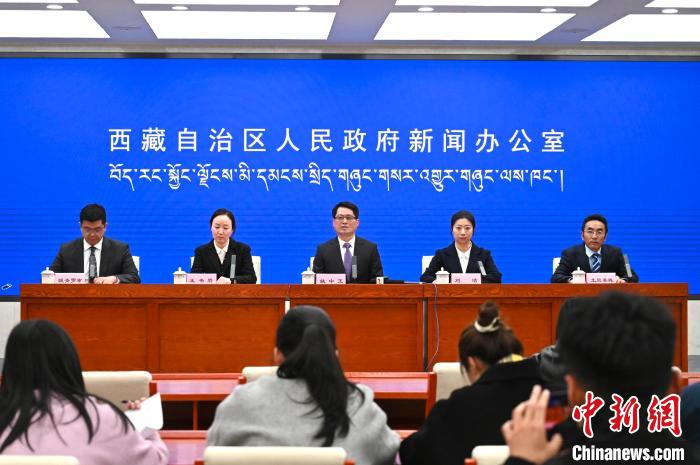
西藏2025年一季度金融运行情况平稳
Zhong Guo Xin Wen Wang· 2025-05-08 02:34
Core Insights - The financial performance in Tibet for Q1 2025 shows steady growth in total financial volume, with significant increases in social financing scale, loans, and deposits [3][4]. Financial Performance - As of the end of March, the social financing scale in Tibet reached 925.95 billion yuan, reflecting a year-on-year growth of 10.73%, which is 2.33 percentage points higher than the national average [3]. - The total balance of loans in both domestic and foreign currencies was 624.97 billion yuan, with an increase of 23.74 billion yuan since the beginning of the year, marking a growth of 3.95% [3]. - The total balance of deposits in both domestic and foreign currencies was 653.54 billion yuan, with an increase of 6.59 billion yuan since the beginning of the year, representing a growth of 1.02% and a year-on-year increase of 2.05% [3]. Sectoral Support and Innovations - Financial support for key sectors and weak links has significantly improved, with loans for scientific research and technical services reaching 4.84 billion yuan, a growth of 7.45% since the beginning of the year [4]. - The green finance sector has expanded, with 37,901 personal carbon accounts established, leading to a total carbon reduction of 2,684.1 tons and 600,800 green energy transactions [4]. - The balance of green loans reached 183.79 billion yuan, showing a year-on-year growth of 38.29% [4]. - Inclusive finance has seen substantial growth, with a 130% year-on-year increase in the balance of inclusive loans, reaching 80.86 billion yuan [4]. - New financial products for elderly care and consumer finance have been introduced, with personal consumer loans reaching 100.39 billion yuan, a year-on-year increase of 23.32% [4]. Monetary Policy and Interest Rates - The company aims to enhance the transmission channels of monetary policy and reduce the overall financing costs, with a focus on implementing interest rate adjustments for commercial loans and housing loans [4].
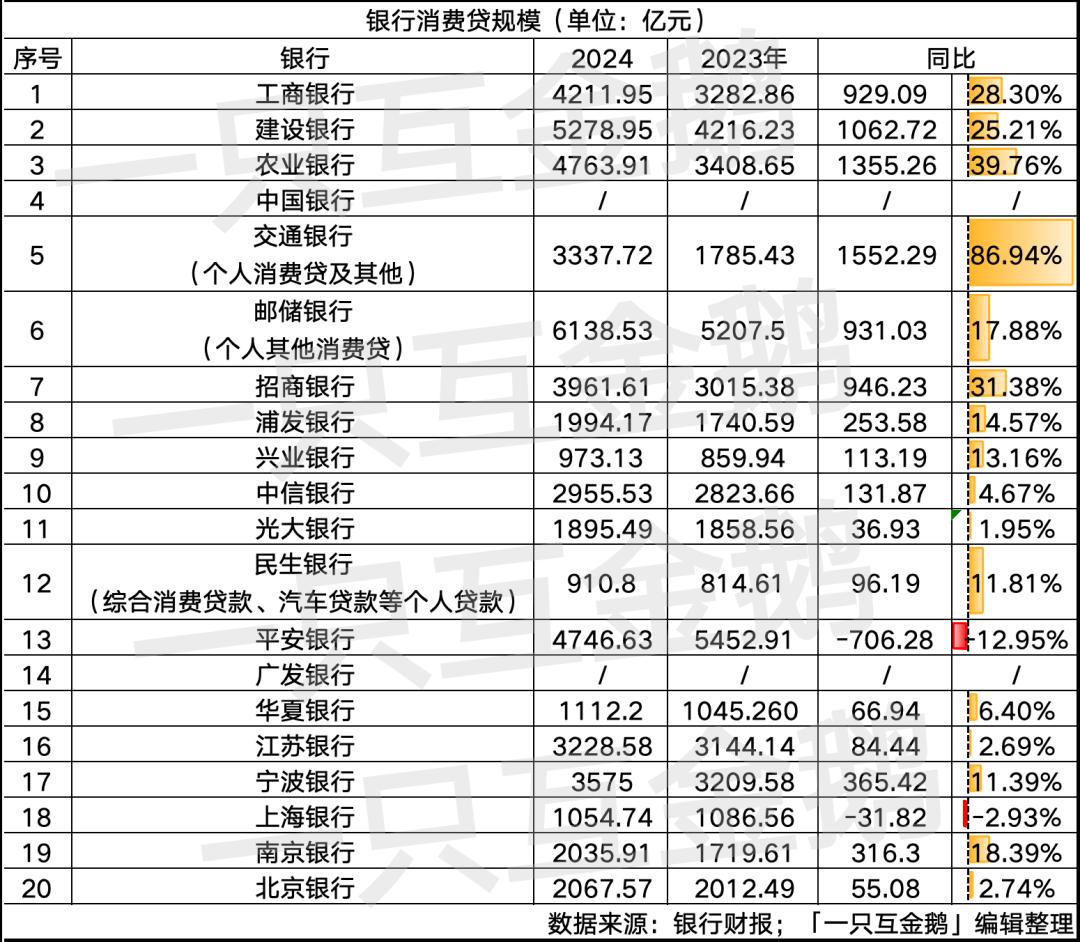
银行「消费贷」不良到底有多少亿?
3 6 Ke· 2025-05-08 02:01
Core Viewpoint - The consumer finance market is primarily driven by licensed consumer finance companies and internet finance platforms, with banks being the largest players. Most banks reported significant growth in consumer loan balances for 2024, indicating a robust demand for consumer credit [1][4]. Summary by Sections Consumer Loan Growth - In 2024, major banks reported substantial increases in consumer loan balances, with notable growth from Agricultural Bank (39.76%), Industrial and Commercial Bank (28.30%), and Postal Savings Bank (17.88%). Overall, 16 banks collectively added over 750 billion yuan in consumer loans [2][4][5]. Non-Performing Loans (NPLs) - Among the 20 banks analyzed, 7 did not disclose specific NPL data for consumer loans. The remaining 13 banks reported a total of 662 million yuan in consumer loan NPLs, with Industrial and Commercial Bank having the highest NPL amount at 100.57 million yuan and a rate of 2.39% [7][8]. Consumer Loan Strategies - Major banks are focusing on high-quality customer segments for their consumer loan products. For instance, Industrial and Commercial Bank targets public sector employees and high-income individuals. Other banks are innovating their product offerings, such as integrating green finance initiatives and enhancing digital services [9][12][20]. Market Trends and Future Outlook - The regulatory environment is supportive of consumer finance growth, with the China Banking and Insurance Regulatory Commission encouraging banks to increase personal consumer loan issuance. This suggests that consumer loan growth is likely to continue in the near future [22][23].






广东:鼓励金融机构在风险可控前提下,加大个人消费贷款投放力度
news flash· 2025-05-07 08:04
Core Viewpoint - The Guangdong Provincial Government has issued an implementation plan to boost consumption, emphasizing the enhancement of credit support for personal consumption loans and small micro-enterprises in the hospitality and catering sectors [1] Group 1: Credit Support for Personal Consumption - Financial institutions are encouraged to increase personal consumption loan issuance under controllable risk conditions, particularly for clients with good credit and significant or long-term consumption needs [1] - There is a proposal to raise loan limits, extend loan terms, and set reasonable interest rates for eligible customers [1] - Financial institutions are urged to optimize repayment methods for personal consumption loans and to conduct orderly renewal of loans [1] Group 2: Credit Card and Loan Management - Commercial banks are encouraged to calculate interest on credit cards based on actual overdraft balances and to improve grace periods and tolerance services for cardholders [1] - Timely reminders for repayment will be provided to cardholders with smaller limits and shorter overdue periods, without immediately impacting their credit records [1] Group 3: Innovation in Financial Products - Financial institutions are encouraged to innovate consumer finance products that cater to new consumption models such as e-commerce, as well as services in health, education, and digital sectors [1] - There is a focus on increasing credit support for small micro-enterprises in the hospitality and catering sectors, again under controllable risk conditions [1]