
隐含波动率

Search documents
金属期权策略早报-20250911
Wu Kuang Qi Huo· 2025-09-11 03:40
Report Summary 1. Investment Rating The document does not provide an overall industry investment rating. 2. Core Viewpoints - The metal sector is divided into non - ferrous metals, precious metals, and black metals. Different trading strategies are recommended for each sector and specific metal varieties based on their fundamentals, market trends, and option factors [8]. - For non - ferrous metals, which are in a weak and volatile state, a seller's neutral volatility strategy is recommended; for black metals with large - amplitude fluctuations, a short - volatility combination strategy is suitable; for precious metals with upward - breaking trends, a spot hedging strategy is suggested [2]. 3. Summary by Category 3.1 Non - Ferrous Metals - **Copper**: The inventory in Shanghai is stable, LME inventory is stable, and COMEX inventory is rising. The market shows a high - level consolidation with support. Option implied volatility is at the historical average, and the PCR indicates some pressure above. Recommended strategies include a short - volatility seller's option combination, and a spot long - hedging strategy [7]. - **Aluminum/Alumina**: Aluminum inventory shows a mixed trend. The market is in a long - biased high - level shock. Option implied volatility is below the historical average, and the PCR indicates strong support below. Recommended strategies include a bull - spread call option combination, a short - neutral call + put option combination, and a spot collar strategy [9]. - **Zinc/Lead**: Zinc fundamentals show certain supply and demand indicators. The market is in a shock - decline with pressure above. Option implied volatility is below the historical average, and the PCR indicates increasing pressure above. Recommended strategies include a short - neutral call + put option combination and a spot collar strategy [9]. - **Nickel**: The spot price is slightly up, and the market is in a wide - range shock with pressure above. Option implied volatility is at a high historical level, and the PCR indicates strengthening short - side power. Recommended strategies include a short - bearish call + put option combination and a spot covered - call strategy [10]. - **Tin**: The inventory shows a certain trend, and the market is in a short - term high - level shock with pressure above. Option implied volatility is at a low historical level, and the PCR indicates range - bound movement. Recommended strategies include a short - volatility strategy and a spot collar strategy [10]. - **Lithium Carbonate**: Production and inventory show specific changes, and the market is in a large - amplitude decline with pressure above. Option implied volatility has risen rapidly to a high level, and the PCR is below 0.6. Recommended strategies include a short - bearish call + put option combination and a spot long - hedging strategy [11]. 3.2 Precious Metals - **Gold/Silver**: Gold's foreign exchange reserve data shows an upward trend, and the market is in a short - term consolidation with a strong upward - breaking trend. Option implied volatility is around the historical average, and the PCR indicates strong support below. Recommended strategies include a bull - spread call option combination, a short - bullish volatility option seller's combination, and a spot hedging strategy [12]. 3.3 Black Metals - **Rebar**: The steel - making capacity utilization rate shows a decline. The market is in a weak consolidation with pressure above. Option implied volatility is at a high historical average, and the PCR indicates strong short - side pressure above. Recommended strategies include a short - bearish call + put option combination and a spot covered - call strategy [13]. - **Iron Ore**: The inventory and consumption data show specific changes, and the market is in an interval shock with some rebound. Option implied volatility is above the historical average, and the PCR is around 1.0. Recommended strategies include a short - neutral call + put option combination and a spot long - collar strategy [13]. - **Ferroalloys (Manganese Silicon/Silicon Iron)**: Manganese silicon's production data shows a decline, and the market is in a weak and bearish state. Option implied volatility has risen rapidly to a high level, and the PCR is below 0.6. Recommended strategies include a short - volatility strategy [14]. - **Industrial Silicon/Polysilicon**: Industrial silicon's supply and demand show specific trends, and the market is in a large - amplitude shock with some recovery. Option implied volatility has risen to a high historical average, and the PCR is below 0.6. Recommended strategies include a short - volatility call + put option combination and a spot hedging strategy [14]. - **Glass**: The supply and demand of glass show specific trends, and the market is in a weak state with pressure above. Option implied volatility is at a high historical level, and the PCR is above 1.0. Recommended strategies include a short - volatility call + put option combination and a spot long - collar strategy [15].
金属期权策略早报-20250908
Wu Kuang Qi Huo· 2025-09-08 02:37
Report Summary 1. Report Industry Investment Rating No relevant information provided. 2. Core Viewpoints - For non - ferrous metals, a neutral volatility seller strategy can be constructed as they show a weak and volatile trend; for the black series, a short - volatility portfolio strategy is suitable due to large - amplitude fluctuations; for precious metals, a spot hedging strategy can be built as they break upward [2]. 3. Summary by Relevant Catalogs 3.1 Futures Market Overview - The latest prices, price changes, trading volumes, and open interest of various metal futures contracts are presented, such as the copper CU2510 contract with a latest price of 79,440, a decline of 500, and a trading volume of 5.54 million lots [3]. 3.2 Option Factor - Volume and Open Interest PCR - Volume and open - interest PCR data for different metal options are provided, which are used to describe the strength of the option underlying market and the turning points of the underlying market [4]. 3.3 Option Factor - Pressure and Support Levels - Pressure and support levels for different metal options are analyzed from the perspective of the strike prices with the largest open interest of call and put options [5]. 3.4 Option Factor - Implied Volatility - Implied volatility data for different metal options are presented, including at - the - money implied volatility, weighted implied volatility, and the difference between implied and historical volatility [6]. 3.5 Strategy and Recommendations - **Non - ferrous Metals** - **Copper**: Based on the stable inventory, the upward - trending price, and the option factors, a short - volatility seller option portfolio strategy and a spot long - hedging strategy are recommended [7]. - **Aluminum/Alumina**: Given the inventory changes, price trends, and option factors, a bull - spread strategy, a short - neutral call + put option combination strategy, and a spot collar strategy are suggested [9]. - **Zinc/Lead**: Considering the supply and demand fundamentals, price trends, and option factors, a short - neutral call + put option combination strategy and a spot collar strategy are recommended [9]. - **Nickel**: Based on the industrial fundamentals, price trends, and option factors, a short - bearish call + put option combination strategy and a spot covered - call strategy are suggested [10]. - **Tin**: Given the inventory and price trends, and option factors, a short - volatility strategy and a spot collar strategy are recommended [10]. - **Lithium Carbonate**: Considering the production, inventory, price trends, and option factors, a short - bearish call + put option combination strategy and a spot long - hedging strategy are suggested [11]. - **Precious Metals** - **Gold/Silver**: Based on the macro - fundamentals, price trends, and option factors, a bull - spread strategy, a short - neutral volatility seller option portfolio strategy, and a spot hedging strategy are recommended [12]. - **Black Series** - **Rebar**: Given the production capacity utilization rate, price trends, and option factors, a short - bearish call + put option combination strategy and a spot covered - call strategy are suggested [13]. - **Iron Ore**: Considering the inventory, price trends, and option factors, a short - neutral call + put option combination strategy and a spot long - collar strategy are recommended [13]. - **Ferroalloys**: Based on the production capacity utilization rate, price trends, and option factors, a short - volatility strategy is recommended for manganese - silicon, and a short - volatility call + put option combination strategy and a spot hedging strategy are suggested for industrial silicon and polysilicon [14]. - **Glass**: Given the supply and demand fundamentals, price trends, and option factors, a short - volatility call + put option combination strategy and a spot long - collar strategy are recommended [15].
隐波下降,市场深度调整
Nan Hua Qi Huo· 2025-09-08 02:37
Report Summary 1. Investment Rating No investment rating for the industry is provided in the report. 2. Core View The market has undergone a significant adjustment, and the implied volatility of financial options has decreased. The trading volume of 50ETF options has declined compared to the previous week, with the trading volume of put options lower than that of call options. The put - call trading ratio has increased compared to the previous week but is below the historical average, while the put - call holding ratio has decreased compared to the previous week but is above the historical average [1][2]. 3. Section Summaries 3.1 Financial Option Data - **Trading Volume and Holdings**: The average daily trading volume of 50ETF options this week was 1.4576 million contracts, a decrease of 18.99% compared to the previous week. The put - call trading ratio was 0.8, which increased compared to the previous week and was below the historical average. The put - call holding ratio last week was 0.85, which decreased compared to the previous week and was above the historical average. The average daily trading volume of Huatai Bairui 300ETF options was 1.5743 million contracts, and the average daily holdings were 1.4231 million contracts; the average daily trading volume of Southern China Securities 500ETF options was 2.1945 million contracts, and the average daily holdings were 1.4044 million contracts; the average daily trading volume of Huaxia Shanghai Stock Exchange Science and Technology Innovation 50ETF options was 2.1735 million contracts, and the average daily holdings were 2.1941 million contracts; the average daily trading volume of Shenzhen 100ETF options was 0.2263 million contracts, and the average daily holdings were 0.1551 million contracts; the average daily trading volume of GEM ETF options was 2.8928 million contracts, and the average daily holdings were 1.6524 million contracts; the average daily trading volume of CSI 300 index options was 0.1834 million lots, and the average daily holdings were 0.2248 million lots; the average daily trading volume of CSI 1000 index options was 0.3718 million lots, and the average daily holdings were 0.3404 million lots [1][4]. - **Implied Volatility**: As of the close on Friday, the implied volatility of CSI 300 index options was 20.54%, a decrease of 3.19% compared to a week ago. The implied volatility of 50ETF options was 18.48%, a decrease of 3.81% compared to a week ago. The implied volatility of CSI 1000 index options was 25.51%, a decrease of 0.98% compared to a week ago [2][4].

能源化工期权策略早报-20250908
Wu Kuang Qi Huo· 2025-09-08 02:36
Group 1: Report Overview - The report is an early morning strategy report on energy and chemical options dated September 8, 2025, covering various types of energy and chemical options including energy, polyolefins, polyesters, alkali chemicals, etc. [2][3] - The recommended strategy is to construct option portfolio strategies mainly as sellers, along with spot hedging or covered strategies to enhance returns [3] Group 2: Underlying Futures Market Overview - The latest prices, price changes, price change rates, trading volumes, volume changes, open interests, and open interest changes of multiple underlying futures contracts such as crude oil, LPG, methanol, etc. are presented [4] Group 3: Option Factors - Volume and Open Interest PCR - The trading volumes, volume changes, open interests, open interest changes, volume PCR, volume PCR changes, open interest PCR, and open interest PCR changes of various option varieties are provided, which are used to describe the strength of the option underlying market and the turning point of the underlying market [5] Group 4: Option Factors - Pressure and Support Levels - The at - the - money strike prices, pressure points, pressure point offsets, support points, support point offsets, maximum call option open interests, and maximum put option open interests of different option varieties are given, indicating the pressure and support levels of the option underlying from the perspective of the strike prices with the largest open interests of call and put options [6] Group 5: Option Factors - Implied Volatility - The at - the - money implied volatility, weighted implied volatility, weighted implied volatility changes, annual average implied volatility, call option implied volatility, put option implied volatility, 20 - day historical volatility, and the difference between implied and historical volatility of each option variety are shown. The at - the - money implied volatility is the arithmetic average of call and put at - the - money implied volatilities, and the weighted implied volatility uses volume - weighted average [7] Group 6: Strategy and Recommendations for Different Option Types Energy - related Options Crude Oil - Fundamental factors include short - term geopolitical disturbances, long - term supply - demand negatives, and concerns about employment deterioration and economic pressure after the non - farm payroll data. The market sentiment is bearish. The price has been weak and range - bound since July, with short - term weakness in August and continued weakness in September [8] - Option factors show that the implied volatility fluctuates around the average, the open interest PCR is below 0.80 indicating a weak and volatile market, and the pressure level is 600 and the support level is 450 [8] - Strategies include constructing a short - biased call + put option combination strategy for the volatility strategy and a long collar strategy for the spot long - hedging strategy [8] LPG - The domestic supply is loose, the demand is low, and the market is weak. The price has been falling and is currently in a weak state [10] - The implied volatility has dropped significantly to around the average, the open interest PCR is around 0.60 indicating strong bearish power, and the pressure level is 5400 and the support level is 4200 [10] - Strategies are similar to crude oil, including a short - biased call + put option combination strategy and a long collar strategy [10] Alcohol - related Options Methanol - The weekly domestic methanol production has increased, and the price has shown a weak trend with some rebounds recently [10] - The implied volatility has decreased and fluctuates below the average, the open interest PCR is below 0.80 indicating a weak and volatile market, and the pressure level is 2600 and the support level is 2250 [10] - Strategies include a bearish spread combination strategy for the directional strategy, a short - biased call + put option combination strategy for the volatility strategy, and a long collar strategy for the spot long - hedging strategy [10] Ethylene Glycol - The inventory at the main port in East China has decreased to a new low in 2025. The price has shown a weak trend [11] - The implied volatility fluctuates below the average, the open interest PCR is below 0.60 indicating strong bearish power, and the pressure level is 4600 and the support level is 4400 [11] - Strategies include a short - volatility strategy for the volatility strategy and a long collar strategy for the spot long - hedging strategy [11] Polyolefin - related Options Polypropylene - The domestic polypropylene maintenance loss has increased. The price has been weak since July [11] - The implied volatility has decreased to below the average, the open interest PCR is around 0.60 indicating a weak market, and the pressure level is 7300 and the support level is 6900 [11] - Strategies include a long collar strategy for the spot long - hedging strategy [11] Rubber - related Options Rubber - The operating loads of all - steel and semi - steel tires have decreased. The price has shown a warming - up trend recently [12] - The implied volatility has dropped to around the average after a sharp rise, the open interest PCR is below 0.60, and the pressure level is 18000 and the support level is 15750 [12] - Strategies include a short - neutral call + put option combination strategy for the volatility strategy [12] Polyester - related Options PTA - The开工 rates of polyester products have changed slightly, and the supply - demand relationship has little change. The price of PTA has been weak [12] - The implied volatility fluctuates at a relatively high level above the average, the open interest PCR is around 0.60 indicating a volatile market, and the pressure level is 5000 and the support level is 4500 [12] - Strategies include a short - biased call + put option combination strategy for the volatility strategy [12] Alkali - related Options Caustic Soda - The caustic soda market was strong in August, but the price has been weak recently [13] - The implied volatility is at a relatively high level, the open interest PCR is below 0.80 indicating a volatile market, and the pressure level is 2800 and the support level is 2400 [13] - Strategies include a long collar strategy for the spot long - hedging strategy [13] Soda Ash - The supply of soda ash has increased, and the price has been in a low - level volatile state [13] - The implied volatility is at a relatively high historical level, the open interest PCR is below 0.60 indicating strong bearish pressure, and the pressure level is 1640 and the support level is 1160 [13] - Strategies include a short - volatility combination strategy for the volatility strategy and a long collar strategy for the spot long - hedging strategy [13] Other Options Urea - The supply - demand difference has decreased, and the price has been in a weak and stagnant state [14] - The implied volatility fluctuates around the historical average, the open interest PCR is below 0.60 indicating strong bearish pressure, and the pressure level is 1900 and the support level is 1700 [14] - Strategies include a short - biased call + put option combination strategy for the volatility strategy and a long collar strategy for the spot long - hedging strategy [14] Group 7: Option Charts - There are various charts for different option varieties such as crude oil, LPG, methanol, etc., including price trend charts, trading volume and open interest charts, open interest PCR and turnover PCR charts, implied volatility charts, historical volatility cone charts, and option pressure and support level charts [15][34][55]
农产品期权策略早报-20250908
Wu Kuang Qi Huo· 2025-09-08 02:15
1. Report Industry Investment Rating No information about the industry investment rating is provided in the report. 2. Core Viewpoints of the Report - The agricultural product option market shows different trends. Oilseeds and oils are in a weak - oscillating state, while oils, agricultural by - products maintain an oscillating trend. Soft commodities like sugar show a slight oscillation, cotton is in a weak consolidation, and grains such as corn and starch are in a weak and narrow - range consolidation [2]. - It is recommended to construct option combination strategies mainly based on sellers, along with spot hedging or covered strategies to enhance returns [2]. 3. Summary According to Relevant Catalogs 3.1 Futures Market Overview - Different agricultural product futures have varying price changes, trading volumes, and open interests. For example, the price of soybean No.1 (A2511) decreased by 0.30% to 3,963, with a trading volume of 7.84 million lots and an open interest of 19.66 million lots [3]. 3.2 Option Factors - PCR - The volume PCR and open interest PCR of different agricultural product options are used to describe the strength of the option underlying market and the turning point of the underlying market. For example, the volume PCR of soybean No.1 is 0.41 with a change of - 0.10, and the open interest PCR is 0.41 with a change of - 0.00 [4]. 3.3 Option Factors - Pressure and Support Levels - From the perspective of the maximum open interest of call and put options, the pressure and support levels of different agricultural product options are determined. For example, the pressure level of soybean No.1 is 4100 and the support level is 3900 [5]. 3.4 Option Factors - Implied Volatility - The implied volatility of different agricultural product options shows different trends. For example, the implied volatility of soybean No.1 has a weighted implied volatility of 12.97% with a change of - 0.10%, and the difference between implied and historical volatility is - 2.34% [6]. 3.5 Strategy and Recommendations 3.5.1 Oilseeds and Oils Options - **Soybean No.1 and No.2**: The fundamental data of soybeans show changes in the US soybean good - rate and Brazilian soybean import costs. The soybean No.1 market shows a pattern of small - range consolidation. Option strategies include constructing a neutral call + put option combination for volatility strategies and a long collar strategy for spot hedging [7]. - **Soybean Meal and Rapeseed Meal**: The supply of soybean meal is abundant, and the price is under pressure. Option strategies include a bear spread strategy for direction and a short - biased call + put option combination for volatility, along with a long collar strategy for spot hedging [9]. - **Palm Oil, Soybean Oil, and Rapeseed Oil**: The palm oil market shows a pattern of high - level and large - range oscillation. Option strategies include a long - biased call + put option combination for volatility and a long collar strategy for spot hedging [10]. - **Peanut**: The peanut market is in a weak consolidation. Option strategies include a bear spread strategy for direction and a long collar strategy for spot hedging [11]. 3.5.2 Agricultural By - product Options - **Pig**: The pig market is in a weak consolidation. Option strategies include a short - biased call + put option combination for volatility and a covered call strategy for spot [11]. - **Egg**: The egg market is in a weak and bearish trend. Option strategies include a bear spread strategy for direction, a short - biased call + put option combination for volatility [12]. - **Apple**: The apple market shows a continuous upward trend with pressure. Option strategies include a long - biased call + put option combination for volatility [12]. - **Jujube**: The jujube market shows a short - term decline. Option strategies include a short - biased strangle option combination for volatility and a covered call strategy for spot [13]. 3.5.3 Soft Commodity Options - **Sugar**: The sugar market is in a weak and bearish trend. Option strategies include a short - biased call + put option combination for volatility and a long collar strategy for spot hedging [13]. - **Cotton**: The cotton market is in a short - term weak trend. Option strategies include a long - biased call + put option combination for volatility and a covered call strategy for spot [14]. 3.5.4 Grain Options - **Corn and Starch**: The corn market is in a weak and bearish rebound. Option strategies include a short - biased call + put option combination for volatility [14].
波动率数据日报-20250905
Yong An Qi Huo· 2025-09-05 09:05
Group 1: Core Concepts - Financial option implied volatility index reflects the 30 - day implied volatility trend as of the previous trading day, while the commodity option implied volatility index is obtained by weighting the implied volatilities of the two - strike options above and below the at - the - money option of the main contract, reflecting the implied volatility change trend of the main contract [2] - The difference between the implied volatility index and historical volatility: a larger difference indicates that the implied volatility is relatively higher than historical volatility, and a smaller difference means it is relatively lower [2] - Implied volatility quantile represents the current implied volatility level of a variety in history. A high quantile means the current implied volatility is high, and a low quantile means it is low. Volatility spread is the implied volatility index minus historical volatility [4] Group 2: Implied Volatility and Historical Volatility Difference Chart - The document presents charts showing the differences between implied volatility (IV) and historical volatility (HV) for various financial and commodity options, including 300 - stock index, 50ETF, 1000 - stock index, 500ETF, and many commodity options such as soybean meal, corn, sugar, cotton, etc. [3] Group 3: Implied Volatility Quantile and Volatility Spread Quantile Ranking - The implied volatility quantile rankings are provided for different options, such as 50ETF, 300 - stock index, etc. For example, the implied volatility quantile of 300 - stock index is 0.82, and for 50ETF, it is shown in the context. The historical volatility quantile rankings are also presented for these options [4][5]
金属期权策略早报-20250905
Wu Kuang Qi Huo· 2025-09-05 01:55
1. Report Industry Investment Rating No relevant content provided. 2. Core Viewpoints of the Report - For non - ferrous metals, a seller neutral volatility strategy is recommended as they are in a weak and volatile state; for black metals, a short - volatility combination strategy is suitable due to their large - amplitude fluctuations; for precious metals, a spot hedging strategy is proposed as they are breaking upward [2]. 3. Summary by Related Catalogs 3.1 Futures Market Overview - The latest prices, price changes, trading volumes, and open interest changes of various metal futures contracts are presented, such as copper (CU2510) at 79,650 with a - 0.41% change, and aluminum (AL2510) at 20,625 with a - 0.05% change [3]. 3.2 Option Factor - Volume and Open Interest PCR - The volume and open interest PCR data of different metal options are given, which are used to describe the strength of the option underlying market and the turning points of the underlying market respectively [4]. 3.3 Option Factor - Pressure and Support Levels - The pressure and support levels of various metal options are analyzed from the perspective of the strike prices with the largest open interest of call and put options, for example, the pressure point of copper is 82,000 and the support point is 80,000 [5]. 3.4 Option Factor - Implied Volatility - The implied volatility data of different metal options, including at - the - money implied volatility, weighted implied volatility, and the difference between implied and historical volatility, are provided [6]. 3.5 Strategy and Recommendations 3.5.1 Non - Ferrous Metals - **Copper**: Construct a short - volatility seller option portfolio strategy and a spot hedging strategy [7]. - **Aluminum/Alumina**: Build a bull spread combination strategy for call options, a short - volatility option combination strategy, and a spot collar strategy [8]. - **Zinc/Lead**: Adopt a short - volatility option combination strategy and a spot collar strategy [8]. - **Nickel**: Use a short - volatility option combination strategy with a short bias and a spot covered call strategy [10]. - **Tin**: Implement a short - volatility strategy and a spot collar strategy [10]. - **Lithium Carbonate**: Construct a short - volatility option combination strategy with a short bias and a spot hedging strategy [11]. 3.5.2 Precious Metals - **Gold/Silver**: Build a bull spread combination strategy for call options, a short - volatility option seller combination strategy, and a spot hedging strategy [12]. 3.5.3 Black Metals - **Rebar**: Adopt a short - volatility option combination strategy with a short bias and a spot covered call strategy [13]. - **Iron Ore**: Use a short - volatility option combination strategy and a spot collar strategy [13]. - **Ferroalloys**: Implement a short - volatility strategy [14]. - **Industrial Silicon/Polysilicon**: Build a short - volatility option combination strategy and a spot hedging strategy [14]. - **Glass**: Adopt a short - volatility option combination strategy and a spot collar strategy [15].
美国就业报告公布前 货币对冲成本再次攀升
Sou Hu Cai Jing· 2025-09-04 09:51
Group 1 - The cost of hedging in the foreign exchange market has risen again after a summer lull, as traders prepare for potential volatility from the upcoming U.S. employment report [1] - The implied volatility of the euro against the dollar reached its highest level since June, indicating increased market sensitivity to employment data and its implications for Federal Reserve policy [1] - A significant drop in U.S. job vacancies to a 10-month low has heightened the focus on the employment report, with expectations that weak data could lead to greater market bets on a more aggressive easing policy from the Federal Reserve [1] Group 2 - The one-week volatility of the euro has surged to a two-month high, coinciding with the upcoming European Central Bank meeting and U.S. inflation data release [2] - An options indicator tracking the difference between implied and realized volatility has shown that contract premiums have reached their highest level since January [2]

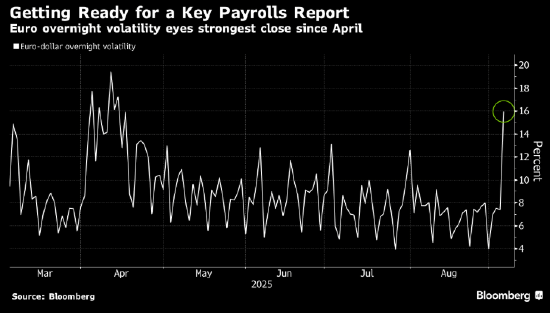
能源化工期权策略早报-20250904
Wu Kuang Qi Huo· 2025-09-04 03:04
1. Report Industry Investment Rating No relevant content in the provided document. 2. Core Viewpoints of the Report - The report focuses on energy - chemical options, covering various sectors such as energy, polyolefins, polyesters, and alkalis. It analyzes the fundamentals, market trends, and option factors of different underlying assets and provides corresponding option strategies and suggestions [3][9]. - It is recommended to construct option combination strategies mainly based on sellers and spot hedging or covered strategies to enhance returns [3]. 3. Summary by Related Catalogs 3.1 Option - Underlying Futures Market Overview - Multiple energy - chemical option underlying futures are presented, including details like the latest price, price change, change rate, trading volume, volume change, open interest, and open interest change. For example, the latest price of crude oil (SC2510) is 484, with a price drop of 8 and a decline rate of 1.67% [4]. 3.2 Option Factors 3.2.1 Volume - Open Interest PCR - The volume - open interest PCR data of various option varieties are provided, which are used to describe the strength of the option - underlying market and the turning point of the underlying market. For instance, the volume PCR of crude oil is 0.61 with a change of 0.08, and the open interest PCR is 0.77 with a change of 0.06 [5]. 3.2.2 Pressure and Support Levels - The pressure and support levels of different option varieties are analyzed from the perspective of the strike prices with the largest open interest of call and put options. For example, the pressure level of crude oil is 600 and the support level is 450 [6]. 3.2.3 Implied Volatility - The implied volatility data of various option varieties are presented, including at - the - money implied volatility, weighted implied volatility, and its change, annual average, call implied volatility, put implied volatility, historical volatility, and the difference between implied and historical volatility. For example, the at - the - money implied volatility of crude oil is 26.005, and the weighted implied volatility is 29.16 with a change of 1.62 [7]. 3.3 Strategy and Suggestions 3.3.1 Energy - Class Options - **Crude Oil**: The fundamentals are healthy with OPEC's supply restraint. The market shows a short - term upward resistance and decline. Option strategies include constructing a neutral call + put option combination strategy and a long collar strategy for spot hedging [8]. - **LPG**: The supply is loose, and the demand is weak. The market is in a weak state. Option strategies include constructing a short - biased call + put option combination strategy and a long collar strategy for spot hedging [10]. 3.3.2 Alcohol - Class Options - **Methanol**: The import volume increases, and the downstream demand is weak. The market is weak. Option strategies include constructing a bear spread strategy of put options, a short - biased call + put option combination strategy, and a long collar strategy for spot hedging [10]. - **Ethylene Glycol**: The port inventory is decreasing. The market shows a wide - range weak oscillation. Option strategies include constructing a short - volatility strategy and a long collar strategy for spot hedging [11]. 3.3.3 Polyolefin - Class Options - **Polypropylene**: The inventory shows a mixed trend. The market is weak. Option strategies include a long collar strategy for spot hedging [11]. 3.3.4 Rubber Options - **Rubber**: The tire production capacity utilization rate shows different trends. The market is short - term weak. Option strategies include constructing a neutral call + put option combination strategy [12]. 3.3.5 Polyester - Class Options - **PTA**: The inventory is decreasing, and the downstream load is rising. The market shows a rebound resistance and decline. Option strategies include constructing a neutral call + put option combination strategy [12]. 3.3.6 Alkali - Class Options - **Caustic Soda**: The production capacity utilization rate decreases in most regions. The market shows an oscillatory trend. Option strategies include a long collar strategy for spot hedging [13]. - **Soda Ash**: The inventory is decreasing. The market shows an oscillatory trend. Option strategies include constructing a short - volatility combination strategy and a long collar strategy for spot hedging [13]. 3.3.7 Urea Options - The port inventory increases, and the enterprise inventory is under pressure. The market shows a low - level oscillation. Option strategies include constructing a short - biased call + put option combination strategy and a long collar strategy for spot hedging [14].
金属期权策略早报-20250904
Wu Kuang Qi Huo· 2025-09-04 01:48
Report Industry Investment Rating - No information provided in the content Core Viewpoints of the Report - For non - ferrous metals, a weak and volatile market is observed, suggesting a seller's neutral volatility strategy [2]. - The black - series shows significant fluctuations, suitable for a short - volatility combination strategy [2]. - Precious metals are on an upward trend, recommending a spot hedging strategy [2]. Summary by Relevant Catalogs 1. Futures Market Overview - The latest prices, price changes, trading volumes, and open interest of various metal futures contracts are presented, including copper, aluminum, zinc, etc. For example, the latest price of copper (CU2510) is 80,260, with a price increase of 80 and a trading volume of 9.90 million lots [3]. 2. Option Factors - Volume and Open Interest PCR - The volume and open interest PCR of different metal options are provided, which can be used to analyze the strength of the option underlying market and potential turning points. For instance, the volume PCR of copper options is 0.32, with a change of 0.03 [4]. 3. Option Factors - Pressure and Support Levels - The pressure and support levels of various metal options are determined based on the strike prices of the maximum open interest of call and put options. For example, the pressure level of copper options is 82,000, and the support level is 80,000 [5]. 4. Option Factors - Implied Volatility - The implied volatility of different metal options is presented, including at - the - money implied volatility, weighted implied volatility, etc. For example, the at - the - money implied volatility of copper options is 11.67% [6]. 5. Strategy and Recommendations Non - Ferrous Metals - **Copper**: Based on fundamental and market analysis, it is recommended to construct a short - volatility seller's option portfolio strategy and a spot long - hedging strategy [7]. - **Aluminum/Alumina**: A bull spread strategy for call options, a short - neutral call + put option combination strategy, and a spot collar strategy are recommended [9]. - **Zinc/Lead**: A short - neutral call + put option combination strategy and a spot collar strategy are suggested [9]. - **Nickel**: A short - bearish call + put option combination strategy and a spot covered call strategy are recommended [10]. - **Tin**: A short - volatility strategy and a spot collar strategy are proposed [10]. - **Lithium Carbonate**: A short - bearish call + put option combination strategy and a spot long - hedging strategy are recommended [11]. Precious Metals - **Gold/Silver**: A bull spread strategy for call options, a short - neutral short - volatility option seller's combination strategy, and a spot hedging strategy are recommended [12]. Black - Series - **Rebar**: A short - bearish call + put option combination strategy and a spot covered call strategy are suggested [13]. - **Iron Ore**: A short - neutral call + put option combination strategy and a spot long - collar strategy are recommended [13]. - **Ferroalloys**: A short - volatility strategy is recommended for manganese silicon, and a short - volatility call + put option combination strategy and a spot hedging strategy are recommended for industrial silicon and polysilicon [14]. - **Glass**: A short - volatility call + put option combination strategy and a spot long - collar strategy are recommended [15].