光伏反内卷

Search documents
壹快评丨银行应在光伏“反内卷”中起好作用
Di Yi Cai Jing· 2025-09-02 06:27
Core Viewpoint - The banking sector's cautious and watchful attitude during the current adjustment phase of the solar industry may exacerbate industry volatility and amplify systemic risks [1][2]. Group 1: Industry Challenges - The solar industry is facing severe challenges, including overcapacity, declining prices, and a complex international trade environment, leading to unprecedented difficulties [2]. - Regulatory bodies and industry associations are taking measures to address "involution" competition, aiming to enhance product quality and promote the orderly exit of outdated capacity [2]. Group 2: Financial Sector's Role - Banks need to establish a more scientific and differentiated credit assessment system, avoiding a one-size-fits-all approach, and should support high-quality enterprises with tailored financial services [3]. - The banking sector should innovate financial products, such as green bonds and asset securitization, to provide diversified financing channels for solar companies [3]. - Banks are expected to play a crucial role in guiding industry consolidation and upgrading through the allocation of credit resources [3]. Group 3: Industry Association's Responsibilities - The China Photovoltaic Industry Association should enhance industry monitoring and data sharing to provide timely information to financial institutions [4]. - The association must actively develop industry standards to prevent low-level competition and facilitate deeper understanding and cooperation between financial institutions and solar companies [4]. - It is essential for the association to represent the industry's voice, reflecting enterprise demands and policy suggestions to create a favorable environment for healthy development [4]. Group 4: Transition Phase - The solar industry is transitioning from scale expansion to quality and efficiency, requiring self-innovation from enterprises and support from the banking sector [4]. - The banking industry should adopt a long-term perspective and responsible attitude to support high-quality solar enterprises through challenging times, ultimately contributing to the high-quality development of the Chinese economy [4].
ST泉为(300716) - 投资者关系活动记录表
2025-09-02 05:52
Financial Performance - In the first half of 2025, the company reported a total revenue of 46.204 million yuan, a year-on-year decrease of 68.28% [1] - The net profit attributable to the parent company was -36.7945 million yuan, indicating a reduction in losses by 21.73% compared to the previous year [1][2] Strategic Measures - To address the financial challenges, the company is implementing several strategies: - Disposing of certain subsidiary assets to improve liquidity [2] - Expanding into new business lines, such as photovoltaic EPC project construction [1] - Actively participating in bidding activities to explore new markets [1] - Communicating with creditors to reduce default and litigation costs [1] - Investigating projects to prepare for attracting new strategic investors [1] Industry Context - The company supports the national call to combat "internal competition" in the photovoltaic industry by refusing low-price bids and reducing production [2] - The overall industry is experiencing losses, but the company has seen some improvement in its operational situation [2] Major Contracts - The company announced a significant contract for the Anshun photovoltaic EPC project, with a total contract value of 1.125 billion yuan [3] - The impact of this contract on the company's financial status and operational results remains uncertain and will be assessed in the audited financial report for 2025 [3] Core Competencies - The company has established a strong foundation in the photovoltaic industry with several competitive advantages: - Continuous innovation in R&D, focusing on HJT and perovskite technologies, and collaboration with major research institutions [4] - Robust production capabilities with two major production bases designed for a total capacity of 4GW [4] - A reliable product series, including the "QianYao" and "Humpback Whale" series, designed for various applications [4] Quality Control - The company has implemented a comprehensive quality management system, ensuring strict quality control throughout the product lifecycle [5][6] - It offers a 25-year product warranty and a 30-year power output warranty for its photovoltaic products [6]

晶澳科技(002459):二季度毛利率大幅修复,再发股权激励、员工持股计划表明信心
Changjiang Securities· 2025-09-01 23:30
Investment Rating - The investment rating for the company is "Buy" and is maintained [7] Core Views - The company reported a significant recovery in gross margin in Q2 2025, alongside the announcement of a stock option incentive plan and employee stock ownership plan, indicating confidence in its future [4][11] - In H1 2025, the company achieved revenue of 23.905 billion yuan, a year-on-year decrease of 36.01%, with a net profit attributable to shareholders of -2.58 billion yuan [2][4] - The company plans to repurchase 200 to 400 million yuan worth of shares within the next 12 months for employee stock ownership or incentive plans, representing approximately 0.35% to 0.70% of total share capital [3][4] Financial Performance - In Q2 2025, the company reported revenue of 13.232 billion yuan, a year-on-year decline of 38.12%, but a quarter-on-quarter increase of 23.99%, with a net profit of -942 million yuan [2][4] - The company’s battery module shipment volume reached 33.79 GW in H1 2025, with overseas shipments accounting for approximately 45.93% [11] - The gross margin in Q2 2025 improved significantly by 5.76 percentage points to -0.95% due to increased operating rates and price recovery [11] - The company had cash reserves exceeding 26 billion yuan in Q2 2025, with a debt ratio reduced by 0.4 percentage points to 75.9% [11] Incentive Plans - The 2025 stock option incentive plan targets 1,975 individuals, including directors (excluding independent directors), senior management, core technical personnel, and key staff, with the proposed stock options accounting for 4.89% of the total [5] - The employee stock ownership plan for 2025 includes a maximum of 57 participants, with the stock involved representing approximately 1.28% [5]

高喊“反内卷”的光伏企业,决定偷偷扩产了
投中网· 2025-09-01 08:08
Core Viewpoint - The Chinese photovoltaic industry is facing a complex dilemma due to both domestic capacity expansion and the rise of overseas competitors, necessitating a reevaluation of strategies to avoid being outpaced by foreign firms [5][6][22]. Domestic Situation - From the beginning of the year to August 20, 2025, there were 46 new photovoltaic projects planned or under construction in China, with a total capacity exceeding 237 GW and an investment of over 80 billion yuan [6][10]. - Among these, 32 projects are focused on capacity expansion, with a total capacity of over 142 GW and an investment of approximately 54.1 billion yuan, primarily in the mid and downstream sectors of the photovoltaic industry [10][12]. - The expansion is largely driven by emerging companies, with perovskite technology being particularly favored, despite the technology not yet being commercially viable on a large scale [9][15]. - The majority of expansion projects (35 out of 39) target the mid and downstream segments, indicating a strong focus on battery and module production [12][13]. Overseas Expansion - In 2025, overseas photovoltaic capacity expansion reached a total of 289 GW, with Chinese companies accounting for approximately 20% of this expansion [17][19]. - The Asia-Pacific region, particularly India, is leading the charge with planned capacity expansions totaling 153.28 GW, while Europe and the Americas are also seeing significant growth [18][19]. - The rise of local production in countries like the US and India poses a threat to Chinese photovoltaic companies, as these markets are increasingly competitive [20][23]. Strategic Recommendations - The Chinese photovoltaic industry must firmly commit to "anti-involution" strategies to combat overcapacity and price wars, which have led to widespread losses [22][24]. - Companies should shift their focus from merely increasing capacity to enhancing quality, technology, and brand reputation, as the market has transitioned from scarcity to oversupply [25]. - Maintaining a technological edge and controlling key segments of the supply chain will be crucial for competing effectively in the global market [25].

双良节能(600481):硅片盈利改善可期,设备业务持续推进
HTSC· 2025-09-01 07:56
Investment Rating - The report maintains an "Overweight" rating for the company with a target price of RMB 6.62 [7][8]. Core Views - The company is expected to see a recovery in silicon wafer profitability as it continues to optimize its processes and reduce costs. The equipment business is also progressing well, potentially creating a second growth curve for the company [2][4]. - The company has experienced a significant reduction in losses compared to the previous year, primarily due to a decrease in asset impairment losses [2][3]. - The report highlights the company's strong cash flow generation, with operating cash flow remaining positive for four consecutive quarters [3]. Summary by Sections Financial Performance - For the first half of 2025, the company reported revenues of RMB 4.39 billion, a year-on-year decline of 37.1%. The net loss attributable to the parent company was RMB 600 million, a significant reduction from RMB 1.26 billion in the same period last year [2]. - In Q2 2025, the company recorded a net loss of RMB 440 million, with a gross margin decrease of 1.3% and an increase in asset impairment losses to RMB 170 million [3]. Silicon Wafer Business - The company has equipped its entire production line with 1600 furnaces, capable of producing M10, G12, and customized rectangular silicon wafers. It is also advancing the construction of smart factories to enhance efficiency [4]. - The company aims to improve yield rates and production efficiency through better material quality control and process management [4]. Equipment Business - The company is expanding its new energy equipment orders, particularly in hydrogen energy, and has established a direct sales network across multiple provinces in China. It has signed a sales contract worth RMB 450 million for green hydrogen systems [5]. - In the data center cooling segment, the company is actively participating in several high-profile projects, which may lead to significant benefits as the data center market continues to grow [5]. Profit Forecast and Valuation - Due to a decline in demand following the end of the domestic photovoltaic installation rush, the company has adjusted its revenue and gross margin assumptions downward for its photovoltaic business. The expected net profits for 2025-2027 are projected to be RMB -665 million, RMB 420 million, and RMB 1.006 billion, respectively [6][13]. - The report assigns a PE valuation of 30.09x for 2026, leading to a target price of RMB 6.62, reflecting an increase from the previous target of RMB 4.94 [6][15].

风电8月招标量价表现强势,锂电排产及固态进展超预期 | 投研报告
Zhong Guo Neng Yuan Wang· 2025-09-01 02:57
Core Insights - The research report from Guojin Securities highlights a significant rebound in the wind turbine bidding scale for central state-owned enterprises, reaching 10.3 GW in August, marking an 88% month-on-month increase and a 0.4% year-on-year increase [1][2] - Wind turbine average bidding prices have also seen a 5% increase in July and August, reaching 1647 RMB/kW, with an 11% increase compared to the average price for the entire year of 2024 [1][2] Wind Power - The wind power sector has shown a strong recovery in August after a decline in June and July, with a notable increase in bidding scale [2] - The average bidding price for wind turbines has increased significantly, indicating a positive trend in pricing [2] AIDC (Artificial Intelligence Data Center) - The sentiment in the liquid cooling sector has improved following a period of adjustment, with domestic companies reporting progress in liquid cooling products [2] - The HVDC (High Voltage Direct Current) segment continues to gain attention, with updates on industry developments [2] Photovoltaics & Energy Storage - The photovoltaic main chain experienced mixed results in Q2, with some companies expected to show strong improvements in Q3 due to effective measures against internal competition [2] - Companies with the ability and willingness to extend their business into high-growth sectors are recommended for attention [2] Lithium Batteries - Lithium battery production in September exceeded expectations, with a projected increase of 4% to 8% in Q3, indicating a high level of market activity [3] - Price increases for key materials have been observed, and solid-state battery development is accelerating [3] Hydrogen and Fuel Cells - The lack of electricity accessibility in the U.S. grid is a significant constraint for data center operations, with a projected 45 GW power shortfall from 2025 to 2028 [3] - Microgrids are becoming essential for supporting AI project implementations in areas without traditional grid access [3] Power Grid - The third batch of bidding for State Grid's ultra-high voltage equipment is in line with expectations, with an acceleration in the bidding pace anticipated [4] - Companies like Mingyang Electric and Jinpan Technology have reported positive Q2 performance, indicating growth opportunities in the data center sector [4] New Energy Vehicles - The market for new energy vehicles is showing signs of recovery, although the overall growth rate remains under pressure due to high year-on-year comparisons [4] - Financial reports from major manufacturers indicate a clear differentiation in performance, suggesting opportunities for secondary leading companies [4] Important Industry Events - Eight manufacturers have qualified for a 10 GW tender from Datang, with generally rising bid prices [5] - Significant developments in the hydrogen energy sector include the establishment of a liquid hydrogen base and support for SOFC and SOEC technology applications [5]





隆基绿能、晶澳科技、天合光能、迈为股份 2025 年上半年业绩_盈利回顾
2025-08-31 16:21
Summary of Conference Call Notes on Solar Industry in China Industry Overview - The solar industry in China is experiencing mixed results in 1H25, with major companies like LONGi, JA Solar, and Trina Solar reporting varying performance metrics. [1][2][3][4] - There is optimism regarding anti-involution policies, which are expected to support price increases above total costs in the second half of 2025. [1][4] Company-Specific Insights LONGi Green Energy - Reported a net loss of -RMB2.6 billion in 1H25, consistent with prior profit warnings. [2] - Gross margin improved to 1.6% in 2Q25 from -4.2% in 1Q25. [2] - Module shipment volume increased to 22.6GW in 2Q25, a 23% YoY increase, compared to 16.9GW in 1Q25. [2] - Capital expenditures rose to RMB4.4 billion in 1H25, up from RMB3.4 billion in 1H24, as the company expands its Back-Contact (BC) capacity. [2] - Asset impairments totaled RMB1.2 billion, significantly lower than RMB5.8 billion in 1H24. [2] - Maintains a strong balance sheet with RMB49.3 billion in cash and a net debt to equity ratio of -18.6%. [2] JA Solar - Reported a net loss of -RMB2.6 billion in 1H25, at the lower end of its profit warning range. [3] - Cell and module shipments totaled 33.79GW in 1H25, a 17% YoY decline. [3] - Unit revenue improved by 6% QoQ, likely due to increased installations. [3] - Announced a share repurchase plan of RMB200-400 million, representing approximately 0.5-1% of its current market cap. [3] Trina Solar - Experienced a wider net loss of -RMB1.6 billion in 2Q25, compared to -RMB1.3 billion in 1Q25. [4] - Solar module segment reported a net loss of -RMB3.3 billion on 32GW module shipments, equating to a net loss of -RMB10c/W. [4] - Management is optimistic about US module demand, particularly in the <1.5MW distributed segment, and anticipates price hikes in 2H25. [4] Maxwell Technologies - Reported a 15% YoY decline in net profit to RMB394 million in 1H25, with 2Q earnings rising by 15% YoY due to reduced operating costs. [8] - Revenue fell 14% YoY, primarily due to a 31% decline in solar equipment sales. [8] - R&D expenses increased by 10% YoY to RMB463 million in 1H25. [8] Key Market Trends - Companies are adjusting their production targets in response to market conditions, with CSI Solar reducing its 3Q25 module shipment target to 5-5.3GW from 8GW. [1] - There is an expectation of further consolidation in the industry, with smaller companies likely to exit the market by 2026. [1] - The overall sentiment remains cautiously optimistic regarding US demand and potential price increases due to tariffs. [1][4] Financial Metrics Overview - LONGi's gross profit margin improved to 1.6% in 2Q25, while JA Solar's gross profit margin was -1.0%. [10] - Trina Solar's gross profit margin was reported at 4.5% in 2Q25. [10] - The net income margins for LONGi, JA Solar, and Trina Solar were -5.9%, -7.1%, and -9.6% respectively in 2Q25. [11] Conclusion - The solar industry in China is navigating through a challenging landscape with mixed financial results among major players. [1][2][3][4] - The focus on anti-involution policies and potential price increases in the latter half of 2025 may provide a pathway for recovery and growth in the sector. [1][4]


电力设备及新能源周报20250831:蔚来全新ES8开启预售,国网高压设备中标结果公示-20250831
Minsheng Securities· 2025-08-31 05:22
Investment Rating - The report maintains a "Buy" rating for key companies in the electric equipment and new energy sector, including CATL, Keda, and others [5]. Core Insights - The electric equipment and new energy sector saw a weekly increase of 3.99%, outperforming the Shanghai Composite Index, with lithium battery index showing the highest growth at 7.37% [1][4]. - NIO's new ES8 SUV has begun pre-sales, featuring advanced design and safety features, and is expected to enhance the competitive landscape in the electric vehicle market [2][9]. - The solar power generation capacity added in the first seven months of 2025 reached 223.25 GW, marking an 80.73% year-on-year increase, indicating strong growth in the renewable energy sector [3][32]. Summary by Sections New Energy Vehicles - NIO's ES8 pre-sale started on August 21, with prices starting at 416,800 RMB for the luxury version and 456,800 RMB for the signature version, set to launch in late September [2][9]. - The ES8 features a 5280mm length and 3130mm wheelbase, making it the largest pure electric SUV in China, with a 777L cargo capacity even with six passengers [10][11]. New Energy Generation - In the first seven months of 2025, solar power generation capacity increased by 223.25 GW, with a monthly addition of 11.04 GW in July, despite a year-on-year decline of 47.55% [3][32]. - The report highlights a significant increase in inverter exports, with a total of 37.109 billion RMB in the first seven months, reflecting a year-on-year growth of 8.87% [26]. Electric Equipment and Automation - The State Grid announced the results of its third high-voltage equipment tender for 2025, with a total value of 1.3 billion RMB, indicating ongoing investment in infrastructure [4]. - Key companies to watch include CATL, Keda, and others, which are expected to benefit from the growing demand in the electric equipment sector [4]. Company Profit Forecasts and Valuations - The report provides earnings per share (EPS) forecasts for key companies, with CATL projected to have an EPS of 14.96 RMB in 2025, and a price-to-earnings (PE) ratio of 19 [5]. - Other companies like Keda and Daikin Heavy Industries are also rated as "Buy," with expected EPS growth in the coming years [5]. Industry Data Tracking - The report tracks lithium battery material prices, showing stability in prices for ternary cathode materials and slight fluctuations in other components [15][43]. - The solar industry is experiencing price adjustments, with polysilicon prices ranging from 50 to 55 RMB per kg, reflecting market dynamics and supply chain adjustments [35][36].




曼恩斯特分析师会议-20250829
Dong Jian Yan Bao· 2025-08-29 15:28
Group 1: Report Summary - The report is about a research on Mannster, a company in an unspecified industry, conducted on August 29, 2025 [1][16] - The company's mid - 2025 business situation was introduced, with revenue increasing and net profit decreasing compared to the previous year [23] - The company's overseas orders increased, and the construction of the global system achieved results [23] Group 2: Research Basic Information - The research object is Mannster, and the reception time is August 29, 2025. The reception staff includes the board secretary Peng Yalin and the securities affairs representative Xu Bijiu [16] Group 3: Detailed Research Institutions - Participating institutions include Guolian Minsheng Securities, Guohai Securities, Caitong Securities, Northeast Securities, Huatai Securities, etc [2][17] Group 4: Main Content Business Performance - Affected by the decline in new orders in 2024, the revenue and profit of coating application decreased in the first half of this year [23] - In the first half of this year, the company's revenue was 560.4829 million yuan, a year - on - year increase of 59.93%; the net profit attributable to shareholders of listed companies was - 23.5133 million yuan, a year - on - year decrease of 132.66% [23] - Overseas revenue in the first half of the year was 17.8781 million yuan, with a year - on - year growth rate of 146.51% [23] Reasons for Loss and Margin Changes - The decline in coating product gross margin was due to intensified market competition, cost - reduction pressure in the industry, and fluctuations in production capacity utilization [23] - As new orders are gradually delivered and production capacity utilization increases, the gross margin will improve [23] - The company's energy system business turned a profit, and the gross margin improved, supporting overall profits [24] Solid - State Equipment Progress - Solid/dry - process related equipment orders placed last year were sent to customers this year, and the commissioning and verification results were recognized by customers [24] - The company has rich experimental data and technical reserves in the wet - and dry - process layout and has obtained order verifications in multiple processes [24] Pan - Semiconductor Business Progress - The company launched a perovskite pilot platform and released a new vacuum coating equipment product this year [25] - The GW - level perovskite coating system was delivered in the first half of the year [25] - The company's panel display equipment passed customer verification and aims to develop more incremental business [25] Robot Business - The subsidiary Lanfang Technology has a small number of orders for micro - linear electric cylinders and has sent samples of electric grippers, but there is no substantial progress in dexterous hand products [25]
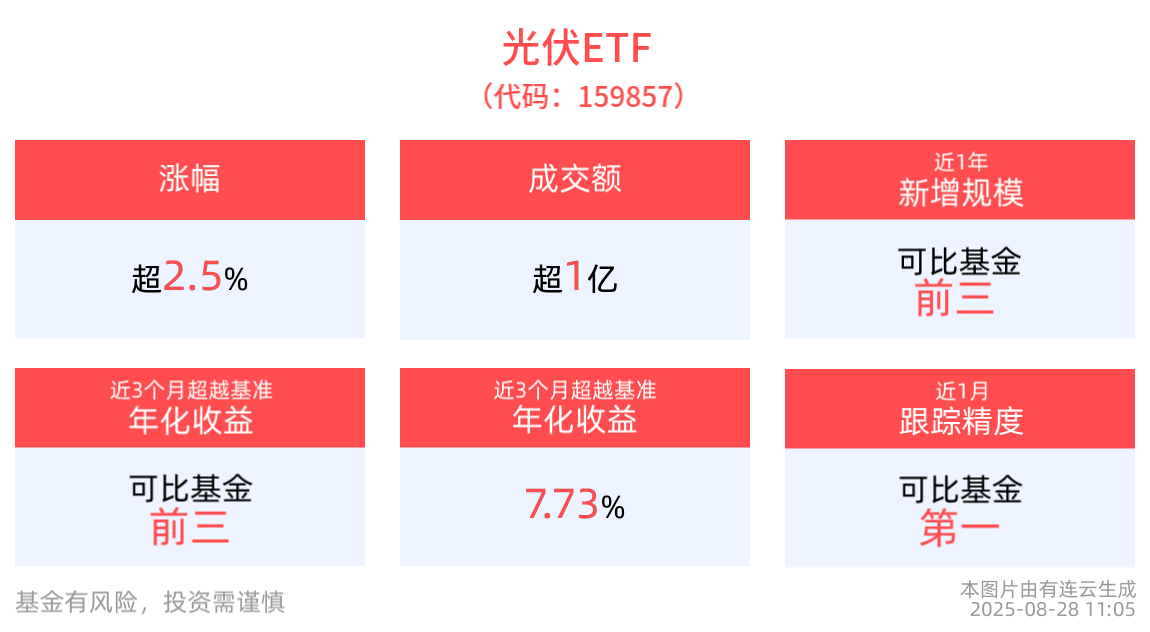
“反内卷”行情升温,成分股多只涨停,深市最大的光伏ETF(159857)量价齐升涨超2.5%,光伏板块迎来估值修复!
Sou Hu Cai Jing· 2025-08-28 05:16
Group 1 - The core viewpoint is that the photovoltaic industry is experiencing significant growth, with increased installation capacity and rising stock prices in related ETFs and companies [3][4] - The photovoltaic ETF (159857) has seen a 2.51% increase, with notable gains in constituent stocks such as Jiejia Weichuang (300724) up 18.75% and Zhengtai Electric (601877) up 9.99% [3] - As of August 27, the photovoltaic ETF (159857) has grown by 5.24 billion yuan in scale over the past year, indicating strong market performance [3] Group 2 - Domestic and international industry associations have raised their forecasts for new photovoltaic power generation installations for 2025, reflecting optimism in the sector [4] - In the first half of the year, China's cumulative photovoltaic installation capacity exceeded 1000 gigawatts, accounting for 30% of the total power generation capacity, while the share of thermal power generation decreased to 40% [4] - The new installation capacity for photovoltaic power in the first six months reached 212.21 gigawatts, a year-on-year increase of 107%, setting a new record [4] Group 3 - Tianfeng International Securities indicates that the photovoltaic sector has reached a valuation bottom, with signs of fundamental changes and valuation recovery following recent policy adjustments [4] - Prices for silicon materials have increased significantly, with companies raising quotes based on cost principles, leading to price hikes in silicon wafers and downstream battery and module prices [4] - Discussions on mergers and acquisitions among silicon material companies have taken place, with preliminary agreements reached during a closed-door meeting at the end of July [4]