
HJT设备

Search documents
熬呗
Datayes· 2026-03-30 12:35
Market Overview - The A-share market showed a strong rebound today, with the Shanghai Composite Index rising by 0.24%, while Japanese and Korean markets fell by nearly 3% each, indicating a competitive advantage for China [1] - The total market turnover reached 19,277.83 billion yuan, an increase of 637.87 billion yuan compared to the previous day, with over 2,800 stocks rising [21] Sector Performance - The aluminum sector led the gains, with companies like Tianshan Aluminum and Chang Aluminum hitting the daily limit. This surge is attributed to attacks on two Middle Eastern aluminum producers, which disrupted global aluminum supply chains [21][31] - The pharmaceutical sector continued to perform well, with stocks like Meinuo Pharma achieving five consecutive limits. The first quarter saw China's innovative drug licensing transactions exceed $60 billion, nearing half of last year's total [21] - The aerospace sector also saw increased activity, with companies like Shenjian Co. and Zengsheng Technology experiencing multiple limit-ups due to recent contract wins and upcoming launches [21] Company Updates - Maiwei Co. experienced a significant drop in stock price, attributed to market rumors regarding export restrictions on equipment and weak first-quarter performance expectations. However, the company has completed the first phase of equipment delivery for HJT production lines in the U.S. [16][18] - The optical fiber sector showed strong performance, with companies like Hengtong Optic-Electric and Changfei Optic-Fiber seeing stock price increases due to rising prices from operators and strong demand from data centers [19][23] - The agricultural sector also saw gains, driven by rising energy prices impacting fertilizer and logistics costs, which in turn raised expectations for agricultural product prices [23] Financial Performance - Zhaoyan New Drug reported a revenue of 1.658 billion yuan for 2025, a decrease of 17.87% year-on-year, but a net profit increase of 302.08% to 298 million yuan [27] - New Sharp Co. expects first-quarter revenue for 2026 to be between 1 billion and 1.15 billion yuan, a year-on-year increase of 89.28% to 117.68% [27] - Huazhi Precision anticipates a first-quarter net profit of 150 to 190 million yuan for 2026, reflecting a year-on-year growth of 413.28% to 550.15% [27] Industry Insights - Goldman Sachs has downgraded the target for the MSCI China Index and the CSI 300 Index by 5% and 4%, respectively, indicating a potential price return of 24% and 12% over the next 12 months [12] - The global economic backdrop is expected to lower the fair value of Chinese stocks by approximately 5%, with 2% attributed to profit deterioration and 3-4% due to a decline in the price-to-earnings ratio [11]


涨声震天!马斯克力挺的“太空光伏”,到底虚实几分?
Sou Hu Cai Jing· 2026-01-25 06:02
Core Viewpoint - The "space photovoltaic" concept has significantly boosted photovoltaic stocks, creating a surge in the capital market following Elon Musk's announcement of plans to build 100GW of photovoltaic capacity for ground data centers and space AI satellites within three years [3][6]. Group 1: Market Reaction - On January 23, 2023, leading companies in the "space photovoltaic" sector, such as Junda Co. (SZ: 002865) and Maiwei Co. (SZ: 300751), experienced a rapid increase in stock prices, with a 20% limit up, contributing to a 9.04% rise in the photovoltaic equipment sector [3][5]. - Since December 2022, the "space photovoltaic" concept has been actively traded, with Maiwei Co. emerging as a leader, seeing its stock price triple in just two months [3][5]. - By January 23, 2023, Junda Co.'s stock reached a peak of 99.44 CNY per share, while Maiwei Co. hit 324.36 CNY per share, marking their highest prices in nearly two years and three years, respectively [9]. Group 2: Industry Developments - More photovoltaic companies are accelerating their involvement in "space photovoltaic" business, with reports suggesting that the sector is nearing industrialization [6][12]. - A report from CITIC Securities indicates that the "space photovoltaic" market could reach a scale of trillions of yuan, highlighting long-term investment opportunities [6]. - The rapid growth of China's commercial space sector is linked to the increasing demand for space photovoltaic products, driven by a significant rise in satellite launches [12]. Group 3: Technological Focus - Key technologies for "space photovoltaic" include perovskite, HJT (Heterojunction Technology), and gallium arsenide, with companies like Trina Solar (SH: 688599) and LONGi Green Energy (SH: 601012) leading the way [6][15]. - Junda Co.'s investment in Xingyi Xinneng aims to leverage their combined expertise in perovskite technology for space applications [10][16]. - The industry anticipates that perovskite tandem cells may become the optimal solution for space photovoltaic applications due to their high efficiency and lightweight characteristics [16]. Group 4: Market Potential - Analysts predict that the global market for space photovoltaic could reach between 500 billion to 1 trillion USD by 2030, driven by the deployment of low-orbit satellites and the demand for space-based power generation [12][13]. - The recent application for 203,000 new satellites by China marks a significant increase in the potential market for space photovoltaic products, as solar power is seen as the ideal energy source for satellites [12]. Group 5: Challenges Ahead - Despite the optimistic outlook, the industry faces significant challenges, including technological hurdles and high costs associated with space photovoltaic applications [17][20]. - Current estimates suggest that the cost of space photovoltaic energy is approximately 2-3 USD per kWh, compared to just 0.03-0.05 USD per kWh for ground-based photovoltaic systems, indicating a substantial cost disparity [20]. - The industry is still in the exploratory phase, with many companies lacking substantial operational experience in space applications, raising concerns about their long-term viability [20].


龙虎榜复盘丨数字人民币概念发力,SpaceX潜在概念股默默走强
Xuan Gu Bao· 2025-12-29 11:04
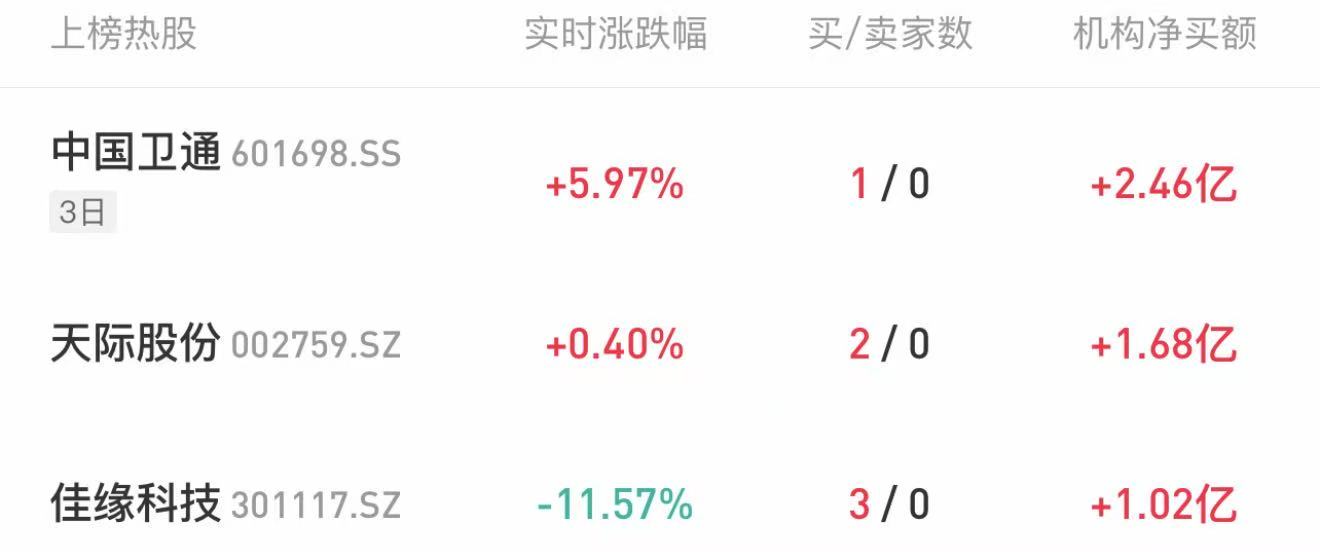
Group 1 - On the day, 36 stocks were listed on the institutional trading leaderboard, with 17 stocks seeing net purchases and 19 stocks experiencing net sales [1] - The top three stocks with the highest net purchases by institutions were China Satellite Communications (CNY 246 million), Tianji Co., Ltd. (CNY 168 million), and Jiayuan Technology (CNY 102 million) [1][2] - China Satellite Communications saw a price increase of 5.97%, while Tianji Co., Ltd. had a slight increase of 0.40%, and Jiayuan Technology experienced a significant decline of 11.57% [2] Group 2 - Chaojie Co., Ltd. had a net purchase of CNY 246 million from one institution, operating 18 commercial communication broadcast satellites and successfully launching multiple satellites [3] - The company has established a complete high-orbit Ka-band high-throughput satellite internet coverage across the entire territory of China and key areas of the "Belt and Road" initiative, with its "Haixing Tong" global network covering over 95% of maritime routes [3] - The People's Bank of China has announced a new action plan for the management and service system of digital RMB, set to be implemented on January 1, 2026, which will allow digital RMB wallet balances to earn interest like demand deposits [3] - East Wu Securities highlighted potential A-share suppliers for SpaceX and commercial aerospace, noting that some companies have the capability to supply key components for the industry [3] - Companies like Maiwei Co., Ltd. and Paike New Materials are identified as having potential in the commercial aerospace sector, with Maiwei being a global leader in HJT equipment and Paike focusing on high-end aerospace forgings [3]

光伏HJT设备,2026年将继续爆发
Ge Long Hui· 2025-12-19 10:51
Core Insights - The U.S. photovoltaic (PV) market is experiencing a dual turning point of "demand explosion + capacity return" in 2025, driven by AI computing power expansion and a declining interest rate cycle, leading to a projected installation capacity of over 60GW in 2025 with a compound annual growth rate of 20% [1][2]. Demand Side - The U.S. renewable energy generation share is low at approximately 10%, significantly below the global average of 30%, indicating substantial room for energy structure transformation [2]. - The demand for PV is catalyzed by the electricity gap created by AI data centers and manufacturing recovery, as these centers operate continuously and require stable power sources, making PV a preferred clean energy option [2]. - The arrival of a declining interest rate cycle has amplified demand potential, as the internal rate of return (IRR) for PV projects is highly correlated with interest rates, leading to lower financing costs and increased investment willingness from developers [2]. Policy Support - The U.S. government is promoting domestic PV production through a combination of "manufacturing subsidies + trade protection," establishing a solid foundation for local capacity expansion [2]. - Although the Investment Tax Credit (ITC) for distributed projects will gradually phase out after 2027, subsidies for manufacturing remain strong, with 4 cents per cell and 7 cents per module, reducing cost pressures for domestic manufacturers [2]. Domestic Capacity and Challenges - The planned domestic PV capacity in the U.S. is set to reach 60-70GW, with approximately 40GW already in production for modules, but only single-digit capacity for cells, highlighting a significant supply gap [3]. - The U.S. PV manufacturing faces challenges such as high labor, energy, and compliance costs compared to China, necessitating the adoption of more efficient and lower-cost technologies like HJT (Heterojunction Technology) [3][4]. HJT Technology Advantages - HJT technology requires only four core processes, resulting in lower operational costs (OPEX) of $5.4-5.5 million per GW, compared to $7.2 million for TOPCon technology, with a cost difference of 2 cents per watt [4]. - Even without government subsidies, HJT can achieve a profit of 1.6 cents per watt, indicating sustainable profitability post-subsidy reduction [5]. Patent Landscape - HJT technology has a patent advantage, as its core patents expired in 2015, allowing U.S. companies to expand capacity without the risk of patent litigation, unlike TOPCon and BC technologies [8]. - Several U.S. companies have announced HJT capacity expansion plans, totaling over 30GW, expected to materialize between 2026 and 2028, providing certainty for the supply chain [8][9]. Equipment Supply Chain - The surge in HJT capacity in the U.S. will benefit Chinese equipment manufacturers, who dominate the global HJT equipment market with over 70% market share, providing a competitive edge in terms of cost and service [10]. - U.S. companies prefer Chinese equipment due to significant cost advantages (60%-70% cheaper than overseas options) and faster service response times, which are crucial for meeting rapid production ramp-up needs [10]. Investment Opportunities - The expansion of domestic PV capacity and the adoption of HJT technology create clear investment themes focused on "equipment leaders + technology support," balancing performance certainty with growth potential [11]. - Key players include: - Maiwei Co., which leads in HJT equipment with over 70% market share, benefiting from U.S. capacity expansion [11]. - Aotwei, a leader in module packaging equipment, with ongoing demand from the 40GW of installed capacity [11]. - Gaomei Co., a core supplier of HJT wafer cutting equipment, benefiting from technology upgrades and U.S. capacity expansion [11]. Auxiliary Investment Themes - The demand for low-temperature silver paste and TCO targets will rise with HJT technology, driving exports of related materials [12]. - Companies producing photovoltaic glass and encapsulants are well-positioned to meet the supply chain needs of U.S. module production, leveraging global presence and cost advantages [12].



捷佳伟创:目前在手订单以TOPCon为主
Mei Ri Jing Ji Xin Wen· 2025-09-29 10:26
Core Viewpoint - The company primarily has orders for TOPCon battery equipment, with positive impacts expected from industry upgrades, overseas expansion, and new technology layouts [1] Group 1: Orders and Technology - The current orders are mainly for TOPCon technology [1] - The company has diversified its technology layout across TOPCon, HJT, XBC, perovskite, and perovskite tandem cells [1] - The company aims to provide cost-effective equipment solutions regardless of the technology chosen by customers [1]
隆基绿能、晶澳科技、天合光能、迈为股份 2025 年上半年业绩_盈利回顾
2025-08-31 16:21
Summary of Conference Call Notes on Solar Industry in China Industry Overview - The solar industry in China is experiencing mixed results in 1H25, with major companies like LONGi, JA Solar, and Trina Solar reporting varying performance metrics. [1][2][3][4] - There is optimism regarding anti-involution policies, which are expected to support price increases above total costs in the second half of 2025. [1][4] Company-Specific Insights LONGi Green Energy - Reported a net loss of -RMB2.6 billion in 1H25, consistent with prior profit warnings. [2] - Gross margin improved to 1.6% in 2Q25 from -4.2% in 1Q25. [2] - Module shipment volume increased to 22.6GW in 2Q25, a 23% YoY increase, compared to 16.9GW in 1Q25. [2] - Capital expenditures rose to RMB4.4 billion in 1H25, up from RMB3.4 billion in 1H24, as the company expands its Back-Contact (BC) capacity. [2] - Asset impairments totaled RMB1.2 billion, significantly lower than RMB5.8 billion in 1H24. [2] - Maintains a strong balance sheet with RMB49.3 billion in cash and a net debt to equity ratio of -18.6%. [2] JA Solar - Reported a net loss of -RMB2.6 billion in 1H25, at the lower end of its profit warning range. [3] - Cell and module shipments totaled 33.79GW in 1H25, a 17% YoY decline. [3] - Unit revenue improved by 6% QoQ, likely due to increased installations. [3] - Announced a share repurchase plan of RMB200-400 million, representing approximately 0.5-1% of its current market cap. [3] Trina Solar - Experienced a wider net loss of -RMB1.6 billion in 2Q25, compared to -RMB1.3 billion in 1Q25. [4] - Solar module segment reported a net loss of -RMB3.3 billion on 32GW module shipments, equating to a net loss of -RMB10c/W. [4] - Management is optimistic about US module demand, particularly in the <1.5MW distributed segment, and anticipates price hikes in 2H25. [4] Maxwell Technologies - Reported a 15% YoY decline in net profit to RMB394 million in 1H25, with 2Q earnings rising by 15% YoY due to reduced operating costs. [8] - Revenue fell 14% YoY, primarily due to a 31% decline in solar equipment sales. [8] - R&D expenses increased by 10% YoY to RMB463 million in 1H25. [8] Key Market Trends - Companies are adjusting their production targets in response to market conditions, with CSI Solar reducing its 3Q25 module shipment target to 5-5.3GW from 8GW. [1] - There is an expectation of further consolidation in the industry, with smaller companies likely to exit the market by 2026. [1] - The overall sentiment remains cautiously optimistic regarding US demand and potential price increases due to tariffs. [1][4] Financial Metrics Overview - LONGi's gross profit margin improved to 1.6% in 2Q25, while JA Solar's gross profit margin was -1.0%. [10] - Trina Solar's gross profit margin was reported at 4.5% in 2Q25. [10] - The net income margins for LONGi, JA Solar, and Trina Solar were -5.9%, -7.1%, and -9.6% respectively in 2Q25. [11] Conclusion - The solar industry in China is navigating through a challenging landscape with mixed financial results among major players. [1][2][3][4] - The focus on anti-involution policies and potential price increases in the latter half of 2025 may provide a pathway for recovery and growth in the sector. [1][4]



迈为股份(300751):海外HJT确收 半导体设备布局加速
Xin Lang Cai Jing· 2025-08-24 08:46
Core Viewpoint - The company reported a decline in revenue and net profit for the first half of 2025, but remains optimistic about long-term growth driven by overseas HJT equipment and semiconductor manufacturing expansion [1][4]. Financial Performance - In H1 2025, the company achieved revenue of 4.21 billion yuan, a year-on-year decrease of 13.5% - The net profit attributable to shareholders was 390 million yuan, down 14.6% year-on-year - Q2 revenue was 1.98 billion yuan, a quarter-on-quarter decline of 11.0%, while net profit for Q2 was 230 million yuan, showing a quarter-on-quarter increase of 43.0% [1]. Margin Improvement - The company reported a gross margin of 39.0% in Q2 2025, an increase of 8.0 percentage points year-on-year and 9.9 percentage points quarter-on-quarter - The net profit margin was 12.3%, up 4.8 percentage points year-on-year and 5.4 percentage points quarter-on-quarter - The improvement in gross margin is attributed to revenue recognition from overseas HJT equipment and semiconductor equipment [1]. Cost Management - The company recorded a provision for impairment of approximately 400 million yuan in H1 2025, accounting for 9.4% of revenue, an increase of 4.7 percentage points year-on-year - The provision mainly relates to credit impairment of 300 million yuan due to pressure on profitability from downstream solar industry clients - The total expense ratio for sales, management, R&D, and financial expenses was 17.40%, a decrease of 1.24 percentage points year-on-year, indicating effective cost control [2]. Equipment and Market Expansion - The company has accelerated its layout in semiconductor equipment, focusing on etching and thin film deposition equipment - High-selectivity etching equipment and atomic layer deposition equipment have entered mass production after multiple customer deliveries - The company maintains a leading market share in domestic wafer laser grooving equipment and has developed various bonding equipment, enhancing its overall solution offerings [3]. Profit Forecast and Valuation - The company has revised down its net profit forecasts for 2025-2027 to 912 million, 1.029 billion, and 1.090 billion yuan, representing decreases of 23%, 21%, and 25% respectively - The estimated EPS for these years is 3.26, 3.68, and 3.90 yuan - Despite short-term profit impacts from slower revenue recognition in the solar business, the acceleration in semiconductor equipment layout is expected to open new growth avenues [4].
迈为股份(300751):海外HJT确收,半导体设备布局加速
HTSC· 2025-08-24 07:36
Investment Rating - The investment rating for the company is maintained as "Buy" with a target price of RMB 110.84 [1][5]. Core Views - The company reported a revenue of RMB 4.21 billion in the first half of 2025, a year-on-year decrease of 13.5%, and a net profit attributable to shareholders of RMB 390 million, down 14.6% year-on-year. However, the second quarter showed a revenue of RMB 1.98 billion, a quarter-on-quarter decrease of 11.0%, but a net profit of RMB 230 million, which is a quarter-on-quarter increase of 43.0% [1]. - The increase in gross margin to 39.0% in Q2, up 8.0 percentage points year-on-year and 9.9 percentage points quarter-on-quarter, is attributed to the recognition of revenue from overseas HJT equipment and semiconductor equipment [2]. - The company has good cost control, with a provision for impairment of approximately RMB 400 million in the first half of 2025, which accounts for 9.4% of revenue, an increase of 4.7 percentage points year-on-year [3]. - The company is accelerating its layout in semiconductor equipment, particularly in etching and thin film deposition equipment, which have entered mass production stages with multiple customer deliveries [4]. Summary by Sections Financial Performance - In the first half of 2025, the company achieved a revenue of RMB 4.21 billion, a decrease of 13.5% year-on-year, and a net profit of RMB 390 million, down 14.6% year-on-year. The second quarter saw a revenue of RMB 1.98 billion, a decrease of 11.0% quarter-on-quarter, but a net profit increase of 43.0% quarter-on-quarter [1]. Gross Margin and Profitability - The gross margin for Q2 was reported at 39.0%, reflecting an increase of 8.0 percentage points year-on-year and 9.9 percentage points quarter-on-quarter, primarily driven by revenue recognition from overseas HJT equipment and semiconductor equipment [2]. Cost Control - The company demonstrated strong cost control with an impairment provision of approximately RMB 400 million in the first half of 2025, representing 9.4% of revenue, which is an increase of 4.7 percentage points year-on-year [3]. Equipment Layout and Market Position - The company is rapidly expanding its semiconductor equipment business, focusing on etching and thin film deposition equipment, which have successfully entered mass production with several customer deliveries [4].
中信证券:推荐HJT设备龙头、喷墨打印技术提供商,以及组件设备龙头、整线方案提供商
Mei Ri Jing Ji Xin Wen· 2025-08-11 00:48
Core Viewpoint - Citic Securities believes that 2025 will mark the beginning of the bidding year for GW-level perovskite production lines, with the lower limit of equipment demand being largely determined within three years, while the path to economic viability is becoming clearer, indicating potential upper limits for the industry [1] Industry Summary - The industry is still in its early development stage, with technology routes not yet converged and the competitive landscape not yet defined [1] - As GW-level production lines become operational and commercialization accelerates, equipment manufacturers with relevant technological accumulation and a high strategic priority on perovskite will likely emerge as the frontrunners [1] Company Recommendations - The focus is on recommending leading manufacturers of HJT equipment, inkjet printing technology providers, as well as leading component equipment manufacturers and complete line solution providers [1] - It is suggested to pay attention to related PVD and laser manufacturers [1]

迈为股份:净利率承压,非光伏业务未来可期-20250506
HTSC· 2025-05-05 15:50
Investment Rating - The report maintains a "Buy" rating for the company with a target price of 89.04 RMB [8][9]. Core Views - The company's revenue for 2024 is projected to be 9.83 billion RMB, a year-on-year increase of 21.53%, while the net profit attributable to the parent company is expected to be 0.93 billion RMB, a slight increase of 1.31% year-on-year [1][5]. - The company is facing pressure on net profit margins due to challenges in the photovoltaic industry and delays in order acceptance, but there is optimism regarding the growth potential of its non-photovoltaic business [1][4]. - The company has seen a significant decline in operating cash flow, with a net cash flow from operating activities of 0.06 billion RMB in 2024, down 92.57% year-on-year, primarily due to increased bank acceptance bill payments and slow customer payments [3]. Summary by Sections Financial Performance - In Q1 2025, the company reported revenue of 2.23 billion RMB, a year-on-year increase of 0.47% and a quarter-on-quarter increase of 8.01%. However, the net profit attributable to the parent company was 0.16 billion RMB, a decrease of 37.69% year-on-year and 3.18% quarter-on-quarter, mainly due to significant credit impairment losses [1][2]. - The gross margin for 2024 was 28.11%, down 2.40 percentage points year-on-year, while the net margin was 9.80%, down 1.01 percentage points year-on-year. In Q1 2025, the gross margin improved to 29.10%, although the net margin decreased to 6.98% [2]. Market Outlook - The report highlights the potential for the company's HJT equipment in overseas markets, noting that HJT technology has lower labor and operational costs and higher photoelectric conversion efficiency. The company is expected to benefit from expanding its presence in these markets [4]. - In the semiconductor and display sectors, the company achieved revenue of 0.67 billion RMB in 2024, representing a year-on-year increase of 88.41%, indicating strong growth potential in these areas [4]. Profit Forecast and Valuation - The forecast for net profit attributable to the parent company has been revised downwards for 2025 and 2026 by 21% each, now expected to be 1.19 billion RMB and 1.31 billion RMB, respectively. The estimated EPS for 2025 is 4.24 RMB [5][7]. - The company is valued at a PE ratio of 21 times for 2025, with a target price set at 89.04 RMB, reflecting a significant adjustment from the previous target price of 150.36 RMB [5].