
5G通信

Search documents
铜冠铜箔(301217) - 301217铜冠铜箔投资者关系管理信息20250717
2025-07-17 08:34
Group 1: Company Overview - The company, Anhui Tongguan Copper Foil Group Co., Ltd., has a total copper foil production capacity of 80,000 tons per year, which includes PCB copper foil and lithium battery copper foil [2][3]. Group 2: Product Structure - The PCB copper foil product structure consists of HTE copper foil and high-frequency high-speed copper foil, with high-frequency high-speed copper foil accounting for 25.33% of the total PCB copper foil production in 2024, showing an increasing trend [2][3]. - In the lithium battery copper foil segment, copper foil specifications of 6um and below represent over 95% of the product mix, with a steady increase in the proportion of medium, high tensile, and ultra-thin copper foil products [2][3]. Group 3: Pricing and Risk Management - The company employs a pricing model based on "copper price + processing fee" and adjusts product prices according to copper price fluctuations and order conditions. It also engages in hedging activities to mitigate risks from price volatility [3]. Group 4: HVLP Copper Foil Development - HVLP (High Voltage Low Profile) copper foil, characterized by low surface roughness and excellent signal transmission performance, is crucial for high-frequency circuit boards and is being developed for applications in 5G and AI [3][4]. - The company has successfully integrated HVLP copper foil into the supply chains of several leading CCL manufacturers, with a focus on producing the second generation of HVLP copper foil [3][4]. Group 5: Production Capacity and Challenges - The company has proactively established multiple complete production lines for HVLP copper foil and has recently acquired additional surface treatment machines to meet future demand [4]. - Production challenges for HVLP copper foil include high precision requirements, long ordering cycles, complex manufacturing processes, and stringent customer certification standards [5]. Group 6: Import and Market Dynamics - In 2023, China imported 79,000 tons of electronic copper foil, with a projected import of 76,000 tons in 2024, primarily for high-frequency high-speed copper foil, indicating limited domestic production in this area [6]. - The company is accelerating the domestic replacement process for high-frequency high-speed copper foil as its output in this segment increases [6].

【省工业和信息化厅】陕西开展数字适老助残产品和服务典型案例推荐
Shan Xi Ri Bao· 2025-07-15 23:08
Group 1 - The provincial Ministry of Industry and Information Technology has initiated a recommendation process for digital products and services aimed at the elderly and disabled for the year 2025 [1] - The recommendation focuses on four categories: innovative technology, internet applications, hardware products, and intelligent services, aiming to enhance the supply of products and services and stimulate the development of the silver economy [1][2] - Innovative technologies include AI models, VR/AR, embodied intelligence, and 5G communication, targeting key areas such as multimodal interaction and information protection [1] Group 2 - Internet applications will focus on high-frequency life scenarios for the elderly and disabled, recommending accessible websites, mobile apps, and mini-programs that lower internet access barriers [2] - Hardware products will address urgent daily living issues for the elderly and disabled, promoting upgrades in digital technology and information accessibility through smart terminals, wearable devices, and service robots [2] - The application process consists of voluntary submission, provincial recommendation, and evaluation, with a deadline for submissions set for August 15 [2]
日本垄断85%!中国光刻胶”破壁”之战:从0到1的逆袭之路
材料汇· 2025-07-13 15:22
Core Viewpoint - The article emphasizes the critical role of photoresist in semiconductor manufacturing, highlighting the challenges faced by domestic companies in this field and exploring potential investment opportunities amidst these challenges [4]. Group 1: Challenges in Photoresist Development - High technical barriers exist due to the complex chemical formulations required for different types of photoresists, necessitating extensive R&D and experimentation [7][9]. - Strict purity requirements for photoresists are crucial, as even minor impurities can lead to defects in chips, demanding a high level of quality control [11]. - Advanced production equipment is essential for photoresist manufacturing, which is often monopolized by foreign companies, posing a significant hurdle for domestic firms [12]. Group 2: Market Landscape - The global photoresist market is projected to reach $4.74 billion (approximately 34.33 billion RMB) in 2024, with a year-on-year growth of 1.6%, driven by the rapid development of the semiconductor industry [30]. - China's photoresist market is expected to exceed 20 billion RMB by 2029, with a compound annual growth rate of about 10% from 2024 to 2029, although high-end products remain largely imported [31]. Group 3: Domestic Opportunities and Challenges - Domestic companies are making strides in the mid-to-low-end photoresist market, with some achieving production in the KrF segment and progressing towards high-end products like EUV photoresists [33][34]. - Government policies are increasingly supportive of the semiconductor industry, providing funding and guidance for photoresist R&D, which is crucial for domestic companies to overcome technological barriers [36][37]. Group 4: Investment Considerations - Investment in the photoresist sector is seen as promising due to the growing market demand driven by advancements in technologies such as 5G and AI [44]. - The potential for domestic companies to replace imported products presents a significant investment opportunity, especially as they enhance their technological capabilities [45]. - Investors are advised to focus on companies with strong technical capabilities, market competitiveness, and excellent management teams to maximize returns [51][52][53].



中国高铁 从追赶到领跑——第十二届世界高铁大会观察
Ren Min Ri Bao· 2025-07-10 22:21
Core Insights - The article highlights the significant evolution of high-speed rail over the past 200 years, from the Stockton-Darlington Railway in 1825 to China's CR450 train achieving a speed of 450 km/h in 2025, marking a remarkable transformation in rail technology [2][4]. Group 1: High-Speed Rail Development - China's high-speed rail network now accounts for over 70% of the world's total high-speed rail mileage, with a total operational length of 48,000 kilometers, covering 97% of cities with populations over 500,000 [3][4]. - The operational mileage of China's high-speed rail has increased more than fivefold in the past 15 years, reshaping the global high-speed rail landscape [4]. Group 2: Technological Advancements - The CR450 train, showcased at the conference, features a 10% reduction in weight compared to its predecessor, the CR400, and improvements in running resistance and energy consumption by 22% and 20%, respectively [5]. - The CR450 train is set to undergo a year-long operational assessment starting in August, with commercial deployment expected by the end of 2026 [5]. Group 3: Infrastructure and Construction - The Chongqing-Taiwan Yangtze River underwater tunnel, designed for a speed of 350 km/h, exemplifies China's advanced construction capabilities, utilizing the "Navigator" shield machine equipped with geological forecasting technology [7]. - China has constructed over 100 high-speed rail tunnels exceeding 10 kilometers in length, showcasing a comprehensive high-speed rail engineering construction technology system [7]. Group 4: Operational Efficiency - China's high-speed rail network can send 16 million passengers daily, representing 76% of the railway's passenger volume and 69% of passenger turnover, making it a key player in medium- and long-distance transportation [9]. - The complexity of train operation scheduling is highlighted, with the Beijing-Shanghai high-speed railway's decision-making combinations reaching an astronomical scale, indicating the advanced operational capabilities of China's rail system [9]. Group 5: Future Directions - The future of high-speed rail is focused on becoming faster, greener, and smarter, with innovations such as superconducting magnetic levitation trains capable of reaching speeds of 600 km/h and hydrogen-powered trains with zero emissions [11][13]. - Artificial intelligence is increasingly integrated into high-speed rail operations, enhancing safety, monitoring, and training processes [15]. Group 6: Global Expansion - High-speed rail is entering a new phase of global expansion, with over 65,000 kilometers of operational high-speed rail worldwide, benefiting billions of passengers annually [16]. - China aims to expand its high-speed rail network to over 50,000 kilometers by the end of 2025, further enhancing connectivity across major urban areas [17]. Group 7: International Collaboration - China is actively participating in international standard-setting for high-speed rail, having led the development of all 13 system-level international standards in this field [22]. - Collaborative agreements have been signed with various countries to enhance cross-border transportation and international cooperation in rail development [22].

中国高铁领跑优势持续扩大
Jing Ji Ri Bao· 2025-07-10 21:56
Core Viewpoint - The article highlights the significant advancements and achievements of China's high-speed rail (HSR) system, emphasizing its role as a global leader in technology and innovation, particularly with the introduction of the Fuxing train series and the ongoing development of the CR450 model [2][4][10]. Group 1: Development and Achievements - The 12th World High-Speed Rail Conference was held in Beijing, focusing on the theme "High-Speed Rail: Innovative Development for a Better Life" [2]. - By the end of 2024, China's high-speed rail operating mileage is expected to reach 48,000 kilometers, accounting for over 70% of the world's total high-speed rail mileage [2]. - The Fuxing train series has been pivotal in establishing China as a leader in high-speed rail technology, with a cumulative passenger volume of 22.9 billion [2][4]. Group 2: Technological Innovations - The Fuxing trains incorporate advanced technologies such as big data, artificial intelligence, and 5G communication, enhancing safety, punctuality, and energy management [3]. - The CR450 model is designed to achieve operational speeds of up to 400 kilometers per hour, with significant improvements in safety, energy efficiency, and passenger comfort [3][4]. - The development of the HSP advanced geological forecasting system for tunnel construction demonstrates China's commitment to innovative engineering solutions [7][8]. Group 3: Infrastructure and Planning - The "Eight Vertical and Eight Horizontal" high-speed rail network plan is progressing well, with approximately 81.5% of the main corridors completed as of June this year [9]. - Major corridors such as the Beijing-Shanghai and Beijing-Harbin routes have been fully operational, while others are in various stages of development [9]. Group 4: Global Influence and Future Directions - China's high-speed rail control technology is gaining international recognition, with successful implementations in Serbia and Indonesia, showcasing the global competitiveness of Chinese technology [11]. - The focus on digital transformation and intelligent systems aims to enhance operational efficiency and safety in the railway sector [12].
中证5G通信主题指数上涨0.15%,前十大权重包含歌尔股份等
Jin Rong Jie· 2025-07-09 12:18
Core Viewpoint - The China Securities 5G Communication Theme Index has shown significant growth, reflecting the performance of companies involved in 5G construction and applications [2] Group 1: Index Performance - The China Securities 5G Communication Theme Index increased by 0.15% to 1032.14 points, with a trading volume of 69.059 billion yuan [1] - Over the past month, the index has risen by 12.92%, 34.48% over the last three months, and 6.07% year-to-date [2] Group 2: Index Composition - The index includes companies related to 5G infrastructure, terminal devices, and application scenarios, with a base date of December 31, 2015, set at 1000.0 points [2] - The top ten weighted companies in the index are: Luxshare Precision (9.91%), Newyea (7.73%), Zhongji Xuchuang (7.42%), ZTE Corporation (6.09%), Hon Hai Precision (6.07%), Zhaoyi Innovation (4.56%), Huitian Technology (3.7%), Dongshan Precision (3.42%), GoerTek (3.17%), and AVIC Optoelectronics (2.88%) [2] - The index's holdings are primarily listed on the Shenzhen Stock Exchange (75.16%) and the Shanghai Stock Exchange (24.84%) [2] Group 3: Sector Allocation - The sector allocation of the index holdings includes: Information Technology (54.67%), Communication Services (40.56%), Industry (3.14%), and Consumer Discretionary (1.63%) [2] Group 4: Index Adjustment and Fund Tracking - The index samples are adjusted semi-annually, with adjustments occurring on the next trading day after the second Friday of June and December [3] - Public funds tracking the 5G communication index include: Huaxia CSI 5G Communication Theme ETF Link A, Huaxia CSI 5G Communication Theme ETF Link C, Yinhua CSI 5G Communication Theme ETF Link A, Yinhua CSI 5G Communication Theme ETF Link C, Yinhua CSI 5G Communication Theme ETF, and Huaxia CSI 5G Communication Theme ETF [3]

数字适老助残技术迎接“银发经济”新格局
Yang Shi Xin Wen Ke Hu Duan· 2025-07-09 10:11
Group 1 - The Ministry of Industry and Information Technology, along with five other departments, has initiated a recommendation project for digital products and services aimed at the elderly and disabled, targeting completion by 2025 [1][4] - The recommendation focuses on four categories: innovative technologies, internet applications, hardware products, and intelligent services, encouraging companies to develop more suitable digital solutions for the elderly and disabled [2][3] - The project emphasizes the need for implemented projects that demonstrate innovative breakthroughs in digital technology adaptation for the elderly, with measurable economic and social benefits [2][4] Group 2 - The initiative aims to bridge the digital divide by utilizing advanced digital technologies to assist the elderly and disabled while addressing the barriers they face in using digital products and services [4][5] - The aging population in China, with over 20% aged 60 and above, is driving the growth of the "silver economy," leading to increased demand for digital literacy programs and suitable products [5][6] - The Ministry of Industry and Information Technology has established a framework for national, industry, group, and local standards, having released over 70 related standards to guide companies in their digital adaptation efforts [6][7] Group 3 - The Ministry of Industry and Information Technology and the Ministry of Civil Affairs have announced a notification to accelerate the integration of robots into smart elderly care services, with pilot projects planned from 2025 to 2027 [7][8] - The market for intelligent service robots in China is projected to reach between 50 billion to 100 billion yuan from 2025 to 2027, with expectations of exceeding 200 billion yuan by 2030 [7][8]
2025年中国铁氧体软磁材料行业产业链图谱、产业环境、市场现状及未来趋势研判:铁氧体软磁应用需求日益增长,我国已成为全球规模最大的产销国[图]
Chan Ye Xin Xi Wang· 2025-07-09 01:13
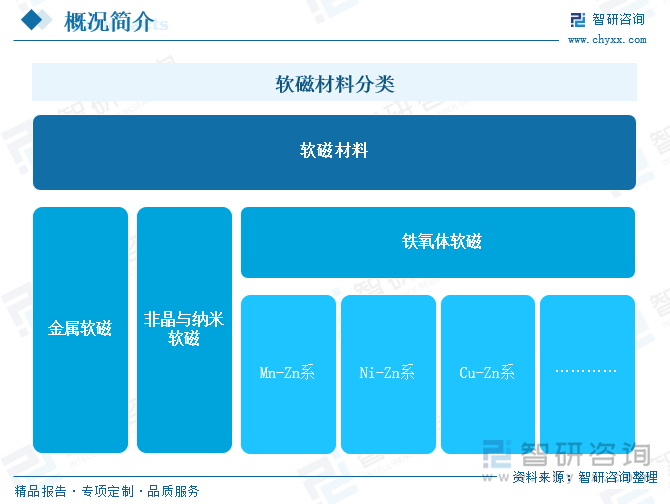
Industry Overview - Ferrite soft magnetic materials, primarily composed of Fe₂O₃, are produced using powder metallurgy and are widely applied in electronic components such as transformers and inductors [1][3] - China has become the world's largest producer of ferrite soft magnetic materials, with a mature application in traditional consumer electronics, industrial manufacturing, and energy sectors [1][14] - The industry is expected to see a sales volume of approximately 510,000 tons in 2024, representing a year-on-year growth of 6.25% [1][14] Application Demand - The demand for ferrite soft magnetic materials is driven by the growth in sectors such as new energy vehicles, photovoltaic systems, and big data [1][8] - In the new energy vehicle sector, production and sales are projected to reach 12.89 million and 12.87 million units respectively in 2024, with year-on-year growth rates of 34.4% and 35.5% [7][8] - The communication sector utilizes ferrite soft magnetic materials in 5G base station power supplies, which are critical for operational efficiency [10][12] Market Dynamics - The industry chain consists of upstream raw material supply (iron oxide, manganese oxide, zinc oxide), midstream production, and downstream applications in various sectors including home appliances and telecommunications [5][14] - The competitive landscape is fragmented, with many small enterprises relying on low-cost strategies, while key players like Hengdian East Magnetic and Spring Light Group hold stronger market positions [16][19] Development Trends - The industry is moving towards high performance and high-end products to meet the increasing demands of new energy vehicles and 5G technology [21] - Customization and personalization of products are becoming essential as electronic components evolve rapidly [22] - Automation and smart manufacturing are being integrated into production processes to enhance efficiency and reduce costs [24]


2025-2031年软磁铁氧体材料行业深度调研及投资前景可行性预测报告-中金企信发布
Sou Hu Cai Jing· 2025-07-08 07:03
Core Viewpoint - The soft magnetic ferrite materials industry is experiencing significant growth driven by increasing applications in emerging sectors such as electric vehicles, smart home appliances, communication devices, and renewable energy systems [4][10][12]. Group 1: Industry Development - The development of soft magnetic ferrite materials began in the 1930s, with significant advancements made in the 1960s and 1980s, leading to the establishment of a robust industry in China by the 2000s [3][4]. - China's soft magnetic ferrite industry has evolved rapidly, with production expanding to meet the growing demand from various sectors, including automotive electronics and renewable energy [4][5][6]. Group 2: Market Size and Growth - The global soft magnetic ferrite market is projected to reach $2.676 billion in sales by 2024 and $3.687 billion by 2031, with a compound annual growth rate (CAGR) of 4.8% [4]. - In China, the sales volume of soft magnetic ferrite materials was 480,000 tons in 2023, with a CAGR of 7.55% from 2021 to 2023 [5][6]. Group 3: Application Areas - Soft magnetic ferrite materials are increasingly used in electric vehicles, where they are essential for various electronic components, including inductors and transformers [8][10]. - The smart home and appliance sector is also a significant market for soft magnetic ferrite materials, driven by the demand for efficient power conversion and control [12][13]. - In the communication sector, soft magnetic ferrite materials are critical for 5G base station power supplies, enhancing performance and efficiency [14][15]. Group 4: Future Trends - The demand for high-performance soft magnetic ferrite materials is expected to grow as industries move towards miniaturization and higher power density requirements [6][10]. - The renewable energy sector, particularly solar energy and energy storage, presents substantial growth opportunities for soft magnetic ferrite materials, with significant increases in installation capacity projected [16][17].
海亮股份(002203) - 002203海亮股份投资者关系管理信息20250707
2025-07-07 10:08
Group 1: Company Overview and Global Presence - Zhejiang Hailiang Co., Ltd. has established 23 production bases globally, with domestic bases located in provinces such as Zhejiang, Shanghai, and Guangdong, and overseas bases in countries including the USA, Germany, and Vietnam [1][2] - The company has built long-term stable business relationships with nearly 10,000 customers across over 130 countries or regions [1] Group 2: Product Development and Market Position - Copper foil is a key product for the company, with significant resources invested in its development; the business faced temporary profit pressure but is showing signs of recovery in 2024 [2] - The company is focusing on lithium battery copper foil and standard copper foil, supporting the growth of the new energy and electronic circuit sectors [2] - Hailiang's Gansu subsidiary is developing solid-state battery copper foil, with plans for mass production in 2025 [2] Group 3: Response to Market Changes - The company has a limited direct impact from recent tariff policy changes due to its established global production network, which mitigates risks from single market fluctuations [3] - Hailiang is proactively addressing the trend of aluminum replacing copper by enhancing its aluminum production capabilities, particularly in the air conditioning and new energy vehicle sectors [3]
