大语言模型

Search documents
GPT-5.2性能爆表,但红色警报没有解除
3 6 Ke· 2025-12-12 01:41
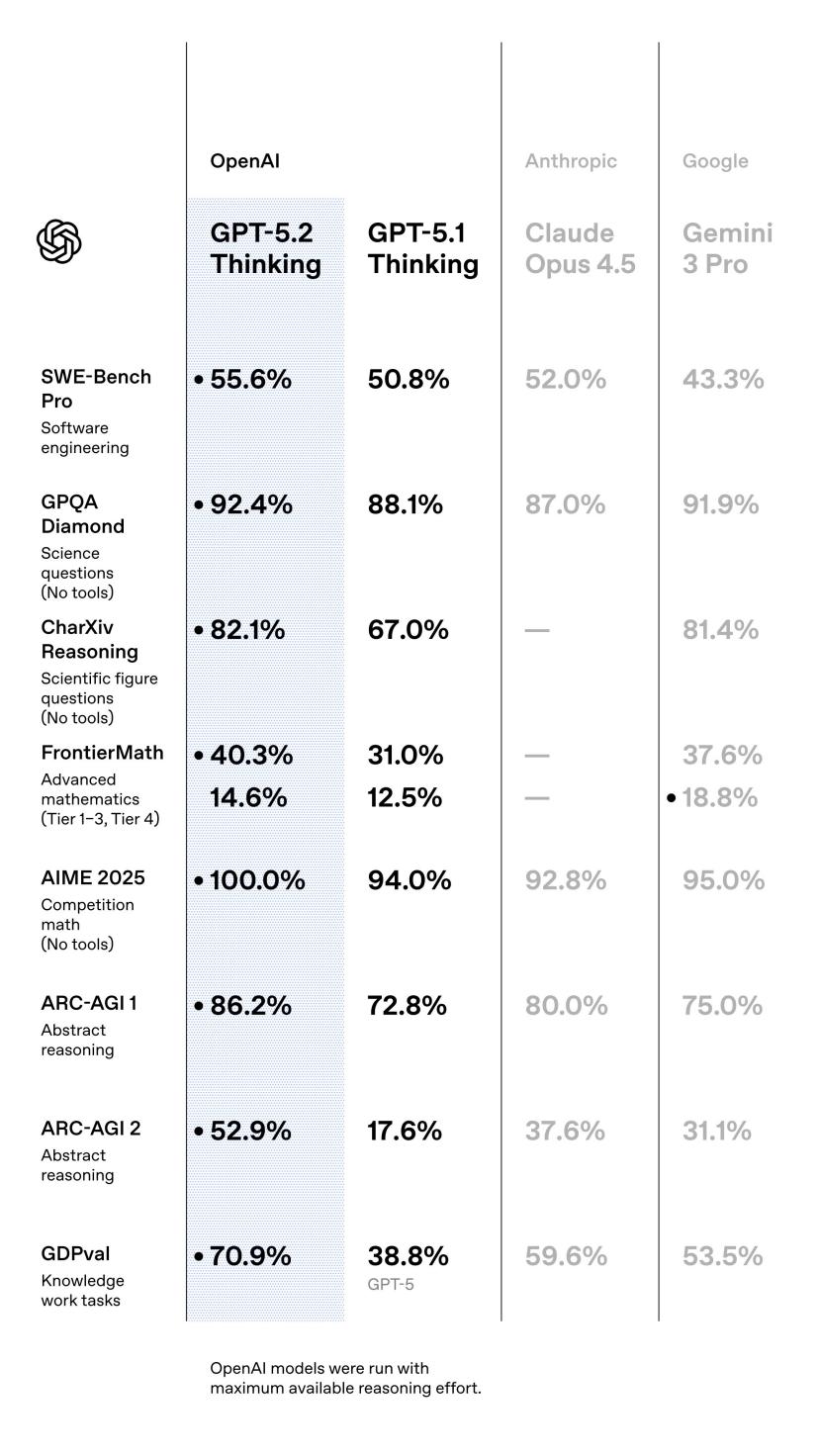
Core Insights - OpenAI has released ChatGPT-5.2, marking the first product launch after issuing a "Code Red" alert, indicating ongoing challenges despite significant performance improvements over its predecessor, GPT-5.1 [1] - The market is becoming more critical of OpenAI, focusing on the cost-effectiveness of computational power, which adds pressure on the company to demonstrate its superiority and irreplaceability [1] Performance Metrics - GPT-5.2 achieved a perfect score of 100% in the AIME 2025 mathematics competition, showcasing its enhanced mathematical reasoning capabilities [2][5] - In various benchmarks, GPT-5.2 outperformed competitors: - SWE-Bench: 55.6% accuracy compared to 50.8% for GPT-5.1, 52.0% for Claude, and 43.3% for Gemini [3] - GPQA: 92.4% accuracy, surpassing GPT-5.1's 88.1% and Claude's 87.0% [3] - AIME 2025: 100% accuracy, compared to 94.0% for Claude and 92.8% for Gemini [4] - ARC-AGI 1: 86.2% accuracy, leading the pack [4] Specialized Applications - GPT-5.2 demonstrated significant potential in professional tasks, achieving a 70.9% success rate against top industry experts in the GDPval benchmark, completing tasks at over 11 times the speed and less than 1% of the cost [5] - In software engineering, it reached 55.6% accuracy in SWE-Bench Pro, indicating strong capabilities in real-world coding tasks [5] Document Understanding and Visual Recognition - The model excelled in long document comprehension, achieving near 100% accuracy on tasks involving 256k tokens, allowing for effective analysis of extensive reports [6] - In visual understanding, GPT-5.2 halved the error rate in tasks related to chart reasoning and software interface comprehension, showing improved spatial recognition of objects [9] Product Variants and Efficiency - The release includes three versions: GPT-5.2 Instant for quick tasks, GPT-5.2 Thinking for deep reasoning, and GPT-5.2 Pro for high-difficulty problems, with the latter achieving a 390-fold efficiency improvement in ARC-AGI-1 testing [11] - The cost for GPT-5.2 has increased significantly, with API pricing set at $1.75 per million input tokens and $14 per million output tokens, reflecting a 40% increase from GPT-5.1 [20][22] Competitive Landscape - OpenAI's pricing strategy contrasts with competitors like Gemini and Claude, which have reduced their prices significantly, positioning GPT-5.2 as a "luxury" product [23][24] - The market dynamics suggest that OpenAI is betting on a segment of users willing to pay a premium for high-quality AI solutions, while also risking alienation if the performance does not meet expectations [24][25]

“横冲直撞”的AI手机来了
第一财经· 2025-12-11 04:10
Core Insights - The article discusses the impact of AI on the traditional mobile ecosystem, highlighting the competition between major tech companies and the emergence of AI-driven applications [3][4][8]. Group 1: AI and Mobile Ecosystem - ByteDance's collaboration with ZTE has prompted the industry to recognize the competition for control over mobile desktop interfaces, shifting focus from AGI and foundational model training to application deployment and entry point competition [4][8]. - The introduction of AI assistants aims to reduce user operation costs and enhance interaction efficiency, representing a significant evolution in smart terminal technology [4][8]. - The AI phone, dubbed Doubao, is seen as a potential disruptor to traditional app usage, allowing users to make requests and have AI complete tasks across multiple platforms [8][9]. Group 2: Challenges and Limitations - Users of the Doubao AI phone report that its accuracy is initially low, requiring multiple tests for optimization [7]. - The AI phone faces restrictions when accessing major applications, often requiring manual intervention for tasks involving sensitive user data [8][12]. - Concerns about privacy and security arise from granting AI systems access to core operating system functions, leading to potential risks such as data breaches and compliance issues [12][14]. Group 3: Industry Response and Future Outlook - Industry experts suggest that the mobile sector has not seen significant innovation for a long time, and the future direction should focus on openness and improved user experiences [11][18]. - There is a call for regulatory frameworks to address the conflicts arising from AI assistants disrupting existing commercial orders, emphasizing the need for both external regulations and internal industry governance [12][13]. - The future of the smart terminal ecosystem is expected to be diverse, involving various hardware and software service providers, with a need for unified standards to facilitate interoperability [18].

2023-2025年功能食品品类趋势与创新洞察变化报告-久谦中台
Sou Hu Cai Jing· 2025-12-10 19:17
Group 1 - The core viewpoint of the report highlights the growth trends in the functional food industry from 2023 to 2025, with an overall CAGR of 14.2%, driven by "strong efficacy" and "scientific ingredients" [1][12][32] - The liquid calcium category is identified as a successful innovation case, achieving a sales CAGR of 56.2% and addressing traditional pain points such as swallowing difficulties and poor absorption [2][11] - Consumer insights have evolved from fragmented data to deep analysis using large language models combined with social media data, enabling a better understanding of consumer motivations and future growth opportunities [6][9] Group 2 - The report emphasizes a significant transformation in consumer demographics, with a shift towards specialized and refined needs, particularly among children, pregnant women, and working professionals [34][36] - The competitive landscape is characterized by a K-shaped differentiation, where serious dosage forms and snack forms occupy the extremes, while mid-tier products face elimination [1][2] - Recommendations for industry participants include focusing on high-growth areas, enhancing product transparency, and leveraging data for personalized services [2][11][32] Group 3 - The report outlines the changing consumer psychology from emotional-driven purchases to rational consumption, focusing on disease prevention, stress relief, and cognitive enhancement [35][36] - The usage scenarios for functional foods have shifted from general daily assistance to specific high-stakes situations such as pregnancy and exam preparation [36][37] - The report suggests that the future of competition will revolve around the integration of functional attributes into food products, rather than treating them as separate entities [33][34]

上市公司数字技术风险暴露数据(2007-2024年)
Sou Hu Cai Jing· 2025-12-10 07:57
Group 1 - The article discusses the exposure of listed companies to digital technology risks from 2007 to 2024, utilizing FinBERT, a large language model, to analyze the Management Discussion and Analysis (MD&A) sections of annual reports for sentiment related to digital technology security [2][3] - The methodology involves identifying relevant text on digital technology risks, constructing a keyword list based on existing guidelines, and extracting sentences that reflect these risks [3][4] - A training dataset is created by annotating a sample of sentences to determine whether they indicate risk exposure or preventive measures, using a combination of AI models for accuracy [4][5] Group 2 - The final exposure level of digital technology risk is defined as the difference between the maximum negative sentiment probability of disclosed risks and the average positive sentiment probability of preventive measures, leading to the creation of specific indicators for data security and cyber risk exposure [6] - The effectiveness of the digital technology risk exposure indicators is validated by examining their correlation with other types of risks, revealing a significant positive relationship with financial and operational risks [7][8] - The model's accuracy in sentiment analysis related to digital technology risks is confirmed through random sampling and manual review, demonstrating high performance, especially in clearly biased sentences [8]

智能体将取代APP和SaaS,张亚勤院士发布这些AI洞见
Di Yi Cai Jing· 2025-12-10 05:56
Core Insights - The future will see more robots than humans within the next decade, with a significant shift towards intelligent agents replacing traditional SaaS and applications [1][4] - The new wave of artificial intelligence is characterized by the deep integration of information, physical, and biological intelligence, leading to a digital transformation across various domains [1][3] Group 1: Trends in AI Development - Generative AI is rapidly evolving into agent AI, with task complexity doubling in the past seven months and achieving over 50% accuracy, indicating alignment with human capabilities [3] - The scaling law's effectiveness is slowing during the pre-training phase, shifting focus to reasoning and agent-level intelligence in the post-training phase, with reasoning costs decreasing to one-tenth while agent computational demands have increased tenfold [3] - AI is transitioning from the information realm to the physical and biological worlds, exemplified by the anticipated 10% of new cars featuring autonomous driving capabilities by 2030 [3] Group 2: Robotics and Intelligent Agents - Robotics is viewed as the largest future market, with predictions that the number of robots will surpass humans within ten years, despite the current immaturity of humanoid robots [4] - Intelligent agents are expected to replace traditional SaaS services and applications, with examples such as a medical intelligent agent network simulating a hospital environment, achieving high diagnostic accuracy [4] - The goal of these intelligent agents is to assist rather than replace professionals, such as doctors, who may have dedicated intelligent assistants in the future [4] Group 3: Future Industry Landscape - The foundational large models will serve as the operating systems of the AI era, reshaping industry structures similar to how Windows and Android transformed their respective eras, with an anticipated industry scale 2-3 orders of magnitude larger than previous technological shifts [5] - It is predicted that there will be no more than ten foundational large models globally, with a split between the US and China, supplemented by a few other countries, leading to a dual-track development ecosystem of open-source and closed-source models [5] Group 4: Path to AGI - Achieving Artificial General Intelligence (AGI) will require new algorithmic frameworks, memory systems, and world models, with a potential paradigm shift in the next five years [6] - The comprehensive breakthrough in information, physical, and biological intelligence is expected to take 15 to 20 years to realize [6]
企业是否该用AI智能体?峰瑞李丰:先评估自身数字化水平,不高可以再等等
Xin Lang Cai Jing· 2025-12-10 02:24
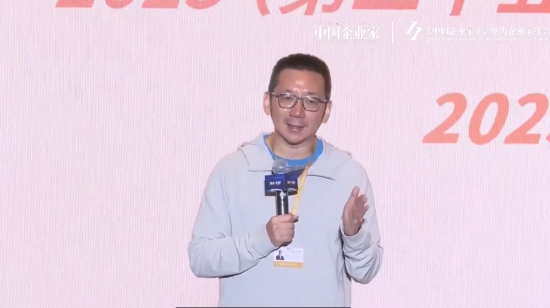
专题:2025《中国企业家》影响力企业家年会 12月5日-7日,由《中国企业家》杂志社主办的"2025(第二十三届)《中国企业家》影响力企业家年 会"(原中国企业领袖年会)在北京举行,主题为"涌现·无限——共创智能商业新形态"。峰瑞资本创始 合伙人李丰出席并演讲。 作为企业家,要不要今天开始和大家一样赶紧用智能体?李丰回答称,需要先评价一下企业内部和行业 链条中数字化水平是不是比较高了。"如果不高,也许还要再等一等。如果企业自身数字化水平很高 了,也许内部可以用一些智能体。" 他提到,这一轮AI是从大语言模型开始的,数据来自于过去超过40年互联网公开文本数据的积累,才 喂出了今天的大语言模型。 除了企业外,李丰表示,大语言模型最适用的垂直智能体场景,就是在任何商务过程和价值实现过程 中,作为自然语言作为交互方式,进行多轮对话,且实现了价值兑现,这样的行业最容易使用和利用到 AI智能体的垂直场景。 他举例到,比如金融行业,全链条数字化,主要靠专业技术和专业技能进行对话,告诉客户投资原因, 如何选金融产品,风险和潜在收益是什么。还有医疗行业,医生会用数字化设备检测身体,告诉患者如 何预防疾病等。这些行业都是最容易 ...
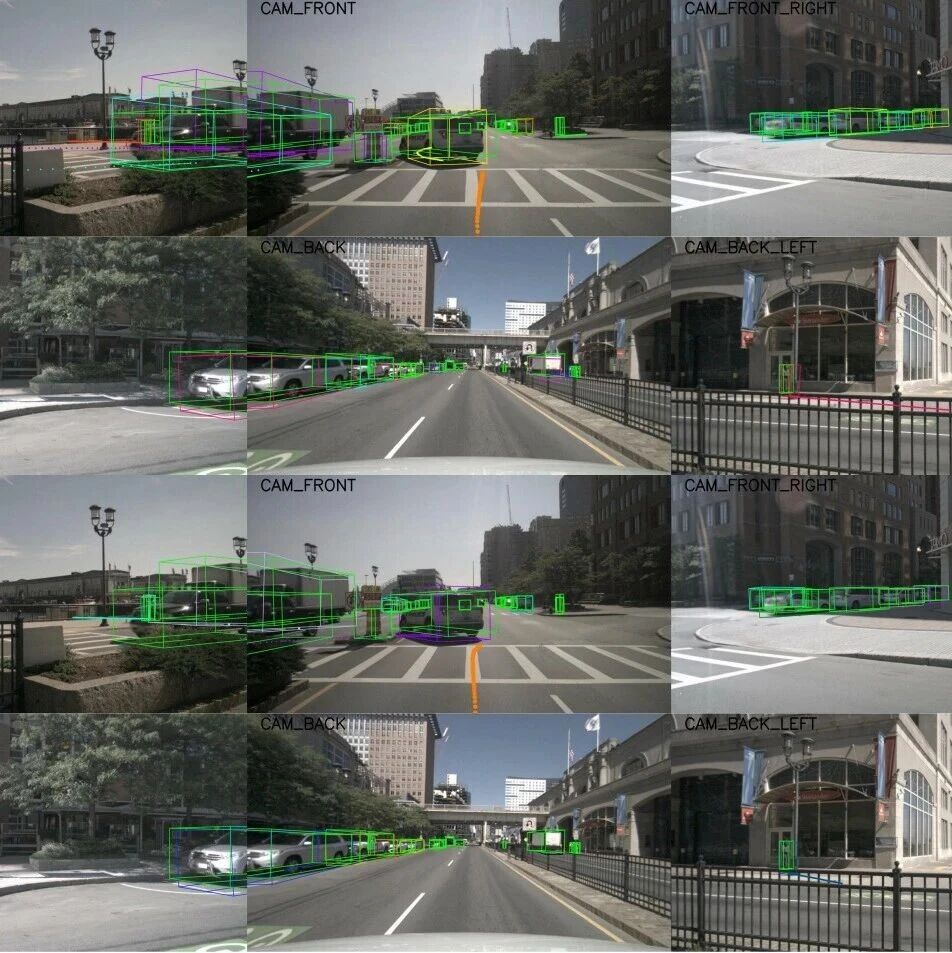
自动驾驶VLA全栈学习路线图
自动驾驶之心· 2025-12-09 19:00
Core Insights - The focus of academia and industry is shifting towards VLA (Vision-Language-Action) for enhancing autonomous driving capabilities, providing human-like reasoning in vehicle decision-making processes [1][4] - Traditional methods in perception and lane detection are becoming mature, leading to a decline in interest, while VLA is seen as a critical area for development by major players in the autonomous driving sector [4][6] Summary by Sections Introduction to VLA - VLA is categorized into modular VLA, integrated VLA, and reasoning-enhanced VLA, which are essential for improving the reliability and safety of autonomous driving [1][4] Course Overview - A comprehensive course on autonomous driving VLA has been designed, covering foundational algorithms and practical applications, aimed at deepening understanding of the perception systems in autonomous driving [6][21] Course Structure - The course consists of six chapters, starting with an introduction to VLA algorithms, followed by foundational knowledge in Vision, Language, and Action, and culminating in practical assignments [11][19] Chapter Highlights - Chapter 1 provides an overview of VLA algorithms and their development history, along with benchmarks and evaluation metrics [12] - Chapter 2 focuses on the foundational algorithms related to Vision, Language, and Action, including deployment of large models [13] - Chapter 3 discusses VLM (Vision-Language Model) as an interpreter in autonomous driving, covering classic and recent algorithms [14] - Chapter 4 delves into modular and integrated VLA, emphasizing the evolution of language models in planning and control [15] - Chapter 5 explores reasoning-enhanced VLA, introducing new modules for decision-making and action generation [16][18] Practical Applications - The course includes hands-on coding exercises, allowing participants to engage with real-world applications of VLA technologies, such as ReCogDrive and Impromptu VLA [15][18] Learning Outcomes - Participants are expected to gain a thorough understanding of current advancements in VLA, master core algorithms, and apply their knowledge to projects in the autonomous driving field [23][21]
H200获准对华出口 英伟达称“是值得肯定的举措”
Zhong Guo Jing Ying Bao· 2025-12-09 08:39
Core Viewpoint - The U.S. government has allowed NVIDIA to export its H200 chips to China and other qualified customers, with a 25% fee on each chip sold, which is expected to benefit NVIDIA significantly in the Chinese market [1][3]. Group 1: Product Details - The NVIDIA H200 chip, launched in November 2023, features a groundbreaking 141GB HBM3e memory system, enhancing its capability to process large models [1]. - Compared to the H100, the H200 has a 76% increase in memory capacity, a 43% increase in bandwidth, and up to a 90% improvement in AI inference performance, making it particularly suitable for large language models and scientific computing [2]. - The current market price for the H200 ranges from 200,000 to 250,000 RMB (approximately 28,000 to 35,000 USD), while complete systems incorporating multiple H200 GPUs can exceed 300,000 USD, potentially reaching over 600,000 USD [2]. Group 2: Market Impact - Major customers for the H200 include cloud service providers (Microsoft, Amazon, Google, Oracle), AI research giants (OpenAI, Meta, Cohere, Mistral), high-performance computing institutions, and enterprise clients across various sectors [2]. - As of December 2025, over 100 large organizations globally are expected to deploy the H200, with numerous smaller clients using it indirectly through cloud services [2]. Group 3: Competitive Landscape - The ability to sell H200 chips to China is seen as advantageous for NVIDIA, as the Chinese market is substantial and developers recognize the CUDA ecosystem [3]. - Despite the potential sales to China, domestic GPU manufacturers are increasingly catching up, with companies like Huawei and Alibaba developing competitive chips that may reduce reliance on NVIDIA [4]. - NVIDIA's CEO has indicated that even with the H200 available for sale in China, local companies may not necessarily choose to purchase it due to the performance of domestic alternatives [4].

谷歌Gemini 3来势汹汹,奥尔特曼拉响“红色警报”
财富FORTUNE· 2025-12-08 13:05
Core Insights - OpenAI CEO Sam Altman has declared a "red alert" status due to increasing competition from Google and other AI rivals, particularly following the release of Google's Gemini 3 model [2][6] - The competitive landscape has shifted, with Google now posing a significant threat to OpenAI's ChatGPT, which previously led the market [5][6] Group 1: Competitive Landscape - Google has launched its Gemini 3 model, which has been integrated into its vast ecosystem, achieving 650 million monthly active users in October [4] - Altman acknowledged the need for OpenAI to improve ChatGPT significantly, indicating that the company is under pressure to respond to Google's advancements [6] - The AI race has intensified, with OpenAI needing to secure additional funding of $100 billion while also increasing subscription revenue to meet investor expectations [5] Group 2: Historical Context - Google was once considered the leader in AI research, having developed foundational technologies like the Transformer architecture and the BERT model [4] - The emergence of ChatGPT marked a pivotal moment, shifting the focus of AI development and forcing Google to defend its position in the market [5] - Altman's internal memo suggests that OpenAI employees may need to cancel winter plans to focus on improving ChatGPT, reflecting the urgency of the situation [6]


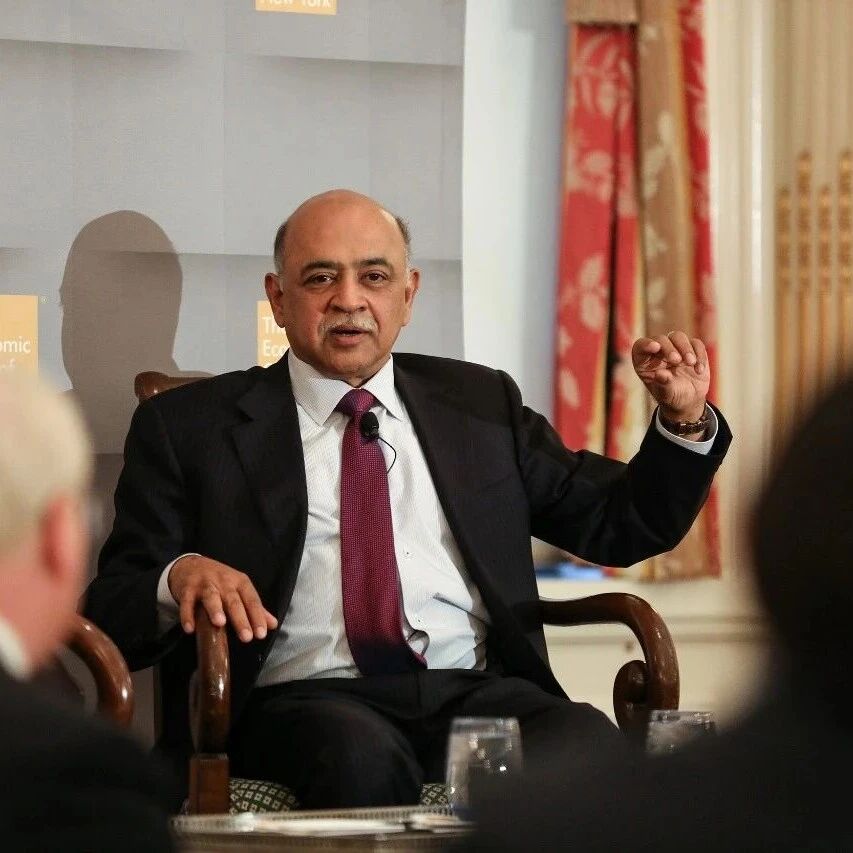
IBM CEO警告:超大规模云厂商的数据中心投资难以盈利
财富FORTUNE· 2025-12-08 13:05
Core Viewpoint - IBM's CEO Arvind Krishna questions the expected returns on the massive investments made by tech giants like Google and Amazon in AI infrastructure, suggesting that such investments are unlikely to yield reasonable returns due to the high costs associated with data centers [2][3]. Investment and Costs - Goldman Sachs estimates that the global data center market currently consumes about 55 gigawatts of power, with only approximately 14% related to AI. This demand is projected to rise to 84 gigawatts by 2027 due to increasing AI needs [2]. - Krishna calculates that building a 1-gigawatt data center requires an investment of about $80 billion. If a company commits to constructing 20 to 30 gigawatts of data centers, the capital expenditure could reach $1.5 trillion, nearly equivalent to Tesla's current market value [2]. - If all major cloud providers expand to around 100 gigawatts of capacity, it would necessitate an investment of approximately $8 trillion, with the required profit scale to cover this expenditure being staggering [2][3]. Profitability Concerns - Krishna emphasizes that $8 trillion in capital expenditure would require around $800 billion in profits just to cover interest payments, making it highly unlikely for such investments to be profitable [3]. - The rapid technological advancements mean that the chips relied upon in data centers quickly become obsolete, further complicating the return on investment [3]. AI Development and Market Trends - Despite the ongoing investment surge, Krishna believes the probability of achieving general artificial intelligence with current technologies is at most 1%. He acknowledges the significant value of this technology, which could unlock trillions of dollars in productivity potential, but asserts that the technological requirements far exceed those of current large language models [5]. - Major cloud providers are accelerating their investments in AI infrastructure, with expected expenditures reaching about $380 billion this year. Alphabet has raised its 2025 capital expenditure forecast from $85 billion to between $91 billion and $93 billion, while Amazon has increased its forecast from $118 billion to $125 billion [5].