消费升级

Search documents
黄金市场消费趋势洞察
炼丹炉· 2026-02-06 02:15
Investment Rating - The report indicates a positive investment outlook for the gold market, highlighting strong demand and growth potential in the jewelry sector [20][24]. Core Insights - The Chinese jewelry market is experiencing robust demand, with a market size increase from 580 billion yuan in 2018 to 820 billion yuan in 2023, reflecting a compound annual growth rate (CAGR) of 7.2% [20]. - Gold maintains a dominant position in the jewelry market, expected to exceed 60% market share by 2028, with a CAGR of 11.0% from 2018 to 2023 and 9.4% from 2023 to 2028 [24]. - The price of gold has been on a steep rise, with SGE gold prices increasing from approximately 370 yuan per gram in July 2021 to over 1038 yuan per gram by 2025, leading to higher retail prices for gold products [28]. - Innovations in gold craftsmanship, such as 3D/5D hard gold, are reshaping market dynamics, with a significant increase in sales of lightweight and fashionable gold products [35]. Industry Overview - The Chinese jewelry market is projected to continue expanding, with expectations to surpass 1.14 trillion yuan by 2028, driven by consumer demand for both emotional and value-retaining attributes of jewelry [20]. - Gold's market share in the jewelry sector is expected to grow significantly, driven by its safe-haven attributes and cultural influences [24]. Consumer Insights - Consumer decision-making in gold purchases is driven by both rational value retention and emotional aesthetic appeal, with weight and purity being primary concerns [47]. - There is a noticeable shift towards emotional and personalized consumption, with self-gifting becoming more prevalent, indicating a transition from traditional gifting scenarios [50]. - Young consumers, particularly women, are emerging as key drivers of gold consumption, with a growing preference for innovative and culturally resonant designs [54]. Competitive Landscape - Major brands like Chow Tai Fook and Lao Pu Gold are leading the market, with Chow Tai Fook maintaining a significant market share while Lao Pu Gold is experiencing rapid growth due to its cultural positioning [64][71]. - Lao Pu Gold is positioned as a high-end brand focusing on traditional craftsmanship, while Chow Tai Fook covers a broad market spectrum with a strong retail presence [64][110]. Trend Insights - Lightweight gold products, such as "small gold beans," are gaining popularity among younger consumers, facilitating a new approach to gold investment [123]. - The rise of personalized gold customization services reflects a growing consumer desire for unique identity expression through jewelry [129]. - Collaborations with popular IPs and cultural elements are becoming a trend, enhancing the appeal of gold products among younger demographics [136].
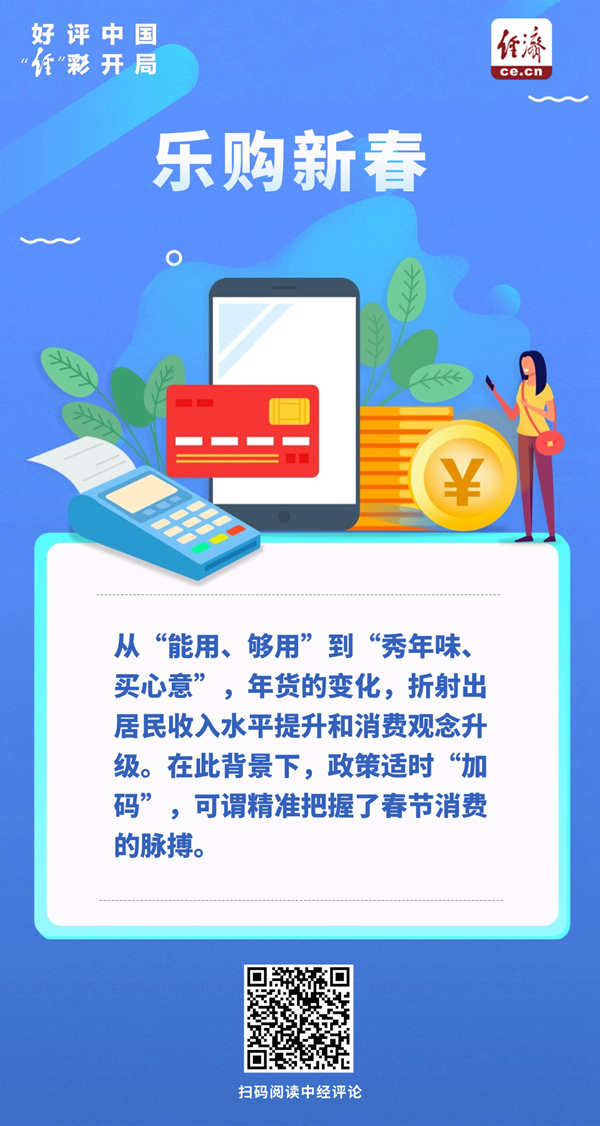
好评中国·“经”彩开局|“乐购新春”,共赴一场消费盛宴
Zhong Guo Jing Ji Wang· 2026-02-06 02:11
Group 1 - The core idea of the article emphasizes the transformation of consumer behavior during the Spring Festival, reflecting an increase in residents' income levels and an upgrade in consumption concepts [3][6] - The "2026 'Happy Shopping Spring Festival' Special Activity Plan" aims to create a nationwide consumption event from February 15 to 23, focusing on cultural traditions, family reunions, and shopping needs [6] - The plan encourages diverse consumption scenarios and aims to stimulate both demand and supply, with initiatives like food maps and local markets to enhance consumer choices [6][7] Group 2 - The goal of promoting consumption is not only to encourage spending but also to strengthen related industries through favorable policies, addressing the mismatch between high-quality demand and supply [7] - The "14th Five-Year Plan" suggests a strong push to boost consumption, with the upcoming Spring Festival seen as an opportunity to enhance the supply of quality goods and services [7] - The article highlights the importance of creating innovative consumption experiences and reducing costs to drive consumption upgrades, thereby injecting momentum into the holiday economy [7][8]


“十四五”时期陕西消费市场繁荣向好
Shan Xi Ri Bao· 2026-02-06 00:40
Core Insights - The report highlights the continuous expansion of the consumer market in Shaanxi during the "14th Five-Year Plan" period, with a total retail sales of consumer goods reaching 53,198.69 billion yuan, which is 1.2 times that of the "13th Five-Year Plan" period [1] Group 1: Consumer Market Growth - The total retail sales of consumer goods in Shaanxi is projected to reach 11,587.99 billion yuan by 2025, with a year-on-year growth of 6% [1] - The retail sales of new energy vehicles are expected to reach 865.27 billion yuan by 2025, which is 21.1 times that of 2020, with an average annual growth rate of 68.8% [1] - The share of new energy vehicle retail sales in total automotive retail sales is projected to be 53.7% by 2025, an increase of 49.9 percentage points compared to 2020 [1] Group 2: Service Consumption - By 2025, the catering revenue is expected to reach 1,272.16 billion yuan, which is 1.34 times that of 2020, with an average annual growth of 6% [2] - The proportion of catering revenue in total retail sales is projected to rise from 9.9% in 2020 to 11% in 2025 [2] - The online sales through public networks are expected to reach 1,274.87 billion yuan by 2025, which is 1.8 times that of 2020, with an average annual growth of 12.3% [2] Group 3: Business Entities Growth - By 2024, the number of legal entities in wholesale, retail, accommodation, and catering sectors is expected to reach 14,104, an increase of 4,436 compared to 2020, with an average annual growth of 9.9% [2] - The proportion of private enterprises in these sectors is projected to be 98.7% by 2024, an increase of 2.2 percentage points compared to 2020 [2] - The number of chain operation stores in the trade and commerce sector is expected to grow from 6,146 in 2020 to 10,423 by 2024, with an average annual increase of over 1,000 stores [2] Group 4: Urban and Rural Market Development - From 2020 to 2025, urban retail sales are expected to grow from 8,503.1 billion yuan to 10,276.54 billion yuan, with an average annual growth of 3.9% [3] - Rural retail sales are projected to increase from 998.1 billion yuan to 1,311.45 billion yuan, with an average annual growth of 5.6% [3] - By 2025, rural retail sales are expected to account for 11.3% of total retail sales, an increase of 0.8 percentage points compared to 2020 [3]
年货购物车也是业态晴雨表
Xin Lang Cai Jing· 2026-02-06 00:22
Group 1 - The core idea of the articles highlights a significant shift in consumer behavior during the Chinese New Year, moving from traditional necessities to personalized and emotionally valuable products [1][2][3] - The traditional "three essentials" for New Year celebrations—sunflower seeds, candies, and alcoholic beverages—are being replaced by new snacks, smart home appliances, cultural creative products, and pet gifts [1] - A survey indicates that 74% of consumers view the Spring Festival as a time for mental and physical adjustment, reflecting a desire for emotional connection rather than just material abundance [2] Group 2 - The changing consumption logic is reconstructing the essence of the New Year, presenting both challenges and opportunities for the market [3] - Government initiatives are encouraging the creation of a consumption festival during the nine-day Spring Festival holiday, focusing on six key areas: food, accommodation, transportation, tourism, shopping, and entertainment [3] - The evolving preferences of consumers are leading to a more vibrant and resilient economic landscape, with a growing emphasis on cultural experiences and emotional fulfillment [3]
“提升消费品质”为经济社会高质量发展注入持久动能
Xin Lang Cai Jing· 2026-02-05 22:20
Core Viewpoint - The China Consumers Association has announced "Enhancing Consumption Quality" as the theme for the 2026 Consumer Rights Protection Year, aiming to strengthen consumer rights protection and meet the growing demand for high-quality living among the public [1][2]. Group 1: Theme Significance - The theme "Enhancing Consumption Quality" emphasizes the responsibility of consumer associations to improve product and service quality, accelerate consumer rights protection, and optimize the consumption environment to support high-quality economic and social development [2][3]. - The focus is on enhancing the quality of goods and services, aligning with national economic priorities, and promoting green consumption through consumer education [2][3]. Group 2: Goals and Objectives - The association aims to achieve four main goals: 1. Act as a hub for consumer rights protection, fostering collaboration across departments to address consumer issues effectively [5]. 2. Improve the organizational structure of consumer associations to enhance complaint handling capabilities and streamline processes [5][6]. 3. Optimize the consumption environment by strengthening supervision and addressing emerging issues in new consumption models [6]. 4. Promote consumer education to empower consumers with knowledge about their rights and encourage rational consumption [6][8]. Group 3: Planned Activities - The association plans to conduct various activities, including: 1. Promoting the theme of consumer rights protection and organizing the "3.15" themed activities to raise awareness [7]. 2. Continuing the "3.15 Golden Autumn Shopping Festival" to highlight quality and service excellence [7]. 3. Enhancing the "National Consumer Wisdom 315" platform to improve complaint resolution rates [7][8]. 4. Strengthening green consumption education and releasing guidelines to promote sustainable living [8][9].
抓住体验产业发展新机遇
Jing Ji Ri Bao· 2026-02-05 22:11
Core Viewpoint - The experience industry is gaining attention and resources as a significant carrier of service consumption, driven by the shift in consumer behavior towards experience-oriented spending and the integration of new technologies [1][2][3] Group 1: Industry Trends - The experience industry is characterized by cross-industry integration, merging with agriculture, industry, and services to create new business models and opportunities [1][3] - Over 70% of young consumers are willing to pay for unique experiences, indicating a shift from material to experiential consumption [2] - The rapid development of technologies such as AI, VR, AR, and 5G is providing strong support for the experience industry, enabling immersive experiences and personalized interactions [2][3] Group 2: Policy and Market Environment - Government policies are increasingly focused on stimulating cultural and tourism consumption, supporting the development of immersive and digital cultural experiences [3][4] - There is a need for a standardized system for experience consumption, including quality requirements and pricing principles, to protect consumer rights and enhance market integrity [4] Group 3: Challenges and Solutions - The experience industry faces challenges such as homogenization of offerings and a lack of differentiated positioning, leading to intense competition [3] - There is a shortage of professionals who can integrate content creation and business operations, highlighting the need for a skilled workforce [3][5] Group 4: Innovation and Consumer Engagement - Utilizing big data and AI to create consumer emotion tagging systems can enhance product recommendations and marketing strategies [5] - Establishing immersive experience zones in retail and cultural venues can expand consumption scenarios and increase consumer engagement [5] Group 5: Inclusive Growth - Developing new business models and products that cater to local needs can enhance the overall consumption potential, especially in rural areas [5] - A focus on creating a consumer-friendly ecosystem can help meet diverse emotional needs and promote broader market participation [5]
从“购物车”变化看春节消费变迁
Xin Lang Cai Jing· 2026-02-05 18:10
Core Insights - The article highlights the transformation of consumer behavior in Quzhou during the Spring Festival, showcasing a shift from traditional practical purchases to a focus on quality, individuality, and cultural significance in shopping choices [1][2][3] Group 1: Consumer Behavior Changes - Quzhou's shopping carts have evolved to reflect new consumer trends, with "quality," "individuality," and "culture" becoming key labels for purchases [2] - The traditional focus on practical and sufficient items has shifted to a preference for personalized and aesthetically pleasing products, particularly among younger consumers [2] Group 2: Food Consumption Evolution - The traditional "big fish and meat" family reunion meals have been replaced by healthier, more diverse options, indicating a significant change in dietary preferences [2] - Local specialties and high-quality fresh produce are now popular, reflecting a shift from merely satisfying hunger to prioritizing health and nutrition [2] Group 3: Gift Purchasing Trends - The logic of gift selection has evolved from "higher price equals better quality" to a focus on meaningful content and practical use, with local specialty gift boxes gaining popularity [2] - This change not only reduces waste but also promotes local culture through consumer experiences [2] Group 4: Economic and Social Implications - The evolution of shopping carts represents a broader narrative of economic development, improved living standards, and upgraded consumer values in Quzhou [3] - Each upgrade in shopping habits reflects the public's aspiration for a better quality of life and highlights the vibrant growth of the Quzhou consumer market [3]
农牧上市公司抢抓春节消费契机
Zheng Quan Ri Bao· 2026-02-05 16:41
Core Viewpoint - Agricultural companies are leveraging innovative products and precise marketing strategies to capture the Spring Festival consumption opportunities, enhancing their market presence and driving sales growth [1][2][3]. Group 1: Company Strategies - Tangrenshen Group is focusing on a combination of traditional upgrades and new product innovations, launching "Tang Xiaochu" health food products to meet Spring Festival consumer demands [1]. - Xiangjia Co. is emphasizing freshness with a product matrix of fresh poultry and dishes, while accelerating the production of smart factories for automated and standardized production [2]. - Daodaquan Grain and Oil Co. is positioning itself with a "health + high-end" strategy, promoting high-end cold-pressed tea oil products and utilizing a combination sales strategy to enhance market penetration [2]. - Jinjian Rice Industry Co. is offering a full range of New Year products, ensuring quality through strict control of raw material planting and processing, while developing health-oriented products to cater to the needs of middle-aged and elderly consumers [2][3]. Group 2: Market Trends and Consumer Insights - Companies are effectively responding to consumer trends by integrating product development, process upgrades, and channel innovations, maintaining core advantages in traditional categories while aligning with health, convenience, and premium consumption demands [3]. - The innovation practices of these agricultural enterprises not only enhance their market competitiveness but also stimulate holiday consumption growth, showcasing the robust vitality and vast development potential of China's agricultural sector [3].




海南免税新政落地,每年1万额度如何改变百姓生活?
Sou Hu Cai Jing· 2026-02-05 14:41
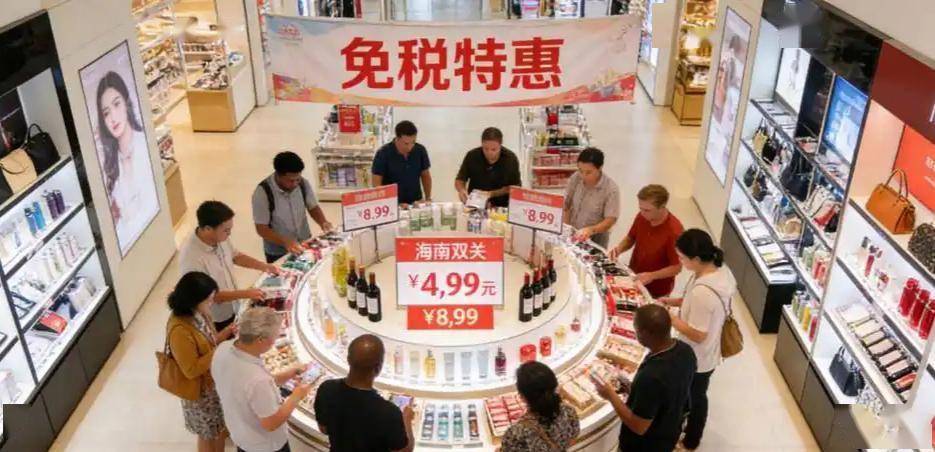
Core Insights - The new "zero tariff" policy in Hainan Free Trade Port allows residents to enjoy a tax-free shopping quota of 10,000 yuan per year, covering daily consumer goods such as food and personal care products, marking a significant shift in consumption patterns for over 8 million residents [2][3] Policy Highlights - The policy uniquely includes "daily consumption" for island residents, enabling a more convenient shopping experience [3] - Key features include no limits on purchase frequency, dynamic adjustment of the product list, and designated locations for on-site pickup, allowing residents to plan their shopping flexibly [3] - The policy prohibits the resale of purchased goods, with violations resulting in a three-year suspension of consumption eligibility [3] Benefits to Consumer Spending - Prices for imported goods have decreased significantly, with Australian beef prices dropping by approximately 15% and Japanese personal care products by up to 20%, translating to savings of about 1,500 yuan in taxes for an average family spending 10,000 yuan on imported goods annually [4] - The policy has led to a notable increase in the sales of imported infant formula, with a 47% year-on-year growth in the first week of implementation [4] Emerging Consumption Trends - The new policy is reshaping the consumption landscape in Hainan, with cross-border e-commerce stores transitioning to "zero tariff" physical stores and supermarkets creating dedicated sections for imported goods [5] - Consumers are adapting to a "fragmented tax-free" approach, breaking down their annual quota into multiple smaller purchases, thus transforming imported goods from "seasonal" to "everyday" items [5] - The 10,000 yuan quota presents both opportunities and challenges for consumers, leading to the emergence of new services such as "tax-free planners" and financial services from banks to help residents optimize their tax-free shopping strategies [5]
提前两周约不到!美团:家政保洁交易翻倍增长
2 1 Shi Ji Jing Ji Bao Dao· 2026-02-05 13:07
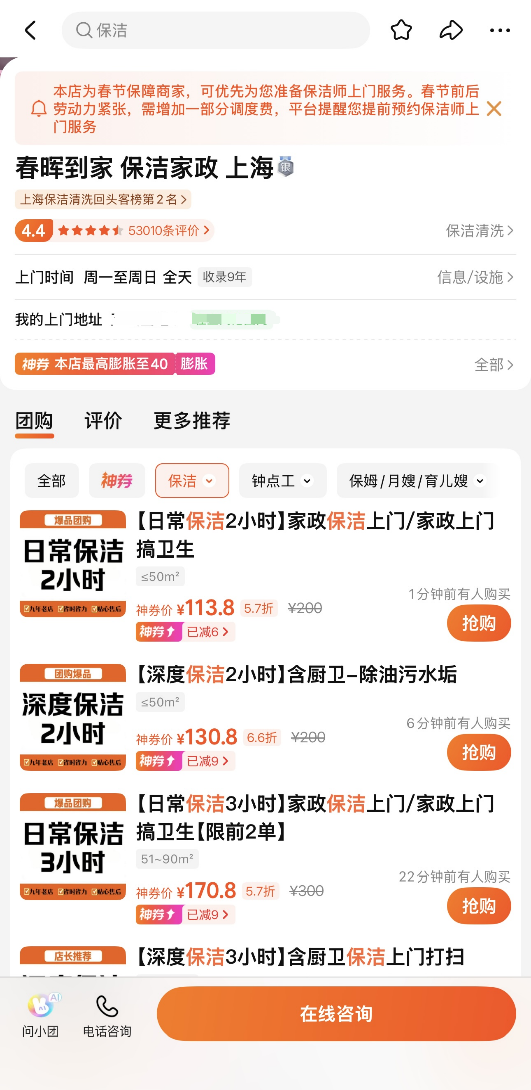
Core Insights - The home cleaning service industry is experiencing a surge in demand ahead of the Chinese New Year, with consumers increasingly viewing these services as essential [1][4] - Meituan's data indicates a significant increase in search volume and order quantity for home cleaning services, with a 158% rise in keyword searches and a doubling of order volume compared to the same period last year [1][4] Industry Trends - The demand for home cleaning services has intensified, particularly for specific services such as window cleaning and deep cleaning, with search volumes increasing by 254% and 260% respectively [4][5] - The primary consumer demographic for these services is individuals aged 30-35, who account for nearly 27% of the market [4] Service Supply and Quality Assurance - Meituan has implemented various measures to address challenges such as booking difficulties and labor shortages, including partnerships with nearly 3,000 service providers across 58 cities [5][6] - The introduction of AI technology has improved service efficiency, reducing average wait times for consumers by over 90% [5] Revenue and Incentives - The increase in demand has led to a significant rise in the income of cleaning service personnel, with average earnings increasing by over 70% in the past two weeks compared to last year [5][6] - Meituan has introduced a cash incentive program for service personnel to ensure stable service supply during peak demand periods [7] Quality Control Mechanisms - A dynamic performance evaluation system has been established to assess service quality and merchant capabilities, resulting in improved service efficiency and reduced service issues [6][7] - The implementation of this quality control mechanism has led to a notable decrease in service problems and an increase in order conversion rates [6]