
车路云一体化

Search documents
计算机行业重大事项点评:稳增长方案发布,L3+智能驾驶迎产业新机
Huachuang Securities· 2025-09-16 07:45
证 券 研 究 报 告 计算机行业重大事项点评 稳增长方案发布,L3+智能驾驶迎产业新机 事项: ❑ 9 月 12 日,工业和信息化部等八部门公布关于印发《汽车行业稳增长工作方 案(2025—2026 年)》的通知。 评论: 行业研究 计算机 2025 年 09 月 16 日 推荐(维持) 华创证券研究所 证券分析师:吴鸣远 邮箱:wumingyuan@hcyjs.com 执业编号:S0360523040001 联系人:周志浩 邮箱:zhouzhihao1@hcyjs.com 行业基本数据 | | | 占比% | | --- | --- | --- | | 股票家数(只) | 337 | 0.04 | | 总市值(亿元) | 59,813.55 | 5.10 | | 流通市值(亿元) | 53,712.71 | 5.68 | 相对指数表现 | % | 1M | 6M | 12M | | --- | --- | --- | --- | | 绝对表现 | 6.9% | 9.8% | 106.8% | | 相对表现 | -1.0% | -3.3% | 63.3% | 0% 39% 78% 117% 24/09 24 ...
长沙发布“车路云一体化”城市级智能网联全场景体系建设目标
Chang Sha Wan Bao· 2025-09-16 01:42
展望未来,长沙目标明确:建设"中部地区'车路云一体化'应用示范标杆",推动智能网联汽车实现城市 级规模应用。以湖南湘江新区为核心,逐步扩展至全市域,并联动株洲、湘潭,共同构建辐射中南地区 的智能网联生态体系。 9月15日,作为2025互联网岳麓大会最受瞩目的硬科技论坛之一,AI与智能网联汽车产业融合发展 论坛在梅溪湖艺术博物馆举行。论坛上,长沙发布"车路云一体化"城市级智能网联全场景体系建设目 标,明确到2026年建成中部地区首个"车路云一体化"应用生态示范标杆,产业规模突破1000亿元,实现 智能网联车辆接入1万辆以上,完成1450平方公里试点区域C-V2X网络全覆盖。 在这一总体目标引领下,长沙将分阶段推进全域路侧智能网联化,实现5G网络全域覆盖及重点区域5G- A增强覆盖,完成信号机网联化改造与重点路口路段的全面感知能力建设。 以应用场景为导向,长沙将推进"十城十车"数据互联示范,与上海、杭州、成都、合肥、无锡等城市协 同,推动红绿灯信息、道路信息等数据能够面向车端提供C-V2X应用服务;构建智能电轨、网联公交、 微循环小巴、自动驾驶出租车等联动的智慧交通体系;推动无人配送、无人环卫、无人零售等功能型无 ...
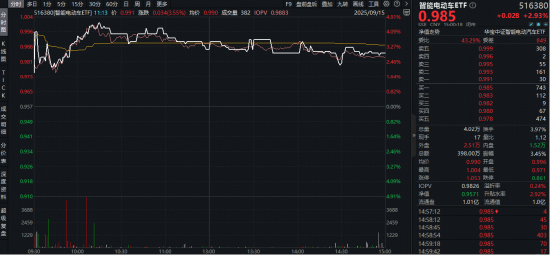
宁德时代大涨9%创新高!新能源政策利好+固态电池技术创新,智能电动车ETF(516380)上探4.6%创3年新高
Xin Lang Ji Jin· 2025-09-15 12:27
Core Viewpoint - The news highlights the positive impact of multiple policies on the new energy sector, particularly in the electric vehicle (EV) market, leading to significant stock price increases for key players in the industry [1][3]. Industry Overview - The electric vehicle ETF (516380) saw a price increase of over 4.6% during the day, closing up 2.93%, reaching its highest point since August 2022 [1]. - Key stocks in the battery sector, such as Tianci Materials and Hunan Youneng, experienced substantial gains, with Hunan Youneng rising by 10.77% and Tianci Materials by 9.99% [3]. - The automotive sector is witnessing a shift towards smart technology, with major companies like Junsen Electronics and Top Group also seeing significant stock price increases [3]. Policy and Market Drivers - The Ministry of Industry and Information Technology, along with seven other departments, recently issued a plan aiming for approximately 32.3 million vehicle sales in 2025, including 15.5 million new energy vehicles [3]. - The upcoming World Energy Storage Conference in Ningde, Fujian, from September 16-18, is expected to further promote advancements in energy storage technologies [4]. - The solid-state battery industry is accelerating its development, with major companies like CATL and Guoxuan High-Tech announcing mass production plans, aiming for GWh-level capacity by 2026 [4]. Investment Opportunities - The automotive parts sector is expected to benefit from the integration of smart technologies, with projections for significant valuation increases across the automotive industry [5]. - The smart electric vehicle ETF (516380) focuses on leading companies in both electrification and smart technology, presenting long-term investment opportunities for those interested in the electric vehicle sector [7].





“剑指”3230万辆!八部门联合印发汽车行业稳增长工作方案,一文速览↓
Yang Shi Wang· 2025-09-15 01:28
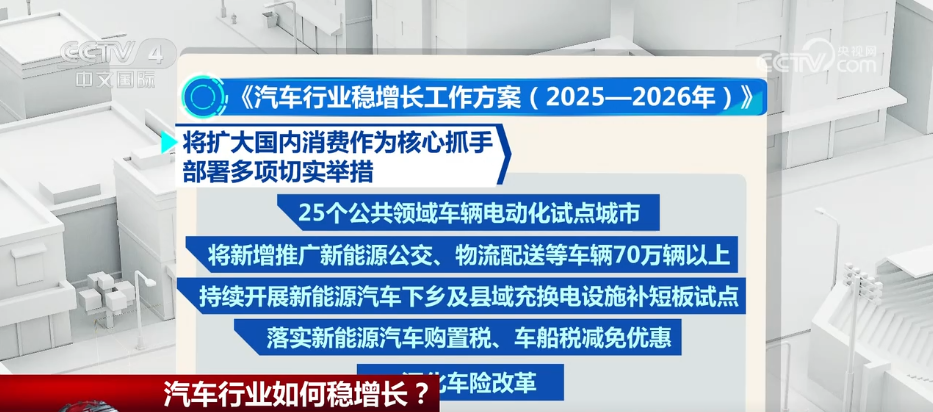
Group 1 - The core viewpoint of the article is the release of the "Automobile Industry Stabilization Growth Work Plan (2025-2026)" by the Ministry of Industry and Information Technology and other departments, aiming for automobile sales of approximately 32.3 million units in 2025, representing a year-on-year growth of about 3% [1] - The plan emphasizes expanding domestic consumption as a key strategy, with initiatives including the promotion of over 700,000 new energy buses and logistics vehicles in 25 pilot cities for electric vehicles, and the implementation of tax reductions for new energy vehicle purchases [3] - The plan also supports the replacement of old vehicles with new ones, encourages the expansion of the aftermarket, and suggests optimizing purchase restrictions in regions with such policies [3] Group 2 - The plan positions intelligent development at its core, focusing on the industrial application of intelligent connected technology and the construction of networked infrastructure and cloud control platforms [5] - It encourages the production approval of L3 level vehicles, which are conditionally automated driving cars, and aims to improve safety and insurance regulations [5] - The article mentions a new grading system for intelligent driving capabilities introduced by the China Automotive Engineering Research Institute, which categorizes intelligent driving into three levels based on technological maturity [9]
闪迪和美光陆续发布涨价函,存储涨价幅度超预期;国家网信办公开征求意见,探索使用数字人民币等新型支付方式开展跨境支付——《投资早参》
Mei Ri Jing Ji Xin Wen· 2025-09-14 23:58
Important Market News - The Ministry of Commerce received an anti-dumping investigation application on July 23, 2025, regarding imported simulation wafer products from the United States, leading to a formal investigation starting September 13, 2025 [1] Industry Insights - Micron Technology announced a price increase of 20%-30% for its memory products, halting all quotes for DDR4, DDR5, LPDDR4, and LPDDR5 products due to anticipated supply shortages [2] - SanDisk has also raised its storage product prices by over 10%, indicating a new wave of price increases in the storage industry [2] - Cloud service providers are increasing capital expenditures by $18 billion in fiscal year 2025, driving demand for storage in the AI sector [2] - According to TrendForce, NAND Flash wafer and client SSD prices rose by 10%-15% and 3%-8% respectively in Q2 2025, with DRAM prices increasing by approximately 72% over six months [3] - The digital yuan sector is seeing positive developments, with a draft regulation aimed at promoting electronic document applications and exploring new payment methods, including the digital yuan for cross-border payments [4] - The global retail cross-border payment market is projected to grow from $39.9 trillion in 2024 to $65 trillion by 2032, with B2B payments dominating [4] - The Ministry of Industry and Information Technology issued a plan to promote the industrial application of intelligent connected vehicles, including trials for L3-level vehicle production [5] - The "vehicle-road-cloud integration" is expected to generate an additional output value of 725.9 billion yuan in 2025, growing to 25.825 trillion yuan by 2030, with a compound annual growth rate of 28.8% [6]


八部门联合印发汽车行业稳增长工作方案
Zhong Guo Zheng Quan Bao· 2025-09-14 20:14
Core Insights - The Ministry of Industry and Information Technology and seven other departments jointly released the "Automobile Industry Stabilization and Growth Work Plan (2025-2026)", aiming for approximately 32.3 million vehicle sales in 2025, a 3% year-on-year increase, with new energy vehicle sales targeted at around 15.5 million, representing a 20% growth [1][2] Group 1: Industry Goals - The plan sets a target for 2026 to maintain a stable and positive development trend in the industry, with further improvements in scale and quality [1][2] - In 2024, the automobile sales reached 31.436 million units, a 4.5% increase year-on-year, with new energy vehicle sales at 12.866 million units, up 35.5% [1] Group 2: Policy Measures - The plan includes 15 key initiatives across four dimensions: expanding domestic consumption, improving supply quality, optimizing the development environment, and deepening open cooperation [2][3] - Specific measures include promoting the consumption of new energy vehicles, supporting vehicle trade-in programs, and enhancing the second-hand vehicle market [2][3] Group 3: Technological Innovation - The plan emphasizes the industrialization of intelligent connected technology, including the integration of vehicle-road-cloud applications and the promotion of high-performance communication modules [3] - It aims to stimulate potential consumer demand through technological innovation, focusing on key technologies such as automotive chips and solid-state batteries [3] Group 4: Export and Financial Services - The plan proposes measures to enhance the quality and efficiency of automobile exports, including improving financial services for exports and optimizing logistics systems [4] - It encourages financial institutions to provide credit support and risk management services for automotive enterprises, addressing challenges such as currency fluctuations [4]
汽车稳增长方案:规范竞争秩序、加快L3准入、突破汽车芯片、固态电池等技术
Hua Er Jie Jian Wen· 2025-09-13 07:08
Core Insights - The Ministry of Industry and Information Technology and eight other departments have jointly issued a plan to stabilize the automotive industry, aiming for approximately 32.3 million vehicle sales in 2025, a year-on-year increase of about 3% [1] - The plan sets a target of 15.5 million new energy vehicle sales in 2025, representing a year-on-year growth of around 20%, indicating a rapid transition towards electrification in the industry [1] - The automotive manufacturing industry's value-added is expected to grow by about 6% year-on-year, reflecting strong policy confidence in stabilizing growth [1] Industry Growth Targets - The plan aims for 2025 automotive sales of approximately 32.3 million units, with new energy vehicles expected to reach 15.5 million units [1] - The automotive manufacturing value-added is targeted to grow by around 6% year-on-year [1] - The overall automotive market is projected to maintain a stable growth trajectory through 2026 [1] Competition Regulation - The plan emphasizes the need to address issues of disorderly competition in the automotive sector, including establishing a feedback mechanism for key enterprises to address supplier payment issues [3] - It calls for a crackdown on false advertising and commercial defamation, as well as enhanced supervision of product consistency [3] - The plan encourages the consolidation of automotive production enterprises to improve resource allocation efficiency [3] Smart Connected Vehicles - The plan promotes the approval and trial of L3-level smart connected vehicles, marking a significant step towards the commercialization of autonomous driving in China [4] - It includes initiatives for integrated applications of smart connected vehicles and infrastructure development [4] - The plan supports the exploration of new business models across automotive, information communication, and transportation sectors [4] Key Technology Development - The plan outlines a focus on accelerating breakthroughs in automotive chips, operating systems, artificial intelligence, and solid-state batteries [5] - It emphasizes the importance of technological innovation in enhancing the core competitiveness of the Chinese automotive industry [5] - The plan encourages collaboration among enterprises of various sizes to foster innovation [5] Talent Development - The plan highlights the need to attract high-level talent in key areas such as automotive chips and operating systems [6] - It supports the establishment of national engineering practice bases in the smart connected vehicle sector to enhance local talent cultivation [6] Consumer Promotion Policies - The plan includes measures to promote vehicle replacement and trade-in programs, as well as the optimization of purchase restrictions in certain regions [7] - It aims to promote the adoption of new energy vehicles in public transport and logistics, targeting the addition of over 700,000 new energy vehicles in 25 pilot cities [7] - The plan also encourages reforms in automotive circulation and second-hand vehicle sales to enhance market efficiency [7]
八部门:推进智能网联汽车准入和上路通行试点,有条件批准L3级车型生产准入,加快突破固态电池等关键技术
Xin Lang Cai Jing· 2025-09-13 05:05
Core Insights - The Ministry of Industry and Information Technology and eight other departments issued a notice on the "Automobile Industry Stabilization and Growth Work Plan (2025-2026)", aiming for a total automobile sales target of approximately 32.3 million units in 2025, representing a year-on-year growth of about 3%, with new energy vehicle sales expected to reach around 15.5 million units, a growth of about 20% [1] Group 1: Industry Growth Targets - The plan sets a target for 2025 to achieve approximately 32.3 million vehicle sales, with a year-on-year increase of about 3% [1] - New energy vehicle sales are projected to be around 15.5 million units, reflecting a year-on-year growth of approximately 20% [1] - The automotive manufacturing industry's added value is expected to grow by about 6% year-on-year [1] Group 2: Smart Connected Vehicles - The plan promotes the industrial application of smart connected technology, including trials for L3 level vehicle production approval [3] - It encourages the development of V2X and 5G communication modules and the large-scale application of the Beidou system [3] - The initiative aims to foster new business models through data collaboration among automotive, information communication, and transportation industries [3] Group 3: Technological Innovation - The plan emphasizes accelerating breakthroughs in key technologies such as automotive chips, operating systems, artificial intelligence, and solid-state batteries [4] - It aims to enhance product performance and develop new features that meet consumer demands through technological innovation [4] - The initiative includes a special action to promote the upward development of Chinese automotive brands with international competitiveness [4] Group 4: Pilot Programs and Approval Processes - The pilot program for smart connected vehicles involves a multi-stage process including application, product approval testing, and road access trials [5][6] - The selection process for pilot programs involves expert evaluations to ensure comprehensive capability and safety assessments [6][7] - The expected outcomes of the pilot programs include improved capacity building for manufacturers and the establishment of a robust legal and regulatory framework [9]
周末大消息!刚刚,利好来了
天天基金网· 2025-09-13 03:59
Core Viewpoint - The article discusses the "Automobile Industry Stabilization and Growth Work Plan (2025-2026)" issued by eight departments, aiming to achieve a target of approximately 32.3 million vehicle sales in 2025, with a focus on boosting the electric vehicle market and enhancing the overall quality and efficiency of the automotive industry [3][5][28]. Summary by Sections Overall Requirements - The plan is guided by Xi Jinping's thoughts and aims to implement the spirit of the 20th National Congress of the Communist Party, focusing on stabilizing growth while promoting quality improvements in the automotive sector [11][35]. Main Goals - The target for 2025 is to achieve around 32.3 million vehicle sales, a year-on-year increase of about 3%, with approximately 15.5 million of those being new energy vehicles (NEVs), reflecting a 20% growth. The automotive manufacturing value-added is expected to grow by around 6% [12][37]. Work Measures - **Expanding Domestic Consumption**: Initiatives include promoting the electrification of public vehicles, supporting the replacement of old vehicles, and enhancing the infrastructure for charging stations [15][38]. - **Improving Supply Quality**: Emphasis on technological innovation to stimulate consumer demand, upgrading standards to enhance product quality, and ensuring the stability of the supply chain [18][40]. - **Optimizing Industry Development Environment**: This includes improving infrastructure for charging stations, reforming management policies for vehicle production, and ensuring fair competition within the industry [21][42]. - **Enhancing International Cooperation**: Encouraging automotive exports, improving financial services for exports, and fostering multi-level international collaboration [23][50]. Safeguard Measures - The plan includes strengthening coordination among departments, enhancing monitoring of industry operations, and focusing on talent development to support the automotive sector's growth [26][28].

事关汽车行业,八部门重磅印发!
Ge Long Hui· 2025-09-13 02:45
Core Viewpoint - The "Automobile Industry Stabilization and Growth Work Plan (2025-2026)" aims to achieve a stable growth trajectory for the automotive industry, with specific targets for vehicle sales, particularly in the new energy vehicle (NEV) sector, and to enhance the overall quality and efficiency of the industry [1][9]. Group 1: Industry Goals - The plan targets approximately 32.3 million vehicle sales in 2025, representing a year-on-year growth of about 3%, with NEV sales expected to reach around 15.5 million, growing approximately 20% [13][14]. - The automotive manufacturing industry's added value is projected to grow by about 6% year-on-year [14]. Group 2: Consumption Promotion - The plan emphasizes the need to boost automobile consumption, including supporting trade-in programs for old vehicles and promoting the use of NEVs in public transport [3][17]. - It encourages the optimization of purchase restrictions in areas with limits on car ownership and aims to facilitate the second-hand car market through measures like "reverse invoicing" [3][17]. Group 3: Technological Advancement - The plan promotes the industrial application of intelligent connected vehicle technology and aims to establish pilot projects for L3-level vehicle production approval [4][18]. - It highlights the importance of technological innovation in areas such as automotive chips, operating systems, and solid-state batteries to enhance product performance and meet consumer demands [5][21]. Group 4: Market Expansion - The plan calls for accelerating the market expansion of NEVs, with initiatives to electrify public sector vehicles and promote the use of fuel cell vehicles [6][16]. - It includes measures to improve charging infrastructure and support the development of a battery swap model to cater to diverse market needs [6][23]. Group 5: Industry Regulation and Competition - The plan aims to regulate the competitive order within the automotive industry, including cost investigations and price monitoring to ensure fair practices [2][24]. - It emphasizes the need for a healthy market environment by addressing issues like false advertising and commercial defamation [2][27]. Group 6: International Cooperation - The plan encourages international collaboration and the establishment of a comprehensive service platform for the automotive industry to enhance global competitiveness [29][31]. - It aims to support automotive enterprises in developing products suitable for international markets and improving their compliance capabilities [29][31].
