量化交易

Search documents
金融科技出海浪潮正劲:如何在监管与发展之间寻路全球化?
证券时报· 2025-06-22 08:22
Core Viewpoint - The demand for Chinese fintech companies to expand overseas has significantly increased, with "going abroad or being eliminated" becoming a consensus in the industry. This trend is crucial for enhancing China's global economic influence and financial rule-making power [1][2]. Group 1: Current Trends and Market Overview - The globalization wave among domestic enterprises is unstoppable, with leading companies, cross-border e-commerce, and financial services acting as strong drivers for overseas expansion [3]. - As of now, there are nearly 12,000 fintech companies in China, primarily located in major cities like Beijing, Shanghai, Shenzhen, and Hangzhou, accounting for over 60% of the market. The fintech market in China is expected to reach $5 trillion, representing over 40% of the global total [4]. - The report indicates that in 2024, China's total foreign direct investment across all industries is projected to be 1,159.27 billion RMB (approximately $162.78 billion), marking an 11.3% year-on-year increase [3]. Group 2: Opportunities and Challenges - Despite the growing demand for overseas expansion, companies face significant challenges, particularly in cross-border regulation and localization. The complexity of regulatory requirements and the high costs associated with compliance are major hurdles [6]. - Local data protection laws and the need for localized teams and products further increase the costs for Chinese fintech companies looking to expand internationally [6][8]. - Opportunities for Chinese fintech companies include the ongoing global push for financial inclusivity and digital transformation, as well as the potential for collaboration with developing countries [9]. Group 3: Strategic Recommendations - Companies are advised to adopt a long-term strategy for overseas expansion, focusing on local market needs and regulatory compliance. Building local development teams and understanding regional demands are essential for success [9][10]. - The importance of collaboration and leveraging local resources is emphasized, with suggestions for forming alliances to enhance competitive advantages in foreign markets [10]. - Hong Kong is highlighted as a strategic launchpad for Chinese companies due to its favorable regulatory environment, access to capital, and international talent [10].


2025年十大高薪行业
Sou Hu Cai Jing· 2025-06-21 12:38
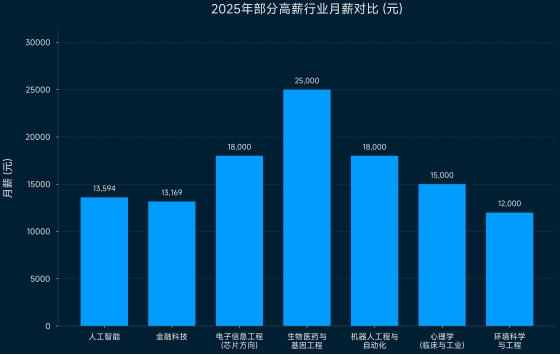
Core Insights - The article highlights the increasing salary disparities among industries in China as the economy transitions and optimizes its industrial structure, emphasizing the importance of understanding the distribution and trends of high-paying industries by 2025 for job seekers and human resource planning [1] Group 1: High-Paying Industries - The Artificial Intelligence industry ranks first with an average monthly salary of 13,594 CNY and a median salary of 10,501 CNY, driven by the growing demand for high-end talent due to the widespread application of AI technologies [3] - The FinTech industry follows closely with an average monthly salary of 13,169 CNY and a median salary of 10,001 CNY, as the integration of finance and technology continues to rise [6] - The Biopharmaceutical and Genetic Engineering industry offers an average annual salary ranging from 250,000 to 1,000,000 CNY, fueled by the aging population and breakthroughs in biomedicine [7] - The Electronic Information Engineering industry, particularly in the chip sector, has an average annual salary between 180,000 and 800,000 CNY, with a significant talent shortage in the semiconductor field [8] - The Robotics Engineering and Automation industry provides an average annual salary between 180,000 and 600,000 CNY, reflecting the increased demand for engineers amid the push for smart manufacturing [10] - The Psychology field, especially in clinical and industrial directions, offers an average annual salary between 250,000 and 500,000 CNY, driven by rising social pressures and awareness of mental health [11] - The Environmental Science and Engineering industry has an average annual salary between 120,000 and 250,000 CNY, supported by stricter environmental policies and the growth of carbon trading and ESG consulting [12] - The New Energy industry is projected to be one of the fastest-growing high-paying sectors by 2025, with increasing demand for talent in sustainable energy fields [13] - The High-End Manufacturing industry offers lucrative salaries for skilled engineers and technical experts, benefiting from the ongoing transformation and upgrading of the manufacturing sector [15] - The Internet and Software Development industry maintains a high salary trend, particularly in cloud computing and big data, with senior software engineers in major cities earning annual salaries of up to 500,000 CNY or more [17]
刷新下限!系好安全带,A股要探底回升了
Sou Hu Cai Jing· 2025-06-19 04:46
今日沪指跌0.86%,全市场超4600股下挫。A股在让人失望这件事情上从来没有让散户失望,下跌的数量也再次刷新最近下限,它还能跌多少家? 这个位置,大家都情绪化了,在股市挣10%比在现实盈利100万元都难,因为长期盈利是一件很难的事情。年初很多人都挣利润了,目前大概率都回撤了。 不出意外,港股的新消费概念走低,A股的白酒连续几天没有跌了,周末都不看好白酒的情况下,这周反而跌幅最少了。 | 前前,都有所不 | AND THE | | | | 304178 | | | | --- | --- | --- | --- | --- | --- | --- | --- | | 2614 11 11 | 12.11 | | | A3.28 | 1800 | | | | | WARRET CON | | 200 2 1 | 35 20 | 5.5481 | | | | Clear .. The N | -11 . 11 . 11 . | | A all " the till | and and | 28880 | | | | A 45 111 | | 11 - 17 | al lil al | | 159811 | | | ...
A股晚间热点 | 陆家嘴论坛召开在即!将释放什么信号
智通财经网· 2025-06-17 14:55
Group 1 - Xi Jinping expressed concerns over the escalating tensions in the Middle East due to Israel's military actions against Iran, emphasizing the need for conflict de-escalation and constructive efforts for regional stability [1] - The 2025 Lujiazui Forum will focus on financial reform and international cooperation to inject new momentum into global economic growth, serving as a platform for important financial policy announcements [2] - The Chinese Ministry of Foreign Affairs criticized Taiwan's inclusion of Huawei and SMIC in its entity list under U.S. pressure, condemning the politicization of technology and trade issues [3] Group 2 - In May 2025, there was a net inflow of $33 billion in cross-border funds, with foreign investment in domestic stocks increasing compared to the previous month, indicating a stable foreign exchange market [4] - Recent reports indicate a rise in the proportion of quantitative trading in the A-share market, attributed to increased activity in small and mid-cap stocks [5][6] - The Hong Kong stock market saw a significant drop in the innovative drug sector, with a decline exceeding 6%, attributed to high trading congestion rather than external negative news [6] Group 3 - The technology sector has shown signs of cooling, with the average daily trading volume on the STAR Market at 92.2 billion yuan in June, ranking among the lowest in the past eight months [7] - The U.S. stock market indices experienced declines, with notable movements in specific stocks, including a 17% increase in a Chinese biotech company [8] - The Federal Reserve is expected to maintain its current interest rate stance, with discussions around the impact of tariffs on inflation expectations [9][10] Group 4 - The Bank of Japan decided to keep interest rates unchanged and will slow down its bond purchase reduction next year, reflecting a cautious approach amid market volatility [10] - The European Union is pushing for a complete ban on Russian gas imports by the end of 2027, aiming to enhance energy security in response to geopolitical tensions [10] - Guangdong's State-owned Assets Supervision and Administration Commission announced increased investments in new industries and high-tech enterprises, with a total commitment of approximately 70 billion yuan [12]


A股:继续横盘,好信号来了?周三,大盘走势分析
Sou Hu Cai Jing· 2025-06-17 09:28
Group 1 - The market is currently experiencing limited fluctuations, with the Shanghai Composite Index showing stability despite 2,921 stocks declining and 9 hitting the limit down [1] - The core market players are primarily concentrated in heavyweight stocks like the CSI 300 and SSE 50, with major support from state-owned entities such as Huijin, leading to a stable market environment [3][6] - The current trading environment is characterized by a lack of significant selling pressure, as major institutional players hold substantial positions in heavyweight stocks, making it difficult for other sectors to drive the market down [4][6] Group 2 - The market is entering a phase of dull competition, with participants waiting for financial policy changes, particularly in real estate and interest rates, to stimulate movement [6][8] - The performance of individual stocks, especially in the technology and small-cap sectors, remains active, while the overall index movements are less relevant to retail investors' profitability [6][8] - The potential for a significant upward movement in the index exists, but many investors may not benefit from it, as their individual stocks may not recover to previous highs [8]

让期货市场成为量化交易的主战场
Guo Ji Jin Rong Bao· 2025-06-16 10:03
Core Viewpoint - The China Securities Regulatory Commission (CSRC) has introduced the "Regulations on the Management of Program Trading in the Futures Market (Trial)" to enhance the regulation of program trading, aiming to standardize trading behavior and maintain market order and fairness. The regulations will take effect on October 9, 2025, marking a new phase of standardized development for quantitative trading in the futures market [1]. Group 1 - The new regulations consist of 7 chapters and 37 articles, covering the entire process of program trading regulation, including definitions, reporting requirements, system access management, prohibited behaviors, and risk management [1]. - The implementation of these regulations is expected to provide clearer guidelines for quantitative trading investors and enhance the institutional framework of the futures market [1]. - The futures market is seen as a more suitable environment for quantitative trading compared to the A-share market, where quantitative trading has faced significant criticism [2]. Group 2 - The futures market primarily consists of institutional investors, with a limited number of individual investor accounts, contrasting sharply with the A-share market, which has over 200 million individual accounts [2]. - The T+0 trading mechanism in the futures market allows for intraday trading without overnight positions, unlike the T+1 system in the stock market, which can lead to passive losses for investors [2]. - The futures market allows for both long and short positions, making it easier for investors to accept quantitative trading strategies that involve short selling, which is not as prevalent in the stock market [2]. Group 3 - The futures market employs a margin trading model, making short-term trading the norm, which aligns well with the high-frequency and short-term strategies of quantitative trading [3]. - The characteristics of the futures market, such as dual-direction trading, T+0 mechanism, and leverage, create a perfect synergy with quantitative strategies, unlike the long-term investment preference in the A-share market [3]. - It is suggested that futures exchanges should take advantage of the new regulations to attract quantitative funds, while regulatory bodies should impose restrictions on quantitative trading in the stock market to guide investors towards the futures market [3].
创纪录!全球巨头出手
Zhong Guo Ji Jin Bao· 2025-06-15 09:10
Group 1 - Jane Street has signed a lease agreement to occupy 223,437 square feet of office space in the Central Waterfront flagship project, marking the largest single office leasing transaction in Hong Kong's Central business district in decades [1][2] - The rental price for the leased space is set at HKD 137 per square foot per month, which translates to a monthly rent of several tens of millions of Hong Kong dollars for Jane Street [2] - The Central Waterfront project will feature a total of 700,000 square feet of Grade A office and ancillary space, along with over 900,000 square feet of retail space, with the first phase expected to be completed by Q4 2026 [2] Group 2 - Jane Street has experienced explosive growth, with trading revenue projected to reach USD 20.5 billion in 2024, a 94% increase from 2023, and net profit expected to be USD 12.96 billion, significantly up from USD 5.9 billion in 2023 [3] - In Q1 2025, despite global market volatility due to tariff policies, Jane Street's trading revenue further increased to approximately USD 7.2 billion, representing over 60% year-on-year growth [3] - The company currently employs around 400 staff in Hong Kong and is actively recruiting for over 50 positions, indicating its expansion ambitions in the region [3]
国家队暂停托市?6月14日,市场泥沙俱下,投资者该何去何从
Sou Hu Cai Jing· 2025-06-14 14:13
Group 1 - The national team has paused market support, leading to a significant drop in the Shanghai Composite Index, which fell below 3400 points after only two days above that level [1] - The recent market rebound failed to break the high point from May, indicating that the current upward movement is merely a temporary disruption in a larger downward trend that has persisted since October of last year [1] - The Hong Kong stock market is also experiencing a noticeable pullback, suggesting that the A-share market may face challenges in rising [1] Group 2 - The A-share market opened lower and continued to decline, with the overall index dropping by 1.46%, indicating a critical third day for potential reversal [3] - Over 4400 stocks declined, and trading volume significantly increased, with half-day trading reaching 936.1 billion, suggesting heightened selling pressure [3] - The main funds played a role in driving the market down, with a net sell of 47 billion in just half a day, particularly affecting major stocks like Kweichow Moutai and Wuliangye [5] Group 3 - All three major indices declined, with the Shanghai Composite Index closing down 0.75% and falling below 3400 points, driven by a net sell of 606 billion from main funds [7] - The pattern of selling at the 3400-point mark appears to be systematic, possibly influenced by AI-driven quantitative trading strategies [7] - The increasing dominance of quantitative trading in the market poses challenges for traditional institutional and individual investors [7]


量化交易来势汹汹,散户又该怎么办?
格隆汇APP· 2025-06-14 08:38
Core Viewpoint - The rise of quantitative trading has significantly altered the structure of the A-share market, creating both opportunities and challenges for retail investors [6][8]. Group 1: Quantitative Trading Impact - As of May 2025, quantitative trading accounts for 25% to 30% of trading volume in the A-share market, with some days approaching 35% [3]. - Quantitative trading operates at a speed of a few hundred milliseconds, compared to the average five seconds for retail investors, creating a substantial speed advantage [5]. - The presence of quantitative trading has introduced a new level of liquidity to the market, but it has also led to perceived unfairness for retail investors [6]. Group 2: Data and Strategy Disparity - Quantitative institutions process terabytes of data daily, including historical market data and social media sentiment, while retail investors rely on fragmented news and financial reports [4][6]. - The disparity in data access and processing capabilities gives quantitative firms a significant edge in strategy execution [6]. - High-frequency trading accounts for approximately 60% of total programmatic trading volume, acting as a "digital scythe" that capitalizes on the slower reactions of retail investors [5]. Group 3: Regulatory Environment - The China Securities Regulatory Commission (CSRC) is implementing a gradual regulatory approach to enhance the oversight of quantitative trading while maintaining its benefits for market efficiency [6]. - New regulations set to be implemented in October will shift the focus from speed to the effectiveness of trading strategies, indicating a potential evolution in the competitive landscape of quantitative trading [7]. Group 4: Future Considerations for Retail Investors - Retail investors face a choice: adapt to algorithmic trading or risk being outpaced by it [8]. - The increasing availability of low-threshold quantitative tools from brokerages may provide retail investors with opportunities to engage in quantitative trading [6].

量化交易来势汹汹,散户又该怎么办?
格隆汇APP· 2025-06-14 08:37
Core Viewpoint - The rise of quantitative trading has significantly altered the structure of the A-share market, creating both opportunities and challenges for retail investors [6][8]. Group 1: Quantitative Trading Impact - As of May 2025, quantitative trading accounts for 25% to 30% of trading volume in the A-share market, with some days approaching 35% [3]. - Quantitative trading operates at a speed of a few hundred milliseconds, compared to the average five seconds for retail investors, creating a substantial speed advantage [5]. - The presence of quantitative trading has introduced a new level of liquidity to the market, but it has also led to perceived unfairness for retail investors [6]. Group 2: Data and Strategy Disparity - Quantitative institutions process terabytes of data daily, including historical market data and social media sentiment, while retail investors rely on fragmented news and financial reports [4][6]. - The disparity in data access and processing capabilities gives quantitative firms a significant edge in strategy execution [6]. - High-frequency trading accounts for approximately 60% of total programmatic trading volume, acting as a "digital scythe" that capitalizes on the slower reactions of retail investors [5]. Group 3: Regulatory Environment - The China Securities Regulatory Commission (CSRC) is implementing a gradual regulatory approach to enhance the oversight of quantitative trading, aiming to maintain market fairness while allowing for efficiency improvements [6]. - New regulations set to be implemented in October will shift the focus from speed to the effectiveness of trading strategies, indicating a potential evolution in the competitive landscape of quantitative trading [7]. Group 4: Future Considerations for Retail Investors - Retail investors face a choice: adapt to algorithmic trading or risk being outpaced by it [8]. - The increasing availability of low-threshold quantitative tools from brokerages may provide retail investors with opportunities to engage in quantitative trading [6].