
数据安全

Search documents
AI应用泄露个人隐私?数据安全亟需构建三方“协作桥”
Zhong Guo Xin Wen Wang· 2025-10-17 16:08
Core Insights - The rapid development of artificial intelligence (AI) has led to increased privacy risks for users, as their personal data is often exploited without consent [1][3] - A collaborative effort among smart terminal manufacturers, app developers, and users is essential to ensure data privacy and security [1][4] Group 1: AI Development and Privacy Risks - AI's explosive growth relies on vast amounts of user data, which raises significant privacy concerns [1] - The National Cybersecurity Center of China reported multiple mobile applications involved in illegal collection and use of personal information, many of which are related to AI models [1][3] Group 2: Security Measures and Challenges - A joint white paper predicts a fundamental shift in mobile agent security architecture from "external" to "internal" protection, emphasizing the need for hardware and system restructuring [2] - The white paper identifies three core challenges for mobile agent security technology: computational overhead from encryption affecting user experience, the diversity of hardware platforms complicating standardization, and unpredictable security incidents due to autonomous decision-making [3] Group 3: Regulatory and Standardization Efforts - Regulatory bodies are intensifying personal information protection measures, pushing for data collection practices to become minimal, necessary, transparent, and controllable [3] - Experts suggest that initial standards and regulations should be established and continuously revised to keep pace with AI technology advancements [4]
报告发布!全国网安产业规模超两千亿,AI等“新蓝海”涌现
Nan Fang Du Shi Bao· 2025-10-17 11:41
Core Insights - The report highlights the importance of advanced cybersecurity technology and a robust cybersecurity industry for maintaining national cybersecurity [1] - The current scale of China's cybersecurity industry has reached nearly 220 billion yuan, but it still faces challenges such as fragmentation and slowing revenue growth among listed companies [1] - Emerging fields like industrial internet, artificial intelligence, and data security are creating new opportunities for industry development, driving a shift towards more integrated and capability-driven security products and services [1] - Generative artificial intelligence is described as a "double-edged sword," enhancing intelligent defense while lowering the barriers for cyberattacks, complicating security regulation [1] Industry Outlook - Despite being in the early stages of development, the Chinese cybersecurity industry has significant growth potential, driven by ongoing optimization of top-level design, deep integration of technologies, and innovation in service models [2] - The industry is expected to achieve leapfrog development in response to major power competition and digital challenges [2]
EDGE与du达成战略合作以强化阿联酋国家电信与金融数据安全
Shang Wu Bu Wang Zhan· 2025-10-16 15:54
Core Insights - EDGE Group has formed a strategic partnership with du Group to enhance data security for telecommunications and financial data in the UAE [1] - The collaboration involves integrating KATIM Gateway network encryption devices into national telecom infrastructure, ensuring secure data flow for financial institutions [1] - This initiative supports connectivity with the Central Bank of the UAE (CBUAE) [1] Group 1 - EDGE Group is a leading advanced technology and defense company in the UAE [1] - du Group is a prominent telecommunications and digital services provider in the UAE [1] - The partnership aims to bolster the security of financial data within the UAE [1] Group 2 - The KATIM Gateway network encryption devices will be embedded in the national telecom infrastructure [1] - The collaboration is expected to provide secure data flow for financial institutions operating in the UAE [1] - The initiative aligns with the regulatory requirements set by the Central Bank of the UAE [1]
消金公司晒出千家“伙伴清单”
Jin Rong Shi Bao· 2025-10-15 02:17
Core Viewpoint - The implementation of the new regulatory framework for internet lending by commercial banks aims to enhance the quality and efficiency of financial services, requiring banks to manage platform operators and credit enhancement service providers through a list management system [1] Group 1: Regulatory Changes - The Financial Regulatory Bureau issued a notice on October 1, mandating commercial banks to disclose lists of platform operators and credit enhancement service providers [1] - Licensed consumer finance companies have begun to disclose their partner lists in compliance with the new regulations during a six-month transition period [1] Group 2: Partner Disclosures - As of September 30, 31 consumer finance companies have disclosed a total of 1,133 partner institutions, including lending, credit enhancement, and collection service providers [3] - Notable disclosures include JD Finance's partnerships with 5 internet loan operators and 3 post-loan service providers, and Citic Consumer Finance's collaboration with 19 platform operators and 15 credit enhancement service providers [2][3] Group 3: Diverse Collaboration Paths - The disclosed partner lists show a diverse range of platform operators, including internet giants like Ant Group and JD, as well as specialized fintech companies and other licensed financial institutions [4] - Different consumer finance companies exhibit varying strategies in partner selection based on their unique strengths and resource endowments [4][5] Group 4: Compliance and Risk Management - The industry faces common challenges related to compliance and risk, particularly concerning consumer complaints about hidden fees and inadequate information disclosure [6] - The new regulations increase compliance costs for consumer finance companies, necessitating enhanced data security measures to protect sensitive information [6][7] Group 5: Strategic Partnerships - Consumer finance companies leverage partnerships with lending platforms to enhance efficiency and share risks, with lending platforms acting as outsourced financial service providers [7] - The collaboration between licensed financial institutions and lending platforms aims to combine funding advantages with effective online customer acquisition and risk management capabilities [7]
车辆生产准入新规征求意见 网络安全、自动驾驶成审查重点
Yang Shi Xin Wen· 2025-10-15 00:12
Core Viewpoint - The Ministry of Industry and Information Technology of China has solicited opinions on the "Access Review Requirements for Road Motor Vehicle Production Enterprises," emphasizing the need to enhance safety requirements for intelligent and connected vehicle production. Group 1: Safety and Quality Enhancement - The draft aims to comprehensively strengthen the safety requirements related to the production of intelligent and connected vehicles, focusing on network security, data security, advanced driver assistance systems, and autonomous driving capabilities [1][3]. - The initiative addresses new risks associated with emerging technologies in the automotive sector and aims to improve product quality and consumer rights protection [3]. Group 2: Adaptation to Industry Trends - The draft also merges the access review requirements for new energy vehicles to align with the trend of electrification in the automotive industry [5]. - It emphasizes reducing the burden on enterprises by optimizing certain research and development capability requirements based on the characteristics of different products [5][7]. - The specialization of new energy vehicle categories has increased, allowing manufacturers to focus on the specific R&D capabilities required for their vehicle types, significantly alleviating the burden of R&D capability construction [7].


从 “卡脖子” 到 “自主可控”:科蓝软件自研数据库撑起技术安全防线
Quan Jing Wang· 2025-10-14 11:32
Core Insights - The article highlights the risks associated with using open-source databases for sensitive information storage, emphasizing the advantages of proprietary databases like those developed by Kelaun [2][3][4] Group 1: Vulnerabilities of Open-Source Databases - Open-source databases have slow vulnerability patching processes, exemplified by the 47-day delay in fixing the "Log4j2" vulnerability in MySQL, during which 30% of global financial apps were at risk [3] - Contracts associated with open-source databases may contain hidden clauses that allow service providers to access user data, leading to potential data breaches, as seen in a case where 3 million users' data was compromised [4] Group 2: Advantages of Proprietary Databases - Kelaun's proprietary database can fix vulnerabilities within 2 hours, significantly faster than open-source alternatives, enhancing data security for users [3][6] - Kelaun's databases are designed with customized security features for sensitive applications, such as encrypting transaction records for banks and anonymizing patient data for hospitals [6] Group 3: National Security Implications - The reliance on foreign-controlled databases poses significant risks to critical national infrastructure, such as power and water systems, which could be compromised if foreign entities gain access [7][8] - Kelaun's databases are installed in energy companies, ensuring data remains within domestic servers and is not subject to foreign control, thus maintaining operational integrity [8] Group 4: Industrial Resilience - Proprietary databases provide operational continuity for industries like automotive manufacturing, which faced significant downtime due to reliance on foreign open-source components [9] - Kelaun's databases are designed to operate independently of foreign technology, ensuring uninterrupted production processes even amidst international restrictions [9] Group 5: Establishing Domestic Standards - The article discusses the need for Chinese enterprises to establish their own standards for database usage, reducing dependency on foreign regulations that may not align with domestic needs [10] - Kelaun is leading the formation of a "Financial-Level Database Open Source Alliance," which aims to create rules that cater to the specific requirements of Chinese companies, promoting industry safety and autonomy [10]


数码视讯跌2.57%,成交额2.21亿元,后市是否有机会?
Xin Lang Cai Jing· 2025-10-14 07:21
Core Viewpoint - The company, Digital Vision, is experiencing a decline in stock price and trading volume, while also showing potential growth in various technology sectors such as digital copyright protection and internet finance [1][5]. Group 1: Company Performance - On October 14, Digital Vision's stock fell by 2.57%, with a trading volume of 221 million yuan and a market capitalization of 8.114 billion yuan [1]. - The company reported a revenue of 265 million yuan for the first half of 2025, representing a year-on-year growth of 24.66%, and a net profit of 16.7 million yuan, which is a significant increase of 2747.64% [9]. Group 2: Technology and Services - Digital Vision has a strong position in traditional DVB network security, with its CAS/DCAS systems having the most provincial network operator cases and the highest national encryption certification level [2]. - The company is actively exploring the integration of copyright protection with new technologies, including blockchain for digital rights management, which offers advantages such as timely rights confirmation and clear ownership [2][3]. - In the data security sector, Digital Vision possesses proprietary digital security architecture and comprehensive information processing platform capabilities, focusing on trusted computing environments and national encryption algorithms [3]. Group 3: Business Development - Internet finance is a key focus for the company, with rapid growth in P2P cooperation business, currently involving nearly 400 partners and a monthly capital flow of 1.5 billion yuan [4]. - The company has achieved a full industry chain layout in ultra-high-definition video, covering aspects from collection to core transmission and security [3]. Group 4: Market Position and Shareholder Information - Digital Vision operates in the IT services sector, with its main revenue sources being video technology products and services (34.01%), information service terminals (21.46%), and financial technology products (6.70%) [8]. - As of September 10, the number of shareholders stood at 80,000, with an average of 16,018 circulating shares per person [9]. - The company has distributed a total of 370 million yuan in dividends since its A-share listing, with 42.83 million yuan in the last three years [10].

数据“洪流”之下:汽车业的机遇、险隘与破局之道
Zhong Guo Qi Che Bao Wang· 2025-10-14 02:09
Core Insights - The automotive industry is undergoing a transformation where data is becoming a core asset, driving innovation and operational efficiency [2][7][13] - Data is not just an auxiliary element but is now a primary driver for research, production, service, and management changes in the automotive sector [2][3] Data-Driven Opportunities - The automotive industry is identified as a key area for leveraging data due to its large data scale, diverse scenarios, and strong cross-industry integration [3][4] - High-quality data generated from vehicles can be utilized for various applications, including advanced driver assistance systems, real-time traffic management, and smart city initiatives [3][5] Challenges in Data Utilization - Automotive companies face challenges in product differentiation, service personalization, and marketing effectiveness, which can be addressed through better data utilization [4][9] - Issues such as data silos and lack of interoperability hinder the effective use of data across the industry [9][10] Data Governance and Security - Data security is critical for the automotive industry's digital transformation, with concerns around compliance, privacy, and data management [10][11] - Establishing a culture of data quality and governance is essential for maximizing the value derived from data [11][13] Recommendations for Industry Players - Companies are encouraged to adopt a collaborative approach to data sharing and governance, utilizing technologies like blockchain and privacy computing [11][13] - The focus should shift from mere parameter competition to enhancing user value and service experience through effective data utilization [13]

什么是关键软件?美国为何对此出口管制?科技当自立!信创ETF基金一度涨超3%,大数据产业ETF逆市活跃
Xin Lang Ji Jin· 2025-10-13 06:07
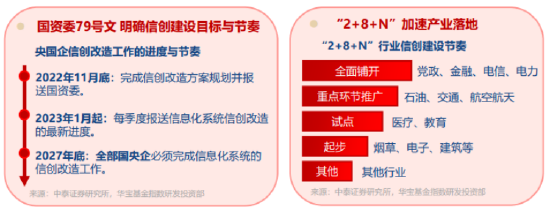
Group 1 - The U.S. President announced an additional 100% tariff on Chinese imports starting November 1, along with export controls on "critical software" [1] - Critical software includes operating systems, databases, and various industrial software, highlighting its strategic importance in national security and economic stability [1] - The move is expected to accelerate the domestic production of industrial and foundational software in China, as the country seeks to enhance its self-sufficiency in technology [1][2] Group 2 - The "信创" (Xinchuang) industry is transitioning from policy-driven to a dual-driven approach of policy and market, with significant growth expected in the coming years [2] - By 2026, the market size of the 信创 industry is projected to exceed 2.6 trillion yuan, with growth rates of 17.84% and 26.82% anticipated for 2025 and 2026, respectively [2] - Government procurement standards are being refined to support the replacement of foreign technology with domestic alternatives [2] Group 3 - The domestic software sector is experiencing active trading, with the 信创 ETF fund showing a price increase of over 3.1% at one point, indicating strong buying interest [4] - Key stocks in the sector, such as 华大九天 and 麒麟信安, have seen significant price increases, reflecting investor confidence in the domestic software market [4] - The 大数据产业 ETF is also showing positive performance, with stocks like 中国软件 and 中国长城 experiencing notable gains [6] Group 4 - The 信创 ETF fund tracks the core segments of the 信创 industry, which includes foundational hardware, software, and information security, and is characterized by high growth potential [8] - The current geopolitical climate and the push for self-sufficiency in technology are driving the demand for domestic solutions in the 信创 sector [8] - The 大数据产业 ETF focuses on data centers and cloud computing, with a strong emphasis on companies that are leading in the technology self-reliance movement [9]
AI陪伴应用泄漏上千万条私密聊天丨南财合规周报(第210期)
2 1 Shi Ji Jing Ji Bao Dao· 2025-10-13 01:07
Core Insights - OpenAI launched Sora 2, which has generated significant attention due to its advanced features and copyright controversies [2] - The Chinese government is coordinating AI model deployment in the public sector to avoid redundancy and enhance security [2] - Qualcomm is under investigation for allegedly failing to report a merger, raising antitrust concerns [3] - Two AI companion applications experienced a major data breach, exposing over 40 million private chat records [4] - The first AI-generated actress made her debut, showcasing the growing influence of AI in the entertainment industry [6] - ChatGPT's weekly active users surpassed 800 million, significantly outpacing its competitors [6] - OpenAI and AMD entered a multi-year partnership for AI acceleration chips, potentially worth billions [7] Regulatory and Data Security - OpenAI's Sora 2 has sparked a copyright debate, leading to a shift in its content generation policy to require authorization from copyright holders [2] - The Chinese government issued guidelines for AI model deployment in the public sector, emphasizing safety and risk management [2] - Qualcomm is being investigated for not legally reporting its acquisition of Autotalks, which may violate antitrust laws [3] - A data breach involving two AI companion apps revealed over 40 million private conversations and other sensitive user data [4] AI Developments - The debut of Tilly Norwood, the first AI-generated actress, indicates a significant shift in the film industry due to AI technology [6] - ChatGPT's user base has grown to 800 million weekly active users, doubling in the last four months and surpassing the combined total of its five main competitors [6] - OpenAI's partnership with AMD involves a multi-year agreement for AI acceleration chips, with the potential for significant stock options for OpenAI [7]

