
新零售

Search documents
马云预言成真?传统电商增速暴跌,三大新购物模式正在瓜分市场
Sou Hu Cai Jing· 2025-11-27 16:22
Core Insights - The retail landscape is shifting towards a model that integrates online, offline, and logistics, as predicted by industry leaders like Jack Ma [1] - Traditional e-commerce is facing unprecedented challenges, with user growth rates declining and competition from new shopping models intensifying [3][4] E-commerce Challenges - Traditional e-commerce platforms are experiencing negative user growth for the first time, with a 3.7% year-on-year decline expected in the first half of 2025 [3] - The average cost of acquiring a new customer has surged to 320 yuan, an 87% increase over three years, making it increasingly difficult for sellers to achieve profitable marketing [4] - The market for online shopping is nearing saturation, with 8.43 billion users and an 84.6% penetration rate, leading to a significant drop in profit margins for small to medium-sized businesses [6] Emergence of New Shopping Models - Community group buying is thriving in lower-tier markets, with over 280 million active users, 68% of whom are from third and fourth-tier cities [8] - Live-streaming e-commerce is gaining traction, with a gross merchandise volume (GMV) of 2.1 trillion yuan in the first half of 2025, accounting for over 26% of online retail sales [8] - Instant retail is projected to reach a market size of 380 billion yuan by 2025, growing 51% as it expands its service offerings [10] Adaptation of Traditional E-commerce - Traditional e-commerce platforms are adapting by integrating online and offline services, with initiatives like "hourly delivery" and the establishment of front warehouses [10] - Companies are diversifying their sales strategies by utilizing multiple channels, such as live streaming for product promotion and instant retail for replenishment, leading to increased customer retention [10] Future Outlook - AI technology is expected to save the retail industry $54 billion by 2025, enhancing consumer experiences through innovations like virtual fitting rooms and smart recommendations [12] - The retail revolution is ongoing, with a focus on creating seamless consumer experiences across various platforms [12]


源飞宠物涨2.75%,成交额2.17亿元,近5日主力净流入4936.72万
Xin Lang Cai Jing· 2025-11-27 07:42
Core Viewpoint - The company, Wenzhou Yuanfei Pet Toy Co., Ltd., is experiencing growth driven by the pet economy, cross-border e-commerce, and benefits from currency depreciation, with a significant portion of its revenue coming from overseas sales [2][3]. Company Overview - Wenzhou Yuanfei Pet Toy Co., Ltd. specializes in the research, production, and sales of pet products and pet food, with main products including pet snacks, leashes, toys, dry food, and wet food [2][7]. - The company was established on September 27, 2004, and went public on August 18, 2022 [7]. - As of September 30, 2025, the company reported a revenue of 1.281 billion yuan, a year-on-year increase of 37.66%, and a net profit of 130 million yuan, up 8.75% year-on-year [7]. Financial Performance - The company’s overseas revenue accounted for 85.78% of total revenue, benefiting from the depreciation of the RMB [3]. - The main revenue composition includes pet snacks (52.09%), leashes (24.77%), staple food (9.79%), other products (7.72%), and toys (5.64%) [7]. - The company has distributed a total of 120 million yuan in dividends since its A-share listing [8]. Market Activity - On November 27, the stock price of Yuanfei Pet increased by 2.75%, with a trading volume of 217 million yuan and a turnover rate of 7.87%, bringing the total market capitalization to 4.925 billion yuan [1]. - The stock has seen a net inflow of 5.7134 million yuan from major investors, indicating a positive trend in investor interest [4]. Strategic Initiatives - The company has established overseas bases in Cambodia to enhance its global production capacity and reduce labor costs, with production facilities already operational [3]. - The company is focusing on building a supply chain in Southeast Asia to improve market competitiveness [3].
居然智家跌2.25%,成交额6.73亿元,主力资金净流出5986.35万元
Xin Lang Zheng Quan· 2025-11-27 05:38
Core Viewpoint - The stock price of Juran Smart Home has experienced a decline of 14.85% year-to-date, with recent fluctuations indicating a potential recovery in the short term, as evidenced by a 5.56% increase over the last five trading days [2]. Financial Performance - For the period from January to September 2025, Juran Smart Home reported a revenue of 9.159 billion yuan, reflecting a year-on-year decrease of 3.38%. The net profit attributable to shareholders was 398 million yuan, down 45.58% compared to the previous year [3]. - Cumulative cash dividends since the company's A-share listing amount to 3.617 billion yuan, with 1.643 billion yuan distributed over the last three years [4]. Stock Market Activity - As of November 27, Juran Smart Home's stock was trading at 3.04 yuan per share, with a market capitalization of 18.93 billion yuan. The stock saw a net outflow of 59.86 million yuan in principal funds, with significant selling pressure [1]. - The company has appeared on the stock market's "Dragon and Tiger List" five times this year, with the most recent instance on February 17, where it recorded a net buy of -160 million yuan [2]. Shareholder Information - As of November 20, the number of shareholders for Juran Smart Home was 98,800, a decrease of 3.37% from the previous period. The average number of circulating shares per person increased by 3.49% to 59,685 shares [3].

妙可蓝多涨2.02%,成交额4327.41万元,主力资金净流入42.61万元
Xin Lang Cai Jing· 2025-11-27 02:15
Core Insights - The stock price of Miaokelan Duo increased by 2.02% on November 27, reaching 26.28 CNY per share, with a market capitalization of 13.404 billion CNY [1] - The company has seen a year-to-date stock price increase of 46.82% and a recent 5-day increase of 1.19% [1] Company Overview - Miaokelan Duo, established on November 29, 1988, and listed on December 6, 1995, is located in Shanghai and specializes in the research, production, and sales of dairy products, primarily cheese [1] - The company's revenue composition includes cheese (83.20%), trade (8.94%), liquid milk (7.29%), and others (0.57%) [1] Financial Performance - For the period from January to September 2025, Miaokelan Duo reported a revenue of 3.957 billion CNY, representing a year-on-year growth of 10.09%, and a net profit attributable to shareholders of 176 million CNY, which is a significant increase of 106.88% year-on-year [2] - The company has distributed a total of 368 million CNY in dividends since its A-share listing, with no dividends paid in the last three years [3] Shareholder Information - As of September 30, 2025, the number of shareholders increased by 13.85% to 39,100, while the average circulating shares per person decreased by 12.51% to 13,045 shares [2] - Hong Kong Central Clearing Limited is the seventh-largest circulating shareholder, having recently acquired 6.1521 million shares [3]

VIP机会日报大消费板块尾盘爆发 栏目解读领域零售 提及多家焦点公司收获涨停
Xin Lang Cai Jing· 2025-11-26 10:08
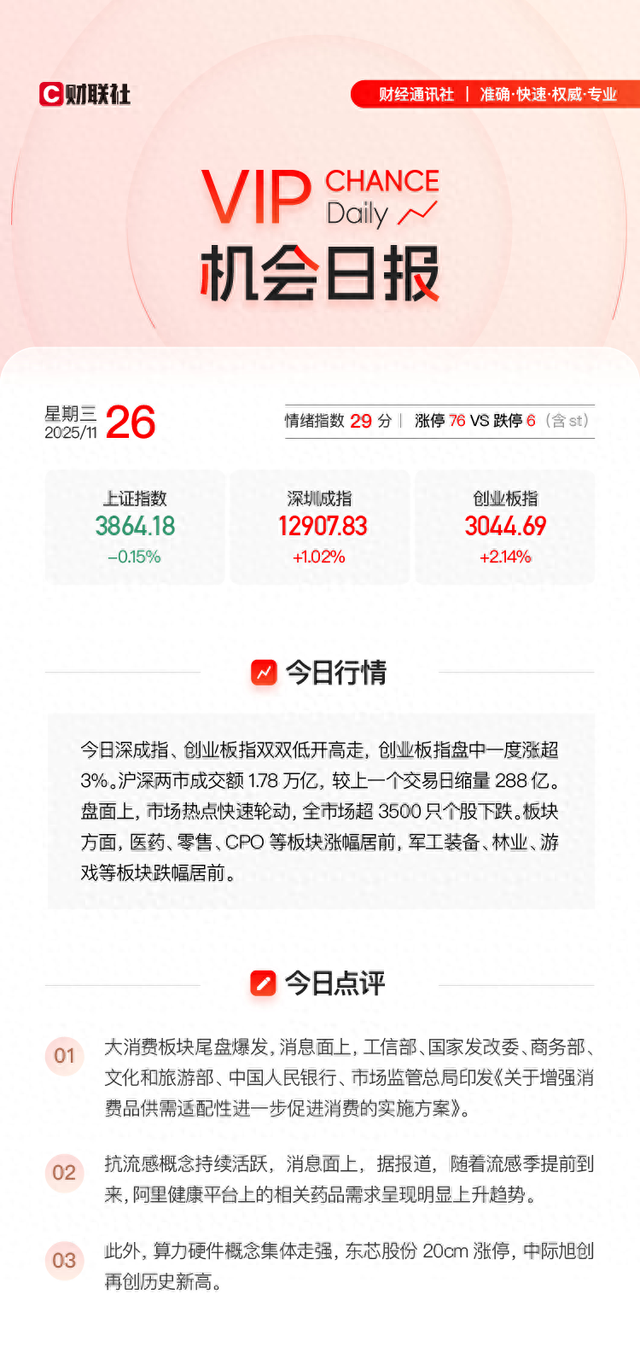
Group 1: Consumer Sector - The Ministry of Industry and Information Technology, National Development and Reform Commission, Ministry of Commerce, Ministry of Culture and Tourism, People's Bank of China, and State Administration for Market Regulation issued a plan to enhance the adaptability of supply and demand for consumer goods and further promote consumption [5] - OpenAI and Target are collaborating to introduce new AI-driven experiences in the retail sector, indicating that AI applications are entering a new catalytic phase [6] - Walmart's stock rose over 6% after the company reported strong quarterly results and raised its full-year outlook, highlighting the advantages of its offline channels [9] Group 2: Influenza Treatment - There is a noticeable increase in demand for influenza-related medications on Alibaba Health's platform as the flu season arrives earlier this year [11] - The flu activity has been rising, leading to increased demand for respiratory medications, with companies like Beijing University Pharmaceutical and Jindike both experiencing stock surges [12] - JD's medicine delivery platform reported a significant month-on-month increase of 10% in sales of flu medications since November [13] Group 3: Consumer Electronics - The consumer electronics industry is accelerating, with Huawei launching the Mate 80 series and other new products [16] - Institutions predict that the AI toy market will exceed 100 billion by 2030, with companies like Fenda Technology customizing AI desktop companion robots [17] - The entry of major companies into the consumer electronics sector is expected to drive growth, with smart glasses potentially becoming a significant product category [19] Group 4: Computing Hardware - Google recently launched its new multimodal AI model Gemini 3 and image generation model Nano Banana Pro, showcasing impressive performance [21] - The introduction of optical switching technology in TPU interconnects is expected to create a broad market opportunity [21] - Semiconductor company Saiwei Electronics has seen a stock price increase of 46.85% due to its MEMS-OCS technology, which serves major clients like Google [23][24]


极光月狐|京东集团2025年Q3,新业务成为新的增长亮点
Xin Lang Cai Jing· 2025-11-26 08:11
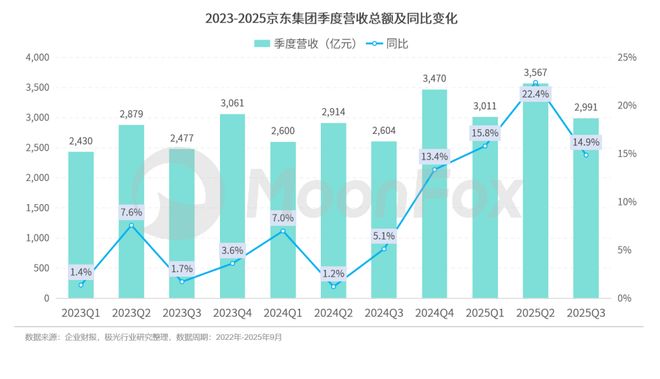
Overall Performance - JD Group achieved total revenue of 299.1 billion RMB in Q3 2025, representing a year-on-year growth of 14.9%, marking the first decline in quarterly revenue growth after four consecutive quarters of increase [2] - Net profit has dropped to the same level as in 2023, with a year-on-year decline exceeding 50% in Q3 [4] - Gross margin for Q3 was 16.8%, down 0.4 percentage points year-on-year, while net margin fell sharply from 4.7% last year to 2.1% [8] Cost Analysis - Operating costs reached 248.6 billion RMB in Q3, up 15.4% year-on-year, slightly exceeding revenue growth [11] - Marketing expenses surged to 21.05 billion RMB, a staggering increase of 110.5% year-on-year, accounting for 7.0% of revenue [11] - Fulfillment costs also rose significantly to 22 billion RMB, up 35.2% year-on-year, representing 7.4% of revenue [11] Business Analysis - In the first three quarters of 2025, service revenue accounted for 24% of total revenue, up 2 percentage points year-on-year, while product revenue decreased by 2 percentage points [13] - Product revenue in Q3 was 226.1 billion RMB, growing 10.5% year-on-year, while service revenue reached 73 billion RMB, a substantial increase of 30.8% [13] - New business revenue saw a remarkable growth of 213.7% year-on-year, totaling 15.6 billion RMB [16] Business Development - JD is expanding its offline stores and enhancing its online-offline retail service network, with over 20 JD MALL stores and more than 100 JD Electrical flagship stores operational by the end of Q3 [17] - The company is investing in AI technology to empower supply chain and vertical business applications, with significant partnerships established in the healthcare sector [17] - The launch of an independent "JD Takeout" app aims to enhance user retention and integrate local services, reflecting a comprehensive approach to local life services [18]

小米高管解读财报:在内存方面一直有储备,考虑通过投资拥抱大模型
Xin Lang Ke Ji· 2025-11-26 07:22
Core Insights - Xiaomi reported a total revenue of 59.5 billion yuan for Q1 2023, a decline of 18.9% year-over-year, while adjusted net profit increased by 13.1% to 3.2 billion yuan, including 1.1 billion yuan in expenses for innovative businesses like electric vehicles [1] - The company aims to improve its inventory management and maintain healthy operations, with a focus on activating market share rather than just shipment volume [3][4] - Xiaomi's promotional strategies, such as the "618" sales event, are designed to boost sales without negatively impacting profit margins, as they are aligned with the company's product lifecycle management [2][3] Financial Performance - Q1 total revenue was 59.5 billion yuan, down 18.9% from the previous year [1] - Adjusted net profit reached 3.2 billion yuan, up 13.1% year-over-year [1] - Inventory levels have significantly decreased, with finished goods inventory dropping to 22 billion yuan, a reduction of 10 billion yuan over the past four quarters [5] Market Strategy - Xiaomi's "618" promotional event includes a 1.6 billion yuan giveaway, with popular models like the Xiaomi 13 and Redmi K60 series offered at discounts [1][2] - The company is optimistic about its overseas market performance, particularly with the Redmi Note series, which has shown strong sales after its recent launch [3] - Xiaomi's new retail strategy has successfully synchronized online and offline promotions, enhancing sales during major events [9][10] AI and Technology Development - Xiaomi has established a large AI model team and is focusing on integrating AI capabilities into its products and services, particularly in enhancing user experience [6][7] - The company emphasizes the importance of its chip development strategy, viewing it as essential for its core business and long-term growth [18][19] Internet Business - The internet services segment achieved a record high in overseas revenue, driven by effective advertising and partnerships with local apps [12][13] - The gross margin for internet services remains healthy at over 72%, with significant contributions from gaming and high-margin advertising [13] Challenges and Outlook - The company acknowledges the impact of the growing second-hand phone market on new phone sales, but believes it can mitigate this through trade-in programs and maintaining customer relationships [14][15] - Xiaomi's market share in India is around 17%, and while there are no specific targets for market share or profit, the focus remains on maintaining a healthy business state [16]

美凯龙涨2.29%,成交额3594.25万元,主力资金净流出34.07万元
Xin Lang Cai Jing· 2025-11-26 03:32
Core Viewpoint - Meikailong's stock price has experienced a decline of 16.51% year-to-date, with significant losses in revenue and net profit reported for the first nine months of 2025 [1][2]. Group 1: Stock Performance - On November 26, Meikailong's stock rose by 2.29%, reaching 2.68 CNY per share, with a trading volume of 35.94 million CNY and a turnover rate of 0.38%, resulting in a total market capitalization of 11.671 billion CNY [1]. - The stock has seen a decline of 1.11% over the last five trading days, 4.29% over the last 20 days, and 13.27% over the last 60 days [1]. Group 2: Financial Performance - For the period from January to September 2025, Meikailong reported operating revenue of 4.969 billion CNY, a year-on-year decrease of 18.62%, and a net profit attributable to shareholders of -3.143 billion CNY, down 66.55% year-on-year [2]. - Cumulative cash dividends since the A-share listing amount to 3.901 billion CNY, with 348 million CNY distributed over the past three years [3]. Group 3: Shareholder Information - As of September 30, 2025, the number of Meikailong's shareholders decreased by 3.86% to 53,900, with an average of 0 circulating shares per person [2]. - The ninth largest circulating shareholder, Hong Kong Central Clearing Limited, holds 15.541 million shares, a decrease of 2.927 million shares compared to the previous period [3].

关闭全部门店,盒马创始人又失败了
Sou Hu Cai Jing· 2025-11-26 03:15
Core Insights - The pet retail project "Paiteshengsheng," founded by Hou Yi, is facing significant operational challenges, leading to the closure of most of its physical stores within just nine months of launch [2][9][11] - Despite the setbacks, the overall pet economy in China continues to grow, with projections indicating a market size exceeding 300 billion yuan by 2024 [12][13] Company Overview - "Paiteshengsheng" was launched in February 2023, with ambitious plans to open 100 stores in Shanghai, combining online and offline sales strategies [3][5] - The brand secured $25 million in angel funding in May 2023, aiming to innovate product offerings and enhance supply chain operations [5][7] - The business model included a diverse range of pet products, emphasizing fresh food and personalized offerings to meet consumer demands [5][11] Operational Challenges - By December 2023, the company plans to close all physical stores, with seven out of ten locations already shut down due to high rental and labor costs [2][9] - The shift in consumer behavior towards online shopping has further strained the viability of physical retail locations [9][11] - The pet food market in China is still developing, with a low penetration rate for fresh pet food compared to markets like the U.S. [12][13] Market Potential - The pet economy is projected to grow, with a 7.5% increase in urban pet consumption expected in 2024 [12] - The global pet fresh food market is anticipated to reach $4.5 billion by 2025, with a compound annual growth rate of 21.3% [12] - There is a recognized need for strong branding in the pet fresh food sector, indicating potential opportunities for future ventures [14]

居然智家涨2.12%,成交额8484.66万元,主力资金净流入597.50万元
Xin Lang Cai Jing· 2025-11-26 02:57
Core Viewpoint - The stock of Juran Smart Home has experienced fluctuations, with a year-to-date decline of 19.05%, while recent trading activity shows mixed results in terms of net inflow and outflow of funds [1][2]. Group 1: Stock Performance - As of November 26, Juran Smart Home's stock price increased by 2.12% to 2.89 CNY per share, with a total market capitalization of 17.996 billion CNY [1]. - The stock has seen a net inflow of 5.975 million CNY from main funds, with significant buying and selling activity recorded [1]. - Year-to-date, the stock has dropped 19.05%, with a slight increase of 0.70% over the past 20 days [1]. Group 2: Company Overview - Juran Smart Home, established on April 25, 1990, and listed on July 11, 1997, operates in various sectors including chain home furnishing, shopping centers, digital and smart services, and intelligent home decoration [2]. - The company's revenue composition includes 56.34% from product sales, 36.97% from leasing and management, and smaller contributions from franchise management and other services [2]. - As of November 20, the number of shareholders decreased to 98,800, while the average circulating shares per person increased by 3.49% [2]. Group 3: Financial Performance - For the period from January to September 2025, Juran Smart Home reported a revenue of 9.159 billion CNY, a year-on-year decrease of 3.38%, and a net profit of 398 million CNY, down 45.58% compared to the previous year [2]. - The company has distributed a total of 3.617 billion CNY in dividends since its A-share listing, with 1.643 billion CNY distributed over the last three years [3]. - As of September 30, 2025, Hong Kong Central Clearing Limited has exited the list of the top ten circulating shareholders [3].