通胀率

Search documents
英国经济7月份未能增长
Shang Wu Bu Wang Zhan· 2025-09-26 05:01
Economic Performance - The UK economy stagnated in July, highlighting challenges for the government in promoting growth and repairing public finances ahead of the high-risk budget in November [1] - Manufacturing decline offset growth in services and construction, aligning with economists' expectations [1] - Economic growth rate slowed from 0.3% in the three months to June to 0.2% in the three months to July [1] Government Response - The Treasury acknowledged the need for more work to stimulate economic growth, indicating that while the economy has not collapsed, it feels stuck [1] - A new "Budget Committee" has been established by Starmer to coordinate efforts between Downing Street and the Treasury ahead of the budget release on November 26 [1] - The government claims to be making progress in reversing the investment shortfalls from previous Conservative administrations [1] Fiscal Challenges - Economists predict that Reeves will be forced to increase taxes in the budget, with estimates suggesting the government may need to raise over £20 billion to fill fiscal gaps [2] - The Bank of England is expected to maintain interest rates at 4% during the upcoming meeting, having cut rates five times since summer 2024 [2] - July's inflation rate was reported at 3.8%, significantly above the Bank of England's target of 2%, with signs of a deteriorating labor market [2]
【环球财经】瑞士央行维持利率不变 仍有可能采取负利率政策
Xin Hua Cai Jing· 2025-09-25 13:46
Core Viewpoint - The Swiss National Bank (SNB) has decided to maintain its policy interest rate at 0%, indicating readiness to intervene in the foreign exchange market if necessary. This decision aligns with market expectations, but there are concerns about the impact of high U.S. tariffs on Swiss economic growth, which may lead to potential rate cuts in the future [1][2]. Group 1: Monetary Policy and Economic Outlook - The SNB's current monetary policy is described as expansionary, with a higher threshold for entering negative interest rates compared to normal rate cuts. The bank is prepared to use all available tools if needed [1][3]. - The chief economist at Syz Bank believes that the current robust monetary policy is reasonable given the economic and political landscape, with the main concern being uncertainty surrounding the export sector [1]. - UBS economists highlight that tariffs pose the greatest downside risk to Swiss economic growth in the short term, and even a reduction in rates to negative territory may not effectively counteract the impact of tariffs [1]. Group 2: Economic Growth and Inflation Projections - Swiss GDP growth is expected to slow to 0.5% by the second quarter of 2025, with high U.S. tariffs likely to suppress exports and investments, particularly in the machinery and watchmaking sectors. However, the service sector remains resilient [2]. - The SNB forecasts moderate economic growth, with GDP growth expectations of 1% to 1.5% for 2025, slowing to nearly 1% in 2026, and an anticipated rise in the unemployment rate [2]. - Current inflation pressures are mild, with the Swiss inflation rate rising to 0.2% in August, driven mainly by the tourism sector and imported goods. The SNB projects inflation rates of 0.2% for 2025, 0.5% for 2026, and 0.7% for 2027 if the policy rate remains at 0% [2].
瑞典国家经济研究所发布9月《瑞典经济报告》
Shang Wu Bu Wang Zhan· 2025-09-25 02:28
Core Insights - The Swedish National Economic Institute's report indicates that household consumption has increased for four consecutive quarters, with an improving outlook on the economy during the summer [1] - Household spending is expected to be a significant driver of ongoing economic recovery, with GDP growth in the second half of the year projected to exceed that of the first half [1] - The report forecasts that economic growth will accelerate further next year, primarily due to expansionary budget measures boosting household income [1] Economic Indicators - The report predicts that inflation will be significantly lower than 2% next year, attributed to temporary reductions in food VAT and electricity taxes [1] - Despite the anticipated low inflation, the central bank is not expected to lower interest rates further [1] - The government is projected to have negative net lending for several years due to large-scale debt financing for defense spending [1]
经合组织上调2025年全球经济增长预期至3.2%
Xin Hua She· 2025-09-25 00:41
Group 1 - The OECD's mid-term economic outlook report predicts a global economic growth rate of 3.2% for 2025, an increase of 0.3 percentage points from the June forecast, while growth is expected to slow to 2.9% in 2026, consistent with the June prediction [1] - The report highlights stronger-than-expected resilience in global economic growth, particularly in emerging market economies, during the first half of 2025 [1] - The report warns of significant risks to the global economic outlook, including potential increases in tariff rates, renewed inflation pressures, heightened concerns over fiscal risks, and reassessment of financial market risks [1] Group 2 - The report forecasts that the U.S. economic growth rate will decline from 2.8% in 2024 to 1.8% in 2025, and further slow to 1.5% in 2026, due to the offsetting effects of tariffs and tightened immigration policies against strong investment growth in high-tech industries [1] - The Eurozone's economic growth is projected to be 1.2% in 2025 and 1.0% in 2026 [1] - The G20 countries' overall inflation rate is expected to decrease from 3.4% in 2025 to 2.9% in 2026, with core inflation rates in developed economies projected to fall to 2.6% and 2.5% in the next two years [1] Group 3 - The report recommends that countries enhance cooperation within the global trade system while improving the transparency and predictability of trade policies in response to economic security concerns [2] - Central banks are advised to remain vigilant and respond swiftly to changes in risks affecting price stability [2] - There is a call for increased structural reform efforts to improve living standards and unlock potential benefits from new technologies such as artificial intelligence [2]
菲经济增长或放缓
Shang Wu Bu Wang Zhan· 2025-09-24 17:10
Core Insights - The Bangko Sentral ng Pilipinas (BSP) projects the Philippine GDP growth rate to stabilize at the lower end of the Development Budget Coordination Committee (DBCC) target of 5.5% to 6.5% for 2025 [1] - Inflation is expected to be 1.7% in 2025, significantly below the government's target range of 2% to 4%, rising to 3.3% in 2026 and 3.4% in 2027 [1] - The Department of Finance acknowledges that economic growth is below initial expectations due to global economic headwinds, but fiscal targets can still be achieved through stronger tax measures and improved tax administration [1] Economic Growth Projections - The Philippine economy is projected to grow within the range of 6% to 7% in 2026, with a return to the target range by 2027 supported by lower policy interest rates and a neutral output gap [1] Inflation Forecast - The inflation rate is forecasted to be 1.7% in 2025, increasing to 3.3% in 2026 and 3.4% in 2027, indicating a gradual rise in inflation after a low initial rate [1] Fiscal Measures - The Philippine government plans to increase revenue through key measures such as digital services VAT, capital market efficiency legislation, and the CREATE MORE initiative, alongside efforts to combat tax evasion [1] - Additional measures under consideration include taxes on electronic gaming, single-use plastics, universal tax amnesty, and an extension of estate tax amnesty [1]
【环球财经】2025年8月澳大利亚通胀率升至3%
Xin Hua Cai Jing· 2025-09-24 08:46
Group 1 - Australia's overall Consumer Price Index (CPI) year-on-year increase for August 2025 is 3%, up from 2.8% in July, aligning with market expectations [1] - The monthly inflation rate for August, excluding volatile items like fruits, vegetables, and automotive fuel, is 3.4%, an increase from 3.2% in July [1] - The trimmed mean inflation rate, a key indicator of core inflation, decreased from 2.7% in the previous month to 2.6% [1] Group 2 - Food and non-alcoholic beverage prices in August saw a year-on-year increase of 3%, unchanged from the previous month [2] - Housing prices increased from 3.6% to 4.5%, with rental prices decreasing from 3.9% to 3.7% and new housing prices rising from 0.4% to 0.7% [1][2] - Electricity prices surged from a 13.6% increase to 24.6% [1]
欧洲央行官员称利率已合适 但降息呼声暗流涌动
Xin Hua Cai Jing· 2025-09-24 07:53
Group 1 - The European Central Bank (ECB) is at a critical juncture in monetary policy, with a consensus among members that the current deposit facility rate of 2% is appropriate, and the threshold for short-term adjustments is considered high [1][2] - ECB Executive Board member Piero Cipollone stated that inflation risks are balanced, and the eurozone's output is still expanding, with growth expected to recover after a slowdown [1][2] - There is a divergence in views among eurozone central bank governors, with some advocating for caution and others supporting a more accommodative stance to achieve inflation targets and support economic growth [2][3] Group 2 - The upcoming December meeting of the ECB is anticipated to provide clearer insights into economic forecasts, particularly regarding the impact of U.S. tariffs on the eurozone [2] - The ECB President Christine Lagarde's position is seen as a key variable in breaking the current policy deadlock, as she has not publicly commented on the balance of inflation risks [2][3] - A participant in a closed-door meeting indicated that while the 2% inflation target has been reached, the sustainability of this target remains uncertain and will be addressed in the December meeting [3]
2025年8月澳大利亚通胀率升至3%
Xin Hua Cai Jing· 2025-09-24 07:07
Core Insights - Australia's overall consumer price index (CPI) year-on-year increase for August 2025 is 3%, up from 2.8% in July, aligning with market expectations [1] - The monthly inflation rate, excluding volatile items like fruits, vegetables, and automotive fuel, is 3.4%, an increase from 3.2% in July [1] - The trimmed mean inflation rate, a key indicator of core inflation, decreased from 2.7% to 2.6% [1] Price Changes - Food and non-alcoholic beverage prices increased by 3% year-on-year, unchanged from the previous month [1] - Alcohol and tobacco prices decreased from a 6.5% increase to 6% [1] - Clothing and footwear prices rose from 2.3% to 3% [1] - Housing prices increased from 3.6% to 4.5%, with rent prices decreasing from 3.9% to 3.7% and new housing prices rising from 0.4% to 0.7% [1] - Electricity prices surged from a 13.6% increase to 24.6% [1] - Furniture, household equipment, and services prices remained stable at a 0.9% increase [1] - Healthcare prices remained unchanged at a 4.1% increase [1] - Transportation prices shifted from a 1% decrease to a 0.4% increase, with automotive fuel prices changing from a 5.5% decrease to a 1.7% decrease [1] - Communication prices rose from 0.8% to 1.9% [1] - Entertainment prices decreased from 2.6% to 1.4% [1] - Education prices slightly decreased from 5.6% to 5.5% [1] - Insurance and financial services prices decreased from 3.1% to 3% [1] Inflation Commentary - The overall inflation rate in Australia for August has reached its highest level since July 2024, primarily driven by high increases in housing, food, and non-alcoholic beverage prices [2] - The trimmed mean inflation rate, which better reflects inflation trends, decreased by 0.1 percentage points in August [2]
经合组织上调今年全球经济增长预期至3.2%
Jing Ji Wang· 2025-09-24 02:25
Group 1 - The OECD's mid-term economic outlook report predicts a global economic growth rate of 3.2% for 2025, an increase of 0.3 percentage points from the June forecast, while growth is expected to slow to 2.9% in 2026, consistent with the June prediction [1] - The report highlights stronger-than-expected resilience in global economic growth, particularly in emerging market economies, during the first half of 2025 [1] - The report warns of significant risks to the global economic outlook, including potential increases in tariff rates, renewed inflation pressures, heightened concerns over fiscal risks, and reassessment of financial market risks [1] Group 2 - The report forecasts that the U.S. economic growth rate will decline from 2.8% in 2024 to 1.8% in 2025, further slowing to 1.5% in 2026, due to the offsetting effects of tariffs and tightened immigration policies against strong investment growth in high-tech industries [1] - The Eurozone's economic growth is projected to be 1.2% in 2025 and 1.0% in 2026 [1] - The G20 countries' overall inflation rate is expected to decrease from 3.4% in 2025 to 2.9% in 2026, with core inflation rates in developed economies projected to fall to 2.6% and 2.5% in the next two years [1] Group 3 - The report recommends that countries enhance cooperation within the global trade system while improving the transparency and predictability of trade policies in response to economic security concerns [2] - Central banks are advised to remain vigilant and respond swiftly to changes in risks affecting price stability [2] - There is a call for increased structural reform efforts to improve living standards and unlock the potential benefits of new technologies such as artificial intelligence [2]
通胀目标不再死守2%?美联储传出颠覆性信号,三高官支持改用区间制
Zhi Tong Cai Jing· 2025-09-24 01:19
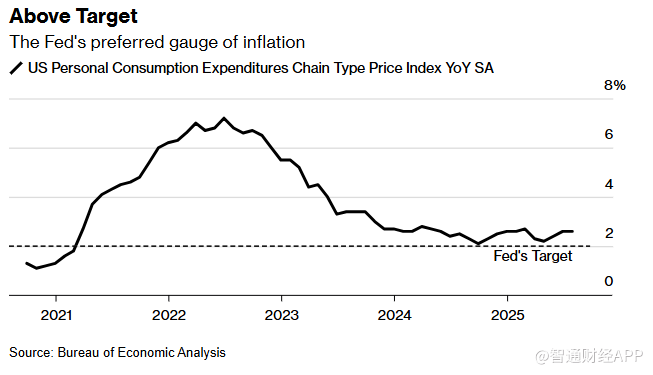
Core Viewpoint - Three Federal Reserve officials support the idea of setting an inflation target range instead of maintaining the current fixed target of 2% [1][4][5] Group 1: Federal Reserve Officials' Perspectives - Stephen Milan, Michelle Bowman, and Raphael Bostic have discussed the potential shift towards an inflation target range following the Federal Reserve's policy framework review in August [1][4] - Milan, a temporary member of the Federal Reserve, expressed that a "very clear" inflation target could lead to excessive micro-management and suggested that the Fed should remain open to other options [4] - Bowman, also a Trump appointee, noted that other countries use target ranges, which could alleviate anxiety over specific inflation numbers [4] Group 2: Current Inflation Context - The inflation rate has been above the Federal Reserve's 2% target for four and a half years, influenced by economic disruptions from the COVID-19 pandemic and recent tariffs imposed by Trump on global trade partners [4] - Prior to 2020, the Federal Reserve was primarily concerned with inflation rates being persistently below the target, which raised concerns about the ability to normalize interest rates [4] Group 3: Bostic's View on Inflation Range - Bostic indicated that the public often misunderstands the precision with which the Federal Reserve controls inflation and expressed a preference for discussing inflation in terms of a range [5] - He suggested a desired inflation range of approximately 1.75% to 2.25% to prevent upward inflationary pressures [5]