全球货币信用体系重构

Search documents
黄金跳水!
Jing Ji Ri Bao· 2025-10-10 03:31
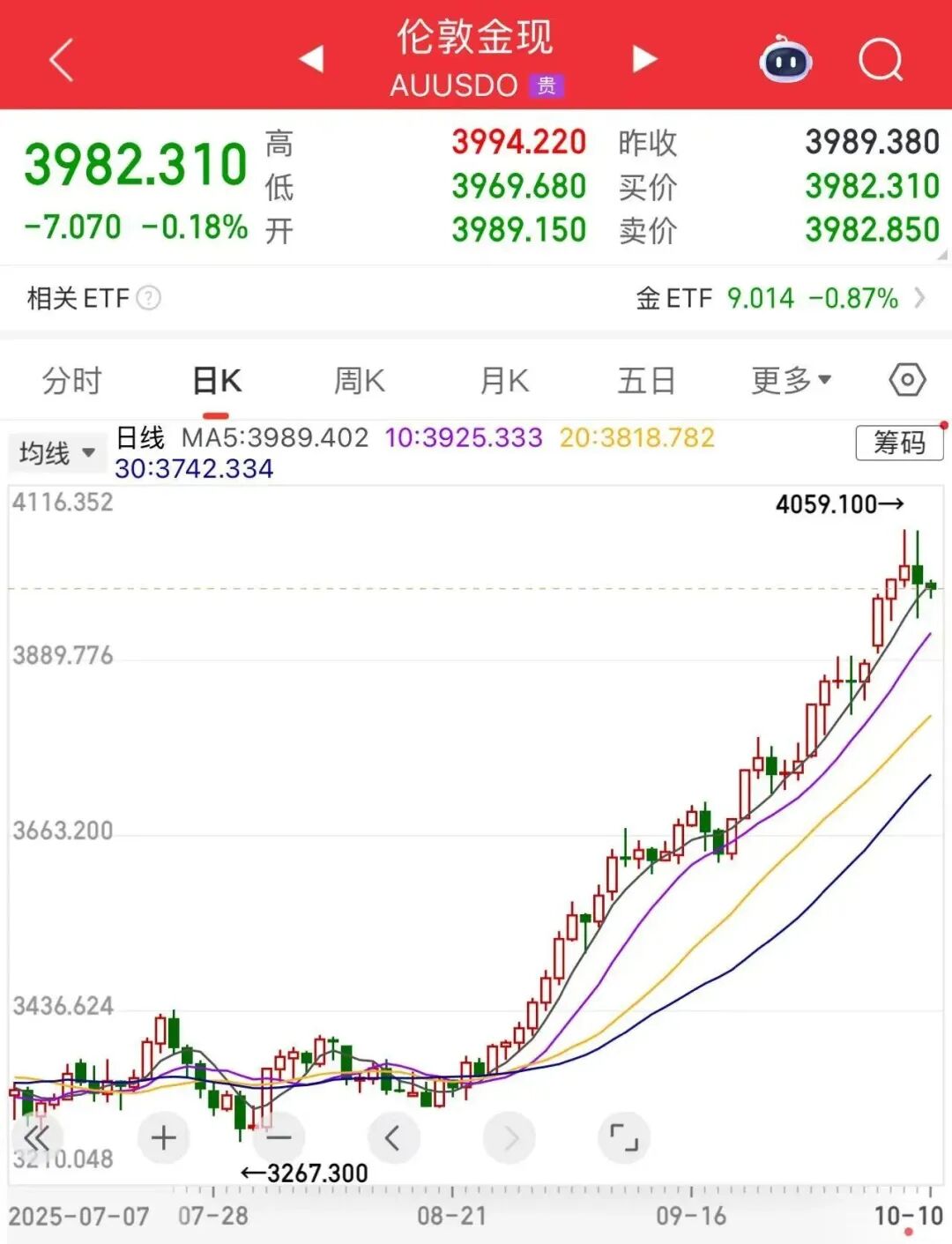
纽约独立金属交易员TaiWong认为:"随着加沙停火生效,投机者正在从谈判桌上拿走一些黄金筹码,因为停火协议令中东局势降温。不过,总体而言, 人们对这一交易的信心基本没有减弱。然而,此前金价涨势如此之快,以至于在3850美元之前都没有真正的支撑。" 截至今日10时16分,现货黄金价格报3982.31美元/盎司。 | | | 伦敦金现 | | | | | --- | --- | --- | --- | --- | --- | | | | AUUSDO 贵 | | | | | 3982.310 | | | 3994.220 | 昨收 | 3989.380 | | | | | 3969.680 | 买价 | 3982.310 | | -7.070 -0.18% 开 | | | 3989.150 | 卖价 | 3982.850 | | 相关 ETF 2 | | | | | 金 ETF 9.014 -0.87% > | | 分时 日K | 周K | | 月K | 王日 | 更容。 | | 均线 ▼ 30:3742.334 | | 日线 MA5:3989.402 10:3925.333 20:3818.782 | | | ...

机构:看好金价中枢上移 黄金板块迎来右侧布局机会
Zheng Quan Shi Bao Wang· 2025-10-10 00:11
Core Viewpoint - Recent significant increases in gold and silver prices, with spot gold briefly surpassing $4050 per ounce [1] Group 1: Market Analysis - Guosen Securities indicates that the support system for the gold market remains solid, driven by long-term factors such as global monetary credit system restructuring, de-dollarization trends, continuous central bank gold purchases, and structural supply-demand imbalances [1] - The long-term bullish trend for gold is expected to continue over the next 2-3 years due to the stability of the support system [1] Group 2: Investment Recommendations - Minsheng Securities highlights the central bank's gold purchases and weakening dollar credit as key themes, maintaining a positive outlook on gold prices and suggesting opportunities for right-side positioning in the gold sector [1] - Recommended stocks include Western Gold, Shandong Gold, Zhaojin Mining, Zhongjin Gold, Chifeng Gold, Tongguan Gold, Wanguo Gold Group, Shanjin International, and Hunan Gold, with additional attention to China National Gold International and Lingbao Gold [1] - Silver stocks recommended include Xingye Silver Tin and Shengda Resources [1]




金价突破4000美元背后的三大支撑因素
Sou Hu Cai Jing· 2025-10-09 11:13
Core Viewpoint - The recent changes in the international financial environment have highlighted the safe-haven and reserve attributes of gold, leading to a historic surge in gold prices, with New York futures reaching $4000 per ounce and spot gold hitting $4040 per ounce, marking a year-to-date increase of over 50% [1][2]. Group 1: Factors Driving Gold Price Increase - The prolonged U.S. government shutdown has raised concerns about the sustainability of U.S. fiscal policy and debt credit, prompting market expectations for continued monetary easing by the Federal Reserve, which has driven funds into gold as a hedge against future rate cuts [1][2]. - Political changes in Europe and Japan have weakened confidence in sovereign currencies, with Japan's new leadership promoting a dual easing policy and France facing challenges in fiscal consolidation, increasing sovereign debt risks in Europe [2]. - Significant capital inflows into gold ETFs from the U.S. and Europe indicate a growing demand for safe-haven assets, as geopolitical tensions and rising debt risks in developed economies encourage private investors to increase gold allocations [2]. Group 2: Market Outlook and Investment Opportunities - Analysts predict that over the next 2-3 years, factors such as the restructuring of the global credit system, de-dollarization trends, continued central bank gold purchases, and supply-demand imbalances will provide strong support for gold prices [2]. - Despite short-term caution regarding gold price movements, the long-term outlook remains optimistic, with a potential shift in the definition of "safe assets" signaling a new order in financial markets [3]. - Investment opportunities in gold-related assets include gold commodity ETFs and gold stock ETFs, which have shown significant growth due to increased demand for gold [4].
多重利好支撑贵金属板块 沪金主力合约日间盘收涨逾4%
Sou Hu Cai Jing· 2025-10-09 07:44
Group 1 - Domestic commodity futures showed mixed performance, with the main contract for Shanghai gold leading the gains [1] - As of the market close at 15:00, Shanghai gold, international copper, and Shanghai copper rose over 4%, while soybean oil, Shanghai nickel, and Shanghai silver increased over 2% [1] - Factors supporting the long-term upward trend of gold include the reconstruction of the global monetary credit system, de-dollarization trends, continuous gold purchases by central banks, and structural supply-demand imbalances [1] Group 2 - The ongoing "shutdown" crisis in the U.S. government has increased market uncertainty regarding economic direction and Federal Reserve policy, leading to heightened investment risk and increased demand for safe-haven assets [2] - The uncertainty surrounding the U.S. economy has raised expectations for Federal Reserve interest rate cuts, contributing to a downward trend in real interest rates [2] - Given the support from macroeconomic slowdown, monetary policy easing, and geopolitical factors, precious metal prices are expected to maintain a bullish outlook in the long term [2]
黄金板块走强 机构这样看后市
Di Yi Cai Jing· 2025-10-09 03:52
Core Viewpoint - The gold sector has shown strong performance, with significant price increases in various gold companies, driven by a combination of long-term and short-term factors supporting gold prices [1] Group 1: Market Performance - Gold prices continued to rise during the National Day holiday, supported by a weakening of confidence in sovereign currencies and a global sovereign debt crisis [1] - Companies such as Sichuan Gold and Shandong Gold reached their daily price limits, while Pengxin Resources increased by over 9%, and both Zhongjin Gold and Zijin Mining rose by over 8% [1] Group 2: Supporting Factors - Three new variables have emerged that support the rise in gold prices: the U.S. government shutdown, political changes in Europe and Japan that weaken confidence in sovereign currencies, and a significant inflow of funds into gold ETFs from the U.S. and Europe, indicating a shift in risk aversion from central banks to private investors [1] - The long-term support system for gold remains solid, driven by the restructuring of the global monetary credit system, de-dollarization trends, ongoing gold purchases by central banks, and structural supply-demand imbalances [1] Group 3: Future Outlook - The long-term bullish trend for gold is expected to continue over the next 2-3 years, with no fundamental changes anticipated in the support system [1] - Short-term factors such as the continuation of the Federal Reserve's easing cycle, the normalization of geopolitical risks, and sustained investment demand are likely to keep gold prices at high levels with a strong upward bias [1]


黄金牛市:长期逻辑、短期触发与未来展望 | 投研报告
Zhong Guo Neng Yuan Wang· 2025-10-09 02:45
Core Viewpoint - The international gold market has experienced a significant upward trend since 2025, with gold prices approaching $4000 per ounce, driven by long-term structural changes in the global monetary credit system [1][3]. Group 1: Recent Price Movements - Since September, gold prices have surged, reaching nearly $4000 per ounce by October 7, 2023 [2]. - The month of September saw a notable increase in gold prices, with an 11.6% rise in USD terms [3]. Group 2: Long-term Logic Behind Gold's Rise - The long-term support for gold's price increase is primarily linked to the restructuring of the global monetary credit system [4]. - Gold's unique attributes as both a commodity and a financial asset tie its price movements closely to macroeconomic conditions, monetary system evolution, and supply-demand dynamics [4]. Group 3: Factors Supporting Gold Demand - The acceleration of de-dollarization is undermining the credibility of the US dollar, prompting countries to diversify their reserve assets, with gold emerging as a key alternative [4]. - Central banks globally are increasingly purchasing gold as a strategic measure, viewing it as a means of value storage and a core resource for stabilizing economies during global turmoil [4]. - The ongoing adjustments in reserve structures are seen as a long-term trend within the broader context of monetary system restructuring, providing stable underlying support for gold demand [4]. Group 4: Risks to Monetary Credit - The accumulation of debt risks in the US is raising concerns about monetary credit, with the heavy interest burden on federal debt posing sustainability challenges [5]. - The rising risk of a debt crisis is eroding confidence in dollar-denominated assets, enhancing gold's appeal as a safe-haven asset [5]. - Historical patterns indicate that when sovereign debt risks escalate and monetary credit is compromised, gold's long-term upward trend tends to strengthen [5].
国信证券:未来黄金怎么看?
智通财经网· 2025-10-09 00:17
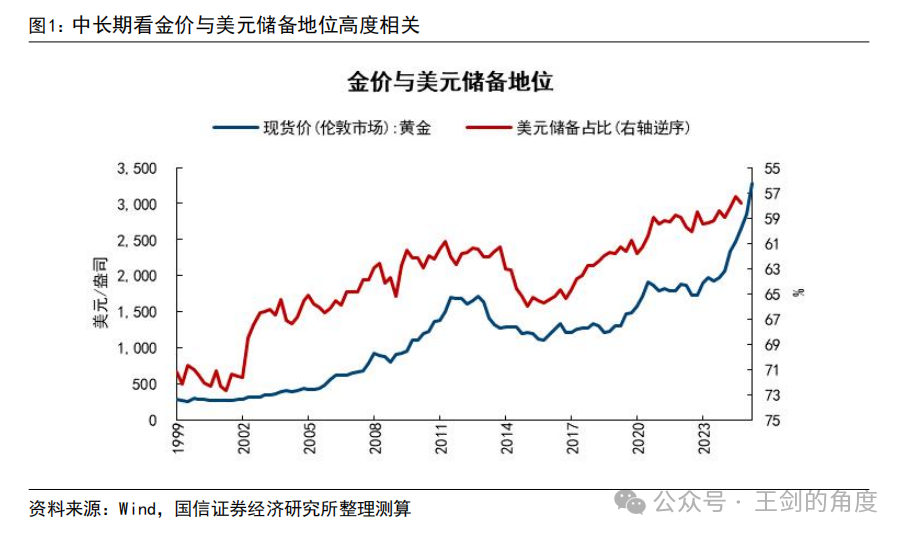
Core Viewpoint - The current support system for the gold market remains solid, driven by long-term factors such as the restructuring of the global monetary credit system, de-dollarization trends, continuous gold purchases by central banks, and structural supply-demand imbalances, which are expected to sustain a long-term bullish trend for gold in the next 2-3 years [1][2]. Long-term Logic of Gold Price Increase - Gold's price trajectory is closely linked to global macroeconomic patterns, the evolution of the monetary system, and changes in supply-demand dynamics. The ongoing restructuring of the global monetary credit system is a key factor supporting gold's sustained rise [3]. - The acceleration of de-dollarization is undermining the credibility of the dollar, with many countries diversifying their reserve assets, making gold a significant alternative. Central banks view gold as a core resource for stabilizing economies during global turmoil, which has become a long-term trend in the restructuring of the monetary system [3][4]. - The accumulation of U.S. debt risks is heightening concerns over monetary credit, with rising debt crisis risks potentially leading to a loss of confidence in dollar assets, thereby reinforcing gold's appeal as a safe haven [4]. Short-term Trigger Factors for Gold Price Increase Since September - The recent surge in gold prices is attributed to short-term events, particularly monetary policy adjustments and escalating geopolitical tensions [7]. - The Federal Reserve's unexpected interest rate cuts in September have been a significant driver for gold prices, as lower interest rates typically boost gold's attractiveness [8]. - Heightened geopolitical tensions and trade policy shifts have increased market risk aversion, leading investors to seek refuge in gold as a safe asset. The rise in the geopolitical risk index since mid-September reflects this trend [10]. - The substantial growth of gold ETFs, which reached 32.57 million ounces in September, indicates strong investor demand for gold amid rising risks, with North American funds contributing significantly to this inflow [12]. Additional Observations - There are speculations regarding central banks potentially increasing their gold purchases, which may have contributed to the recent price surge. However, evidence suggests that the primary upward momentum in gold prices is linked to U.S. trading hours and the Fed's policy adjustments rather than significant purchases by the Chinese central bank [13].

黄金饰品品牌寻求差异化市场定位
Zheng Quan Ri Bao· 2025-10-08 16:05
Core Viewpoint - The recent surge in gold prices is attributed to increased global macroeconomic uncertainty, leading investors to seek gold as a hedge against risk, with both COMEX and spot gold prices rising over 50% year-to-date [1]. Group 1: Gold Price Trends - On October 7, COMEX gold reached $4000 per ounce, and on October 8, it peaked at $4071.5 per ounce, while spot gold hit a high of $4049.64 per ounce [1]. - The increase in gold prices is seen as a result of a combination of long-term structural factors, short-term influences from the Federal Reserve's unexpected rate cuts, and rising gold ETF sizes [1][2]. Group 2: Market Sentiment and Consumer Behavior - Analysts believe that the current phase represents the early stage of a third wave of a bull market for gold, with the Federal Reserve's independence being compromised, further enhancing gold's reserve value [2]. - Despite rising gold prices, consumer demand for gold jewelry remains strong during the National Day and Mid-Autumn Festival, with many consumers still purchasing gold [2]. Group 3: Consumption Trends - In the first half of the year, retail sales of gold and silver jewelry reached 194.8 billion yuan, marking an 11.3% increase, indicating that while demand volume may be declining, the overall consumption value is on the rise [3]. - The World Gold Council reports a divergence between gold consumption value and demand volume, suggesting that consumer purchasing intent remains robust despite high prices, particularly among younger demographics [3].



黄金还能走多远?卖方高呼“第三浪启动”
智通财经网· 2025-10-08 08:02
Group 1 - The price of gold has been continuously rising, reaching new historical highs during the National Day and Mid-Autumn Festival holidays, with over 1,000 reports on gold published by brokerages this year, including 233 since September [1] - Major research institutions are optimistic about the future of gold, citing a clear long-term upward trend driven by the expansion of dollar credit cracks and the potential for a long-term bull market [2][3] - The core driving factors for the rise in gold prices include the U.S. government debt issues and the long-term logic of de-dollarization, which are expected to maintain a bullish market for gold [4] Group 2 - As of October 8, the spot gold price surpassed $4,000 per ounce, marking a year-to-date increase of 53.57%, while silver also reached a new high since May 2011 [5] - Gold-related stocks performed strongly during the recent trading days, with notable increases in companies such as Chifeng Jilong Gold Mining and Shandong Gold Mining [6] - Central banks in emerging markets are expected to continue increasing their gold reserves, contributing to the upward pressure on gold prices, with China's gold reserves reported at 7.406 million ounces as of the end of September [6]
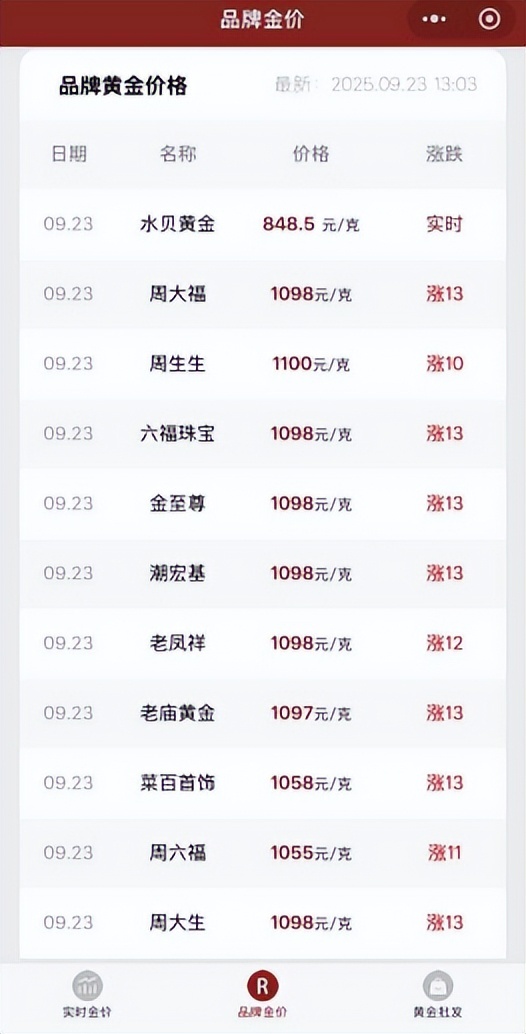
国际金价创历史新高,国内首饰金价突破1100元/克大关
Huan Qiu Wang· 2025-09-23 07:09
Group 1 - International gold prices have reached a historical high, with spot gold surpassing $3750 per ounce and COMEX futures hitting $3795 per ounce [1][3] - Domestic gold jewelry prices have increased accordingly, with brands like Chow Sang Sang and Chow Tai Fook seeing prices rise to 1100 RMB per gram and 1098 RMB per gram respectively [1][2] - The rise in gold prices is attributed to factors such as strengthened expectations of interest rate cuts by the Federal Reserve, increased risk of a U.S. government shutdown, and heightened geopolitical uncertainties [1][4] Group 2 - The sales of gold jewelry are experiencing a "volume decrease but price increase" trend, as high gold prices lead to lower total weight sold, but higher overall sales revenue [3] - A-share listed companies in the gold sector, such as Zhongjin Gold and Xiaocheng Technology, have seen significant stock price increases, indicating strong market interest [3] - Institutional research has focused on gold pricing, cost changes, and production targets for the second half of the year, reflecting heightened investor interest in the gold sector [3][4] Group 3 - Market expectations suggest that gold prices will maintain a high and strong oscillating pattern, with forecasts predicting an average price of $3800 per ounce by Q4 2025 and over $4000 by Q1 2026 [4] - Factors such as monetary policy easing, de-dollarization trends, and ongoing demand for safe-haven assets are expected to contribute to a significant turning point in the gold market [5]